



Gasgoo Munich-Inside a modern laboratory in the Beijing Economic-Technological Development Area, a humanoid robot named "Embodied Tiangong 3.0" balanced on one hand to smoothly vault over a one-meter-high obstacle. The feat isn't just a display of raw physical power; it signals that the robot's "brain" can make dynamic decisions based on real-time environmental interactions.
A global race is heating up over the core technologies of robot "brains" and "bodies," yet Beijing is taking a different path. While many competitors focus on building their own proprietary machines, a state-backed innovation platform here is busy deconstructing the most fundamental technology modules underpinning robotics.
As a national-level platform for embodied intelligence in robotics, the Beijing Humanoid Robot Innovation Center is acting as the architect of the "technical foundation" for China's robot industry.

Image Source: Beijing Humanoid Robot Innovation Center
I. National Team Role: From "Going It Alone" to "Defining the Public Standard"
The humanoid robot industry faces a fundamental paradox: immense market potential coexists with towering barriers to entry. Historically, companies fought solitary battles, pouring resources into redundant foundational research—a cycle that fragmented technical roadmaps and wasted capital.
The establishment of the Beijing Innovation Center marks a strategic pivot for China. As a national platform, its core mission isn't to manufacture a specific robot product. Instead, it aims to conquer the critical common technologies stalling the industry's progress and share those achievements through open-source and open-access models.
The center has launched a one-stop public service platform for embodied intelligence, integrating capabilities across the entire chain: from common technology research and data training to pilot verification and industrial application. The essence of this platform strategy is to solve the industry's "reinventing the wheel" problem. By establishing an industry-level public technology infrastructure, it allows developers to innovate on top of a mature, reliable "standard version," significantly lowering development barriers and shortening cycles across the sector.
II. Tiangong: Defining the Universal Robot Chassis Platform
The rapid iteration of the "Tiangong" series clearly traces the Beijing Center's trajectory in defining the performance baseline for universal robot bodies.
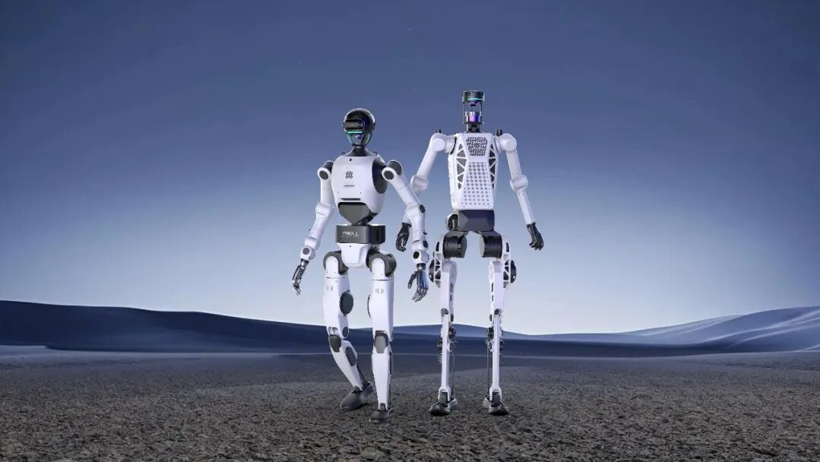
Image Source: Beijing Humanoid Robot Innovation Center
● "Tiangong 1.0LITE," released in April 2024, was the world's first full-size humanoid robot capable of human-like running using pure electric drive. The version quickly evolved into the 1.1PRO and 1.2MAX, featuring 42 degrees of freedom.
● By April 2025, "Tiangong 2.0" became China's first humanoid robot capable of adaptive walking across complex terrain.
● In February 2026, the latest "Embodied Tiangong 3.0" marked a significant leap forward. Standing 1.69 meters tall and weighing 62 kilograms, it boasts 43 degrees of freedom. It is the industry's first full-size humanoid robot to achieve high-dynamic whole-body motion control through tactile interaction. Equipped with high-torque integrated joints, it possesses the explosive power needed to maintain stability on rugged terrain while maintaining millimeter-level operational precision for industrial tasks. The hardware also includes multiple expansion interfaces for rapid adaptation to diverse scenarios.
The greatest value of "Tiangong" lies in its open-source nature and exceptional compatibility. The Beijing Innovation Center has fully released key technical materials to the industry, including software development documentation, structural design files, and URDF (Unified Robot Description Format) data. Crucially, it has even open-sourced its core "running secret"—the motion control framework.
This depth of openness means any research institution or enterprise can build upon a verified, high-performance baseline design—eliminating the need to start from scratch.
III. Huisikaiwu: Building the "Industrial Operating System" for the Intelligence Era
If "Tiangong" defines the standard "body," then the "Huisikaiwu" platform aims to provide a unified "brain" and "nervous system"—positioning itself as the "industrial operating system" for the era of embodied intelligence. The platform constructs a full closed loop of "perception-decision-execution." Its innovation lies in a collaborative architecture featuring an "embodied brain" and an "embodied cerebellum." The "brain," powered by world models and Vision-Language Models (VLMs), handles high-level cognition, task planning, and common sense reasoning. The "cerebellum," driven by Vision-Language-Action (VLA) models and fully autonomous navigation, manages real-time perception, obstacle avoidance, and precise action execution.
This architecture points toward a core capability: "one brain, multiple machines; one brain, multiple skills." A multi-agent collaboration system built on this platform achieves cross-body compatibility and asynchronous task scheduling. This means a single intelligent system can control robots of different forms performing different tasks—marking a fundamental shift from single-machine intelligence to swarm intelligence, and from specialized control to universal empowerment.
IV. Data and Computing: The "Public Fuel" Driving Intelligent Evolution
The evolution of intelligence depends on massive, high-quality data training. To this end, the Beijing Innovation Center has built a dual public infrastructure.
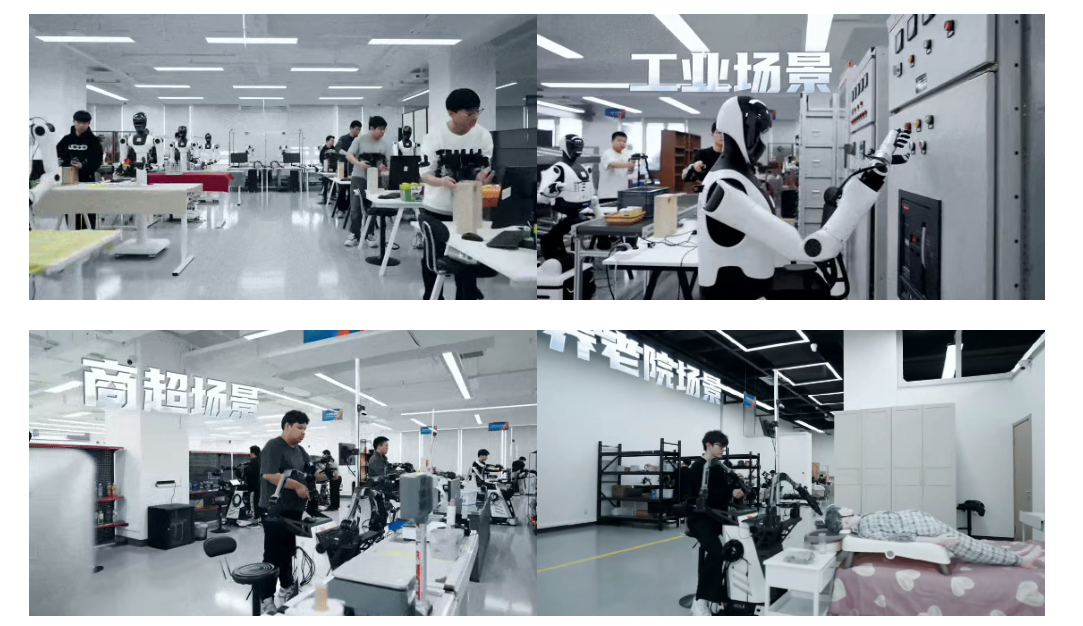
Image Source: Beijing Humanoid Robot Innovation Center
On the data front, the center is establishing an embodied intelligence data training base grounded in real-world scenarios. Located in the Beitou Taihu Industrial Park, the facility plans to collaborate with industry partners to build over 10 typical physical training environments—including commercial services, households, industrial settings, and logistics. The goal is to address industry pain points regarding high data collection costs and limited scenario coverage.
Regarding computing and algorithms, the center partnered with Peking University to launch "RoboMIND," a large-scale dataset and evaluation benchmark for multi-configuration intelligent robots. The dataset has been downloaded over 15,000 times on platforms like its official website and Hugging Face. Users span top universities such as Tsinghua University and the University of Science and Technology of China, as well as core industry players like Baidu and SenseTime, earning the project significant industry awards.
Beijing is also laying out computing infrastructure at a macro level. In November 2025, the Beijing Large-Scale Intelligent Computing Cluster Open Interconnection Innovation Center was unveiled. It aims to build an autonomous, open computing ecosystem by promoting unified standards like the Computing Link (CLink) bus protocol, providing underlying support for large-model training.
V. From Lab to Factory: Filling the Critical Gap in Industrialization
The value of a "technical standard" ultimately requires industrial verification, and the Beijing Innovation Center has secured critical support in this area.
First, regarding financing, the center completed its first round of market-oriented fundraising in early 2026, raising over 700 million yuan. The round attracted strategic investment from the Beijing Artificial Intelligence Industry Investment Fund, E-Town Investment, and industry players like Baidu and Kyland Technology. The capital will be prioritized for the technical iteration and promotion of its two major platforms.
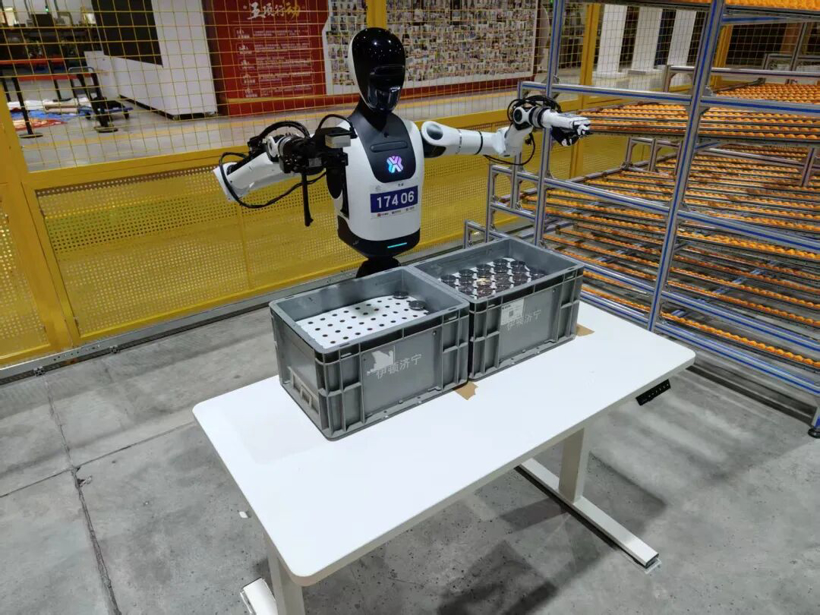
Image Source: Beijing Humanoid Robot Innovation Center
Second, on production capacity, its pilot verification platform in Yizhuang is now operational. It has the capacity for the trial production and testing of 5,000 sets of embodied intelligent robots annually.
Furthermore, its technical prowess has been repeatedly proven on the international stage—for instance, the "Embodied Tiangong Ultra" robot autonomously completed a half-marathon and took first place, demonstrating extreme endurance and autonomy. Currently, the Beijing Center has launched deep collaborations with leading enterprises such as the Electric Power Research Institute, Foton Cummins, and Bayer in fields ranging from special operations to industrial manufacturing, driving the implementation of practical solutions.
From mastering high-performance integrated joints to building a universal intelligence platform for "one brain, multiple machines," and establishing a complete open-source ecosystem and industrialization capabilities, the Beijing Innovation Center is systematically fulfilling its mission as the "national team." It aims to do more than just build an advanced robot; it is dedicated to creating a suite of enabling tools, open standards, and a symbiotic ecosystem. This effort is designed to fundamentally solidify the technical foundation for the autonomous development of China's embodied intelligence industry—and define the ceiling for its future growth.

