



Gasgoo Munich- The shift from 12V to 48V low-voltage architectures is moving from a niche energy-saving experiment to a mainstream solution driving the smart EV revolution.
First scaled around 2016, 48V technology has evolved over nearly a decade. Originally designed as mild-hybrid systems to ease engine loads, it is now becoming the backbone for advanced driving, smart cockpits, and steer-by-wire chassis.
At this industry inflection point, Bosch—the global top-tier supplier—is leveraging its deep expertise in core components and 48V tech to drive the shift toward this new voltage standard.
Bosch recently announced a strategic deepening with Chery, turning industry discussions about "next steps" for 48V architectures into tangible reality.
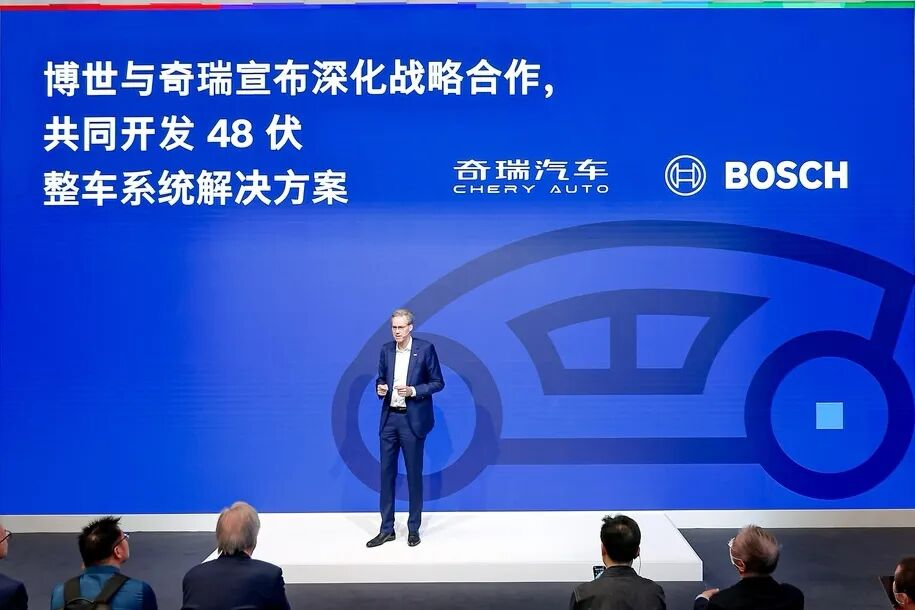
Image source: Bosch
Strong Partnership to Lead 48V Architecture Mass Production
On April 24, Bosch (China) Investment and Chery Automobile signed a framework agreement in Beijing to co-develop and mass-produce 48V vehicle architectures, aiming to pioneer the rollout of next-gen systems in China.
Back in October 2024, the two sides signed an MOU on 48V low-voltage systems and formed a pre-research team. After 18 months of joint effort, they completed system development, prototype parts, and industrialization groundwork—laying the technical foundation for this mass-production deal.
Building on these results, the latest partnership focuses on overhauling the underlying electrical architecture of smart vehicles.
The jointly developed architecture boasts high power, light weight, and high integration. Vehicle power supply jumps to 15kW, system weight drops by over 10 kilograms, and steer-by-wire motor response speeds up by more than 20%.
To put 15kW in perspective: mainstream 12V systems top out around 3kW to 4kW, nearing their physical limits. With power-hungry features like smart cockpits and advanced driving systems becoming standard, the power gap is widening. Upgrading the low-voltage grid is no longer a choice—it's a deadline.
A 15kW capacity essentially builds in ample headroom for future feature expansions from the design stage.
It's a strategy of "buying time with redundancy": rather than waiting for demand to catch up, supply capability is getting a head start.
On safety, the architecture uses independent redundant power circuits for critical systems like driving, braking, and steering. Even if the main loop fails, a backup loop ensures stable operation under extreme conditions.
For Level 3+ autonomous driving, this isn't a luxury—it's a baseline. When drivers can go "hands-off and eyes-off," any single point of failure in the power network poses unacceptable risks.
The technology will debut in flagship models under Chery's premium brand, Exeed, with potential future expansion into robotics.
Bosch has spent years refining 48V tech, building a full portfolio from chips and core components to system solutions and vehicle integration. It offers everything from complete architectures to individual parts like zone controllers, 48V batteries, and thermal management systems.
Whether an OEM needs a ground-up full-stack solution or targeted optimization for a single module, Bosch can adapt.
Bosch has accumulated mass-production experience across millions of mild-hybrid units. At IAA 2025, it showcased a 48V lithium-ion battery designed to integrate seamlessly into the vehicle structure. Lead-free and durable, it powers safety-critical systems even during long periods of inactivity.
In smart chassis, Bosch has developed a 48V direct-drive steer-by-wire product, slated for mass production as early as 2027.
This "bottom-up" full-stack capability allows Bosch to optimize architecture design and performance at the system level.
Through simulation and system-level energy management software, Bosch precisely manages energy consumption to boost efficiency. Its deep technical know-how ensures the 48V grid remains reliable and safe even under complex conditions.
As autonomous driving evolves, system redundancy is paramount. The 48V architecture provides stable, independent power paths for braking, steering, and computing. If the main source fails, a backup takes over seamlessly, enhancing overall safety.
Moving 48V from experimental tech to mass production requires more than just supplier breakthroughs—it demands OEM support.
Chery, a domestic automaker with deep experience in architecture development, brings mature mass-production capability and sharp insight into local market needs. The partnership creates a synergy of technical prowess and practical experience.
With 25 years of collaboration behind them, Bosch and Chery share a foundation of trust and engineering coordination. This history should accelerate technical validation and mass production, offering a replicable roadmap for the industry's 48V transition.
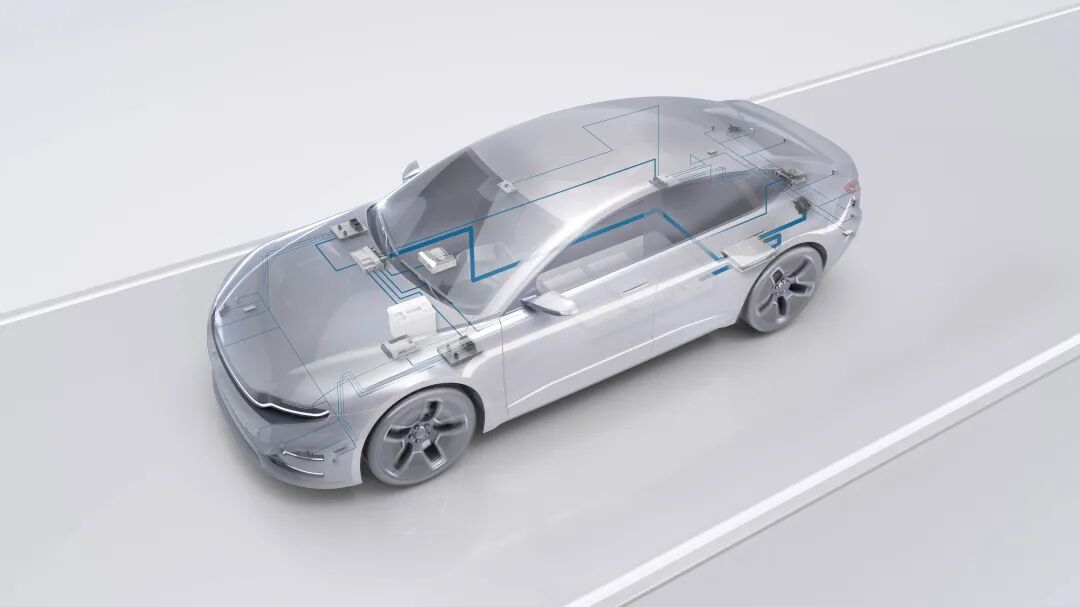
Image source: Bosch
48V Becomes Mandatory; Scale-Up Imminent
There is little doubt that 48V architecture is becoming the foundational technology for the next phase of smart EVs.
Dr. Markus Heyn, a Bosch board member, has been clear: as cars get smarter, they consume more power, making an upgrade from the 12V standard—used since the 1960s—essential. He expects China's low-voltage grid to transition within the next three to five years.
The logic is straightforward.
High-power configurations in smart EVs—from cockpits to chassis—are driving up demand. Traditional 12V architectures simply cannot handle these loads, making voltage upgrades inevitable.
The shift to 48V offers more than just higher voltage. Because power equals voltage times current (P=UI), boosting voltage four times cuts current to a quarter for the same power. With the same wire gauge, transmission losses drop to one-sixteenth—a significant efficiency gain.
This efficiency leap means thinner wires, lighter harnesses, and more flexible routing. At a manageable cost increase, it meets high-power demands—especially for advanced driving and peripherals—while extending range.
Think of 12V like the narrow pipes in an old apartment building, adequate for basic needs. 48V is like a high-pressure smart grid in a skyscraper, capable of serving hundreds of units with intelligent distribution.
With 48V, you get higher flow without needing thicker pipes, and far less "leakage" along the way. That is the core appeal: not just a tech upgrade, but a paradigm shift in energy delivery.
While the industry agrees on 48V's benefits, early adoption focused on mild-hybrids for fuel economy and emissions compliance.
Only recently, as intelligence and electrification surged, did leaders like Tesla and Xiaomi pivot to 48V. The technology is graduating from a hybrid auxiliary feature to a mainstream standard for smart EVs.
More companies are now positioning themselves for 48V, and the supply chain is ramping up. The industry is on the verge of a mass-production explosion.
Yet, most current applications remain limited to specific high-power parts like suspension or steering—essentially "spot tests."
Bosch and Chery are aiming higher: a "vehicle architecture" overhaul. This isn't just adding a circuit for one device; it's migrating the entire low-voltage network from 12V to 48V.
Such a deep reconstruction brings significant challenges. Components from motors to ECUs may need redesigning, requiring OEMs and suppliers to coordinate under unified standards rather than making isolated breakthroughs.
This is where Bosch excels.
Few suppliers possess Bosch's depth across semiconductors, controllers, actuators, and system integration, giving it unique cross-layer capabilities.
The partnership also reflects the broader industry's urgent need for architectural upgrades.
The 12V standard has dominated for decades, supported by mature supply chains and low costs. But the wave of intelligence is breaking down that barrier—when computing power drives the car, the power architecture must keep up.
This isn't a gradual improvement; it's a leap from "passive adaptation" to "active reconstruction."
Conclusion
The move to 48V is more than a voltage increase; it is a generational overhaul of electrical architecture. As smart features become essential, the mass adoption of 48V is a certainty.
With its full-chain technology portfolio and deep ties with Chery, Bosch is solidifying its leadership in the mass production of 48V architectures.


