



Gasgoo Munich-The Auto China 2026 officially kicked off on April 24.
Under the theme "AI-Driven Mobility," Bosch used this year's show to send a clear signal: the car is evolving rapidly from a simple tool for getting around into an AI-powered "personal partner."
At the opening, Dr. Marcus Heyn, member of the Bosch board of directors and chairman of Bosch Mobility, painted a picture: "Imagine you're driving to the mountains for a holiday. Leaving the city, you barely notice the traffic because your car navigates the congestion autonomously. On the mountain roads, the system warns of icy surfaces ahead but handles them safely on its own. For the final stretch, you take the wheel. The car knows your preferences and switches to off-road mode for a more agile drive."
That description captures Bosch's full vision for the future—but it's also a reality that is rapidly taking shape.
Dr. Heyn's assessment is clear: breakthroughs in electrification, automation, and software-defined vehicles have already ushered in a new era of mobility.
But this is just the beginning. To make those once-unimaginable levels of safety and convenience a daily reality, technologies must fuse more deeply, innovation must be approached from a whole-vehicle perspective, and AI must be woven into every layer of the car.
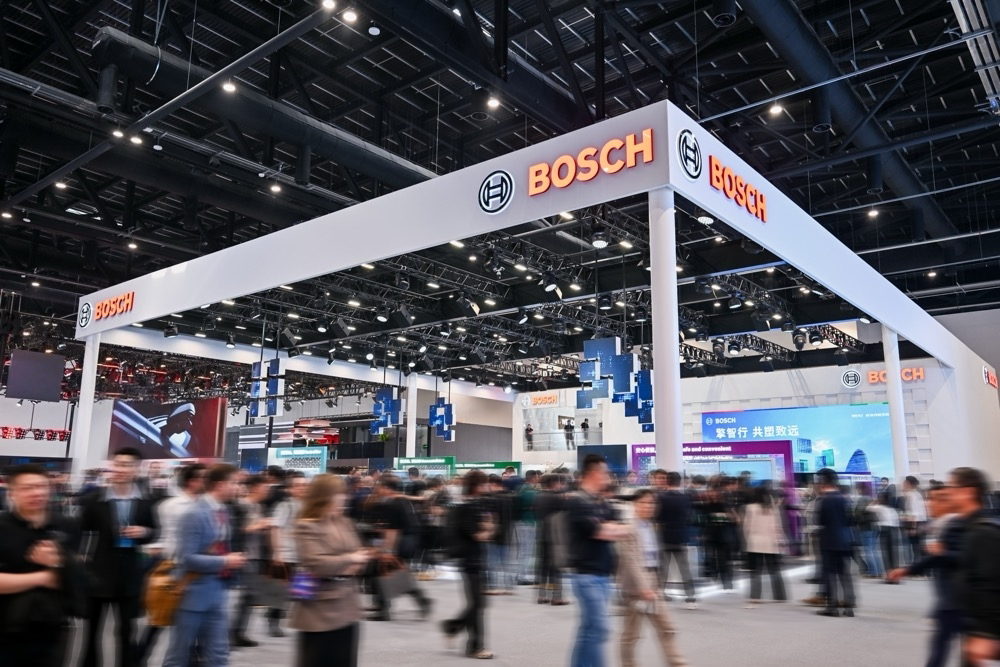
Bosch booth at the Beijing Auto Show. Image source: Bosch.
Reshaping Future Mobility: Three Key Pieces, All Essential
In fact, the steady evolution of vehicle electronic and electrical (E/E) architectures in recent years has already broken down barriers between different functional domains to some extent.
Yet for Bosch, achieving deep AI integration requires more than just "domain integration." It demands cross-domain fusion—and that is precisely where Bosch holds the advantage.
Around core technologies like automated driving, smart cockpits, vehicle motion control, energy management, and powertrain, Bosch has built a full-stack foundation covering both hardware and software. This provides system-level support for cross-domain fusion at the vehicle level.
Notably, Bosch is one of the few—perhaps the only—suppliers capable of delivering cross-domain solutions from a whole-vehicle perspective, both in China and globally.
Automated driving, vehicle motion control, and the smart cockpit are the three core pieces Bosch sees as underpinning the future mobility experience—and they were the highlights of its exhibition at this year's show.
● Automated Driving: End-to-End Intelligence and L3, Running on Parallel Tracks
In the automated driving space, Bosch focused on its "one-stage end-to-end" advanced driver assistance system and its Level 3 autonomous driving solution. The former targets mass production, while the latter aims for a higher-tier experience.
Bosch's end-to-end system is already in mass production on models like the Exeed Sterra ET and the new Chery Exeed EX7, marking the start of widespread adoption. Centered on cross-domain fusion, it fully links perception, planning, and execution—handling everything from dense traffic to sudden obstacles with composure.
Proof of its capability lies in the results: since the China Intelligent Driving Competition began last November, Bosch's end-to-end system has taken first place in Taizhou, Wenzhou, Jinhua, and Wuhu—earning it a reputation as a true "champion solution."
The L3 solution, meanwhile, represents Bosch's push deeper into higher-level autonomy.
Supporting speeds of up to 120 km/h, the system enables autonomous lane changes and navigation-guided lane changes on highways and urban expressways. Within specific operational design domains (ODDs), it offers a "hands-off, eyes-off" experience.
To meet the rigorous safety and compliance standards of L3, Bosch has built a vehicle-level redundancy architecture covering perception, computing, communication, power supply, braking, and steering. Furthermore, according to Wang Weiliang, president of Bosch Mobility China, the system uses heterogeneous redundancy: one path runs mass-produced L2 software, while the other runs software prepared for L4.
"We believe this is the only way to achieve true safety redundancy, because two identical systems could fail at the same time," Wang said. Notably, this reuse strategy is also Bosch's key lever for controlling L3 costs.
Bosch's L3 solution has already secured an autonomous driving test license for highways and expressways in Wuxi.
● Vehicle Motion Control: Software-Hardware Decoupling for a Personalized Driving Future
The second major piece Bosch showcased is vehicle motion control.
Here, Bosch's core innovation is the VMM (Vehicle Motion Manager) system. By decoupling software and hardware, VMM coordinates braking, steering, powertrain, and suspension controllers to manage the vehicle's six degrees of motion—enhancing both safety and comfort.
According to Dr. Heyn, VMM now supports over 100 functions. Its latest Automatic Emergency Evasive Maneuver (AES) is a prime example of cross-domain safety innovation: when an obstacle appears and braking distance is insufficient, the system identifies risks in milliseconds, calculates the optimal evasive path, and coordinates braking and steering to avoid collision while keeping the car stable. Even on low-traction winter roads, Bosch's AES performs safely.
This cross-domain function covers scenarios from L2 driver assistance to L3 and above. It also supports OEM proprietary development, allowing for deeper personalization and continuous optimization. It has already been launched in a mass-produced model from a Chinese domestic brand.
Underpinning this upper-layer control system is Bosch's years of expertise in chassis actuation. Specifically, technologies like brake-by-wire and steer-by-wire—key to domain-centralized control and software-defined vehicles—are a major focus for Bosch right now.
In brake-by-wire, Bosch is pursuing both hydraulic and fully dry braking paths. "By covering both paths, we can respond to the diverse needs of the Chinese market while giving partners greater flexibility," Dr. Heyn explained.
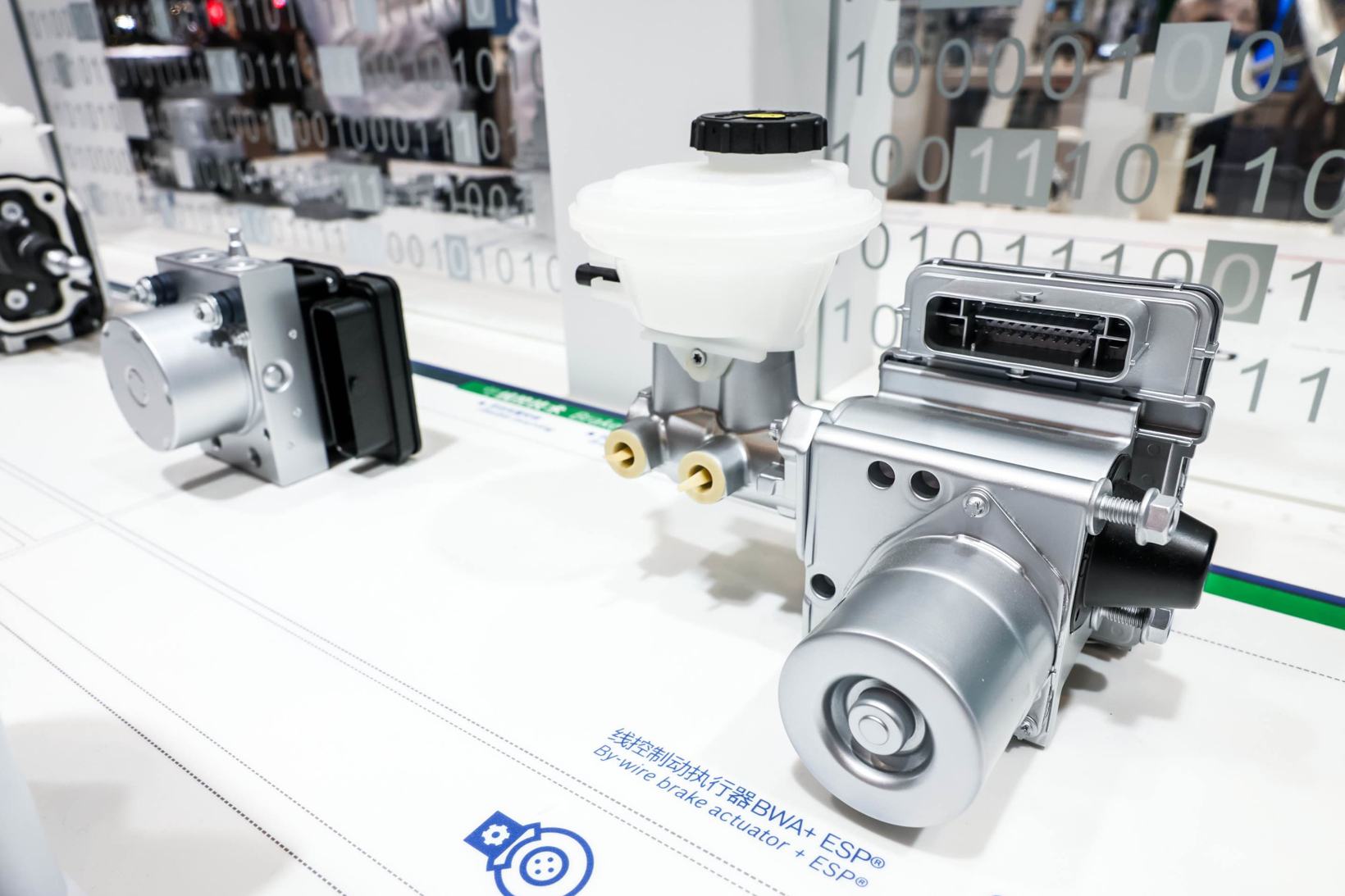
Bosch hydraulic brake-by-wire actuator BWA + ESP® solution. Image source: Bosch.
Its hydraulic brake-by-wire actuator BWA + ESP® solution relies on mature, mass-produced components. High reliability makes it a balanced choice for performance and cost.
Bosch has partnered with multiple global OEMs for this solution, which will soon be deployed in several leading domestic Robotaxi models.
The fully dry Electro-Mechanical Brake (EMB) is built for the next generation of high-level autonomous driving. By eliminating hydraulic lines and fluid, EMB uses independent electromechanical actuators at each wheel, controlled by redundant central or zone units. It drives brake calipers directly, enabling superior response and safety redundancy—better meeting the high demands of advanced autonomous driving. It is widely considered the ultimate solution for braking systems.
Dr. Heyn revealed that Bosch's EMB has completed testing in extreme winter conditions and is set for mass production in China this year.
In steer-by-wire, Bosch Huayu has partnered with several OEMs, with mass production scheduled for this year on new models from brands like IM Motors and XPENG.
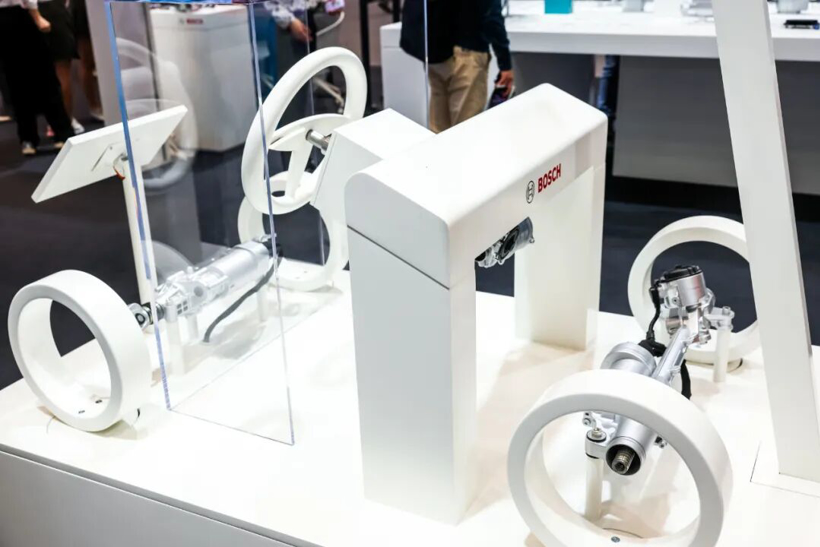
Steer-by-wire four-wheel solution. Image source: Bosch.
Unlike traditional mechanical steering, steer-by-wire removes the physical link between the steering wheel and wheels. This allows for variable steering ratios, significantly improving maneuverability in tight spaces like narrow roads or parking lots.
Moreover, Bosch Huayu's system features full-link, system-level redundancy, ensuring steering remains stable and controllable even if a single point fails.
However, higher intelligence and drive-by-wire capabilities demand greater power. Without a robust power architecture, even the smartest motion control is useless—highlighting the strategic value of the 48-volt low-voltage power grid.
Compared to traditional 12-volt systems, the 48-volt grid significantly boosts power supply capacity while optimizing costs, delivering higher efficiency, lower energy consumption, and better lightweighting.
Spotting this trend, Bosch has built a complete 48-volt product portfolio—from chips and core components to systems and vehicle integration—meeting the diverse development needs of OEMs.
During the show, Bosch announced a deepened strategic partnership with Chery to jointly develop 48-volt vehicle system solutions. This means Bosch is not just a core supplier of 48-volt parts, but a system-level partner for the entire vehicle power architecture.
● Smart Cockpit: AI-Powered Evolution into a "Personal Assistant"
If automated driving and motion control answer "how the car drives," the smart cockpit answers "how passengers live" inside the vehicle of the future.
In this area, Bosch highlighted its latest generation AI smart cockpit solution.
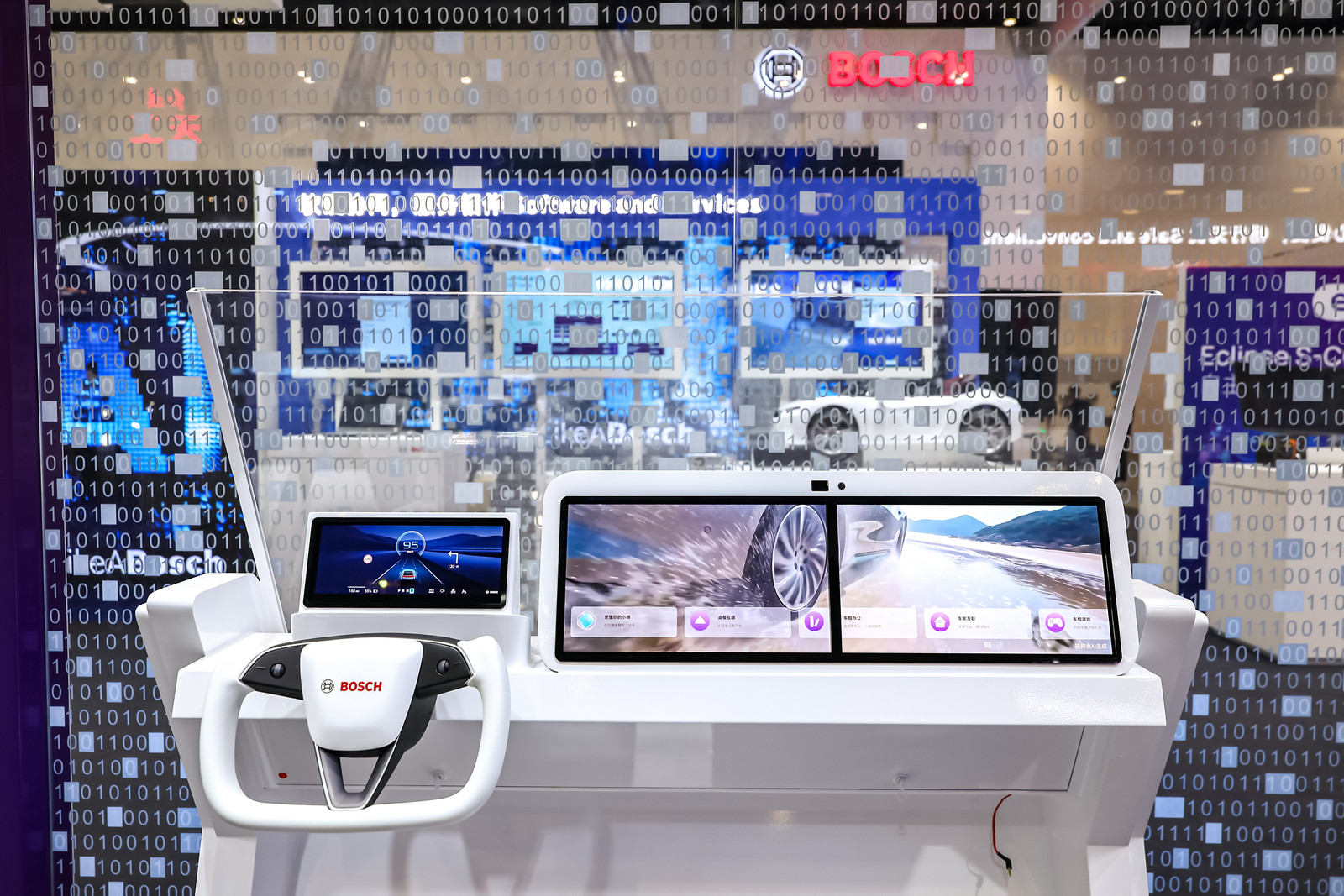
AI Smart Cockpit. Image source: Bosch.
Leveraging on-device multimodal fusion, the solution combines fuzzy voice semantic understanding, in-cabin and out-cabin visual perception, and vehicle SOA services. This marks an upgrade from "passive command response" to a "personal assistant" experience that is "always on, wake-word free, and proactive."
Consider a typical scenario: while driving, if the driver says "it's a bit stuffy" and the passenger says "I'm cold," the AI assistant needs no wake word or manual input. It precisely identifies both needs and automatically adjusts the climate control for each zone.
On the computing front, Bosch's AI cockpit now supports mass production on Qualcomm's SA8397 and MediaTek's CX-1. It is the only technology supplier in the industry deploying across multiple high-computing AI cockpit hardware platforms. This chip-agnostic strategy gives OEMs greater flexibility.
Its platform based on MediaTek's CX-1 is set for mass production in the fourth quarter of this year.
Notably, beyond chassis domain fusion via VMM, Bosch is accelerating its "cabin-driving fusion" solution, leveraging its dual expertise in driving and cockpits. Wang Weiliang revealed that related projects will "hit the market soon."
Looking further ahead, Bosch's roadmap extends beyond cabin-driving fusion. It aims for cross-domain collaboration with the smart chassis—covering drive, brake, steering, and suspension—to deliver even more personalized and scenario-based experiences.
Strategic Evolution: Driven by China, Empowering the World
The coordinated display of Bosch's three key pieces at this year's show reflects its core judgment on the future of smart cars. It also signals a deeper shift: Bosch is building a positive innovation loop where China drives development and the world benefits.
The starting point of this loop is the establishment of China as a source of innovation for Bosch.
From an early follower of technology, Bosch China has transformed into a key innovation hub in the global landscape—a shift that has happened faster than many expected.
Take automated driving: Bosch's end-to-end solution moved from concept to mass production in just seven months, relying on local ecosystem synergy. Behind that speed is the Chinese team's deep understanding of local road conditions and user habits. Crucially, this development model and its results—proven first in China—are now being fed back into Bosch's global system, providing a reusable framework for projects in other markets.
In electric drives, Bosch's e-axle was also developed and launched first in China. Since then, the technology and experience have been shared across major markets in Asia, Europe, and the Americas for localized application.
In short, for Bosch, the Chinese market is shifting from a sales stronghold to the starting point for technology exports.
Given this reality, Dr. Heyn offered a clear verdict in a group interview after the press conference: "With innovation in China moving this fast, it naturally deserves to be the global hub for innovation."
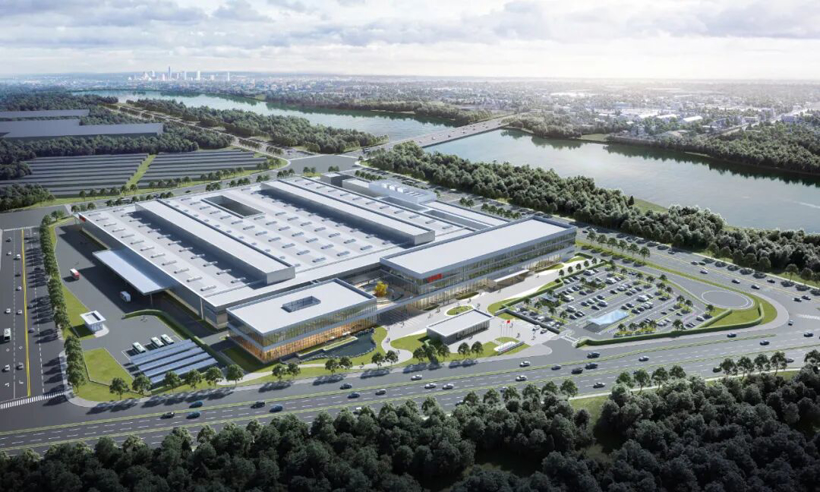
Bosch's light commercial vehicle electric drive system project in Nanchang. Image source: Bosch.
The second ring of Bosch's innovation loop is the strategic closed loop formed by deep local roots and a global network.
Bosch has established 38 production bases and 28 R&D centers in China, investing an average of about 6 billion yuan annually to strengthen local capabilities. For 2025, Bosch announced a 10 billion yuan investment in Suzhou over the next five years for innovation and deployment in intelligent driving and cockpits.
This depth, combined with a global network of about 500 branches across more than 60 countries, allows Bosch to keep pace with China's iteration speed while scaling innovations globally.
Co-creating in China and going global is now the top priority of Bosch's "localization plus globalization" strategy.
In recent years, numerous Bosch innovations have been integrated into hundreds of vehicle platforms from Chinese OEMs destined for international markets. Many of these technologies were developed and applied in China first, then expanded globally. For instance, in smart cockpits and driver assistance alone, Bosch has supported nearly 300 Chinese-brand models entering overseas markets.
In this process, Bosch's global network serves as a natural moat against the challenges Chinese automakers face when going abroad.
When entering a new market, Chinese carmakers often hit certification barriers first—getting new technology or models approved requires deep knowledge of local regulations. That is where Bosch excels. Furthermore, if Chinese automakers plan local production, Bosch's local R&D and manufacturing resources can be mobilized directly, significantly shortening the lead time from plant construction to production.
With this foundation, Bosch is moving from "rooted in the local market" to "based in China, serving the world." Its value is now dual-faceted: it helps Chinese automakers lower compliance costs and trial-and-error risks abroad, while allowing Bosch to reap larger-scale returns on its Chinese innovation investments through its global network.
Conclusion
The signal Bosch sent at this year's Beijing Auto Show is clear and unequivocal: the next stage of smart mobility is cross-domain fusion, and it is an AI-driven evolution of the vehicle itself.
Yet while innovation may take root in China, its ultimate value must flow to the world. Looking ahead at the next phase of global competition, only companies that deeply integrate localization with globalization can truly secure the lead.
In this regard, Bosch is leveraging its three key pieces as a fulcrum to make comprehensive strategic moves across technology, markets, and its global system.


