Gasgoo Munich - Sodium batteries have arrived ahead of schedule.
On February 5, Changan officially unveiled its global sodium-ion strategy. Coinciding with the announcement, the world's first mass-produced passenger car featuring CATL's sodium-ion battery made its debut.
The vehicle has already completed winter calibration in Yakeshi, with its range, cold-weather resilience, safety, and discharge performance fully meeting user needs. Real-world tests highlighted three standout capabilities: ultra-long range, extreme cold performance, and superior safety.
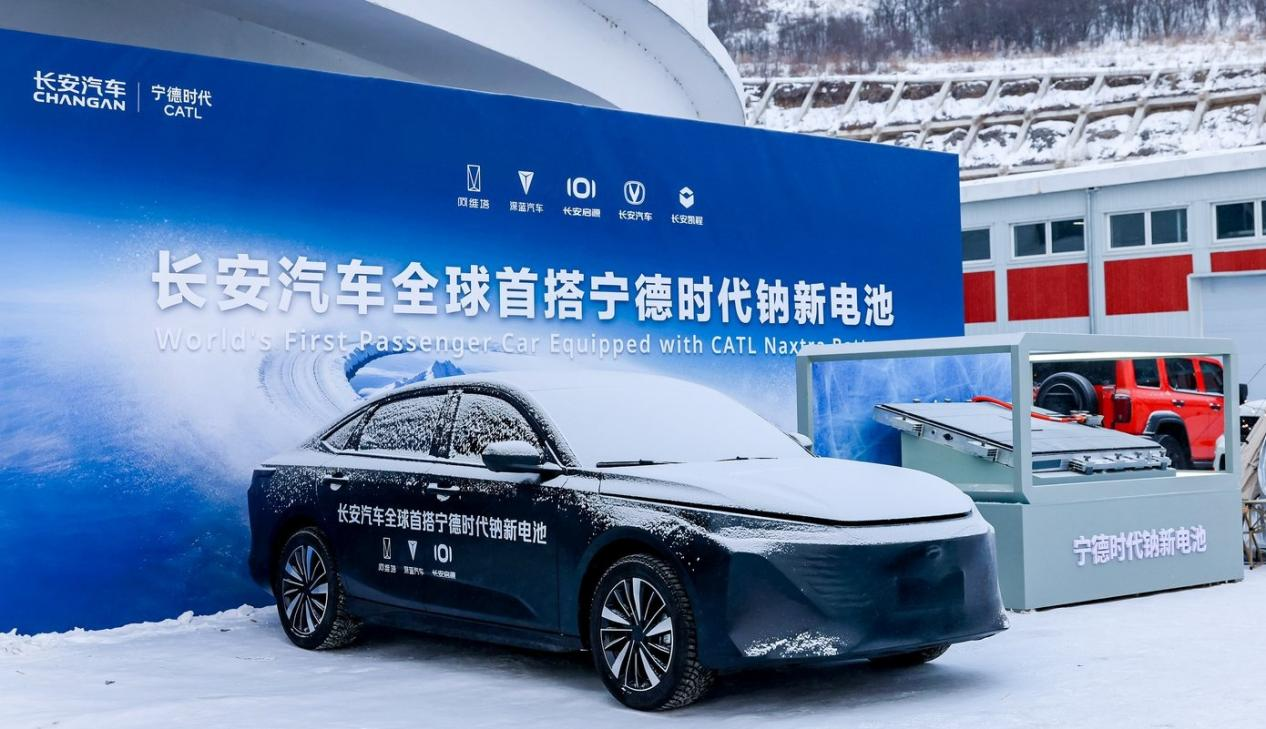
Image source: CATL
Test data shows that pairing CATL's sodium battery with its third-generation CTP technology delivers a pure electric range exceeding 400 km. Thanks to precise control via CATL's BMS intelligent management strategy, the vehicle achieves "displayed accuracy," while the cell's maximum energy density reaches 175 Wh/kg.
At -30°C, the vehicle's discharge power is nearly three times that of a comparable LFP model. Capacity retention exceeds 90% in extreme cold of -40°C, and it can even discharge stably at -50°C.
Even when fully charged, CATL's sodium battery withstands extreme abuse—such as multi-directional crushing, drilling, and sawing—without smoking, catching fire, or exploding. Remarkably, it continues to discharge normally even after being sawn through, setting safety standards far beyond national requirements.
Officials project that as the sodium-ion supply chain matures, pure electric range could climb to 500 km or even 600 km, while extended-range models could exceed 300 km or 400 km. That would cover more than 50% of the new energy market's range requirements.
CATL's sodium battery is designed for deep integration across multiple brands, balancing flexibility with performance upgrades. Changan announced that its Avatr, Deepal, Qiyuan, and Viva brands will all feature the technology moving forward.
CATL began developing sodium-ion technology in 2016. By 2025, the company will have invested nearly 4 billion yuan, tested nearly 300,000 cells, and deployed over 300 R&D personnel—including more than 20 PhDs.
This nearly decade-long technological marathon is now entering commercialization. With its disruptive performance, sodium-ion technology has the potential to establish a distinct and competitive roadmap—but the market will be the final judge.