



Gasgoo Munich- Solid-state batteries and humanoid robots have emerged as the two critical battlegrounds for measuring an automaker's technological depth.
Just recently, Changan Automobile voluntarily disclosed key developments on an investor platform: solid-state batteries are slated for vehicle verification soon, while humanoid robots have been categorized by size based on application scenarios.
Amid a brutal price war and a race for technological survival, this seemingly forward-looking strategy is actually an inevitable move for Changan to secure its footing for the future.
Solid-State Batteries and Robots: Changan’s "Must-Win Territory"
Addressing investor concerns about solid-state battery progress, Changan set a clear timeline: before the third quarter of this year, its "Golden Bell" solid-state batteries will be installed in robots and undergo vehicle verification.
Official specs reveal that Changan’s all-solid-state battery boasts an energy density of 400Wh/kg. That means vehicles equipped with it could exceed 1,500 kilometers of range on a full charge. Meanwhile, AI-powered remote diagnostics boost safety by 70% compared to traditional liquid batteries. As planned, once vehicle verification wraps up in 2026, mass production will begin rolling out in 2027.
Widely recognized as the "ultimate form" of power batteries, solid-state technology offers the first mover a chance to define new standards in the premium market.
Automakers are currently sprinting toward this goal collectively. BYD plans small-batch production of sulfide-based solid-state batteries by 2027, while Geely has also set its sights on small-scale industrialization of all-solid-state batteries that same year.
Against this backdrop of industry competition, Changan’s decision to target the third quarter of 2026 for "vehicle verification" serves a dual purpose: demonstrating its ability to deliver technology and ensuring it doesn't fall behind in the next round of the battery race.
In its response, Changan broke down its robotics business in detail, outlining a "1+N+X" strategy to organize intelligent automotive robot technology and operations around core scenarios.

Image Source: Changan Automobile
Specifically, "1" represents the humanoid robot as the main driver, pulling the entire sector forward. Product forms are divided into full-size (for manufacturing), medium-size (for retail stores), and small (for home use), covering multiple scenarios. "N" encompasses business forms like in-vehicle component robots, smart mobility ecosystem robots, and specialized service robots. "X" signifies the company’s role as a chain leader, integrating the upstream and downstream robotics industry—including components, software services, infrastructure, and operators.
Previously, Changan showcased its self-developed humanoid robot "Xiao An" at the Guangzhou Auto Show and plans to launch its first in-vehicle component robot in the first quarter of 2026.
In terms of timing, 2026 is also a "year of verification" for Changan’s robotics. While it may not contribute significantly to financial statements in the short term, it is a crucial strategic move in Changan’s long-term transformation from a "vehicle manufacturer" to a "smart mobility ecosystem service provider."
Notably, Changan specifically mentioned that batteries will be "mounted on robots and undergo vehicle verification." Using robots as the debut verification scenario for solid-state batteries reveals more than just confidence in safety and energy density; it implies an internal strategic logic of technical synergy across the "automotive + robotics" dual tracks.
Targeting 3.3 Million Units, Where Tech Narratives Meet Reality
Every tech narrative eventually has to translate into sales figures. Recently, Changan announced plans to buy back A-shares and B-shares to reduce registered capital, using its own funds. The total buyback ranges from 1 billion to 2 billion yuan—comprising 700 million to 1.4 billion yuan for A-shares and 300 million to 600 million yuan for B-shares. Research reports note that the substantial size of this buyback signals strong confidence in long-term growth and a commitment to shareholder returns.
Changan is targeting 3.3 million in sales for 2026, a 13.3% year-over-year increase. Of that, new energy vehicles are expected to account for 1.4 million units, jumping 26.2%.
This target is grounded in reality. In 2025, Changan’s sales hit 2.913 million—a nine-year high—while the new energy sector's 51.1% growth proved the initial success of its transformation. Underpinning the 2026 goal are 43 new products launching over the next three years and a continued push overseas (with a target of 750,000 units abroad).
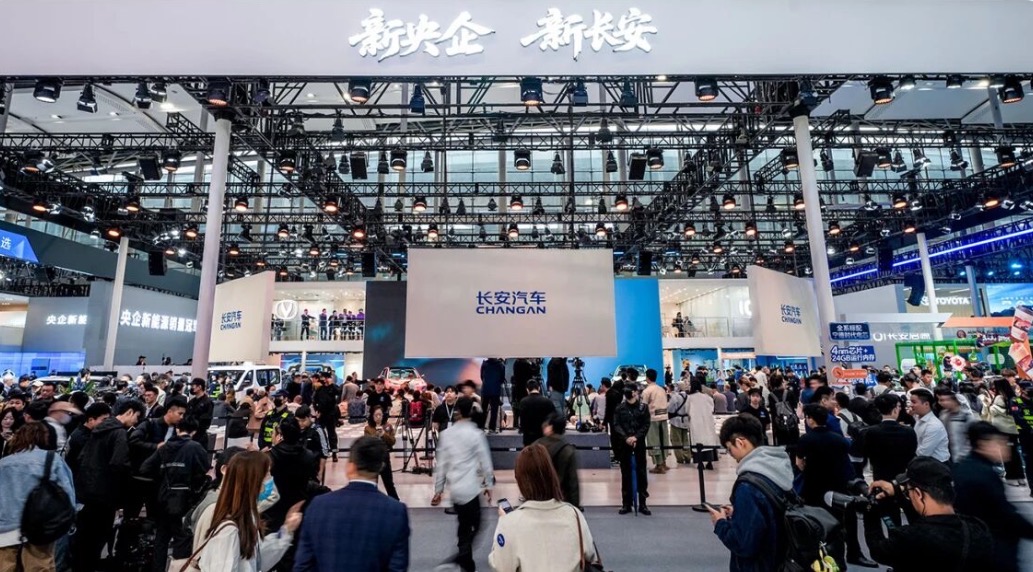
Image Source: Changan Automobile
Addressing investor concerns over production capacity, Changan offered reassurance: "Existing capacity can effectively meet market demand, and we will adjust dynamically according to market changes."
The research reports further suggest that in the short term, sales should maintain steady growth as the company rolls out highly competitive new models. Over the medium to long term, deeper expansion into overseas markets, combined with the commercialization of emerging sectors like robotics and flying cars, is poised to forge new growth engines.
The 2026 auto market is destined to be a brutal battlefield where automakers must "have it all." Changan’s response clearly outlines a two-front war: one front is the technological assault led by solid-state batteries—a battle that must be won to secure product competitiveness post-2027. The other is the strategic positioning of future ecosystems led by robotics—a move essential for capturing growth potential through 2030.
For Changan, the third-quarter solid-state battery verification will be a major exam for the entire industry to watch. If it passes smoothly, Changan secures a ticket to the next generation of premium new energy vehicles. Meanwhile, its early moves in robotics give it more leverage in the ultimate debate over whether a car is merely a tool for transport or a smart terminal.


