



Gasgoo Munich- The passenger vehicle market in China set a complex tone for the year with a first quarter marked by pressure. Data from the China passenger vehicle Association (CPCA) shows retail sales of narrowly defined passenger vehicles reached 4.226 million units in Q1, down 17.4% year-on-year. As April arrives, that divergence remains. While internal combustion engine (ICE) vehicles face a double squeeze from pricing and fuel costs, new energy vehicles (NEVs) are regaining momentum after a brief adjustment, with market penetration poised to breach the 60% threshold.
The CPCA's latest forecast pegs April retail sales for narrowly defined passenger vehicles at roughly 1.42 million units—a modest 13.8% decline from March, aligning with seasonal norms. Yet beneath this overall calm, NEV retail sales are projected to hit 860,000 units, lifting the penetration rate to 60.6%. The market is struggling to pivot from "policy-driven" growth to "product-driven" demand, and a competitive shakeout centered on product competitiveness and market share has entered an intensely competitive phase.
Uneven Performance: NEVs Regain Their Footing
On the surface, April's sales figures appear uneventful, even tepid. But look past the aggregate numbers, and a picture of a diverging market emerges: the ICE sector remains under strain, while the NEV market is rediscovering its growth rhythm after a brief first-quarter slowdown.
CPCA data shows ICE vehicle retail sales hit 795,000 units in March. While that met expectations, the downward trend compared to last year is clear. That pressure hasn't let up in April. International oil prices remain high, driving up operating costs for ICE vehicles and dampening potential demand. Meanwhile, ICE vehicle pricing structures have loosened under the shock of the NEV price war. Consumers are holding back, fearing further drops, which has lengthened the time to close a deal.
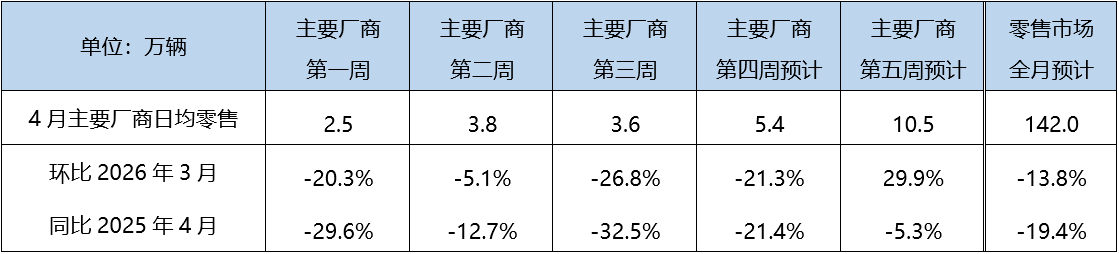
Image Source: CPCA
Across the broader market, CPCA surveys indicate that leading manufacturers—which account for over 70% of total sales—have all lowered their April retail targets week-over-week. Weekly data tells the story: the first week of April, impacted by the Qingming Festival holiday, saw daily retail sales of just 25,000 units. The second week recovered to 38,000, but still lagged behind last year's levels. The third and fourth weeks saw a rebound in showroom traffic and orders as a wave of new models debuted ahead of the Auto China 2026, though the impact on actual deliveries will take time to materialize.
The NEV sector, however, is enjoying its own recovery. March retail sales of new energy passenger vehicles reached 852,000 units, with a penetration rate of 51.7%. The CPCA expects that figure to climb to 860,000 in April, pushing the penetration rate past the 60% milestone. That means for every five new cars sold, three are new energy vehicles.
This return to growth is no accident. April, leading up to the Auto China 2026, has been packed with launch events. If last year's price war was a Pyrrhic conflict—harming the rival as much as oneself—the focus for both domestic and joint-venture brands has now shifted entirely to product competitiveness. Domestic brands are expanding their hybrid and pure-electric lineups, while joint ventures are accelerating models built on native electric platforms. This barrage of new products is effectively activating demand from buyers who had been sitting on the sidelines. The market's driving force is shifting from the "crutch" of policy subsidies to the intrinsic strength of the products themselves.
From "Price Wars" to "Product Wars": Q2 May Mark the Rebound
Behind the sales figures lies a profound reshaping of the market's underlying logic. The "price wars" that defined the past year are gradually giving way to a "product value war" centered on technology and experience. For the Chinese auto market, April's flat overall sales mask its strategic importance as a bridge between the past and the future.
Looking back at Q1, retail auto sales fell 9.1% year-on-year—a stark contrast to the broader economy's 5% GDP growth. This highlights not only the weakness in big-ticket spending but also the severity of the market's internal polarization. Simple price cuts are no longer enough to unlock significant demand. Consumers have become savvier and more selective; they aren't buying just because a car is a few thousand yuan cheaper. They are prioritizing intelligent features, real-world range, and charging convenience.

Image Source: IM Motors
This is the reality of April's market. Supply-side heat far outstrips demand. The wave of new model launches surrounding the Auto China 2026 has become the key variable in shifting market sentiment. Domestic brands are deploying advanced driver-assistance systems and high-voltage platforms to enter the premium segment, while joint-venture brands—once slower to pivot to electrification—are actively defending their turf. While this fierce product rivalry has intensified the wait-and-see mood in the short term, it has greatly expanded consumer choices long-term, setting the stage for a future surge in demand.
The CPCA analysis suggests the auto market is in a critical transition phase, moving steadily from "policy-driven" growth to "market-guided" and "product-driven" expansion. Although April delivery rhythms were constrained by the lag between new launches and actual handovers, the anticipation surrounding the auto show is expected to translate into a small peak in sales by the end of April and early May as new vehicles begin reaching customers.
In sum, April's buildup is preparation for a steady rebound in the second quarter. As expectations for a mild economic recovery grow and local pro-consumption policies take effect, demand that was suppressed or deferred is likely to be unleashed over the next two months. For automakers, those who deliver compelling technology and experiences in this product-driven competitive shakeout will seize the initiative in China's 2026 market. And with the NEV penetration rate topping 60%, the irreversible shift toward electrification has been confirmed.


