Gasgoo Munich- As the global auto industry enters an era defined by zero-sum competition, regional divergence in electrification, and geopolitical shifts reshaping supply chains, Chinese automakers are moving beyond the early days of simply shipping finished cars abroad. The sector is undergoing a profound transformation from pure product trade to a holistic ecosystem that integrates manufacturing, supply chains, and services. Gasgoo Institute, in partnership with AlixPartners, draws on the latest export data and corporate practices to analyze the key characteristics and growth logic of this new stage across four dimensions: industry overview, market landscape, core trends, and representative manufacturers. The core findings of the report are as follows:
Industry Overview
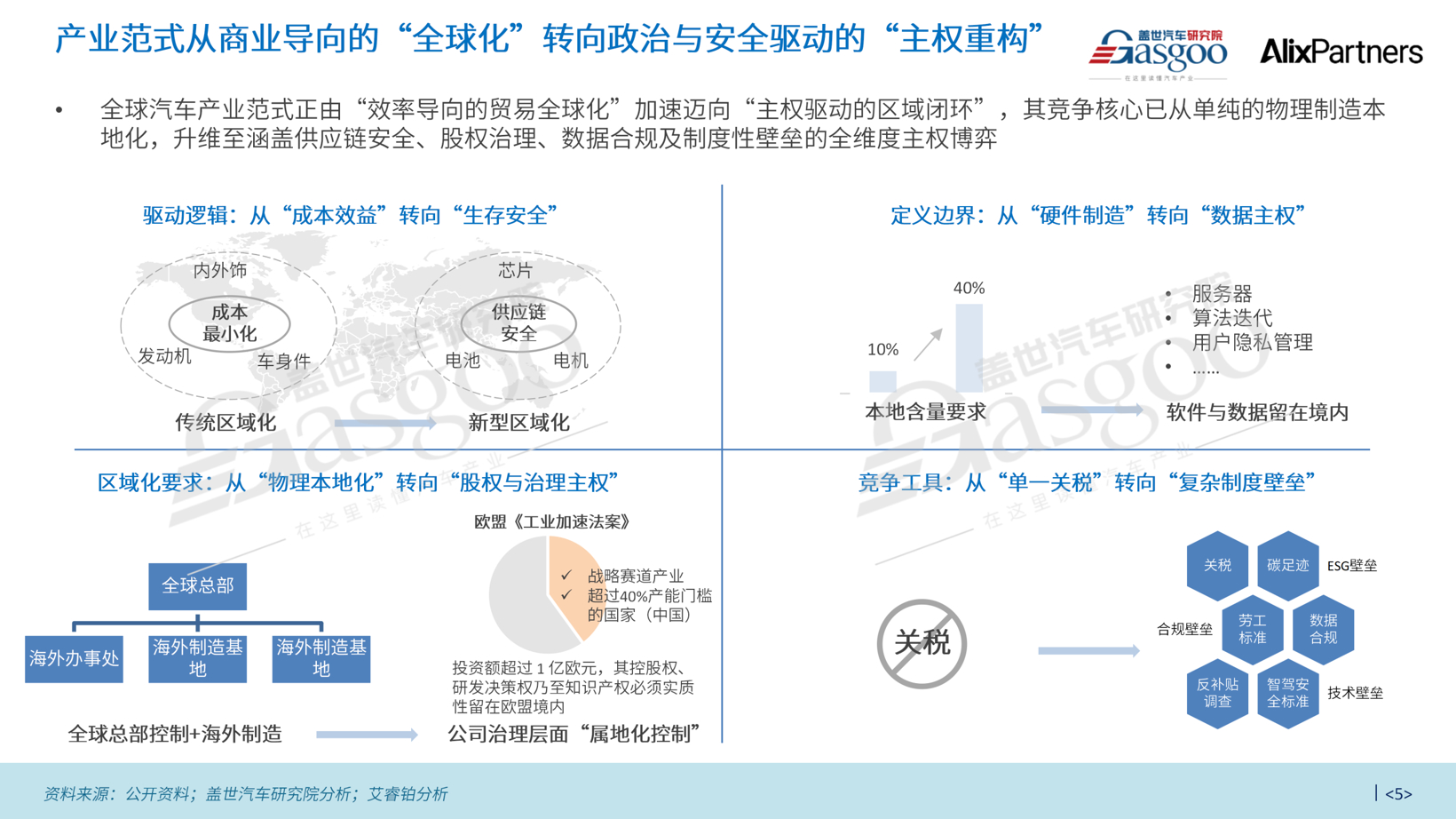
Global auto sales have settled into a period of low-speed, steady growth, defined by two major shifts. First, the electrification timeline has fractured from a global rhythm to a regional one, with China, Europe, Southeast Asia, and North America moving at vastly different speeds. Second, the industry paradigm is pivoting from efficiency-driven globalization to security- and sovereignty-focused regionalization. Local content requirements, data compliance, and equity governance have emerged as the new barriers to entry.
China's auto export sector is simultaneously undergoing a structural upgrade, marked by three critical transitions. On the product side, the focus has shifted from exporting single models to offering diversified powertrain matrices. Supply chains are moving from solo efforts by OEMs to coordinated overseas expansion with core component suppliers. Business models are evolving from merely selling vehicles to building integrated ecosystems that cover distribution, finance, after-sales service, and charging infrastructure. Trade barriers, geopolitical volatility, shifting policies, and insufficient localization remain the core challenges that must be overcome in this new phase.
Market Landscape
The scale of Chinese passenger vehicle exports continues to climb, with ongoing optimization across three structural pillars: export regions, powertrain types, and corporate entities.
Regionally, the Middle East became China's largest export market for passenger vehicles in 2025, growing roughly 30% year-on-year. Europe saw a significant rebound with a growth rate of about 40%, rising to second place. Central and South America along with Southeast Asia maintained steady growth, with the latter entering an explosive phase of electrification.
In terms of powertrain structure, the export strategy has shifted from a pure EV focus to a diversified approach where internal combustion engine (ICE) vehicles provide a baseline, plug-in hybrids (PHEVs) drive growth, and battery electric vehicles (BEVs) make selective inroads. ICE vehicles still dominate in markets with weaker infrastructure, such as the Middle East, Africa, and Latin America. PHEVs and hybrids are gaining rapid traction in Latin America and Europe, where charging infrastructure is incomplete and fuel prices are high. BEVs, meanwhile, are concentrating on regions with favorable policies and clear demand for high-end models.
Regarding the competitive landscape, leading state-owned enterprises and private automakers have become the dominant force. Domestic brands like Chery, BYD, SAIC, and Geely occupy the top spots on export rankings, while the share of foreign and joint ventures continues to shrink.
Development Trends
In the short term, Chinese passenger vehicle exports are set to maintain their high-growth momentum. Volumes are projected to surpass 6.9 million units by 2026, driven primarily by localized production and the expansion into new markets.
Over the medium to long term, four clear trends are emerging. First, brand consolidation will continue as top domestic players capture global growth. Second, powertrain strategies will run in parallel, with the strategic importance of plug-in hybrids and extended-range vehicles rising further. Third, the export model is upgrading from shipping whole vehicles to coordinated industry chain expansion, with components, software, and services landing in sync. Fourth, partnerships between Chinese and foreign companies are evolving from simple distribution agreements to deep integration across capital, technology, manufacturing, and ecosystems.
The long-term objective is for the Chinese automotive industry to move beyond cost advantages and localized restructuring toward exporting a global industrial paradigm. This signifies a transformation from being a market participant to becoming a standard-setter.
Representative Manufacturers
Magna: A Strategic Partner for Asset-Light Entry into Mature Markets
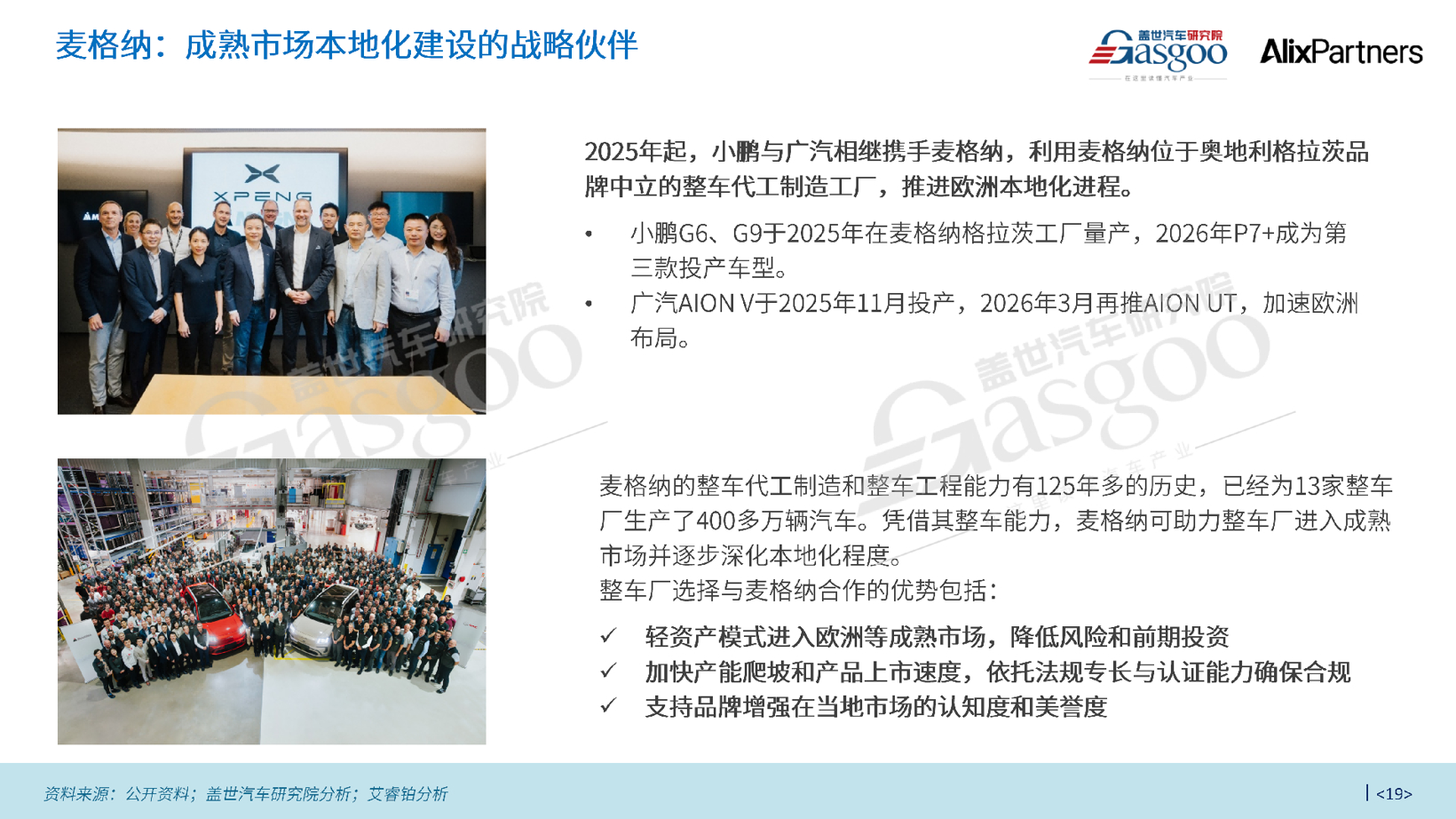
Leveraging 125 years of experience in vehicle manufacturing and engineering services, Magna has become a key partner for Chinese automakers entering mature markets like Europe. Starting in 2025, XPENG and GAC have partnered with the company to achieve mass production of their models at the Graz plant in Austria. The advantages of this model include:
1. Entering mature markets like Europe through an asset-light model, thereby reducing risk and upfront investment;
2. Accelerating production ramp-up and time-to-market, while ensuring compliance through regulatory expertise and certification capabilities;
3. Supporting brands in enhancing their visibility and reputation in local markets.
Yuanfeng Technology: A Benchmark Enterprise in Global Auto Components
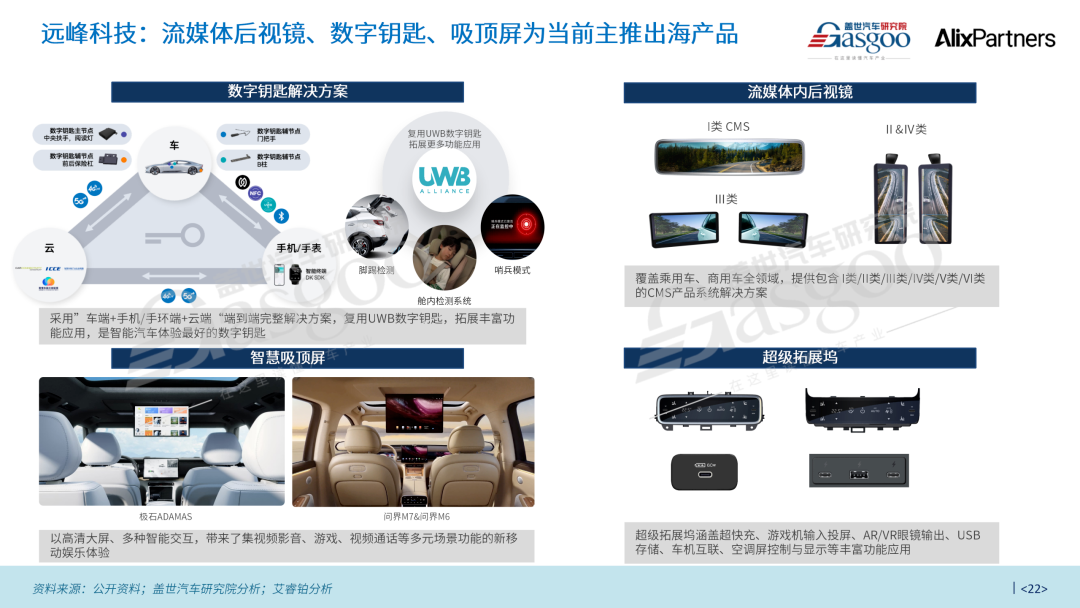
Centered on automotive electronics, Yuanfeng Technology has built a global system integrating R&D, manufacturing, and services. The company has established smart manufacturing bases in Dongguan and Atlanta, and set up R&D and sales centers in Shanghai, Shenzhen, Stuttgart, Detroit, and Yokohama, covering core markets in Asia, Europe, and North America. Its flagship export products include streaming media rearview mirrors, digital keys, smart overhead displays, and super docking stations. Notably, its streaming media mirrors hold a domestic market share of over 70%, while its digital key technology leads the market. Smart overhead displays have been adopted in numerous high-end models, bolstering the global competitiveness of Chinese automakers through intelligent component capabilities.