



Gasgoo Munich- China's auto industry recorded a noticeable slowdown in February mainly due to the holiday reason, with vehicle production totaling 1.672 million units and sales reaching 1.805 million units, according to data by the China Association of Automobile Manufacturers (“CAAM”). Compared with January, output and sales dropped by 31.7% and 23.1% respectively, while year-on-year declines stood at 20.5% and 15.2%.
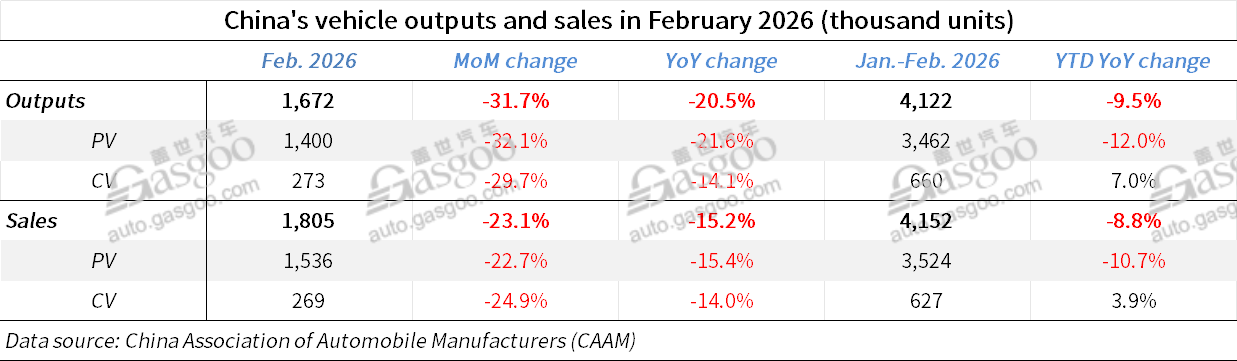
For the first two months of 2026, cumulative production reached 4.122 million vehicles and total sales came in at 4.152 million units, representing year-on-year decreases of 9.5% and 8.8%.
During the January–February period, the top fifteen automobile groups by sales collectively delivered 3.875 million vehicles, down 9% from a year earlier. These companies accounted for 93.3% of total market sales, slightly lower than the share recorded in the same period last year.
The CAAM said this year's Chinese New Year holiday fell in the latter half of February and lasted longer than usual, leaving only 16 effective working days during the month. The shortened production schedule and reduced business activity dampened overall market momentum.

Industry performance in the first two months of the year was also affected by a combination of factors, including adjustments to policy incentives, earlier-than-usual demand releases in late 2025, the shifting timing of the holiday season, relatively weak consumer sentiment, and a high comparison base from the previous year. Passenger vehicle and new energy vehicle sales both declined year on year, while the commercial vehicle segment continued to improve and exports maintained strong growth.
Authorities have signaled renewed efforts to stimulate consumption in the government's annual work report, calling for coordinated policy measures to boost domestic spending and address excessive price competition within the industry. Industry observers expect that the rollout of local subsidy programs after the holiday period, together with promotional campaigns at spring auto shows and a wave of new model launches, could help restore consumer confidence and stabilize the market in the coming months.
Domestic demand remained under pressure in February. Vehicle sales within China totaled 1.133 million units, down 32% from the previous month and 32.9% compared with a year earlier. Sales of traditional internal-combustion vehicles reached 650,000 units, representing declines of 36.4% month on month and 29.9% year on year.
Across January and February combined, domestic auto sales amounted to 2.799 million vehicles, a 23.1% drop from the same period last year. Of that total, conventional fuel-powered vehicles accounted for 1.673 million units, down 19.8% year on year.
Exports continued to provide a key growth engine for the industry. China shipped 672,000 vehicles overseas in February, a slight 1.4% decline from January but a strong 52.4% increase compared with the same month last year.
In the first two months of 2026, total vehicle exports reached 1.352 million units, marking a year-on-year jump of 48.4%.
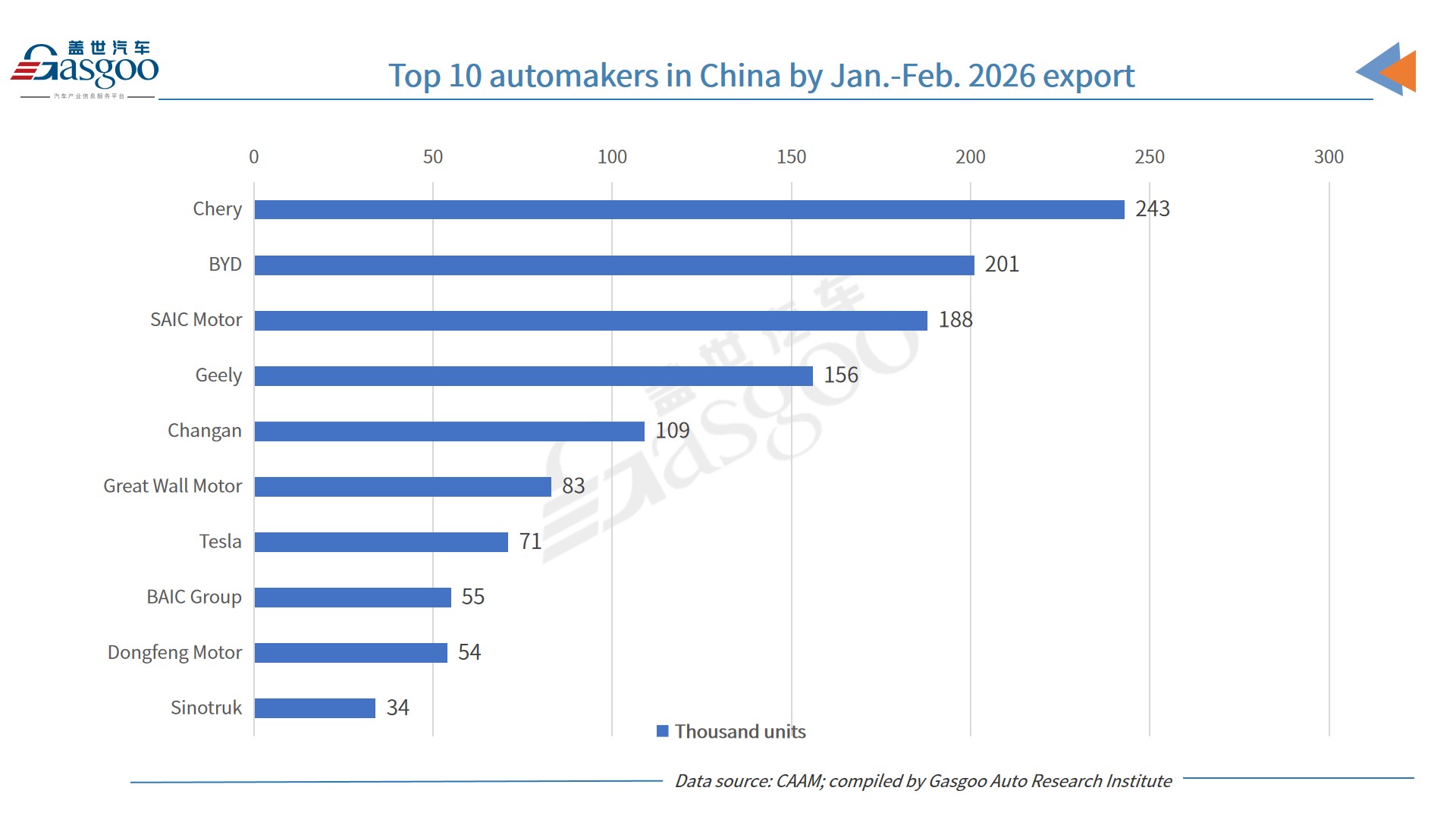
Among the top ten vehicle exporters in February, Chery led the rankings with 124,000 units shipped overseas, up 44.1% year on year and accounting for 18.5% of China's total auto exports for the month. Meanwhile, Tesla posted the fastest export growth rate, delivering about 20,000 vehicles abroad—more than four times its export volume from a year earlier.
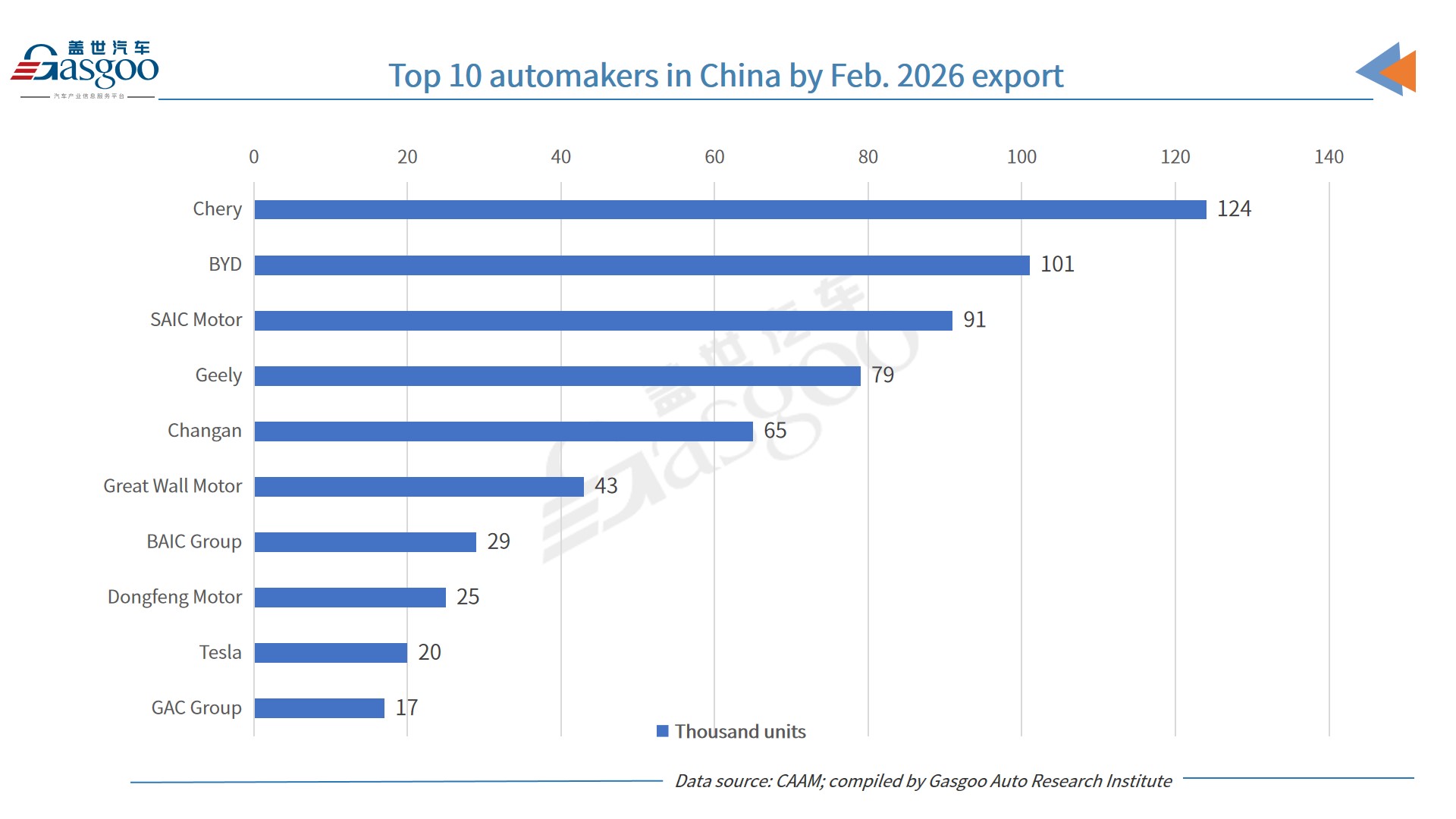
For the January–February period, Chery remained the leading exporter with 243,000 vehicles shipped, representing an increase of 45.6% and about 18% of the country's total exports. Geely recorded the most rapid export expansion among major players during the period, sending 156,000 vehicles overseas, roughly 2.5 times the level of a year earlier.
In February, China's passenger vehicle production totaled 1.4 million units while sales reached 1.536 million units. Both figures fell sharply from the previous month, declining 32.1% and 22.7% respectively. Compared with the same period last year, production and sales were down 21.6% and 15.4%.
Over the January–February period, passenger vehicle production amounted to 3.462 million units and sales reached 3.524 million units, representing year-on-year decreases of 12% and 10.7%.
Of those, China's domestic brands continued to dominate the passenger vehicle market despite the broader slowdown. In February, Chinese-brand passenger vehicles recorded sales of 1.078 million units, down 15.9% year on year. Their market share stood at 70.2%, slipping slightly by 0.4 percentage points from the same month last year.
For the first two months of the year, Chinese brands sold 2.409 million passenger vehicles, representing a 12.1% decline year on year. Their market share during the period reached 68.3%, 1.1 percentage points lower than a year earlier.
Across vehicle segments, sales trends diverged between conventional and electrified passenger vehicles. For traditional fuel-powered models, sales declined across the A0 to C segments during the January–February period. The A-segment remained the largest category, with cumulative sales reaching 1.079 million units, down 8.4% year on year.
In the new energy passenger vehicle market, smaller A00 to A-segment models also experienced declines, while demand shifted toward larger vehicles. B-segment electric vehicles emerged as the most popular category, posting sales of 506,000 units for the first two months and achieving a 9.4% year-on-year increase.
From a pricing perspective, conventional fuel-powered passenger vehicles continued to concentrate in the mid-range segment. Models priced between 100,000 and 150,000 yuan accounted for the largest share, with cumulative sales of 624,000 units in the first two months, though this represented an 11.2% decline year on year.
The pricing structure for new energy passenger vehicles showed a more mixed pattern. Sales declined in the entry-level segment below 80,000 yuan and in the 150,000–250,000 yuan range, while other price brackets posted growth. The 100,000–150,000 yuan category remained the largest, with sales reaching 343,000 units in the Jan.-Feb. period, up 2% from the previous year.
Domestic demand for passenger vehicles weakened significantly in February. Sales in the Chinese market totaled 950,000 units, falling 32.1% from January and 34.2% compared with the same month last year. Within this total, sales of traditional fuel-powered passenger vehicles reached 505,000 units, down 38% month on month and 30.4% year on year.
Across the first two months of the year, domestic passenger vehicle sales amounted to 2.35 million units, representing a 26.2% year-on-year decline. Of that total, conventional fuel-powered models accounted for 1.322 million units, down 22.6%.
Exports remained a bright spot for the passenger vehicle sector. China exported 586,000 passenger cars in February, a slight 0.6% decline from January but a strong 58% increase compared with the same month last year.
For January and February combined, passenger vehicle exports reached 1.174 million units, marking a year-on-year leap of 53.3%.
The commercial vehicle market showed mixed performance. In February, production and sales reached 273,000 and 269,000 units respectively, declining both month on month and year on year. Sales of natural gas-powered commercial vehicles totaled 13,000 units during the month, dropping sharply compared with both January and the same period last year.
However, the sector maintained overall growth in the first two months of 2026. Commercial vehicle production reached 660,000 units while sales totaled 627,000 units, representing increases of 7% and 3.9% year on year. Of those, sales of natural gas commercial vehicles stood at 36,000 units for the period, broadly stable compared with last year.
Domestic commercial vehicle sales in February totaled 183,000 units, down 31.3% from January and 24.7% year on year.
For the first two months of the year, domestic commercial vehicle sales amounted to 449,000 units, representing modest growth of 2%.
Commercial vehicle exports also maintained steady growth. China exported 87,000 commercial vehicles in February, a slight decline from the previous month but an increase of 23.1% compared with a year earlier.
For January–February, commercial vehicle exports climbed to 178,000 units, up 22.4% year on year.
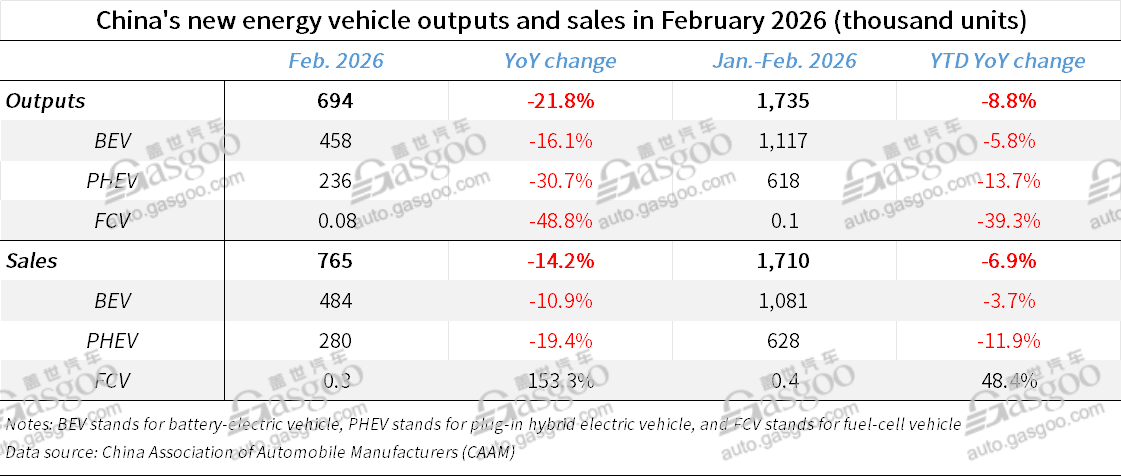
China's new energy vehicle (NEV) market also experienced a temporary slowdown early in the year. In February, NEV production reached 694,000 units while sales totaled 765,000 units, representing year-on-year declines of 21.8% and 14.2%. Despite the drop, NEVs still accounted for 42.4% of total new vehicle sales during the month.
In the January–February period, NEV production totaled 1.735 million units and sales reached 1.71 million units, down 8.8% and 6.9% year on year. In terms of shares, NEVs accounted for 41.2% of overall vehicle sales.
The leading players continued to dominate the NEV market. The top fifteen automotive groups collectively sold 1.65 million new energy vehicles in the first two months of 2026, representing a 7.3% decline from the previous year. These companies accounted for 96.5% of total NEV sales, slightly lower than their share during the same period in 2025.
Domestic NEV sales totaled 483,000 units in February, falling 24.9% month on month and 36.4% year on year. Passenger NEVs accounted for the bulk of the volume at 445,000 units, while new energy commercial vehicles recorded sales of 39,000 units.
For the January–February period, domestic NEV sales reached 1.126 million units, representing a 27.5% decline from a year earlier. Passenger NEVs accounted for 1.028 million units, while new energy commercial vehicles posted stronger momentum with sales rising 25.3% to 99,000 units.
Even with weaker demand, electrification levels remained high. In February, NEVs accounted for 42.7% of total domestic vehicle sales. Within the passenger vehicle segment, NEV models represented 46.8% of sales, while in the commercial vehicle market the share stood at 21.1%.
Across the first two months of the year, NEVs represented 40.2% of overall domestic vehicle sales. Their share reached 43.7% in the passenger vehicle segment and 22% in commercial vehicles.
Exports continued to power growth in the new energy vehicle segment. China shipped 282,000 NEVs overseas in February, slightly lower than the previous month but more than doubling compared with the same period last year. Passenger NEVs accounted for the vast majority of exports at 276,000 units, while new energy commercial vehicles contributed around 5,000 units.
During the January–February period, total NEV exports reached 583,000 units, also more than doubling year on year. Passenger NEVs made up nearly all shipments at 572,000 units, while exports of new energy commercial vehicles declined 13.9% year on year to 12,000 units.
Breaking down NEV exports by technology, battery electric vehicles accounted for 174,000 units in February, down from January but more than doubling from a year earlier. Plug-in hybrid vehicles recorded exports of 107,000 units, increasing both month on month and year on year.
Across the first two months of 2026, China exported 377,000 battery electric vehicles and 206,000 plug-in hybrids, representing year-on-year growth of roughly 100% and 120%, respectively.


