



As the global auto industry accelerates into electrification, China and Europe — two core markets and manufacturing hubs — are shaping the wider supply chain. In January 2026, the two sides reached common ground on a price undertaking mechanism for EV exports, effectively pressing a "soft landing" for a trade dispute that has dragged on for more than two years. The breakthrough could avert the damage of an escalating trade war and, more importantly, reset the competitive logic for Chinese EVs heading to Europe.
Price undertaking: a new path to settling the trade dispute
On the evening of January 12, 2026, China's Ministry of Commerce said that, to implement the consensus from the China–EU leaders' meeting and properly resolve the EU's anti-subsidy probe into Chinese EVs, the two sides had held multiple rounds of talks. Both agreed it was necessary to offer general guidance on price undertakings to Chinese exporters of battery-electric vehicles bound for the EU, addressing European concerns in a World Trade Organization–compliant way.
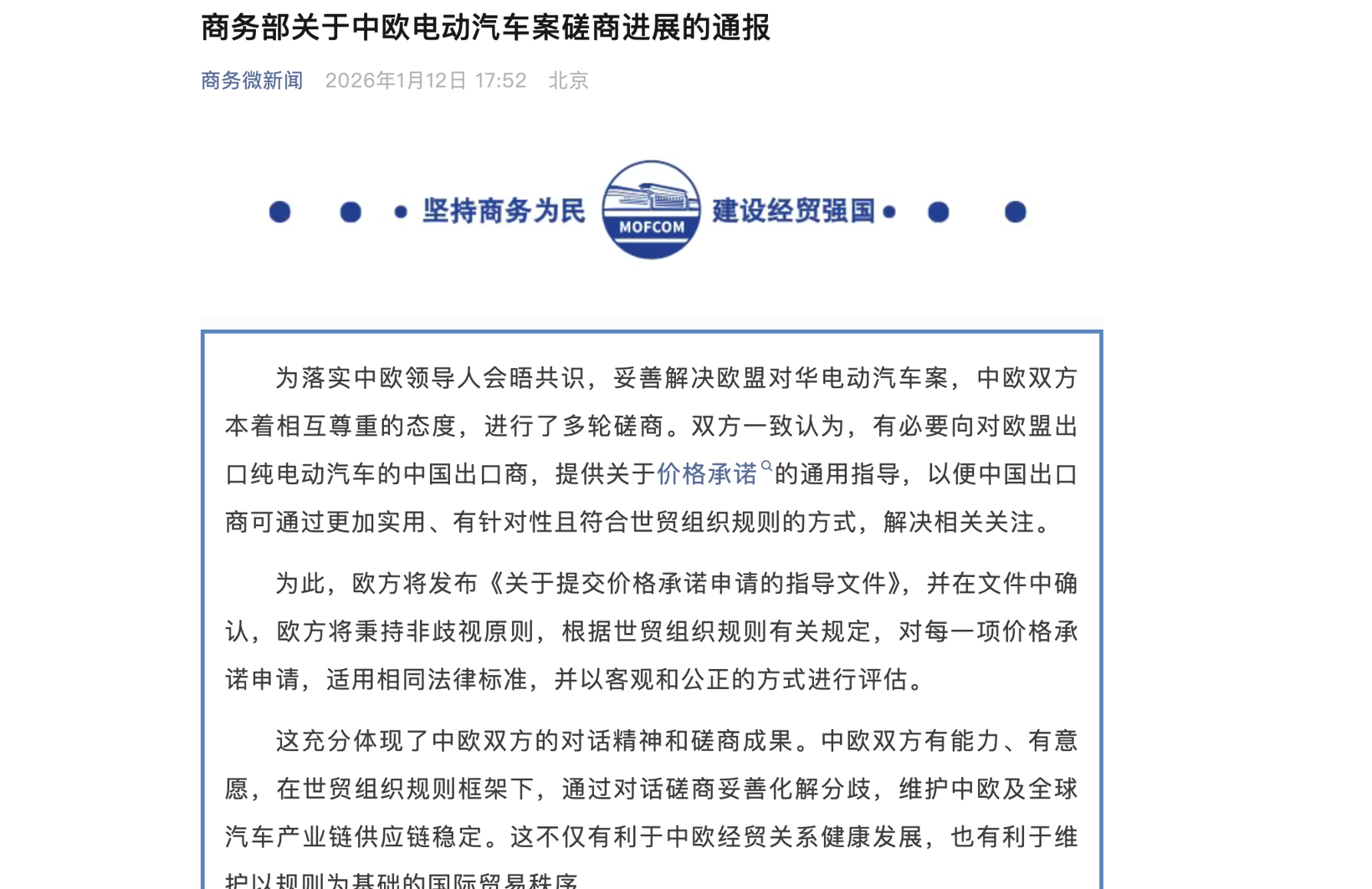
Image source: China's Ministry of Commerce
To that end, the European Commission will release “Guidance on Submitting Price Undertaking Applications.” The document confirms the EU will apply non-discrimination and, in line with WTO rules, assess every application using the same legal standards, with objective and impartial evaluations.
This is no ad hoc compromise; it's a pragmatic choice reached through repeated negotiation within a rules-based framework, while factoring in industrial realities.
Rewinding the dispute: the Commission launched an anti-subsidy investigation into Chinese EVs in October 2023 and, in October 2024, imposed steep countervailing duties. Stacked on top of a 10% base import tariff, some Chinese automakers faced composite rates edging toward 45% — a heavy blow to their cost structures and pricing strategies for Europe.
Cui Dongshu, secretary-general of the China Passenger Car Association (CPCA), put it bluntly: such high rates "deliver a massive hit to the cost and pricing systems for Chinese EV exports to Europe, with some automakers even facing the risk of exiting the EU market."
From the EU's perspective, keeping tariffs high isn't optimal either. Consumers would be forced to pay more, and with inflation not fully tamed, that would sap momentum across the EV market. The EU auto industry, meanwhile, depends heavily on Chinese batteries, motors and other key components. Raising trade barriers invites supply-chain knock-on effects that ultimately boomerang on domestic industry.
Against that backdrop, price undertakings emerged as the key lever for both sides to balance interests and break the impasse.
Several German media outlets reported that on January 12 the Commission published general guidance on price undertakings. Chinese BEV exporters must file undertaking letters with the EU, coordinating minimum prices directly with Brussels. Disclosed details indicate the letters will cover export prices, sales channels and other information.
A Commission spokesperson said the minimum import price mechanism set via undertakings could eventually replace the current provisional duties. Even so, the document released is guidance only; additional steps are needed to put it into practice.
A two-way boost: price undertakings could reset the industry's ecosystem
The mechanism's rollout isn't a mere policy tweak. It will trigger multi-layered, deeper chain reactions across China's EV industry, China–EU supply-chain cooperation, and the global competitive landscape.
For Chinese automakers, the mechanism can shield them from the direct shock of high tariffs, offering institutional support to stabilize share in the EU market.
Cui Dongshu noted that by replacing steep tariffs with non-discriminatory, WTO-compliant price undertakings, the EU has essentially preserved a core access channel for Chinese carmakers. Unlike tariff walls, undertakings constrain sticker prices, but automakers can optimize costs and adjust product mixes to sustain reasonable margins — the overall hit is far smaller than tariffs. “In 2025, Chinese brands’ share of Europe's EV market topped 10%. Independent Chinese brands are growing rapidly in the EU, and this outcome will further cement that momentum.”
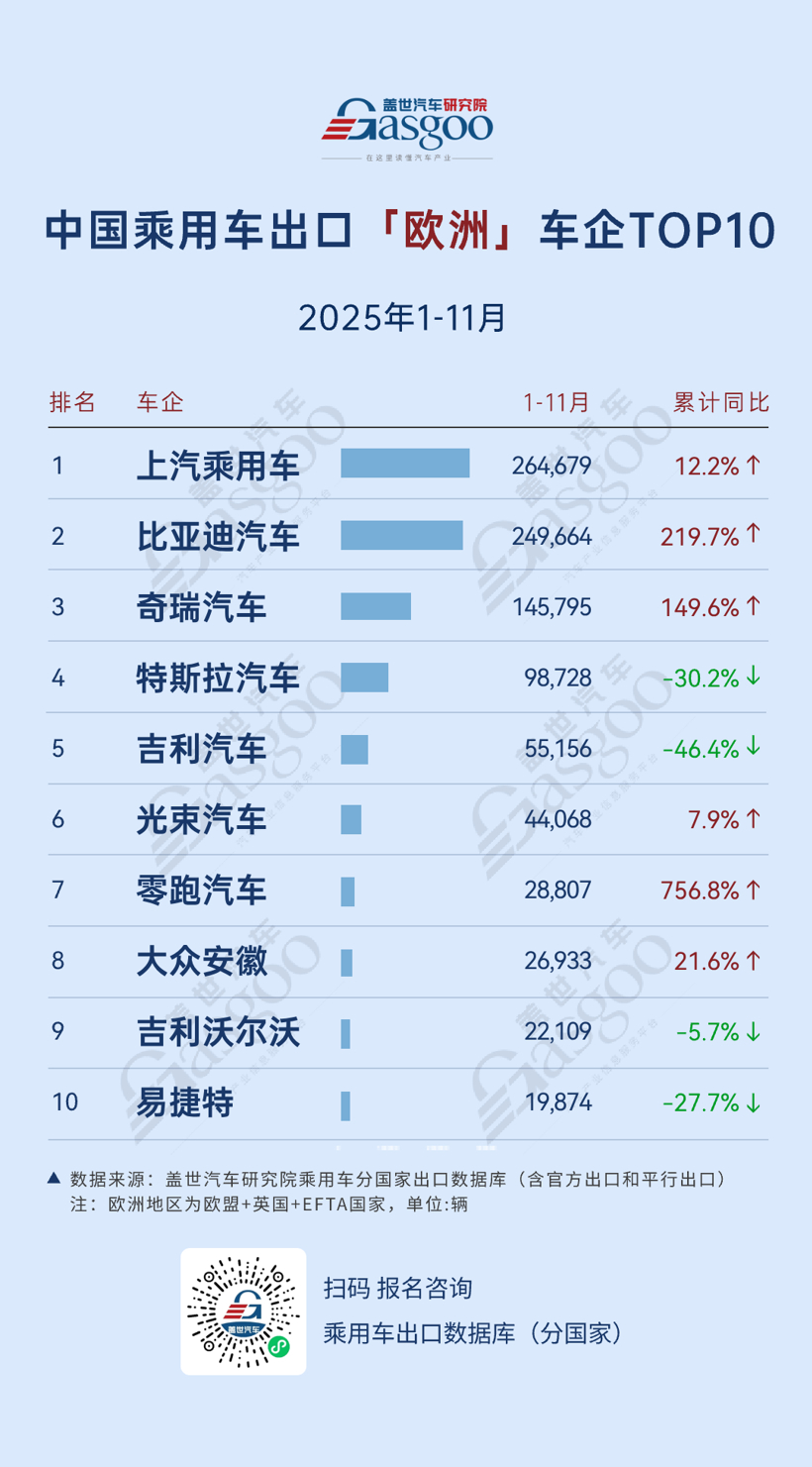
More profound is the shift it forces: price caps will push Chinese automakers to move beyond the traditional low-price, volume-led playbook and accelerate toward premium and smart-tech segments. Some of their previous edge in Europe stemmed from cost-driven pricing. That approach invites friction and is weak for long-term brand building. With undertakings in place, space for entry-level budget models will shrink, nudging companies to refocus on R&D and high value-added products.
As Cui put it, price constraints will drive automakers “to step up R&D investment and focus on high value-added models — improving autonomous driving and battery performance, among other core technologies — competing in the EU on technology premiums rather than price.” That dovetails with the broader transformation of China’s auto industry.
For the EU, price undertakings balance multiple goals. Minimum prices offer some shielding for domestic industry, easing the pressure from rapid Chinese EV penetration. The mechanism also buys time for local players to transition, helps stabilize supply chains, and preserves consumer choice.
In competitive terms, undertakings will hasten divergence among Chinese brands in Europe. Near term, top-tier players — with stronger technology, scale and compliance capabilities — are set to shape the landscape. BYD and XPENG, which already have brand recognition and channels in Europe, can swiftly recalibrate pricing and optimize product structures to fit the new rules. Weaker firms reliant on low prices may fail to adapt and exit, lifting market concentration.
That divergence can both improve the outbound ecosystem for Chinese automakers and pivot Europe’s competition from price wars to value-based contests, pressing the entire industry to upgrade.
The mechanism also anchors expectations and lifts confidence for going overseas. Repeated China–EU trade frictions had made Chinese automakers wary of investing in capacity and channels across the bloc. The guidance clarifies application procedures and evaluation standards, reducing policy gray areas. Companies can now set clearer export and investment strategies — from pricing adjustments to planning localized production — which is critical for stabilizing expectations and bolstering confidence.
Beyond détente: the China–EU consensus and its global industrial reach
The significance of price undertakings goes well beyond settling a single dispute. Its long-term value lies in upgrading China's globalization model, deepening China–EU industrial integration, and offering a replicable template for resolving trade frictions — three dimensions that could shape the global auto industry for years.
On overseas strategy, the mechanism will push companies to evolve from "product exports" to "localized operations," building more resilient global footprints. To navigate undertakings and potential trade risks, localization in Europe is accelerating: Chery is building a plant in Spain, BYD plans one in Hungary, and SAIC and NIO are advancing their European bases — creating a multi-site localized production network.
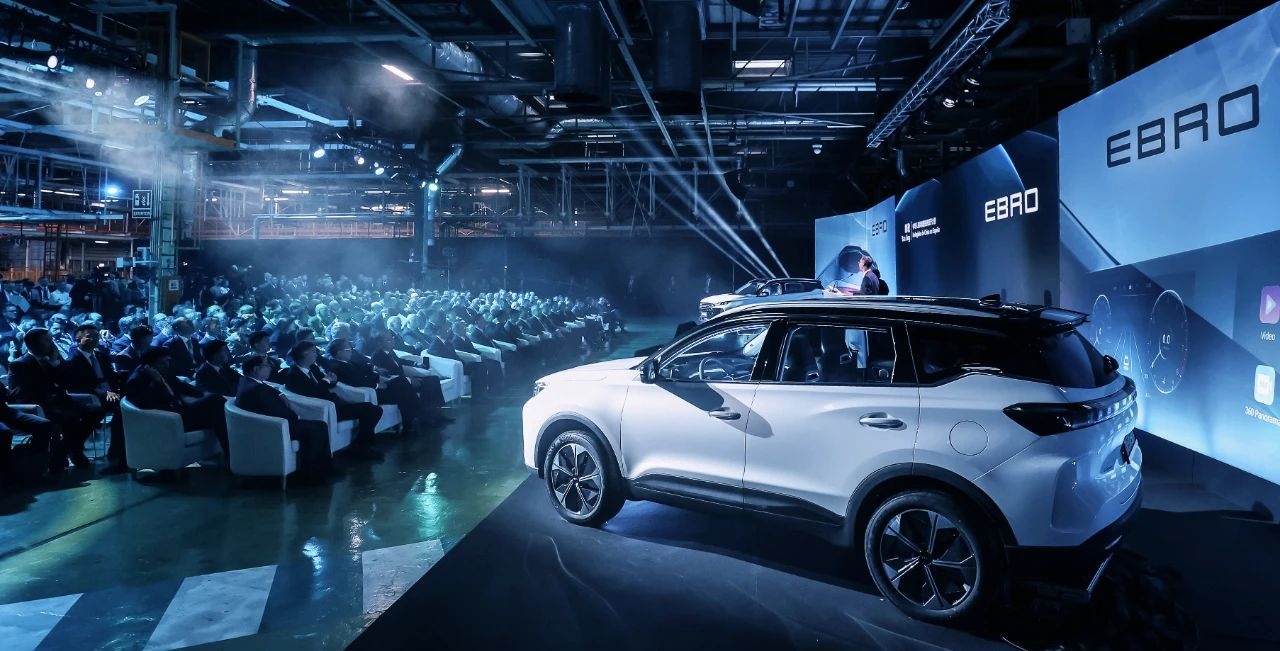
Image source: Chery
Faster localization not only sidesteps price caps and tariff risks, it also pulls Chinese parts suppliers offshore, enabling a China–EU regional supply chain. CATL is building a battery plant in Hungary, and NIO is expanding its energy ecosystem in Europe. This “vehicles + components + services” cluster reduces logistics costs and supply-chain risk while elevating China's voice in the global value chain.
Cui forecasts that with localized capacity coming online and products becoming more competitive, Chinese EV exports to the EU will grow at about 20% annually between 2026 and 2028, emerging as a key engine for global EV growth. That expansion will rest not on low prices, but on technology innovation, localized operations and supply-chain collaboration — a more sustainable foundation.
On product strategy, price undertakings will drive a fundamental pivot from “price advantage” to “value advantage.” Cui said Chinese automakers will reshape their EU lineups by trimming entry-level budget models and prioritizing mid-size and large SUVs, sedans and high-end smart EVs. Differentiation will be crucial: NIO’s battery swapping, BYD’s CTB technology, and XPENG’s intelligent driving systems can attract EU consumers through distinctive tech and services, breaking away from price-only competition.
From a collaboration standpoint, the mechanism nudges both sides from trade-level sparring toward deeper industrial integration. China–EU auto supply chains are tightly bound: the EU relies on Chinese core components, while Chinese automakers need European technology and market access. The mechanism sets a positive stage for cooperation in battery technology, charging standards and intelligent connectivity. Chinese charging standards and battery swapping could gain further EU recognition, aiding global standard convergence. Partnerships such as Volkswagen–XPENG and Stellantis–Leapmotor are likely to deepen, and joint work in battery recycling and carbon-footprint management can accelerate the EU’s electrification. Together, that should lift both sides’ global competitiveness and power the industry’s green transition.
Just as importantly, the resolution of the China–EU EV trade row offers a “China–EU sample” for global disputes, underscoring the importance of a rules-based order. Amid rising protectionism and geopolitical strains, the two sides avoided escalation and, through repeated consultations, sought a balance within the rules — a pragmatic approach with clear signaling value.
Cui argued the outcome “offers a template for resolving global trade disputes,” showing that dialogue and negotiation — not trade barriers — can maximize mutual interests. The template’s core value is that it both upholds WTO principles and accommodates industrial needs, providing a workable consultation framework and implementation path for similar cases.
Challenges remain for Chinese automakers in Europe, from brand perception and service-network gaps to data-privacy constraints — all requiring sustained investment. Yet price undertakings remove a key obstacle to their global push. As the mechanism takes hold, China and the EU are set to enter a new phase of collaborative growth, while Chinese carmakers climb the global value chain with higher-quality gains — injecting fresh momentum into the industry's transformation.


