



Gasgoo Munich- What were the major headlines in the new energy vehicle market this week?
XPENG to Rebrand
On March 27, Gasgoo learned from official sources that XPeng Inc. (HK stock code: 9868) announced it will change its Chinese name from "XPeng Motors Limited" to "XPeng Group" effective April 1, 2026. The English name, XPeng Inc., remains unchanged.
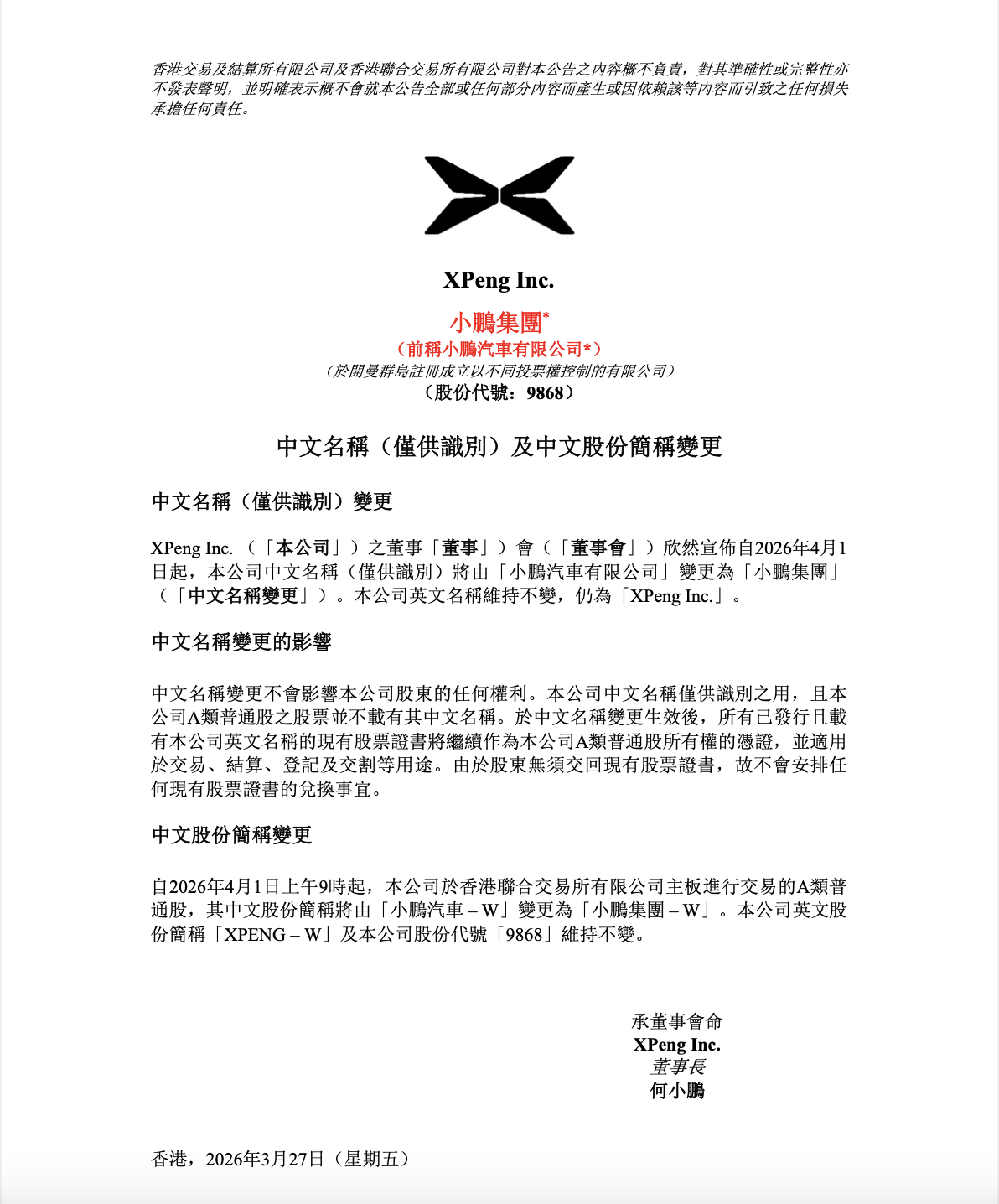
Image source: XPENG
Concurrently, the Chinese short name for its Class A ordinary shares traded on the Main Board of the Stock Exchange of Hong Kong Limited will shift from "XPeng Motors – W" to "XPeng Group – W." The English short name "XPENG – W" and stock code "9868" will remain unchanged. The rebranding does not affect shareholder rights; existing stock certificates need not be surrendered, and no exchange arrangements are required.
"From XPeng Motors to XPeng Group marks twelve years—a full cycle and a fresh start," said He Xiaopeng, Chairman and CEO of XPENG. "Starting with our journey in smart electric vehicles, and expanding to flying cars, Turing AI chips, VLA autonomous driving models, the IRON humanoid robot, and Robotaxis, we are turning our dreams into reality, step by step, on the global expedition of physical AI."
Gasgoo Take: The rebranding to "Group" signals a critical strategic upgrade for XPENG as it transitions from a single automaker to a diversified technology entity.
Restoring Market Confidence: Li Auto to Buy Back $1 Billion in Shares
On March 24, Li Auto announced its board approved a share repurchase program of up to $1 billion, valid through March 31, 2027. The news sent Li Auto’s U.S. shares surging in pre-market trading, with gains exceeding 5% at one point after the open. The following day, its Hong Kong stock rose 3.3% to HK$69.8 per share.
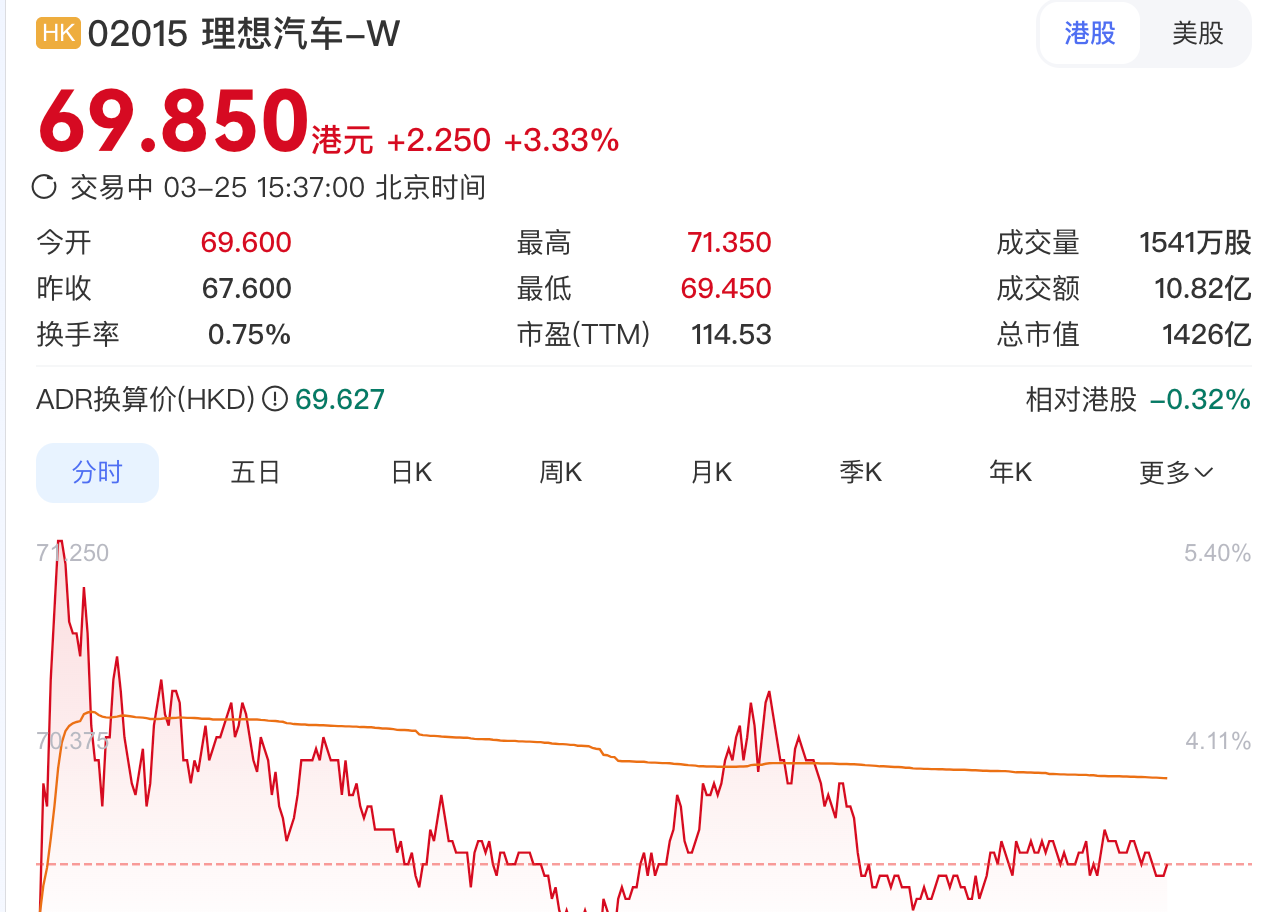
Image source: Baidu Stock
Li Auto noted that a general repurchase authorization was granted by the board at the annual general meeting on May 30, 2025. Li Xiang, Chairman and CEO, stated that the buyback plan reflects the company's firm confidence in its strategic roadmap and future value creation—ultimately benefiting the company and delivering value to shareholders.
While the industry remains fixated on computing power, sensor counts, and the speed of city-assisted driving rollouts, Li Auto is pushing to evolve smart EVs into embodied intelligence products—essentially building cars with the approach used for embodied intelligent robots.
The logic behind this shift is that Li Auto no longer views cars merely as extensions of transportation tools. Instead, it aims to equip them with a complete "perception-brain-body" architecture, allowing vehicles to understand and interact with the physical world like thinking robots. The upcoming new-generation Li Auto L9 Livis is the practical embodiment of this concept.
To achieve this, Li Auto is doubling down on R&D. Financial data shows R&D spending reached 11.3 billion yuan in 2025—a record high—with AI-related investments accounting for 50%. Over the past three years, the company has averaged 1 billion yuan in monthly R&D spending, a high-intensity investment focused on breakthroughs in core embodied intelligence technologies.
Gasgoo Take: The $1 billion buyback sends a clear signal to the market: have faith in Li Auto. With a cash reserve of 101.2 billion yuan, the company is well-positioned to fund the repurchase.
Report: Sony-Honda Joint Venture Considers Halting EV Development
Gasgoo News: Sony Group and Honda Motor are considering halting development of their jointly developed AFEELA electric vehicle, according to a March 25 report by Nikkei.
Honda, responsible for production at the Sony Honda Mobility joint venture, has adjusted its EV strategy, making it difficult for the collaborative project to proceed.
On March 12, Honda announced it would cancel three electric models planned for North America. Due to the strategic reassessment, the company expects to incur total costs and losses of 2.5 trillion yen ($157 billion). Honda now forecasts a net loss of 420 billion to 690 billion yen for fiscal 2025, a sharp reversal from its previous projection of a 300 billion yen net profit.
Sony Honda Mobility was established in 2022 with the goal of redefining the concept of the car, transforming travel time into an experience enriched with entertainment content like anime and video games.
However, losses have widened annually since its inception. On June 30 last year, the company disclosed that its annual operating loss for the fiscal year ending in March had doubled to 52 billion yen ($362 million), up from a loss of 20.5 billion yen the previous year.
At last year's CES, Sony Honda Mobility unveiled the AFEELA 1, the first model under the AFEELA brand. The vehicle comes in two configurations with a starting price of $89,900, including a three-year subscription to select features and services.
On January 2 this year, the company announced trial production of the AFEELA 1 had begun at Honda’s East Liberty Auto Plant in Ohio. Yet, specific timelines for mass production and delivery remain undisclosed. Honda’s strategic reassessment casts a shadow over the new model's market launch.
Gasgoo Take: The uncertainty surrounding AFEELA highlights the high cost of tech giants crossing into auto manufacturing—and reflects the brutal shakeout as the global EV market shifts from mania to rationality.
Automotive Revenue Tops 100 Billion Yuan! Xiaomi Group Releases 2025 Financial Report
On March 24, Xiaomi Group released its full-year financial report for 2025.
Total revenue for the year reached 457.3 billion yuan, up 25.0% year-over-year, while adjusted net profit surged 43.8% to 39.2 billion yuan. Revenue from innovative businesses, including smart electric vehicles and AI, jumped 223.8% to 106.1 billion yuan.
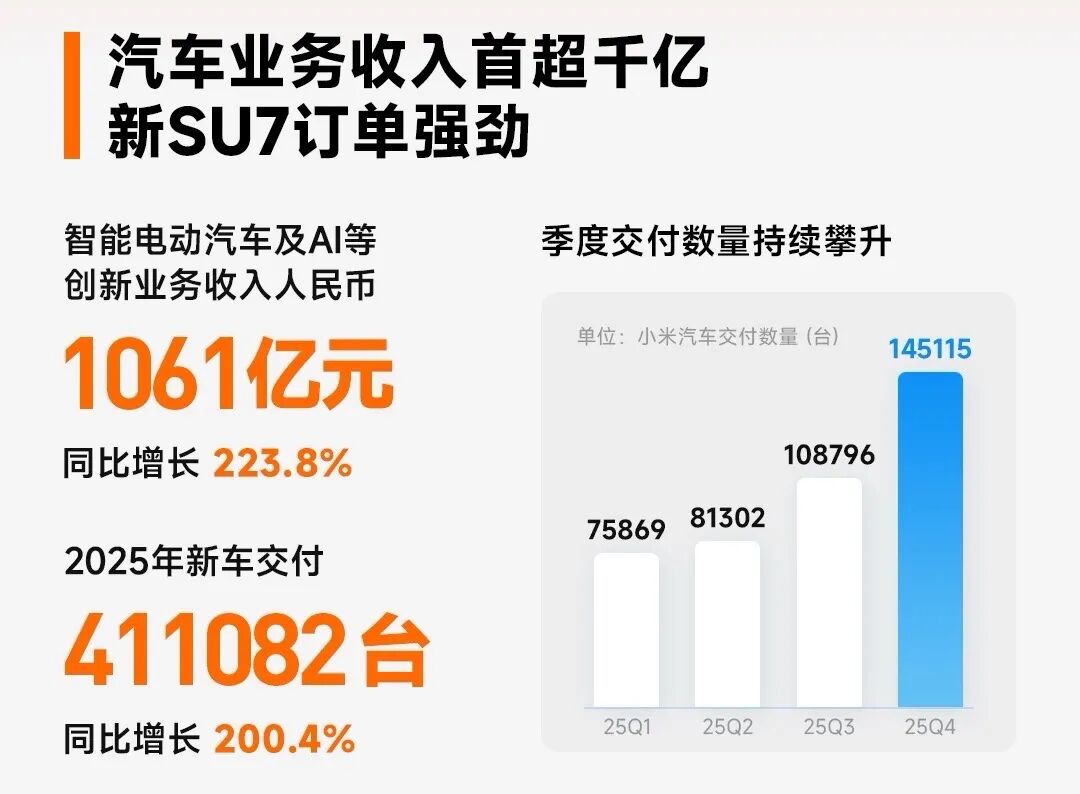
Image source: Xiaomi
New vehicle deliveries for 2025 totaled 411,082 units, a 200.4% annual increase. The Xiaomi SU7 claimed the top spot in sales for sedans priced above 200,000 yuan in China, while the Xiaomi YU7 led the mid-to-large SUV segment for seven consecutive months.
On the evening of March 19, Xiaomi EV launched the next-generation SU7. The new model comes in three versions: Standard at 219,900 yuan, Pro at 249,900 yuan, and Max at 303,900 yuan—representing a 4,000 yuan increase across the board compared to the first-generation SU7.
As Xiaomi EV’s first major update, the new SU7 features upgrades in powertrain, chassis, smart cockpit, and driver assistance. The vehicle retains its classic proportions—nearly 5 meters long, a 3-meter wheelbase, and nearly 2 meters wide. It offers nine exterior colors, five interior options, and six wheel designs, alongside a new intake grille and an added 4D millimeter-wave radar.
Lei Jun previously stated in a livestream that the delivery target for 2026 is 550,000 units. With orders for the new SU7 growing steadily, Xiaomi is well-positioned to hit that goal. Reports indicate strong demand: the new model secured over 15,000 locked orders within 34 minutes of launch and surpassed 30,000 within three days.
Gasgoo Take: Building on 100 billion yuan in revenue and over 400,000 annual deliveries, the next-generation SU7 will remain a key driver for Xiaomi EV’s 550,000-unit delivery target in 2026.
Strengthening Self-Reliance: Leapmotor Establishes Thermal Control Company
On March 27, Gasgoo learned via the Qichacha app that Zhejiang Linghao Thermal Control Co., Ltd. was recently established with a registered capital of 72 million yuan and Song Yining as legal representative. Its business scope covers the manufacturing of automotive parts and components, battery parts production, and sales of new energy vehicle electrical accessories.
Equity penetration data shows Zhejiang Linghao is wholly owned by Zhejiang Lingxiao Energy Technology Co., Ltd., a subsidiary of Leapmotor. This marks another significant move by Leapmotor into the core components sector.
Based on its business scope, Zhejiang Linghao focuses on thermal management systems—a critical technology for NEVs that directly impacts battery safety, range, and energy efficiency. As NEV penetration rates rise, the importance of thermal management is growing, driving increases in both technological content and value per vehicle.
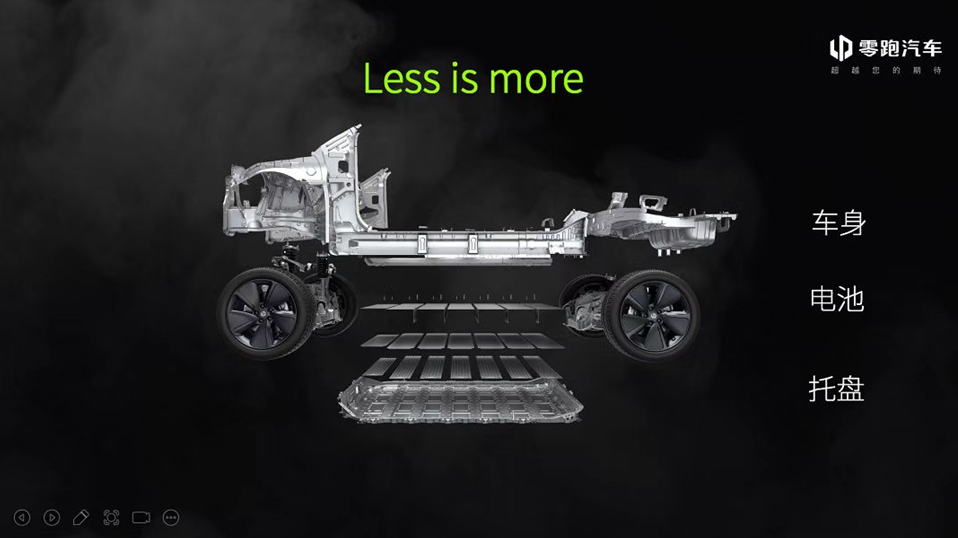
Image source: Leapmotor
At an industry level, competition has shifted from vehicle assembly capability to the vertical integration of core technologies. More automakers are choosing to build or control capacity for key components to mitigate supply chain risks and uncover cost optimizations amid a fierce price war. Leapmotor’s increased investment in thermal control is a microcosm of this trend.
The establishment of Zhejiang Linghao also sends a clear signal that Leapmotor is ramping up tech investment and refining its industrial layout. As a fast-growing NEV player, accelerating the localization of core components will help Leapmotor enhance product competitiveness and profitability as its sales volume expands. The new company’s technological progress in thermal management and its impact on Leapmotor’s vehicle performance are worth watching.
Gasgoo Take: The launch of Zhejiang Linghao will strengthen Leapmotor’s vehicle integration capabilities, reduce reliance on external supply chains, and give the company greater autonomy in cost control and technological iteration.


