



Gasgoo Munich- Early 2026 marked a milestone for the Beijing Innovation Center of Humanoid Robotics. Its pilot verification platform went live, rolling out the 1,000th customer-specific prototype on-site. Almost simultaneously, the center announced it had closed its first market-oriented funding round at over 700 million yuan. State and industry capital—including the Beijing AI Industry Investment Fund, E-Town Capital, Beijing Industrial Development and Investment Fund, and Baidu—all piled in.
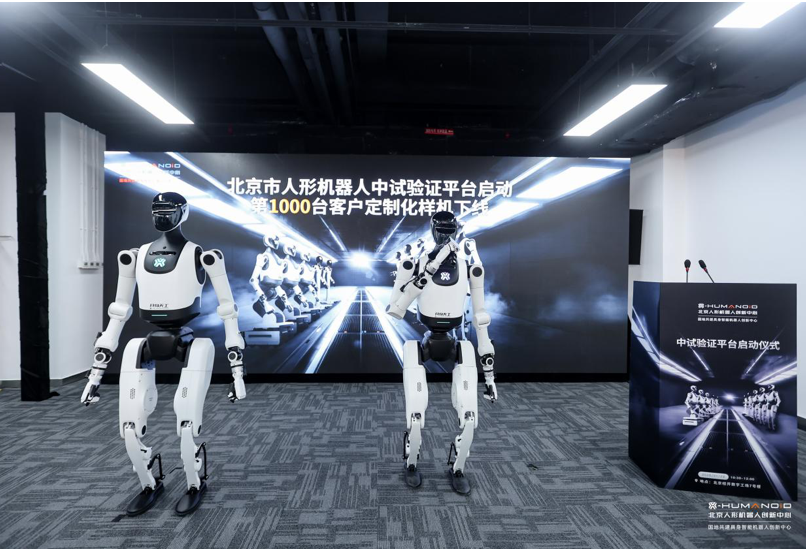 Image source: Beijing Innovation Center of Humanoid Robotics
This is no isolated incident. Since late 2023, China has ignited a "new infrastructure" race in embodied AI and humanoid robotics, driven by national and provincial innovation centers. Regions like Beijing, Shanghai, Zhejiang, Anhui, Guangdong, and Sichuan have opened over a dozen centers, pooling local resources to seize the high ground of industrial transformation. In 2025, "embodied AI" was written into the government work report for the first time, officially injecting state will into the contest.
Against this backdrop, a distinct map of China's embodied AI innovation has begun to take shape—one defined by "national dual-core leadership and the rise of key provincial clusters." How is this map constructed? What national strategic division of labor and local competitive logic lie behind it? Based on public information, this article provides a panoramic breakdown of this emerging industry's innovation landscape.
I. Core Map: An Innovation Network Where State and Local Intersect
To understand the current landscape, one must first see the full picture. The construction of China's embodied AI innovation system is far from disorderly; it presents a clear tiered structure. Two "national" innovation centers act as the top-level traction, while a batch of provincial centers focused on industrialization serve as the backbone, forming a network that connects specific points with a broader surface.
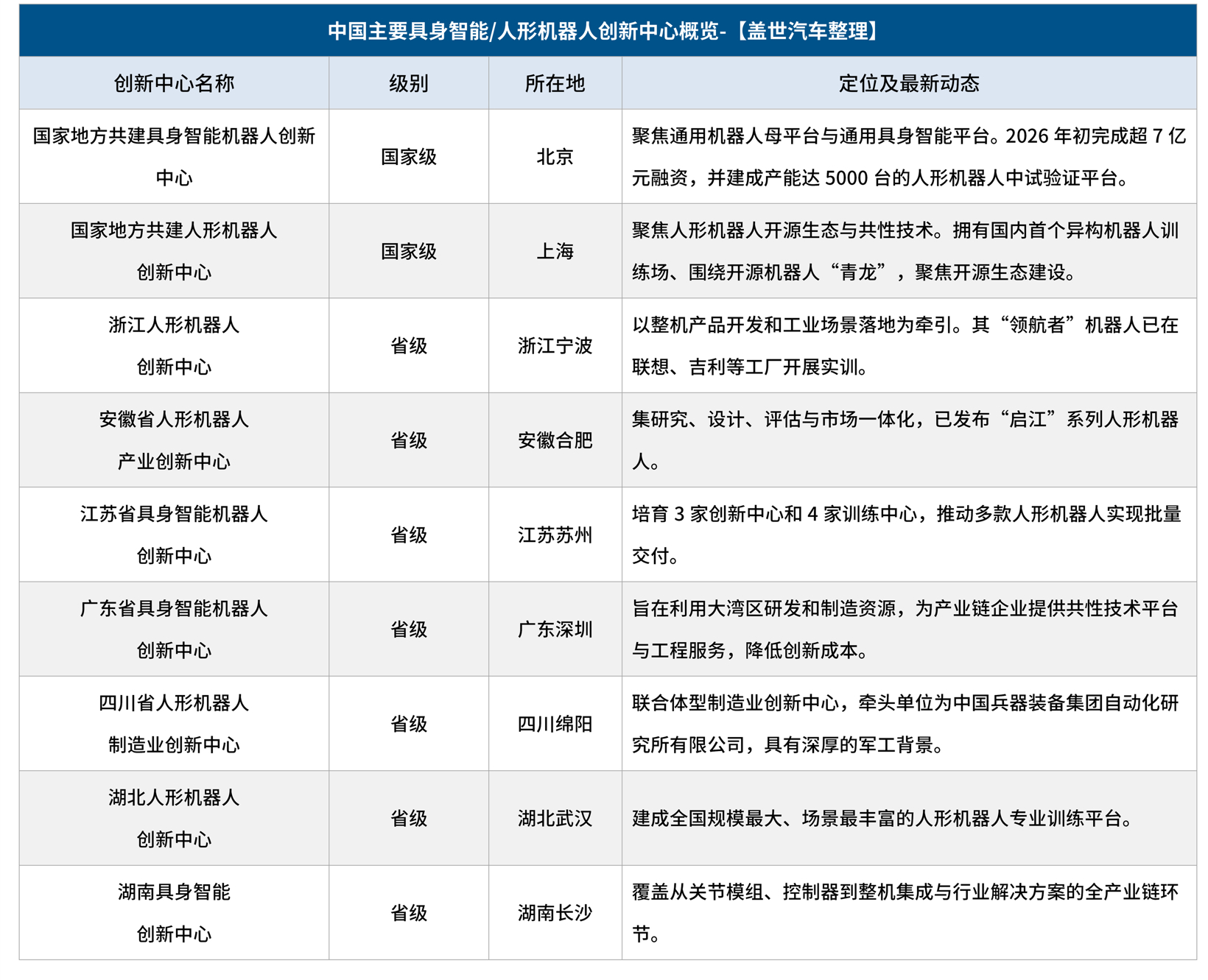
Image source: Gasgoo
Three distinct features emerge from this map. First, national intent is clear: Beijing and Shanghai, the two comprehensive national science centers, each have a piece, forming a top-level layout. Second, major economic and industrial provinces are competing to catch up; manufacturing heavyweights like Guangdong, Zhejiang, Jiangsu, and Anhui are all present. Third, the chosen paths rely heavily on local industrial foundations—a factor closely tied to the deeper logic analyzed below.
II. Top-Level Design: The "State-owned Force-Backed Team's" Dual-Core Division and Diverging Paths
The two national centers in Beijing and Shanghai offer the best window into national strategic intent. Despite similar names, they have displayed clear path divergence from their inception, representing the state's "double bet" on this frontier field.
Beijing: Tackling the "Brain and Cerebellum," Defining the Universal Intelligence Base
The Beijing center's core positioning is "key common technology R&D." Its mission is distilled into two specific platforms: the general robot mother platform "Tiangong" and the general embodied intelligence platform "Huisikaiwu." The naming itself reveals its strategic focus: building a "standard body" and a "unified brain" for intelligent robots.
● The "Tiangong" Platform: Aims to provide high-performance, redevelopable hardware master templates for various robots. The world's first full-size humanoid robot capable of running via pure electric drive was born here, reaching speeds of up to 12 km/h.
● The "Huisikaiwu" Platform: Composed of an AI large-model-driven task planning "brain" and a data-driven end-to-end skill execution "cerebellum," this open platform supports various robots interacting with the physical world. It pioneered the "one brain, multiple machines" mode, capable of simultaneously controlling robotic arms, wheeled robots, and humanoids. Its open-source Pelican-VL large model leads in multiple benchmarks, aiming to become the unified operating system for intelligent robots.
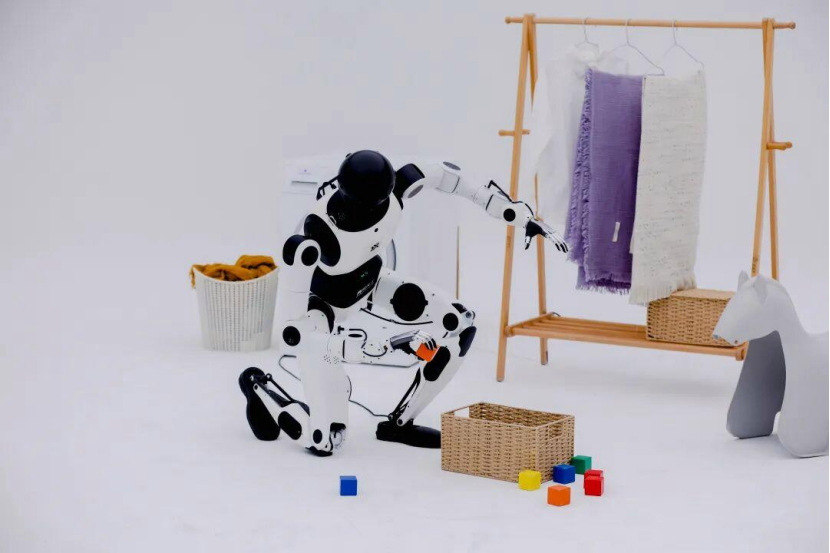
Image source: Beijing Innovation Center of Humanoid Robotics
Shanghai: Building an "Open Source Ecosystem," Accelerating Industrial Maturity, and Setting Standards
The Shanghai center points directly to "humanoid robot industrialization," dedicated to building an ecosystem that spans the innovation chain to the industrial chain. Its core logic is "open source" and "standards," aimed at lowering industry barriers and accelerating industrial maturity.
● Open Source Hardware and Community: Launched "Qinglong," China's first full-size open-source general humanoid robot public edition, and operates the OpenLoong open-source community to share technical resources.
● Standardization and Training Infrastructure: Spearheaded the country's first national-level standardization pilot for embodied intelligence and built "Qilin," the nation's first heterogeneous humanoid robot training ground. It can accommodate up to 100 robots training simultaneously, providing the "data fuel" for algorithm evolution.
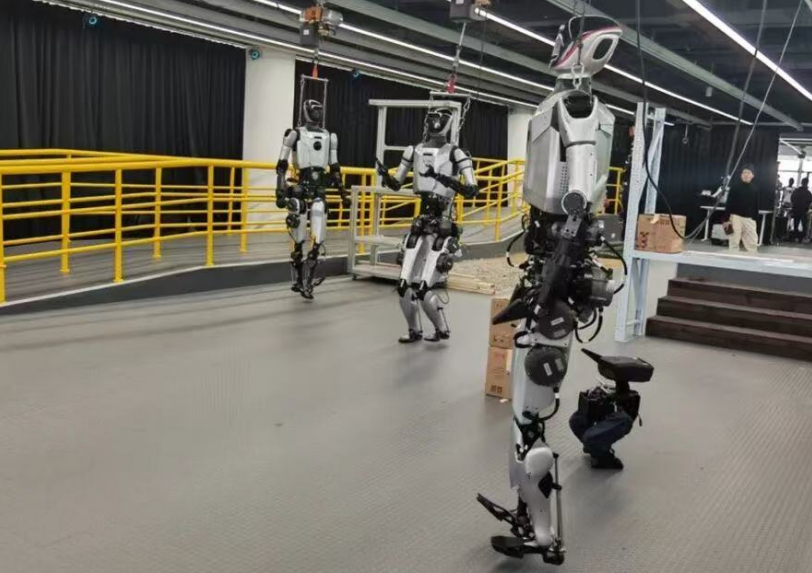 Image source: Shanghai Commission of Economy and Information Technology
Beijing's path can be summarized as "technology-driven, top-down," starting from the most foundational general platforms to pursue technical depth and unity. Shanghai's path is "ecosystem-driven, point-to-area," quickly gathering industrial forces through open source and standards to pursue breadth and speed of application. This is not competition, but complementary dual tracks laid by the state to lead future industries amid the high uncertainty of frontier technology.
III. Local Competition: Three Rise Modes Shaped by Industrial Genes
The national centers have outlined the blueprint, but the booming development of provincial innovation centers vividly illustrates how regions are transforming their "industrial genes" into competitive advantages on this new track. Three distinct models of emergence have taken shape.
The Yangtze River Delta Model: An Ecosystem Closed Loop Driven by Whole-Machine Development
Led by Shanghai, the Yangtze River Delta has formed the country's most complete collaborative innovation circle for humanoid robots. Its core feature is "driving downstream whole-machine development and scenario implementation with an upstream open-source ecosystem."
● Zhejiang: Plays the role of "vanguard application." Co-built by the Ningbo government and Professor Xiong Rong's team at Zhejiang University, its "Navigator" series of humanoid robots have entered factories like Lenovo and Geely for practical training. This tightly integrates academic frontiers with the needs of the region's developed private manufacturing sector.
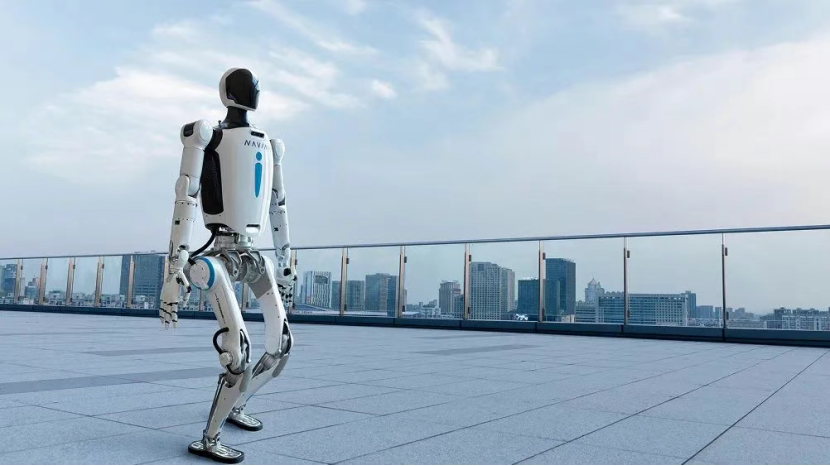 Image source: Zhejiang Humanoid Robot Innovation Center
● Anhui: Embodies the linkage between "frontier research and vehicle manufacturing." Led by JAC, the University of Science and Technology of China (USTC), and iFlytek, it released the "Qijiang" series of humanoid robots. Here, robotics are viewed as an extension of the next generation of smart vehicles.
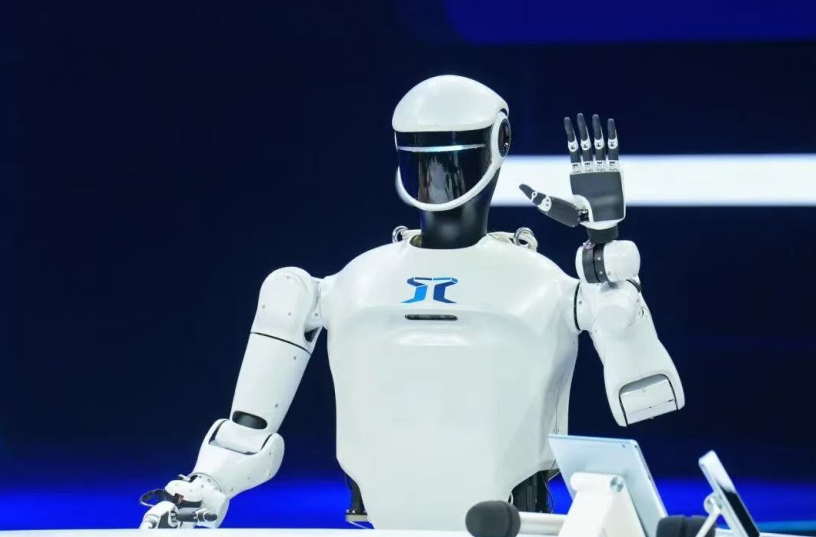 Image source: JAC Frontier Technology Collaborative Innovation Center
● Jiangsu: Demonstrates the characteristics of "systematic layout at the provincial level." In late 2025, the "Jiangsu Embodied Intelligence Robot Innovation Center" was officially inaugurated to coordinate efforts across the province. Plans are in place to cultivate three innovation centers and four training centers, driving multiple humanoid robots toward batch delivery.
The Pearl River Delta Model: Agile Innovation Pushed by Scenarios
Guangdong's innovation practice is highly pragmatic, presenting a typical style of "market traction and rapid iteration."
● The Guangdong Embodied Intelligence Robot Innovation Center explicitly states its goal is to solve the "one increase, one decrease" problem for enterprises: increasing order opportunities while reducing innovation and trial costs. Leveraging the Greater Bay Area's unparalleled electronic manufacturing and supply chain capabilities, it provides companies with small-batch, customized processing and engineering services. This essentially replicates the agile model of the consumer electronics sector within the robotics industry.
The Central-Western Model: Differentiated Paths Relying on Local Dominant Industries
Represented by Sichuan, Hubei, and Hunan, central and western provinces are not competing head-on with coastal regions in consumer-level scenarios. Instead, they rely on local industries and scientific resources to focus on advantageous scenarios and ecosystems, achieving a differentiated rise.
● Sichuan: Fully leverages its military manufacturing heritage. Led by the Automation Research Institute of China South Industries Group Corporation, it has formed a "union-type" innovation entity with upstream and downstream partners. The aim is to conquer full-chain key technologies—from the "body" and "cerebellum" to the "brain"—and promote the early deployment of humanoid robots in specialized scenarios and manufacturing fields.
● Hubei: Built the country's largest and most scenario-rich professional training platform for humanoid robots. Covering 12,000 square meters, it features 23 high-fidelity scenarios and an annual data collection capacity exceeding 1 million entries.
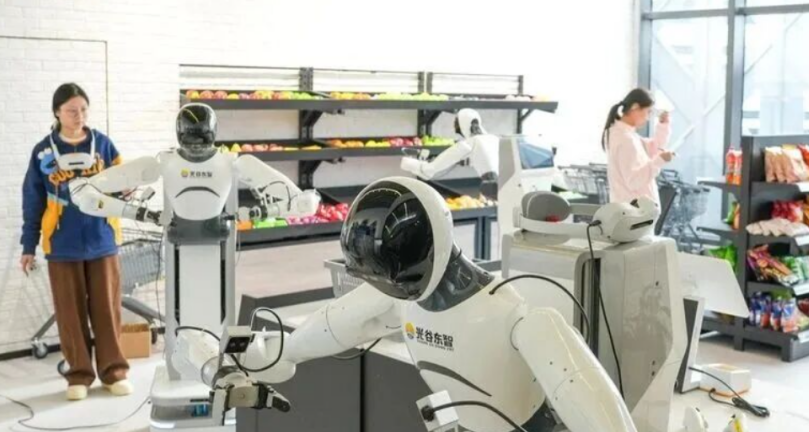
Image source: Hubei Humanoid Robot Innovation Center
● Hunan: Jointly operated by local manufacturing giants such as Lens Technology. The first phase deployed over 120 robots and gathered nearly 30 ecosystem companies, covering the entire industrial chain from joint modules and controllers to whole-machine integration and industry solutions.
IV. Future Outlook: Evolution from "Inaugurations" to "Ecosystem Co-opetition"
The first round of local layout, characterized by "inaugurations," is drawing to a close. The innovation map is shifting from a physical distribution of "points" to a "web" of resource and ecosystem connections. Over the next two to three years, the landscape will be reshaped by three key variables:
● Convergence and divergence of technical routes: The competition between different technical approaches—such as end-to-end versus hierarchical decision-making, or dexterous hand linkage/gear drives versus tendon drives—will become increasingly clear. Once a mainstream path forms, it will profoundly alter the technical weight of each center.
● The battle for "industrial commons": Competition for future discourse power will increasingly focus on "industrial commons"—specifically standards, open-source protocols, and high-quality training data. Shanghai's push for standardization and open-source ecosystems, alongside the large-scale training grounds and datasets being built in Beijing, Shanghai, Jiangsu, and Hubei, are all moves to seize this future high ground. We may soon see alliances forming around distinct technology ecosystems.
● The variable entry of cross-border giants: Baidu's strategic investment in the Beijing Innovation Center of Humanoid Robotics sends a clear signal. Cross-border giants like Huawei, BYD, and Midea possess massive underlying technology, manufacturing capacity, and market channels. Their choices in technical routes and ecosystem alliances hold the potential to alter local or even global patterns.
China's embodied AI innovation map is a grand practice driven by local industrial genes under a national strategic blueprint. The "dual cores" of Beijing and Shanghai have laid two cornerstones—technology and ecosystem—for the nation. Meanwhile, the "clusters" in the Yangtze River Delta, Pearl River Delta, and Central-West regions are exploring differentiated paths for industrial application through diverse models. This newly drawn map is far from solidified. The forces of technological breakthrough, capital flows, and ecosystem aggregation will continue to drive its dramatic evolution. The only certainty is that this competition, with innovation centers as pivots, will profoundly define China's ultimate position in the new global wave of AI and robotics.


