Gasgoo Munich- Data from Gasgoo Automotive Research Institute shows that in February 2026, new energy vehicles (NEVs) and internal combustion engine (ICE) models continued their parallel trajectories in the passenger car market. Driven by star products, NEVs maintained high volume: the Geely Galaxy Star Wish and Tesla Model Y both surpassed 30,000 sales, while BYD’s multi-model matrix kept up the pressure. Meanwhile, demand for ICE vehicles remained stable, with the Chery Tiggo 7/7Plus claiming the top spot. Domestic brands dominated through SUV and sedan lineups, while joint-venture classics retained a solid foothold. Together, these two powertrains form the core landscape of China’s passenger car market, catering to diverse consumer needs and usage scenarios.
Feb 2026 Fuel-Powered Passenger Vehicle Sales Chart
First place, Chery Tiggo 7/7Plus, February sales 18,303 units
Second place, Volkswagen Lavida, February sales 16,135 units
Third place, Geely Binyue/Binyue Pro, February sales 15,439 units
Fourth place, Chery Explore 06, February sales 15,370 units
Fifth place, Chery Omoda, February sales 14,557 units
Sixth place, Geely Boyue L, February sales 14,484 units
Seventh place, Geely Emgrand, February sales 14,255 units
Eighth place, Volkswagen Tiguan L, February sales 13,313 units
Ninth place, Geely Xingrui, February sales 13,150 units
Tenth place, Chery Tiggo 5X, February sales 12,750 units
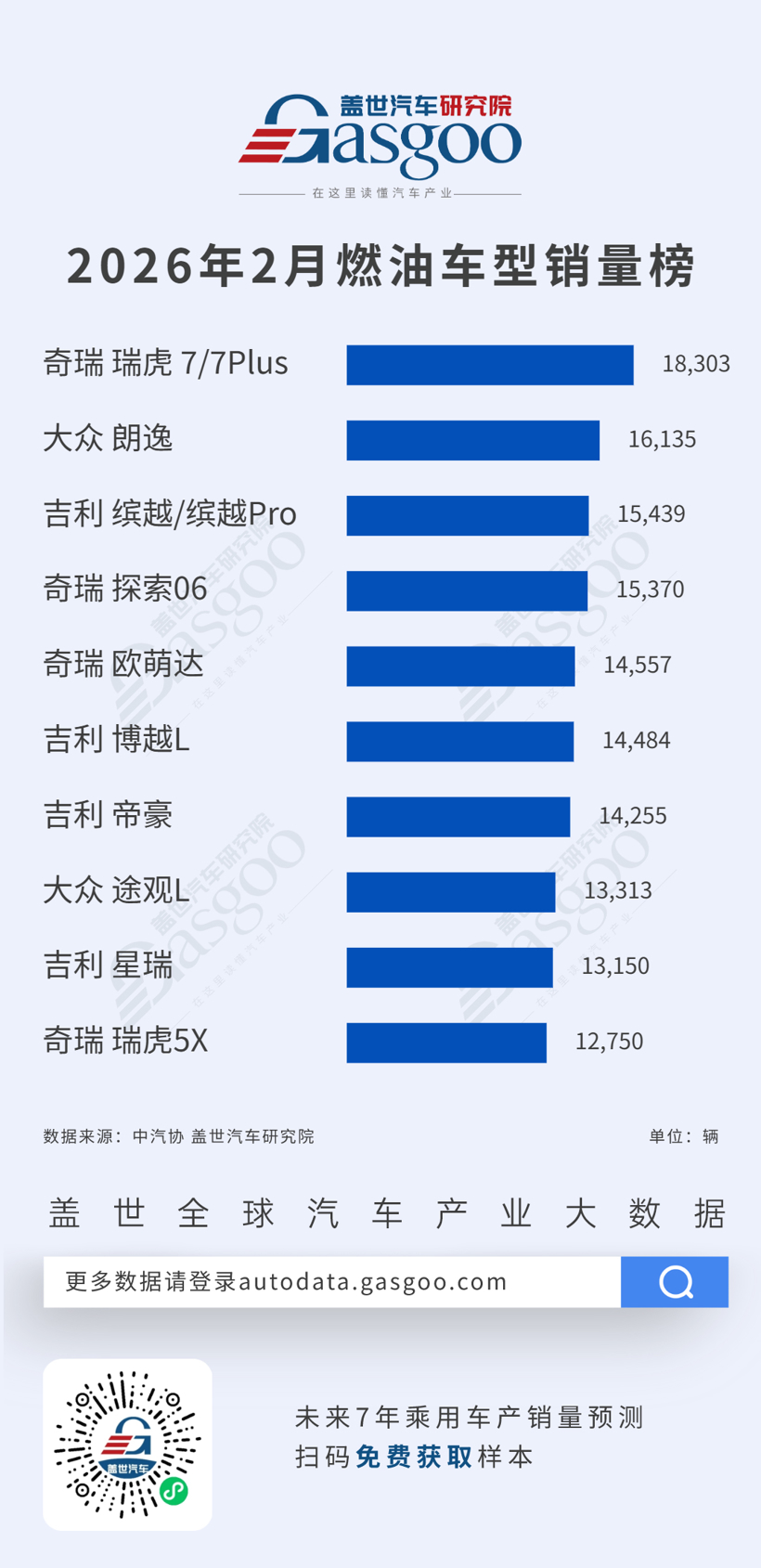
In the February 2026 fuel-powered vehicle rankings, Chery’s Tiggo 7/7Plus claimed the top spot with 18,303 units sold, followed by Volkswagen’s Lavida at 16,135 and Geely’s Binyue/Binyue Pro at 15,439. Chery’s Explore 06 rounded out the top five with 15,370 deliveries. Overall, sales among the frontrunners held steady in the 12,000 to 18,000 range, underscoring enduring demand in specific segments. Meanwhile, models like the Chery Omoda, Geely Boyue L, Emgrand, Xingrui, and Tiggo 5X secured top-ten positions, spanning both SUV and sedan categories.
The list highlights a market dominated by domestic players. Chery fielded four entries—the Tiggo 7/7Plus, Explore 06, Omoda, and Tiggo 5X—creating an SUV matrix across various price points. Geely matched this with four models of its own—the Binyue/Binyue Pro, Boyue L, Emgrand, and Xingrui—achieving a comprehensive layout covering both sedans and SUVs. Notably, Volkswagen’s Lavida and Tiguan L maintained a strong foundation for joint ventures, demonstrating the lasting appeal of traditional combustion engines among certain consumer groups.
Despite the steady encroachment of new energy vehicles, the combustion market retains significant scale and stable demand. Domestic brands are expanding their share in SUV and sedan niches through upgraded product offerings and competitive pricing. Simultaneously, joint ventures are holding their ground in legacy segments by leveraging mature platforms and hard-earned reputations. Looking ahead, as hybrid technology further integrates with traditional powertrains, competition in the fuel sector will likely intensify around overall value proposition and user experience.
Feb 2026 New Energy Passenger Vehicle Sales Chart
First place, Geely Galaxy Star Wish, February sales 37,859 units
Second place, Tesla Model Y, February sales 31,624 units
Third place, Xiaomi YU7, February sales 20,196 units
Fourth place, BYD Seagull, February sales 20,190 units
Fifth place, Tesla Model 3, February sales 17,195 units
Sixth place, BYD Song Pro, February sales 16,456 units
Seventh place, Li Auto i6, February sales 16,007 units
Eighth place, BYD Qin L, February sales 13,350 units
Ninth place, BYD Qin Plus, February sales 12,700 units
Tenth place, BYD Seal 06, February sales 12,448 units
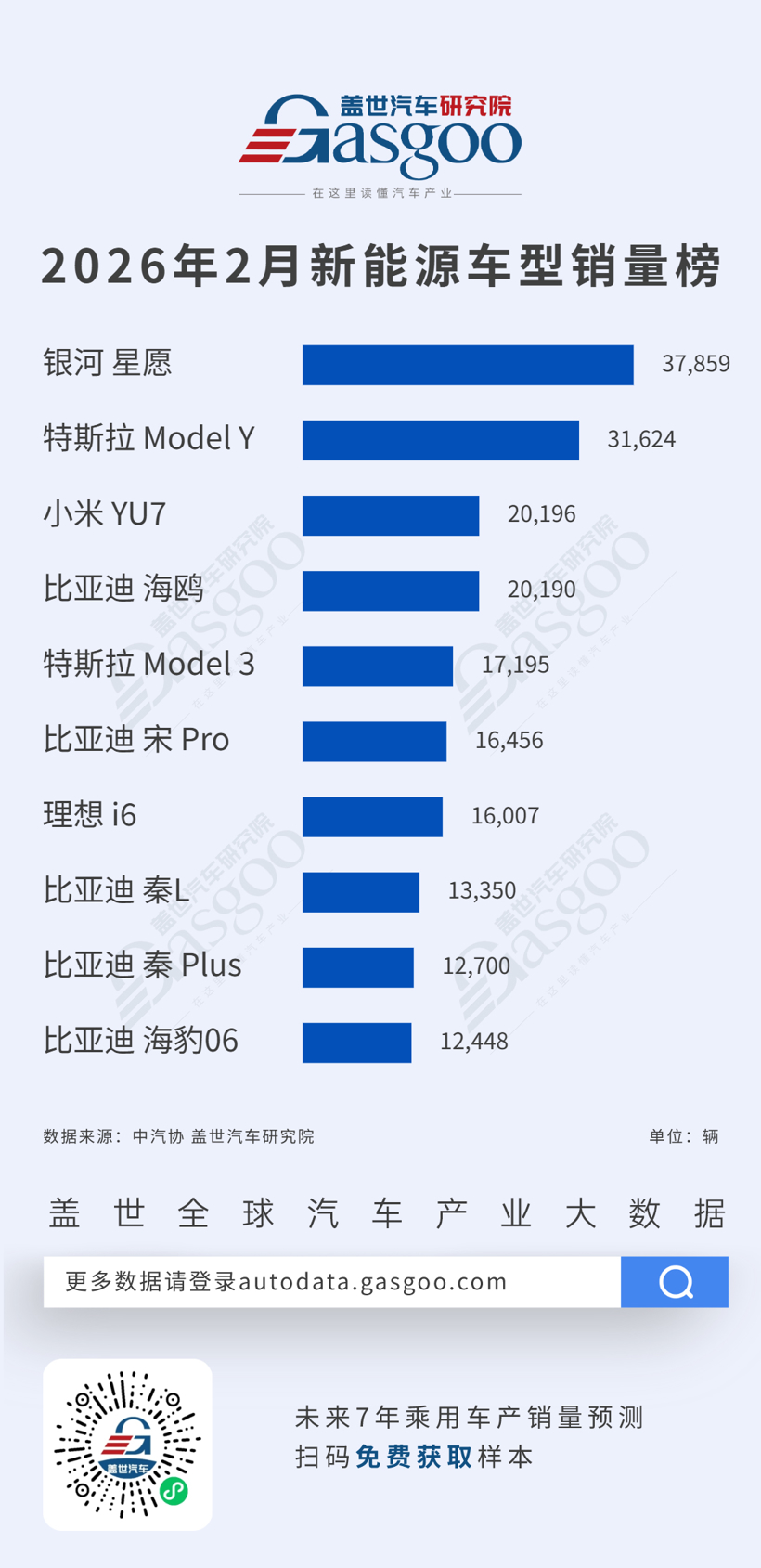
In the NEV rankings for February 2026, Geely’s Galaxy Star Wish led the pack with 37,859 units, followed by Tesla’s Model Y at 31,624. Both models surpassed the 30,000 mark, continuing to set the pace for the sector. Xiaomi’s YU7 and BYD’s Seagull took third and fourth place with 20,196 and 20,190 sales respectively—a gap so narrow it highlights the intensity of the rivalry. Overall, a clear hierarchy is emerging among the top contenders, even as the market fragments across diverse segments.
Breaking down the lineup, Tesla’s Model 3 secured fifth place with 17,195 deliveries. BYD demonstrated its matrix effect with four models—Song Pro, Qin L, Qin Plus, and Seal 06—cracking the top ten. Meanwhile, Li Auto’s i6 entered the list with 16,007 units sold, reflecting vigorous competition across sedans, SUVs, and various price brackets within the new energy space.
The broader picture suggests a shift away from relying on a single blockbuster toward multi-product synergy. Domestic brands like Geely Galaxy and BYD are steadily increasing market share through comprehensive product lineups, while Tesla maintains its strong pull with star models like the Model Y and Model 3. New entrants like Xiaomi are also rapidly capturing share by carving out differentiated positions. As NEV penetration continues to rise, overall product competitiveness and brand ecosystem building are becoming the decisive factors for sales success.