



The battle for power batteries is heating up as 2026 gets underway.
NIO recently signed a cooperation agreement with the Anting Town People's Government in Shanghai's Jiading District, officially landing a new battery R&D base in the area. Just prior, NIO Battery Technology (Shanghai) Co., Ltd. completed its business registration with 100 million yuan in capital, naming Zeng Shizhe—the company's vice president of battery systems—as its legal representative.
This marks NIO's second independent battery entity. Following the October 2022 launch of NIO Battery Technology (Anhui) Co., Ltd.—capitalized at 2 billion yuan and focused on manufacturing—the company is now expanding. From Anhui to Shanghai, and from production to R&D, NIO is executing a strategic pincer movement around the electric vehicle's "heart."
Across the wider industry, a technological revolution in power batteries is quietly gathering pace.
Why Carmakers Are Racing to Build Batteries
The competition in new energy vehicles boils down to core technology. And the battery is the heart of the machine.
The power battery sector has weathered two profound shifts in recent years. The first was a race for capacity, where leaders like CATL and BYD erected cost barriers through sheer scale. The second is technological iteration—moving from lithium iron phosphate to ternary lithium, and from liquid to semi-solid chemistries—continuously pushing energy density and safety higher.
For automakers, relying solely on external suppliers is becoming increasingly precarious. Consequently, major players are doubling down on in-house battery development.
BYD's Blade Battery, GAC's Magazine Battery, and Great Wall's SVOLT are all markers of this trend. NIO, however, is taking a more radical approach—building a complete closed loop that spans everything from cell research and pack integration to material innovation and recycling.
NIO's battery strategy didn't happen overnight.

Image Source: NIO
As far back as NIO Day 2021, the company unveiled a 150 kWh solid-state battery pack, claiming an energy density of 360 Wh/kg and a range exceeding 1,000 kilometers. At the time, many dismissed it as hype—commercializing solid-state batteries is notoriously difficult, with materials, processes, and costs posing formidable obstacles.
Yet NIO pressed on.
By December 31, 2025, NIO held 1,382 battery-related patents covering materials, cells, systems, software, and cloud strategy—spanning cell design, pack integration, thermal management, and recycling. Zeng's personal leadership of the Shanghai battery unit underscores the business's central role within the group.
The newly signed Jiading R&D base will focus on next-generation power batteries, bolstering technological autonomy. It complements the Anhui unit's manufacturing mandate, formally establishing a "Shanghai R&D plus Anhui Manufacturing" dual-platform structure.
Analysts suggest several reasons behind NIO's decision to spin off its battery business: sharper technological focus, as rapid iteration demands sustained capital and talent that independent operations can better concentrate; cost and efficiency, with potential to sell technology and products to other automakers, creating new revenue streams; and strategic security, as holding core technology internally helps buffer against supply chain volatility.
Betting on the Next Generation: NIO's Solid-State Play
Solid-state batteries are widely regarded as the "ultimate battery" for electric vehicles. They target energy densities of 400–600 Wh/kg—1.5 to 2 times that of traditional lithium-ion units—along with 5–10 minute charging times to 80% that rival refueling, and thermal runaway thresholds exceeding 200°C to eliminate safety concerns.
The industry has marked 2026 as year one for solid-state mass production.
Dongfeng Motor plans to install semi-solid batteries by September 2026, offering 350 Wh/kg density and 1,000 km range. Chery's Exeed brand has announced a 2026 debut for all-solid-state batteries capable of 500 km range in just five minutes. SAIC's IM L6, featuring semi-solid batteries with 368 Wh/kg density, is set for delivery in the second quarter of 2026. GAC, Geely, and FAW have also revealed their progress.
NIO's roadmap is equally distinct.
A company representative told media that NIO is leveraging Shanghai's R&D strengths to accelerate solid-state development, with expectations for scaled application of the technology after 2027.
Notably, NIO has already achieved seamless integration of semi-solid batteries across its entire family of swap stations, making it the first global automaker to deploy solid-state battery swapping at scale. This means that as the technology matures, NIO owners could be among the first to experience it—using the swap network to exchange solid-state batteries instantly, just like conventional ones, without waiting to charge.
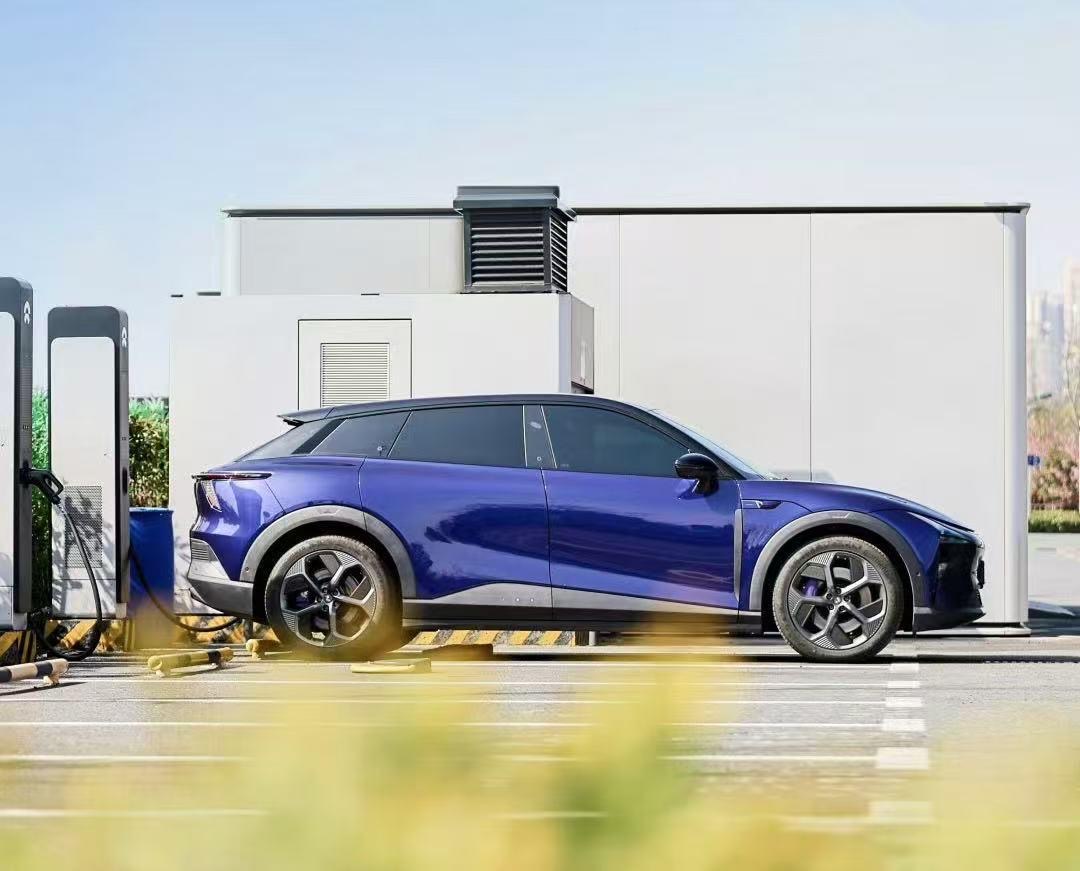
Image Source: NIO
From battery swapping to self-developed chips, and from battery manufacturing to solid-state R&D, NIO is transforming investments once criticized as cash-burners into technological barriers that rivals will struggle to replicate.
Data shows NIO's cumulative R&D spending has exceeded 60 billion yuan, funding an independent development system spanning batteries, electric drive, smart systems, intelligent chassis domain controllers, and swapping technology. As of March 2026, the company holds nearly 10,000 granted and pending patents.
Underlying these figures is NIO's obsession with the electric vehicle's heart.
While the industry still debates the merits of liquid versus solid batteries, NIO has already used real capital to secure its position on the next-generation track.
The power battery market of 2026 is shaping up as a transition between the old guard and the new. Automakers that master core technologies first will seize the initiative. For NIO, the strategic encirclement of the EV heart—moving from "collaborative R&D" to "autonomous control" and linking "Anhui manufacturing" with "Shanghai R&D"—is just entering its harvest phase.


