On December 31, 2025, with New Year’s Eve festivities barely underway, the tech world was already lit up by a launch event.
Peng Zhihui, chairman of Shangwei New Materials — known to 2.8 million Bilibili fans as "Zhihuijun" — unveiled Qiyuan Q1, billed as the world’s first small-size humanoid robot with full-body force control, and introduced the "Shangwei Qiyuan" brand to enter the personal-robot arena.
Standing 0.8 meters tall, small enough to slip into a backpack, it executes dance moves and precision grabs. For everyday consumers, this isn’t just a product debut; it’s a pivotal test of a tech influencer’s leap into entrepreneurship.
From Huawei "Genius Youth" to Bilibili star to listed-company chairman, what’s the logic behind Zhihuijun’s three-step rise? And can a "scientist + influencer" model help personal robots break out of the niche?
From creator to chairman: Peng Zhihui’s "hardcore DNA" is embedded in the product
Before decoding Qiyuan Q1, it helps to read Peng. This 1990s-born technologist has always moved around two watchwords: hardcore engineering and mass communication.
In 2017, "Zhihuijun" posted his first video on Bilibili — modular keyboards and mini TVs — drawing early fans with everyday inventions. In 2021, a self-driving bicycle sent him viral: after slipping on a rainy day, he spent four months building a bike with self-balancing, path planning, object recognition and avoidance; the video drew nearly 5 million views.
The six-axis robotic arm that followed impressed even more, precise enough to "stitch" a grape — cementing his "wild Iron Man" nickname.
In 2020, he joined Huawei’s "Genius Youth" program after seven rounds of interviews, with an annual salary of more than 2 million yuan; he left in late 2022 to start a business, founded Zhiyuan Robotics in 2023; by July 2025, Zhiyuan moved to acquire Shangwei New Materials, and in November he was elected chairman — completing the shift from creator to corporate helmsman.
The arc looks wide, but the core idea holds steady: take advanced tech out of labs and into everyday life. Qiyuan Q1 is that idea, distilled.
Look closely at Qiyuan Q1 and Peng’s fingerprints are everywhere.
The main breakthrough is an egg-sized QDD (quasi-direct-drive) joint that squeezes full-size force-control performance into a tiny package — making it, by the company’s claim, the first small humanoid with full-body force control. That "miniaturized + high-performance" mindset echoes his early DIY ethos: high functionality at low cost.
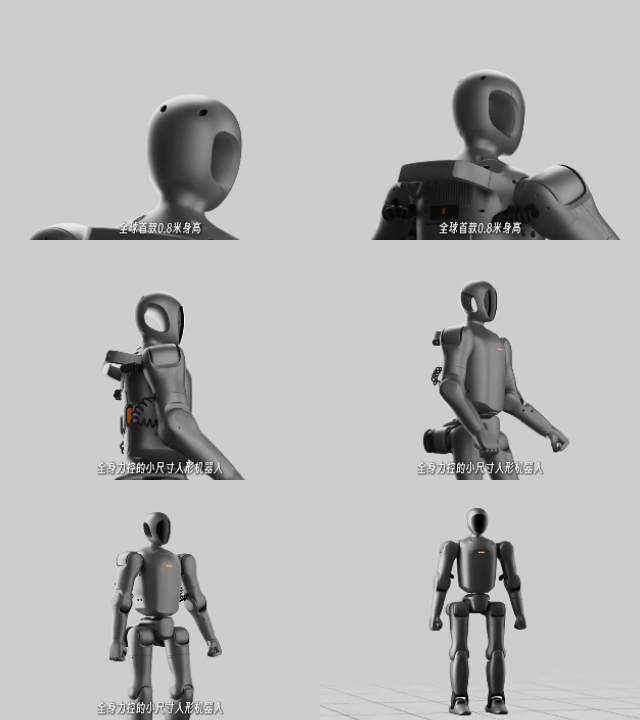
Image source: Shangwei Qiyuan
Equally distinctive is its rugged, "built to be dropped" design. It may seem counterintuitive, but it squarely addresses creators’ pain point: debugging invites mistakes, and durability lowers trial-and-error costs.
Open-source SDK/HDK strengthens that creator DNA. Peng’s videos have long stressed "technology you can replicate." Qiyuan Q1 opens the software development kit and hardware docs, and even supports 3D-printed custom shells.
The monetization power of personal IP shows through. Notably, Shangwei New Materials surged 1,821% in 2025, the biggest gainer among A-shares.
Qiyuan Q1’s "hardcore" credentials also rest on Shangwei New Materials’ strengths.
As a traditional composites player, Shangwei’s process know-how helps Qiyuan Q1 cut weight and boost durability at small size. That "traditional materials + frontier robotics" synergy is likely central to Peng’s choice of partner.
The user’s question: How close is a 0.8-meter robot to daily life?
Hype reels aside, consumers care about two things: What can a 0.8-meter robot actually do? And can people who don’t code use it? Those answers will determine whether Qiyuan Q1 is a tech novelty or a day-to-day device.
Humanoids are touted as the next productivity platform, drawing in giants from Tesla to Xiaomi. Even so, the personal consumer market remains largely untapped.
Compared with full-size robots like Tesla’s Optimus and Boston Dynamics’ Atlas, a 0.8-meter form factor suits homes, desks and indoor spaces — especially when weight drops and the hardware can survive falls, cutting experimentation costs.
The three official use cases — research and teaching, maker-style creation and home interaction — aim to address the twin hurdles of full-size humanoids: price tags that can run to hundreds of thousands of yuan and constrained lab environments, while meeting the core needs of consumer robots today.
This track aligns with Peng’s philosophy: real technological progress should be not only seen, but experienced. Personal robots make that tangible, bringing advanced tech out of labs and into everyday life.
The timing looks right. 2025 is widely viewed as year one for scaled humanoid production. Zhiyuan Robotics has booked more than 1 billion yuan in orders from clients including China Mobile Information, Fulin Seiko and Longcheer Technology, with deliveries climbing severalfold year on year — laying groundwork for the personal-robot market.
Ecosystem building is the deeper play. Through "co-creation," Qiyuan Q1 lets users make content and even mod the look — boosting stickiness and keeping the brand in conversation. Peng is, in effect, betting on an Android-style path: open source to accelerate innovation and adoption.
Still, personal robots are early, and Qiyuan Q1 faces challenges. Consumer bots commonly struggle with limited functions and stiff interactions. Whether Qiyuan Q1 can break through those bottlenecks will be for the market to judge.
As Zhihuijun said at the launch: "Real technological progress should be not only seen, but experienced."
Closing remarks:
From Bilibili’s "wild Iron Man" to a personal-robot trailblazer, Peng Zhihui and Qiyuan Q1 mark the meeting of tech ideals and everyday needs. It may not be a market disruptor, but an open-source stance and accessible positioning bring science fiction closer to daily life. As technology sheds its aloof veneer and innovation anchors in real demand, personal robots gain a clearer path to the mainstream.