



On January 7, GAC International and Grab, Southeast Asia's leading super-app platform, announced they had formed a comprehensive strategic partnership.
The tie-up is not only a major commercial agreement, but also a key milestone as GAC Group advances its "Tech GAC, ecosystem going global" blueprint — marking a shift on its internationalization path from exporting standalone products to building an integrated overseas ecosystem of "products + services + data."
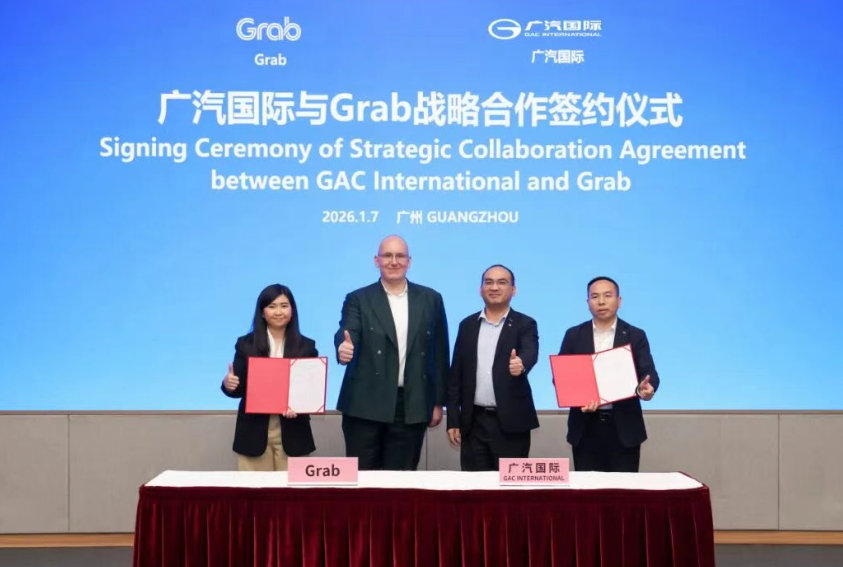
Photo: GAC
Under the plan, the partners will leverage their core strengths — in new-energy vehicle (NEV) R&D and manufacturing on GAC's side, and in localized mobility services on Grab's — pooling resources and co-innovating.
GAC International will supply high-performance, intelligent electric vehicles, while Grab, drawing on its large user base, extensive service network and deep market insight, will work with GAC to shape green mobility solutions tailored to Southeast Asia.
The two sides set an ambitious market goal: over the next two years, they aim to jointly promote 20,000 GAC high-performance EVs across six key Southeast Asian countries.
The concrete target is designed to materially accelerate the region's transition to greener mobility, giving local consumers cleaner, smarter travel options.
The collaboration goes far beyond traditional car sales. It fuses GAC's cutting-edge intelligent EV technologies with Grab's super-app, digital services and operational capabilities to build a full-lifecycle ecosystem spanning vehicle sales, charging services, aftersales maintenance, data value mining and exploration of innovative mobility models.
Analysts say Southeast Asia is rapidly becoming a hotspot for global NEV expansion. The GAC International–Grab alliance aims to seize the region's shift toward electrification and intelligent mobility — a case of Chinese auto brands moving from simply "going abroad" to embedding locally and co-building ecosystems.
The strategic coordination between the two is expected to accelerate the build-out of a green, smart mobility ecosystem in Southeast Asia, while offering a fresh reference for cross-industry integration and innovation in the global auto sector.


