From the regional split of Chinese independent automakers' passenger vehicle exports in November 2025, leading groups are taking sharply different globalization paths. BYD, Geely Holding and Chery Holding all sit in the first tier of exporters, yet they diverge on core market choices, regional concentration and growth logic: some are breaking into high-barrier markets such as North America and Europe, others are digging deeper into traditional strongholds like the CIS and the Middle East, while a few are leveraging a single "super market" to pull multiple regions higher in tandem. Those differences are sketching out three distinct tempos and strategic leanings in their march overseas.
According to the Gasgoo Auto Research Institute export database, BYD's passenger vehicle export regional ranking for November 2025 is as follows:
No. 1 North America: In November, BYD exported 34,618 vehicles to the region.
No. 2 EU + UK + EFTA: In November, BYD exported 22,630 vehicles to the region.
No. 3 Southeast Asia: In November, BYD exported 20,921 vehicles to the region.
No. 4 Middle East: In November, BYD exported 17,084 vehicles to the region.
No. 5 Central & South America: In November, BYD exported 14,561 vehicles to the region.
No. 6 CIS: In November, BYD exported 10,776 vehicles to the region.
No. 7 Oceania: In November, BYD exported 4,301 vehicles to the region.
No. 8 Other Asia: In November, BYD exported 4,038 vehicles to the region.
No. 9 Africa: In November, BYD exported 2,198 vehicles to the region.
No. 10 Other Europe: In November, BYD exported 428 vehicles to the region.
No. 11 South Caucasus: In November, BYD exported 52 vehicles to the region.
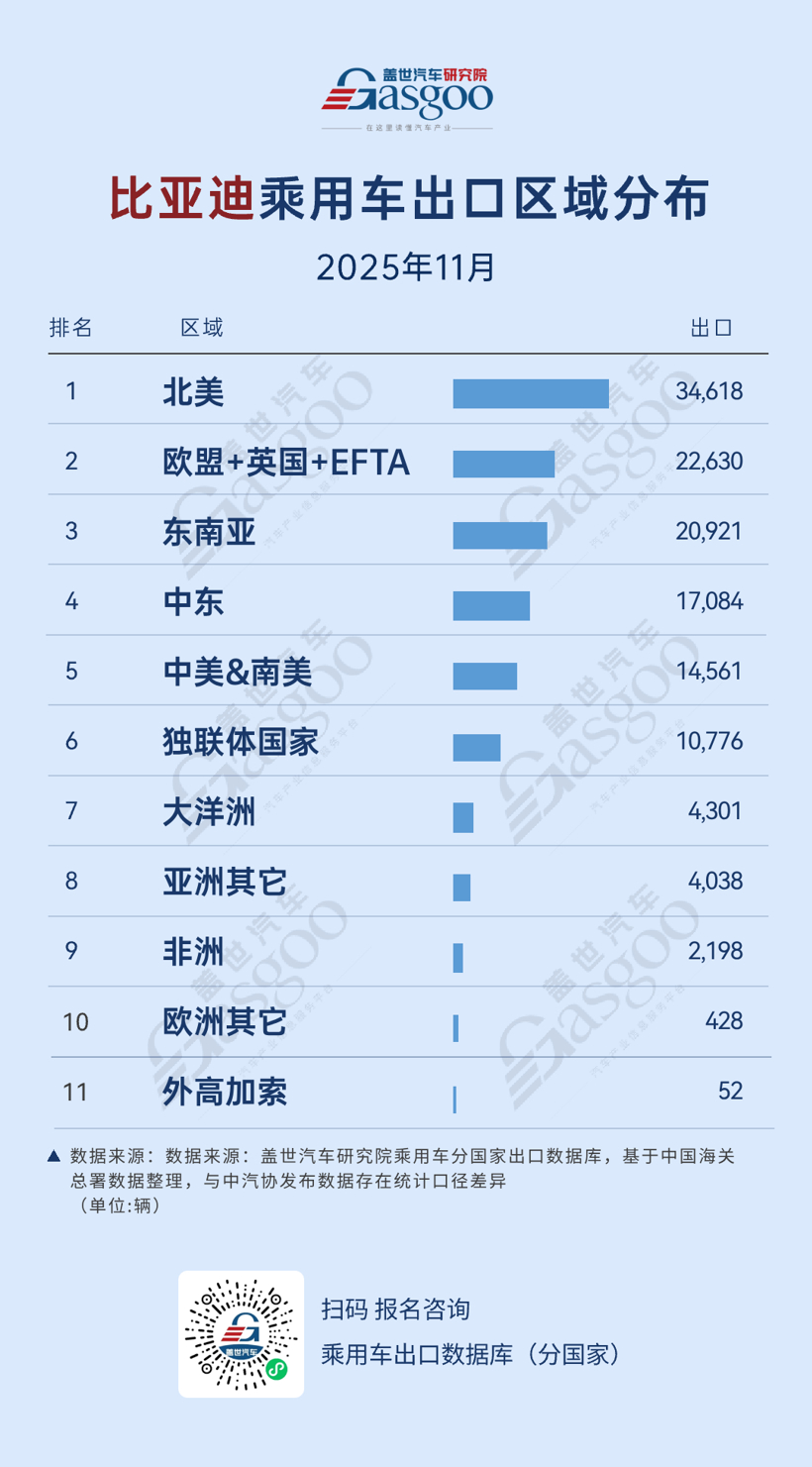
In November 2025, North America emerged as BYD's largest export market by region. Shipments to the region reached 34,600 vehicles, well ahead of other areas and nearly double parts of its traditional strongholds. Mexico will raise tariffs on autos imported from China to 50% from 20% effective Jan. 1, 2026, lifting the expected duty burden. In the window before the policy takes effect, BYD front-loaded exports to Mexico — a textbook move to offset rising tariff costs by advancing deliveries and accelerating customs clearance.
Europe remains a key pillar, albeit with more pronounced internal divergence. Exports to the EU, UK and EFTA totaled 22,600 vehicles, ranking second and underscoring resilient demand. Even so, "Other Europe" accounted for just 428 vehicles, suggesting BYD is prioritizing markets with more mature policy frameworks, charging infrastructure and NEV acceptance, opting for precision over blanket coverage.
Southeast Asia, the Middle East, Central & South America and the CIS all sat in the 10,000–20,000 monthly export range, together contributing substantial volume. BYD’s advantages in cost, supply chain and model lineup give it room to keep expanding across these markets. Africa, the South Caucasus and Other Asia remained smaller in scale; as local policies, infrastructure and consumer awareness improve, these markets carry "low-base, high-elasticity" upside.
Overall, BYD's export profile shows a twin-track pattern of "breakthroughs in mature markets + steady gains in emerging ones." Scale-ups in North America and Europe lift the quality of the mix, while Southeast Asia and the Middle East anchor volume stability. That portfolio helps BYD diversify risk, smooth volatility, and lay groundwork for deeper globalization.
According to the Gasgoo Auto Research Institute export database, November 2025 Geely Holding's passenger vehicle export regional ranking is as follows:
No. 1 CIS: In November, Geely Holding exported 19,607 vehicles to the region.
No. 2 North America: In November, Geely Holding exported 13,329 vehicles to the region.
No. 3 Africa: In November, Geely Holding exported 8,919 vehicles to the region.
No. 4 Middle East: In November, Geely Holding exported 8,680 vehicles to the region.
No. 5 EU + UK + EFTA: In November, Geely Holding exported 5,747 vehicles to the region.
No. 6 Central & South America: In November, Geely Holding exported 3,624 vehicles to the region.
No. 7 Southeast Asia: In November, Geely Holding exported 2,371 vehicles to the region.
No. 8 Other Asia: In November, Geely Holding exported 2,111 vehicles to the region.
No. 9 Oceania: In November, Geely Holding exported 1,999 vehicles to the region.
No. 10 South Caucasus: In November, Geely Holding exported 84 vehicles to the region.
No. 11 Other Europe: In November, Geely Holding exported 68 vehicles to the region.
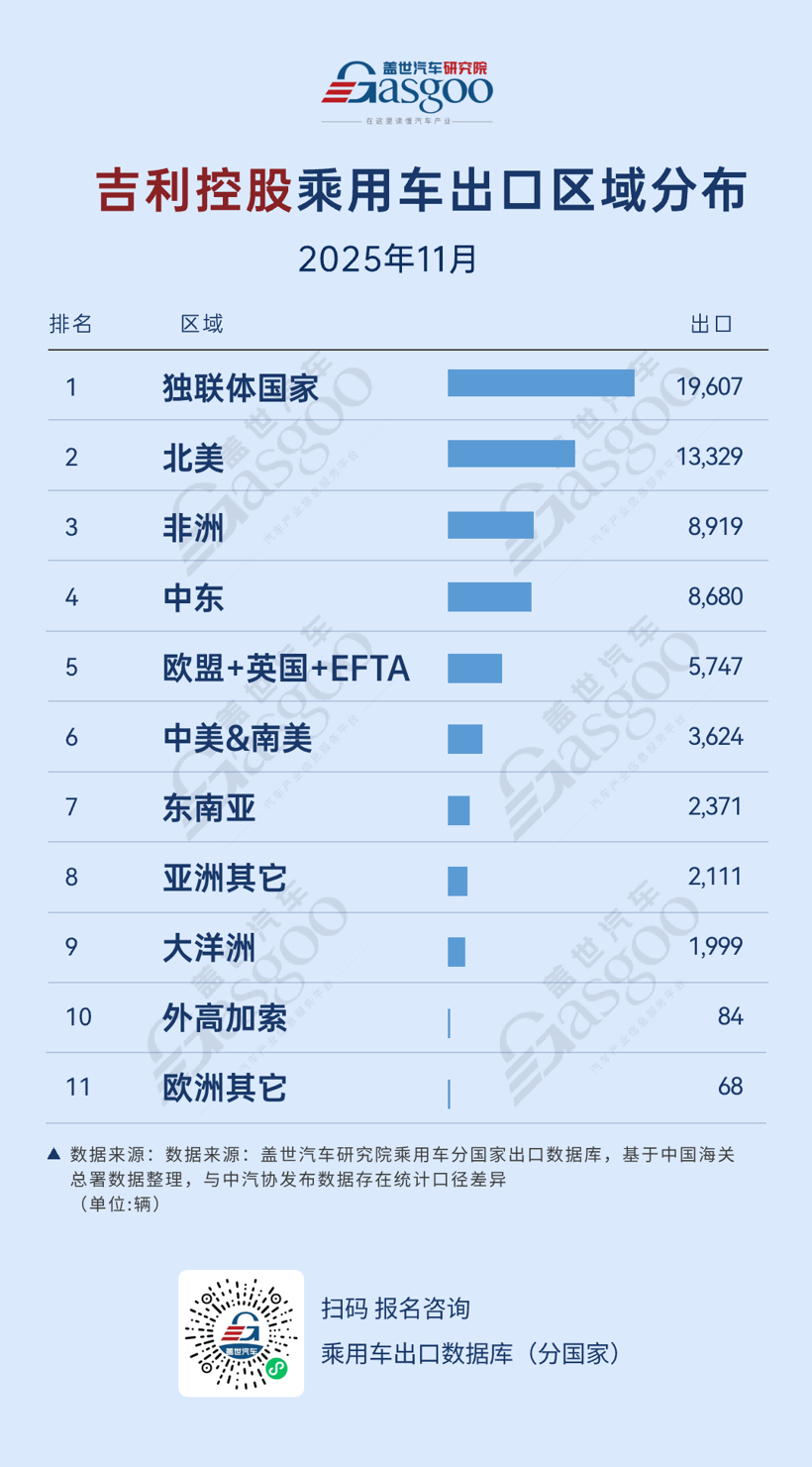
The CIS is Geely Holding's most critical overseas market at present. In November 2025, exports to the region reached 19,600 vehicles, the highest among all geographies. The CIS's preference for value, reliability, and acceptance of ICE and hybrids matches Geely's current product mix, making it a key pillar for steady scale-up. Meanwhile, shipments to North America came in at 13,300 vehicles. While short of the top markets, that footprint carries weight given tighter rules, certification hurdles and tougher competition. With its multi-brand and platform advantages, Geely is treating North America as a strategic market for medium-to-long term investment and gradual ramp-up.
Africa and the Middle East each saw monthly exports near 9,000 vehicles, ranking third and fourth. Both regions offer large addressable markets with high price sensitivity and parallel acceptance of new energy and conventional powertrains — conditions that favor Geely's multi-powertrain strategy and differentiated pricing to widen coverage quickly. The EU, UK and EFTA combined totaled 5,747 vehicles, well below the CIS and North America.
In short, Geely Holding is prioritizing emerging markets while steadily penetrating mature ones. Rather than chasing high-end and NEV scale everywhere, Geely is consolidating volume in the CIS, Africa and the Middle East, while maintaining a continued presence in North America and Europe to preserve options for an upgrade in its global push over the longer run.
According to the Gasgoo Auto Research Institute export database, Chery Holding's passenger vehicle export regional ranking for November 2025 is as follows:
No. 1 Middle East: In November, Chery Holding exported 48,667 vehicles to the region.
No. 2 Central & South America: In November, Chery Holding exported 18,083 vehicles to the region.
No. 3 CIS: In November, Chery Holding exported 17,301 vehicles to the region.
No. 4 EU + UK + EFTA: In November, Chery Holding exported 14,415 vehicles to the region.
No. 5 Africa: In November, Chery Holding exported 12,494 vehicles to the region.
No. 6 Southeast Asia: In November, Chery Holding exported 10,498 vehicles to the region.
No. 7 Oceania: In November, Chery Holding exported 7,129 vehicles to the region.
No. 8 North America: In November, Chery Holding exported 1,086 vehicles to the region.
No. 9 Other Asia: In November, Chery Holding exported 1,017 vehicles to the region.
No. 10 Other Europe: In November, Chery Holding exported 141 vehicles to the region.
No. 11 South Caucasus: In November, Chery Holding exported 117 vehicles to the region.
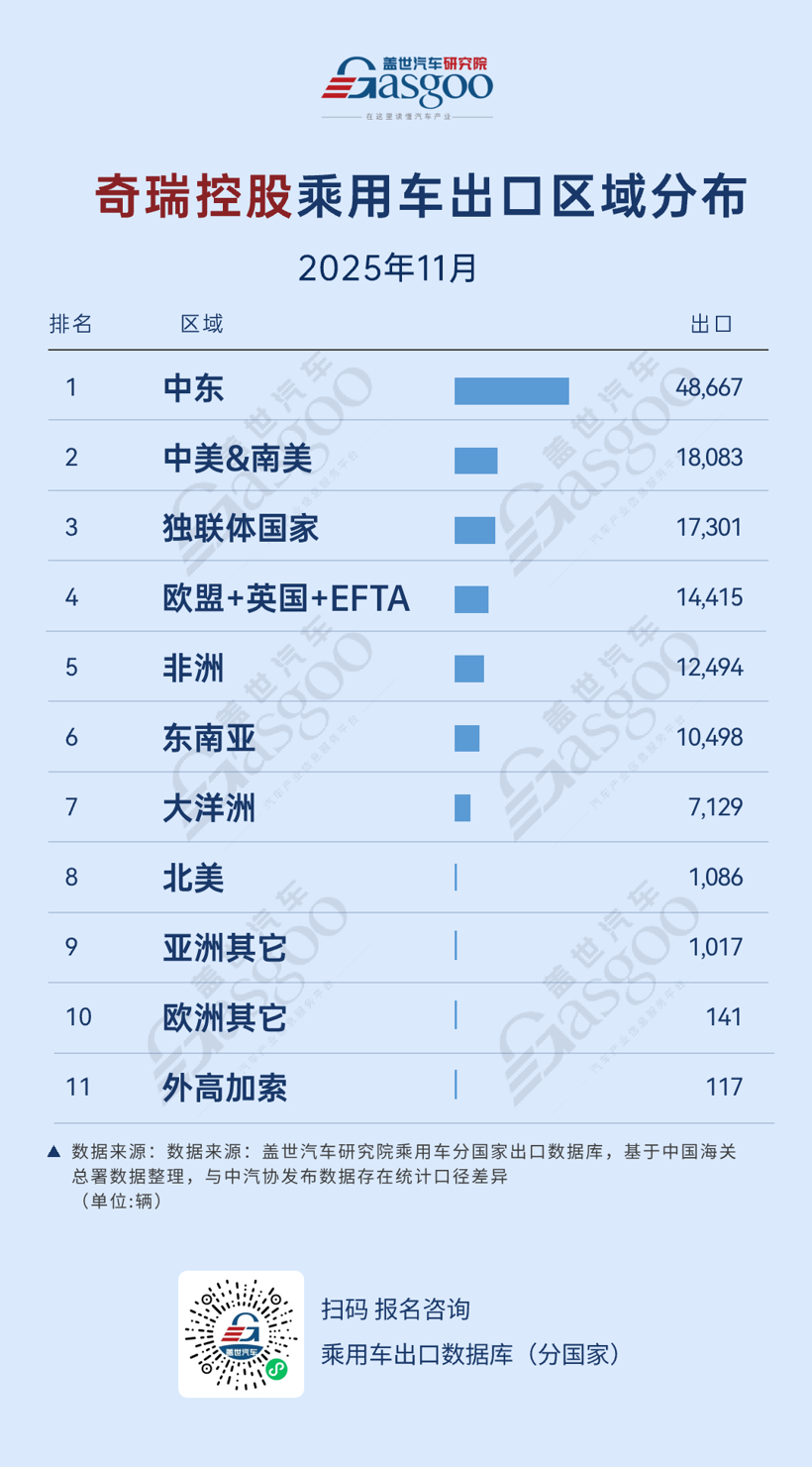
In November 2025, Chery Holding shipped 48,700 vehicles to the Middle East — a single-region scale that far outstrips other markets and is roughly equal to the combined total of its No. 2 and No. 3 regions. That heft reflects years of groundwork in channels, brand-building and product-market fit; it also signals a shift from an "export introduction" phase to scaled operations.
Central & South America and the CIS form Chery’s second growth rung, with 18,100 and 17,300 vehicles respectively, underscoring its capacity to keep scaling. The EU, UK and EFTA together took 14,400 vehicles. Against a backdrop of compliance, tariff and competitive pressures facing Chinese brands in Europe, that showing carries weight. Compared with its earlier dependence on emerging markets, Chery is gaining traction in Europe, nudging its export mix toward higher-standard markets.
Africa and Southeast Asia each topped 10,000 vehicles in November, a sign Chery retains strong product competitiveness and channel penetration across emerging markets. North America remained small at 1,086 vehicles, well behind other regions — reflecting a cautious approach focused on brand testing, compliance groundwork and preparation for a longer-term entry.
Relative to Chinese peers, Chery holds deeper scale advantages in the Middle East and several emerging markets while gradually opening a beachhead in Europe. Anchored by a single super market and amplified by multi-region coordination, its structure offers resilience to volatility — along with room to press the offensive.