



Gasgoo Munich- On February 25, 2026, Beijing's Great Hall of the People hosted a high-stakes dialogue between government and business leaders. Chinese Premier Li Qiang and German Chancellor Friedrich Merz co-chaired a meeting of the China-Germany Economic Advisory Committee. On the Chinese side, entrepreneurs like Geely's Li Shufu, NIO's Li Bin, Xiaomi's Lei Jun, and Inceptio Technology's Ma Zheren sat face-to-face with executives from roughly 30 top German firms, including Volkswagen, Mercedes-Benz, and BMW. This marks Merz's first visit to China since taking office last May, making him the first foreign leader to visit in the Year of the Horse.
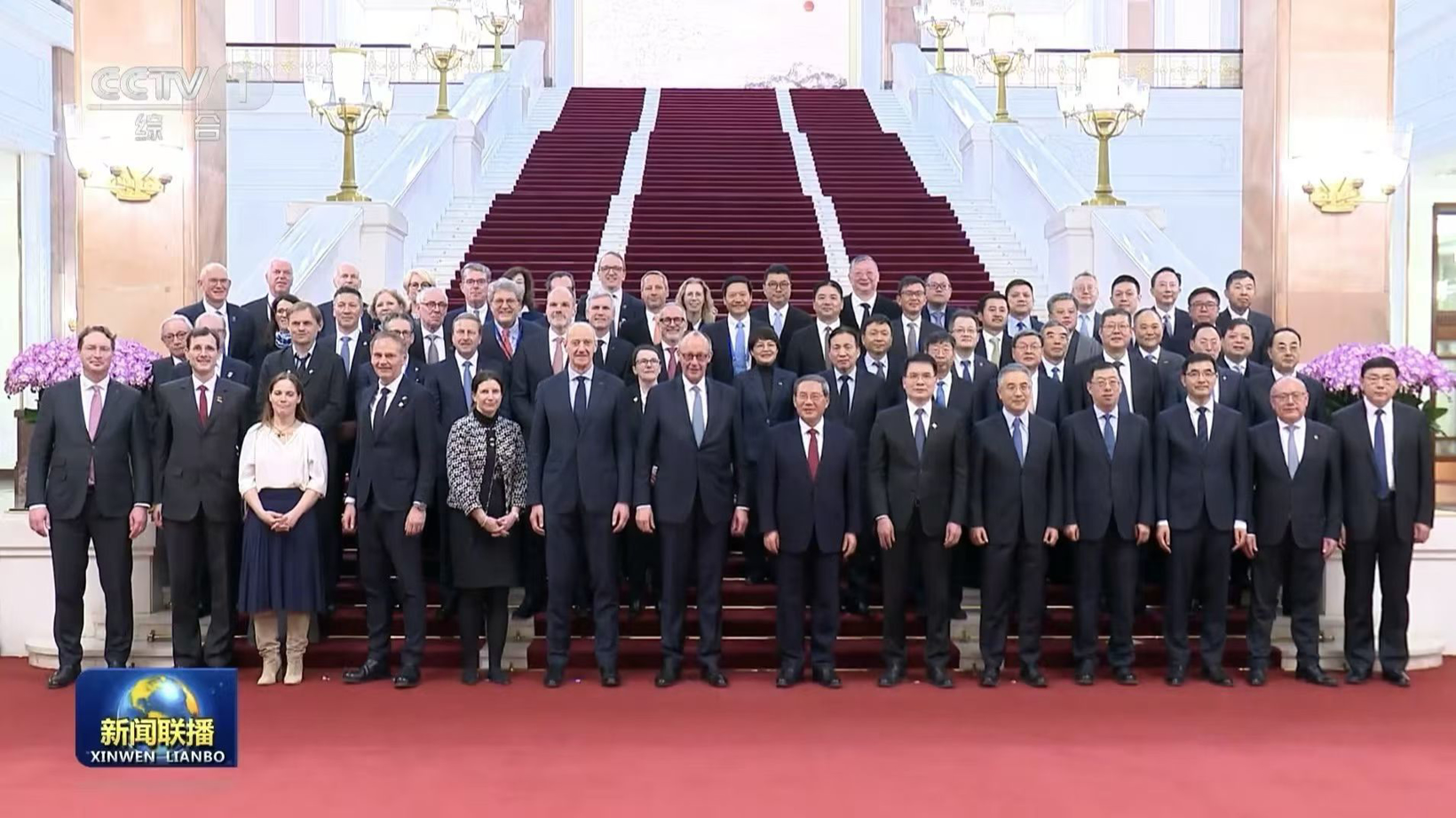
Image source: Screenshot from Xinwen Lianbo
Against a global backdrop of rising unilateralism and protectionism, this visit—dubbed the "largest-scale German delegation since the Merkel era"—sends a signal that transcends routine diplomacy.
"Cooperation is the optimal solution for managing risk; development is the only option for ensuring security," Li Qiang stated bluntly at the symposium. Behind those words lies the deeper logic of two of the world's largest economies seeking a new balance between competition and cooperation.
Why the "Largest Scale"?
Consider the data: In 2025, total trade in goods between China and Germany reached 1.51 trillion yuan, up 5.2% year-on-year. China exported 846.3 billion yuan to Germany and imported 664.3 billion yuan. After a one-year gap, China has reclaimed its position as Germany's largest global trading partner, surpassing the United States.
Meanwhile, trade between Germany and the U.S. shrank by 5% in 2025, weighed down by American tariff policies. This divergence speaks volumes about the market "voting with its feet" against protectionism. Through concrete action, German industry has made it clear: the deep integration of the Chinese market is something no political slogan can replace.
The German delegation covers key sectors like automotive, chemicals, biopharma, machinery, and the circular economy—with Volkswagen, Mercedes-Benz, BMW, Siemens, BASF, Bayer, and Airbus all in attendance. The Chinese delegation reflects a blend of generations: established manufacturers like Geely and JNMPT sit alongside cross-sector newcomers like NIO and Xiaomi, as well as rising stars in embodied intelligence like BrainCo and Rokid. The face-to-face interaction of over 60 entrepreneurs is, in itself, a vivid portrait of how deeply Chinese and German supply chains are interlocked.
Established in May 2013, the China-Germany Economic Advisory Committee was the first bilateral economic cooperation advisory mechanism China set up with a major global economy. This symposium marks another high-level dialogue following the meeting in April 2024 between Li Qiang and then-German Chancellor Olaf Scholz.
Cao Kebo, chairman of JNMPT, has participated in these events for the sixth consecutive time. "Germany is an indispensable link in JNMPT's global strategy," he said after the meeting. "Through this platform, we can better grasp the policy direction of Sino-German automotive cooperation."
From "Market for Technology" to "Two-Way Innovation Flow"
As China's new energy vehicle penetration rate breaches 50% and German automotive giants face hurdles in their intelligent transformation, the logic of cooperation is shifting quietly. It is no longer simply "German technology plus Chinese manufacturing"; instead, it is moving toward "joint R&D, shared platforms, and shared outcomes."
Premier Li Qiang outlined three key directions for future cooperation at the symposium:
- Solidify the foundation of traditional cooperation: Deepen collaboration in machinery, equipment, and chemicals, accelerate business localization, and continuously improve resilience and efficiency.
- Seize new opportunities for future growth: Support the two-way flow of innovation resources between companies and research institutions in both countries. Deepen joint R&D, platform building, and results sharing, while jointly exploring third-party markets.
- Foster a favorable environment for investment: Welcome German enterprises to invest and deepen their presence in the Chinese market, while supporting more Chinese companies in investing and doing business in Germany.
This framework drew a positive response from the German side. Merz explicitly stated that Germany is willing to strengthen mutually beneficial cooperation in automotive, chemicals, machinery, renewable energy, and the digital economy. He affirmed support for German firms investing deeply in China and welcomed more Chinese enterprises to Germany.
In reality, the structure of Sino-German trade is already evolving. While electromechanical products still account for over 70% of trade volume, emerging sectors are growing fast: imports and exports of 3D printers and industrial robots reached 2.6 billion yuan and 1 billion yuan respectively in 2025. This signals that the trade bond between the two nations is extending from simple "exchange of goods" to the "flow of innovation factors."
Closing Thoughts
The clearest signal from the China-Germany Economic Advisory Committee meeting is this: seeking win-win outcomes amidst competition is not just a consensus between the two business communities, but the bedrock of global supply chain stability in turbulent times. For the automotive industry, riding the waves of change, the depth and breadth of Sino-German cooperation will continue to define the evolutionary trajectory of the global auto sector.
When Premier Li Qiang said that "the areas of cooperation far outweigh the areas of competition," he was not only boosting the confidence of companies from both nations but also offering a reference path for global economic governance. In a world fraught with volatility and turmoil, cooperation remains the optimal solution for managing risk.


