



Gasgoo Munich- On February 26, XPENG Chairman He Xiaopeng revealed that Volkswagen is set to become the launch customer for the automaker's second-generation VLA model.
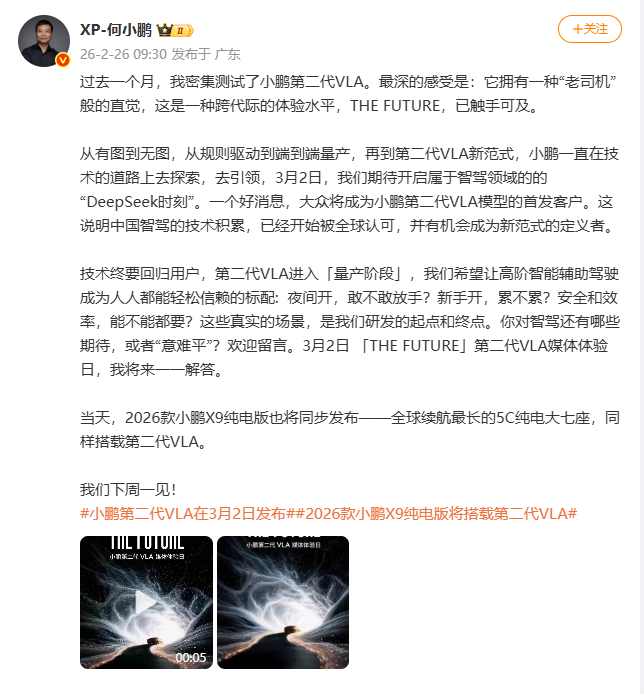
Image source: Screenshot from Weibo
He wrote that after a month of intensive testing, the system exhibits the intuition of a seasoned driver—an experience that represents a generational leap. "THE FUTURE is within reach," he noted. XPENG has pushed boundaries consistently, moving from map-based to mapless navigation, from rule-driven systems to end-to-end mass production, and now to this new VLA paradigm.
Building on that, He confirmed that Volkswagen will serve as the launch customer for the second-generation VLA. The move signals that China's accumulated expertise in intelligent driving is gaining global recognition, positioning the country to define this emerging paradigm.
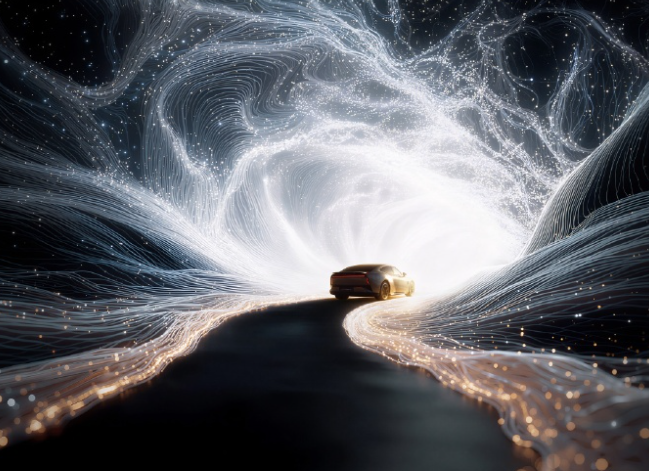
Image source: He Xiaopeng's Weibo
He stressed that technical development must ultimately circle back to user needs. As the second-generation VLA enters mass production, XPENG aims to make advanced driver-assistance systems a trusted standard feature. Separately, the 2026 XPENG X9 pure electric version is set for release on March 2. Positioned as the 5C pure electric large seven-seater with the longest range globally, the vehicle will also feature the new VLA system.
Public data indicates the system runs on XPENG’s proprietary Turing AI chip, delivering an industry-leading 2,250 TOPS of effective computing power. It boosts inference efficiency by 12 times and scales parameters to 10 times that of mainstream solutions. Crucially, unlike traditional "Vision-Language-Action" architectures, XPENG's VLA bypasses language translation entirely, enabling direct end-to-end output from visual signals to action commands.
Furthermore, the second-generation VLA marks XPENG's first mass-produced "physical world" large model. It functions both as an action generator and as a model for understanding and reasoning about the physical world, providing a unified intelligent foundation for AI-powered vehicles, humanoid robots, and flying cars.


