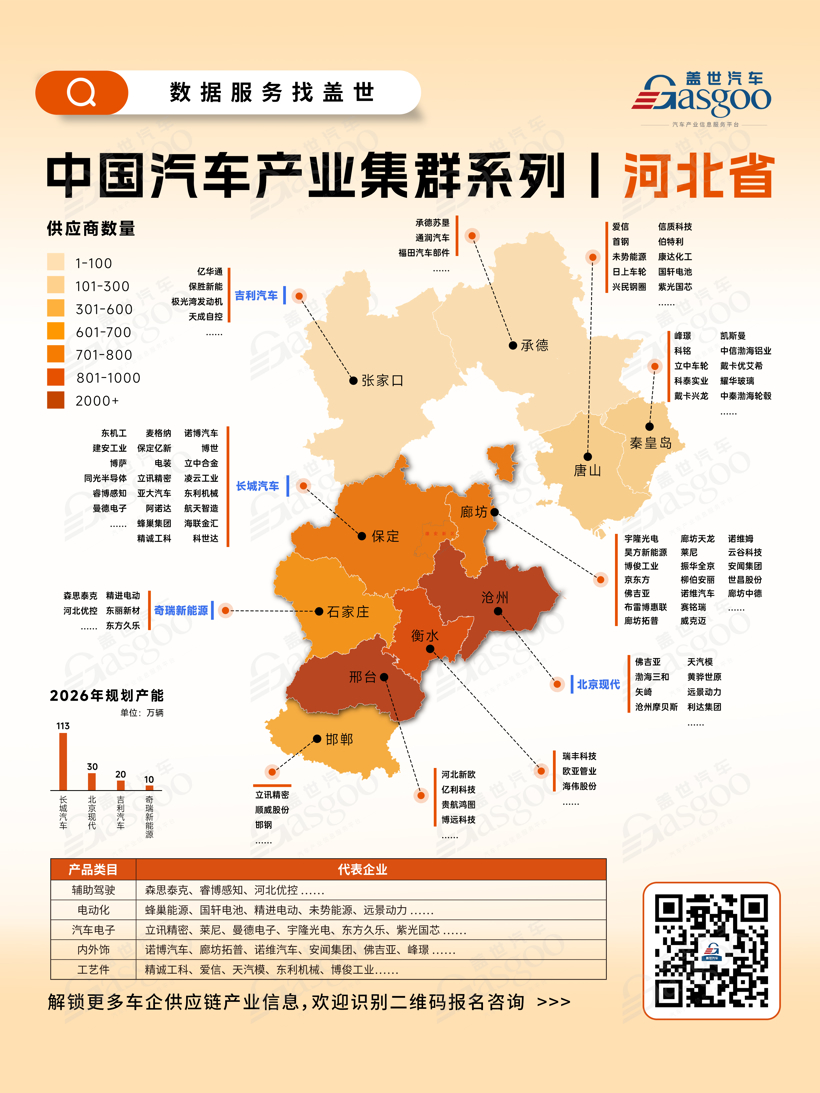
Gasgoo Munich- According to Gasgoo Global Auto Industry Big Data, Hebei's automotive sector has developed a multi-layered, collaborative ecosystem. Anchored by hubs like Baoding, Cangzhou, Shijiazhuang, and Xingtai, the province has built a cluster defined by distinct roles, complementary strengths, and tight integration. Spanning traditional components, high-end smart manufacturing, and new-energy technologies, the industry's overall resilience is steadily climbing.
Baoding leverages Great Wall Motor's position as a chain leader to forge a complete ecosystem ranging from R&D and core components to vehicle assembly. The region has gathered local heavyweights like SVOLT Group, Nobo Auto, and Mande Electronics, creating a self-reliant system of research and production. It has also drawn top-tier global suppliers like Bosch, Denso, and Magna to deepen their presence, helping Baoding stay ahead in R&D and high-end component manufacturing.
Cangzhou, driven by Beijing Hyundai's manufacturing base, has achieved scale in key supporting sectors like automotive electronics and interior/exterior trim. A group of parts makers—including Faurecia, AESC, and Tianqi Mold—have established a comprehensive supply chain network there.
Shijiazhuang is capitalizing on Chery New Energy's manufacturing capabilities to accelerate a synchronized development of vehicles and core components. Companies like Sentek, Jing-Jin Electric, and Hebei Youkong provide strong support in areas like driver assistance and electrification. This "vehicle-led, component-supported" ecosystem is injecting strong momentum into Hebei's race in the new-energy sector.
Xingtai, drawing on deep industrial roots and strategic transport links, has cultivated a "comprehensive yet specialized" cluster for basic components. With deep expertise in precision parts, rubber and plastics, and lightweight materials, firms like Hebei Xino, Elit Technology, and Guihang Hongtu are deeply integrated into the supply chain for the Beijing-Tianjin-Hebei region and the nation at large. Their specialized, refined capabilities continue to solidify Xingtai's unique competitive edge upstream in the chain.
Looking at production capacity, Hebei is targeting roughly 1.73 million vehicles by 2026. Great Wall Motor dominates with about 1.13 million units, followed by Beijing Hyundai at 300,000, Geely at 200,000, and Chery New Energy at 100,000. This multi-tiered capacity structure will reinforce the ability of chain leaders to integrate upstream and downstream resources, pushing the province's auto industry to a higher level.
Overall, Hebei's auto cluster is pivoting from isolated layouts to ecosystem collaboration, anchored by chain leaders. By leveraging complementary roles, the province is upgrading the entire supply chain and building a high-quality industrial system. Still, the province must improve resource allocation across regions and deepen vertical integration. Promoting the efficient flow of resources and joint innovation is essential to bolster the industry's resilience against risk.