



The powder keg of the Middle East—straddling the throat of the Eurasian landmass—has been lit once again. Following joint military strikes by the U.S. and Israel, Iran retaliated and announced the closure of the Strait of Hormuz, plunging the region back into conflict.
For the global automotive industry, this is more than just another geopolitical headline; it is a systemic shock to supply chains, energy costs, and the regional market landscape. In Tehran, dealers are grappling with a cruel reality: the region's last "island market" with a million-unit volume, which enjoyed a brief resurgence in 2025, is being frozen once again by the fog of war.
As a core OPEC member and a de facto gatekeeper of the Strait of Hormuz, every geopolitical tremor in Iran reverberates far beyond local car-buying decisions. It tugs at the nerves of the global crude oil supply chain and, by extension, the upstream materials essential to the auto industry.
For China's auto industry, Iran was once a land of opportunity. Having transformed from a "gold rush" territory at the turn of the century into a case study in risk, the market is now testing the strategic resilience and risk maturity of Chinese automakers in the most brutal way possible.
The fate of Chinese automakers here is no longer just a matter of export sales figures; it serves as a prism reflecting geopolitical risks, supply chain resilience, and strategic resolve.
Fragile Prosperity in an Isolated Market
The Iranian auto market occupies a unique position within the Middle East.
While oil-rich Gulf states like Saudi Arabia and the UAE have feasted on rising EV penetration and luxury car consumption over the past two years, Iran presents a starkly different picture.
Data compiled by Gasgoo Auto shows that total sales in the Middle East approached 3 million units in 2024. Iran alone contributed 990,000 units—a volume several times that of the Israeli market—securing its position as the region's largest.
Yet the operating logic here diverges sharply from its neighbors. Driven not by free trade or diversified imports, it is a closed market spawned in the cracks of severe international sanctions, dominated by two local giants.
Iran Khodro (IKCO) and Saipa, the two domestic automotive groups, have long commanded a combined 70% to 80% market share. The latest data from Gasgoo Auto indicates that in 2025, these two giants again captured roughly 70% of the market. This deeply monopolistic structure is both a product of sanctions and the root of the market's fragility.
Western sanctions have proven a heavy shackle. Having endured multiple rounds of stringent measures, Iran's imported vehicle supply chain has been long constrained. International names like Renault and PSA have exited the market several times over, leaving Iranian consumers with few options in the imported car segment. Moreover, prolonged sanctions have weighed heavily on the broader economy. With limited budgets, the average consumer is extremely price-sensitive, favoring affordable models and making economy cars the dominant product category in Iran.
According to Gasgoo Auto, Iran's auto production and sales showed a fluctuating upward trend from 2023 to 2025, climbing back above the million-unit annual mark in 2025. However, the escalating geopolitical conflict is set to slam the brakes on that momentum. Supply chain disruptions, currency volatility, and a collapse in consumer confidence have effectively severed the fuel line of the Iranian auto market.
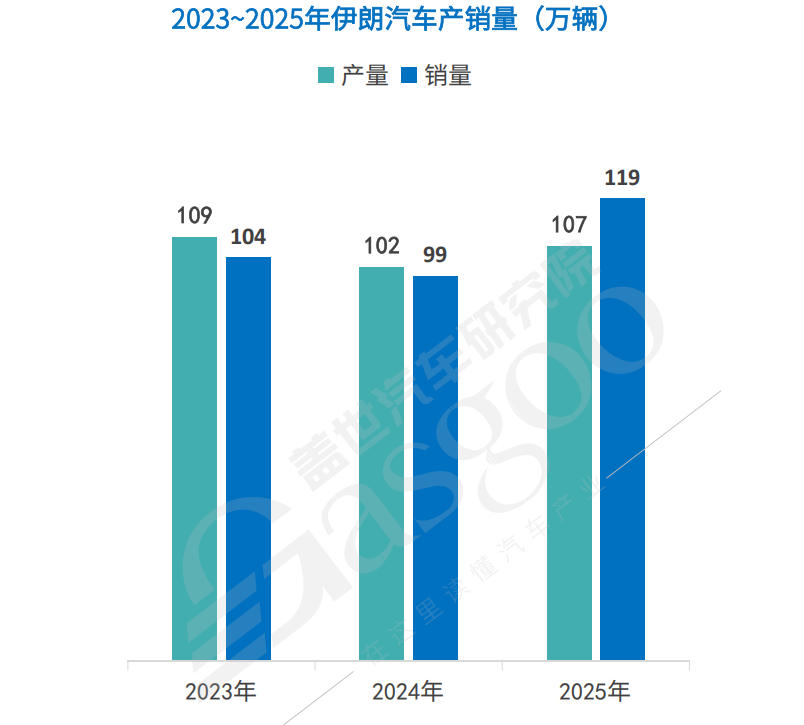
Image Source: Gasgoo Auto, Data Source: Gasgoo Auto Industry Big Data Platform
Even more fatal is the physical "suffocation" the closure of the Strait of Hormuz poses to the Iranian auto market.
This choke point, through which 20% of the world's maritime oil passes, is also the lifeline for the auto parts supply chain. For an Iranian auto industry heavily reliant on imported knock-down (KD) kits for local assembly, a parts cutoff means production lines grind to a halt. Even models in inventory cannot be delivered due to severed logistics and soaring insurance costs.
The Iranian market is morphing from a beacon of recovery into a frozen wasteland of stalled transactions, halted production, and currency collapse. Its role in the Middle Eastern automotive landscape is destined for a dramatic shift: it is no longer a "Persian hub" with regional reach, but risks becoming the eye of the storm that fractures regional supply chains and drives up trade risks across the Middle East.
A Race for Survival for the "Chinese Legion"
Outside of Iran's two domestic brands, Chinese brands have essentially captured the remainder of the market.
Constrained by sanctions and brand exits, French automakers—once strong players in Iran—are rapidly losing ground, having already been overtaken by Chinese rivals. In 2025, Chinese brands claimed 19.7% of the total market share, while the French share fell to 11.4%. To circumvent sanctions, most Chinese automakers operate through CKD assembly for localized production.
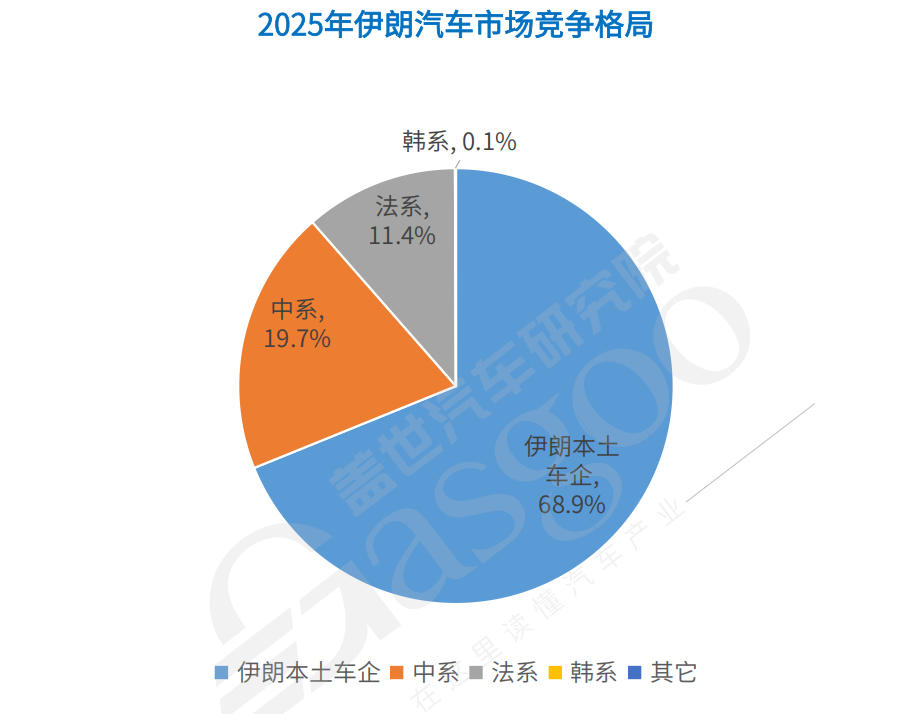
Image Source: Gasgoo Auto, Data Source: Gasgoo Auto Industry Big Data Platform
This unique market structure dictates that any ripple in the Iranian auto market will transmit directly to the overseas earnings reports of Chinese automakers.
On the whole, the trajectory of Chinese automakers in Iran amounts to an epic of survival, fraught with twists and turns.
Historically, Chinese brands were the primary beneficiaries of the sanctions gap. As French brands withdrew under pressure, Chinese automakers quickly filled the void using KD kits, becoming the only significant foreign force in the Iranian market for a time.
In 2025, China exported 164,000 passenger vehicles to Iran, comprised almost entirely of KD kits. Beyond high cost-performance, their success is rooted in adaptive development tailored to Middle Eastern demands and active alignment with local policies. Consumers in the region show a high acceptance of new technologies and products, willing to embrace emerging forms of mobility. Chinese brands, offering rich configurations and a convenient, comfortable driving experience at competitive prices, have strengthened their competitiveness and won over an increasing number of Middle Eastern consumers.
To better adapt to the Middle East's climate and road conditions, many Chinese automakers implement targeted improvements for exports. These include reinforcing air conditioning for extreme heat, using more corrosion-resistant materials and processes to withstand desert and coastal environments, and fine-tuning suspensions, chassis, and tires. These specific adaptations were once key to Chinese cars gaining acceptance in the Iranian market.
Yet, faced with a total market freeze caused by war, these product advantages may temporarily lose their relevance. The increasingly complex regional environment could evolve into a rational wave of strategic withdrawals. In fact, at the start of 2026, facing surging inflation and unstable foreign exchange allocation, news emerged that some Chinese automakers had begun exiting the local market—providing a sobering case study in cutting losses. The harsh environment brought by escalating conflict may prompt even more Chinese brands to consider leaving Iran.
When a nation's currency system begins to collapse, even if sales are achieved locally, the revenue may be impossible to repatriate, rendering paper profits a mere numbers game. Given Iran's current situation, shifting strategic focus to neighboring markets—or concentrating resources on emerging, policy-stable regions like Southeast Asia that offer investment incentives without sanctions risks—may be a prudent, forward-looking adjustment.
It must be said that the "pivot point" of the Middle East auto market, once so full of promise, is rapidly losing its commercial certainty.
Looking ahead, the future for Chinese automakers in Iran is no longer a simple business decision; it is a complex chess game involving geopolitical maneuvering, supply chain survival, and strategic resource reallocation. In the short term, the combination of warfare, sanctions, and an impending financial collapse has effectively eliminated the normal consumer market. Even if the conflict subsides at some point, it will leave behind ruins requiring a long cycle of reconstruction.
From a broader perspective, Iran's dilemma offers a profound textbook on risk management for Chinese automakers going global. Faced with extreme scenarios, the industry must think beyond specific sales fluctuations and gain a clearer understanding of the "risk premium" inherent in globalization.
The Supply Chain "Tsunami"
It is also worth noting that the escalation of regional war impacts the auto industry far beyond Iran's borders. It will surely spread globally through the "capillaries" of the supply chain. Even if Chinese automakers withdraw from the Iranian market, they cannot fully escape the shadow cast by this conflict.
First is the price shock to energy costs and raw materials.
The surge in oil prices caused by war will directly break through the cost floor for operating internal combustion vehicles. While this might seem to benefit electric vehicles, the situation in Iran and its surrounding markets is far more complex. Soaring oil prices drive up the cost of all petroleum derivatives—plastics, rubber, and tires—further squeezing the profit margins of vehicle manufacturing.
A more insidious blow comes from upstream minerals. Iran is not just a major oil producer but also a key exporter of various ores. Take celestite, for example: crucial for producing strontium carbonate, a core material for permanent magnets in EV motors. A total shutdown of Iranian ports implies a rapid decline in celestite exports, which could directly impact global EV production costs and delivery cycles.
Next is the obstruction of logistics and global trade routes. The closure of the Strait of Hormuz and ongoing tensions in the Red Sea will cause freight rates for exports to Europe and the Middle East to skyrocket, while insurance premiums often double during wartime. For international automakers that planned to use Iran as a hub to reach West Asia and North Africa, a forced interruption at this critical node means guaranteed delivery delays and skyrocketing risks of cargo stagnation. This could transmit downstream, cooling overseas dealers' willingness to order and plunging the entire export chain into a liquidity crisis.
Finally, there is the risk of secondary sanctions regarding chips and technology. Israel is a significant global chip production base; if the conflict damages its capacity, it will exacerbate the already fragile supply of automotive-grade chips. Meanwhile, the U.S. has explicitly stated it will impose punitive tariffs on any country continuing to trade with Iran. This means that even companies that have exited the Iranian market could face secondary sanctions in the U.S. if their supply chains or partners are deemed to have indirect ties to Iran.
This "Sword of Damocles" hanging overhead forces all automakers with a footprint in the Middle East to re-examine their compliance and risk control frameworks.
Summary: Looking at the future of the Iranian auto market from the vantage point of March 2026, it is clearly no longer a normal commercial market in the short term. With social order in turmoil, credit collapsing, and military conflict ongoing, it is easy to imagine a landscape where auto consumption grinds to a halt. For Chinese automakers, the question is no longer how many cars they can sell, but whether local assets can be preserved and how to handle after-sales service for existing owners.
In the medium to long term, having weathered this turmoil, Chinese automakers should emerge more mature. The importance of risk identification will surpass the impulse for market expansion, with stable regions possessing complete manufacturing bases likely becoming the core focus for resources. However, this does not mean a total withdrawal from Iran to zero. Some automakers with strategic resolve and barter trade capabilities may retain a foothold during the post-war reconstruction.
The Iranian auto market of 2026 is a concentrated microcosm of current global geopolitical risks. What automakers experience here may become a critical lesson in the "Age of Discovery" for Chinese car companies. It teaches the industry that globalization is not just a smooth path paved with gold, but a thorny journey through geopolitical minefields. For companies still at the table, survival itself is victory. For the industry as a whole, the lessons drawn from this crisis will serve as ballast for steady progress in broader global markets in the future.


