



In 2025, China's automotive industry took a pivotal step onto the global stage. According to data released by the China Passenger Car Association (CPCA), China's auto exports reached 8.32 million units last year — a 30% surge from the previous year.
That marks the third consecutive year China has held the title of the world's largest car exporter. But beyond sheer scale, a profound transformation is underway in how Chinese automakers go global: the strategy is shifting from simple "product exports" driven by price competitiveness to a holistic "ecosystem export" that integrates technology, manufacturing, branding, and service. This evolution signals a comprehensive upgrade in China's manufacturing capabilities and underscores the country's transition from a mere participant to a reshaper of the century-old automotive industry.
Rising Quality Behind the Numbers
Exports maintained a steady upward trajectory throughout 2025. In a final sprint at the year's end, December alone saw 990,000 units shipped overseas — a 73% year-on-year jump and a 23% increase from November — capping the year at a record high.
Yet the optimization of the underlying structure matters more than the sheer rise in volume. New energy vehicles (NEVs) have taken the baton of growth, emerging as the primary engine driving exports. For the full year of 2025, NEV exports reached 3.43 million units, surging 70% from the previous year.

Image Source: Huaban
Within the NEV breakdown, plug-in hybrid vehicles (PHEVs) delivered a standout performance. Exports hit 1.11 million units in 2025 — a 252% explosion that captured 13% of total exports. Combining the technological sophistication of electrics with the convenience of freedom from range anxiety, PHEVs have become a potent weapon for Chinese automakers entering overseas markets where charging infrastructure remains patchy. It also reflects the industry's agile response to the diverse demands of the global market.
Meanwhile, traditional internal combustion engine (ICE) vehicle exports totaled 3.578 million units, accounting for 43% of the total — an 11-percentage-point drop. This shift signifies that the growth engine of China's auto exports is switching from gasoline to electric. The "high quality" of exports is evident not only in the changing energy mix but also in rising overall value. Despite fierce competition, Chinese automakers are steadily increasing the added value of their exports through product upgrades and premium branding, moving away from a past reliance solely on price advantages.
From Single-Point Reliance to Global Expansion
If the shift to new energy is an "engine switch," then the restructuring of the market landscape is a "route reset." Market diversification emerged as another defining feature of China's automotive export drive in 2025. By proactively adjusting their strategies, Chinese automakers have reduced their dependence on single markets, forging a global layout with broad coverage and multiple pillars of support.
Markets like Russia had previously commanded a dominant share, but geopolitical tensions and market volatility introduced massive uncertainty. In 2025, most Chinese automakers proactively adjusted their export strategies, accelerating the trend toward diversification.
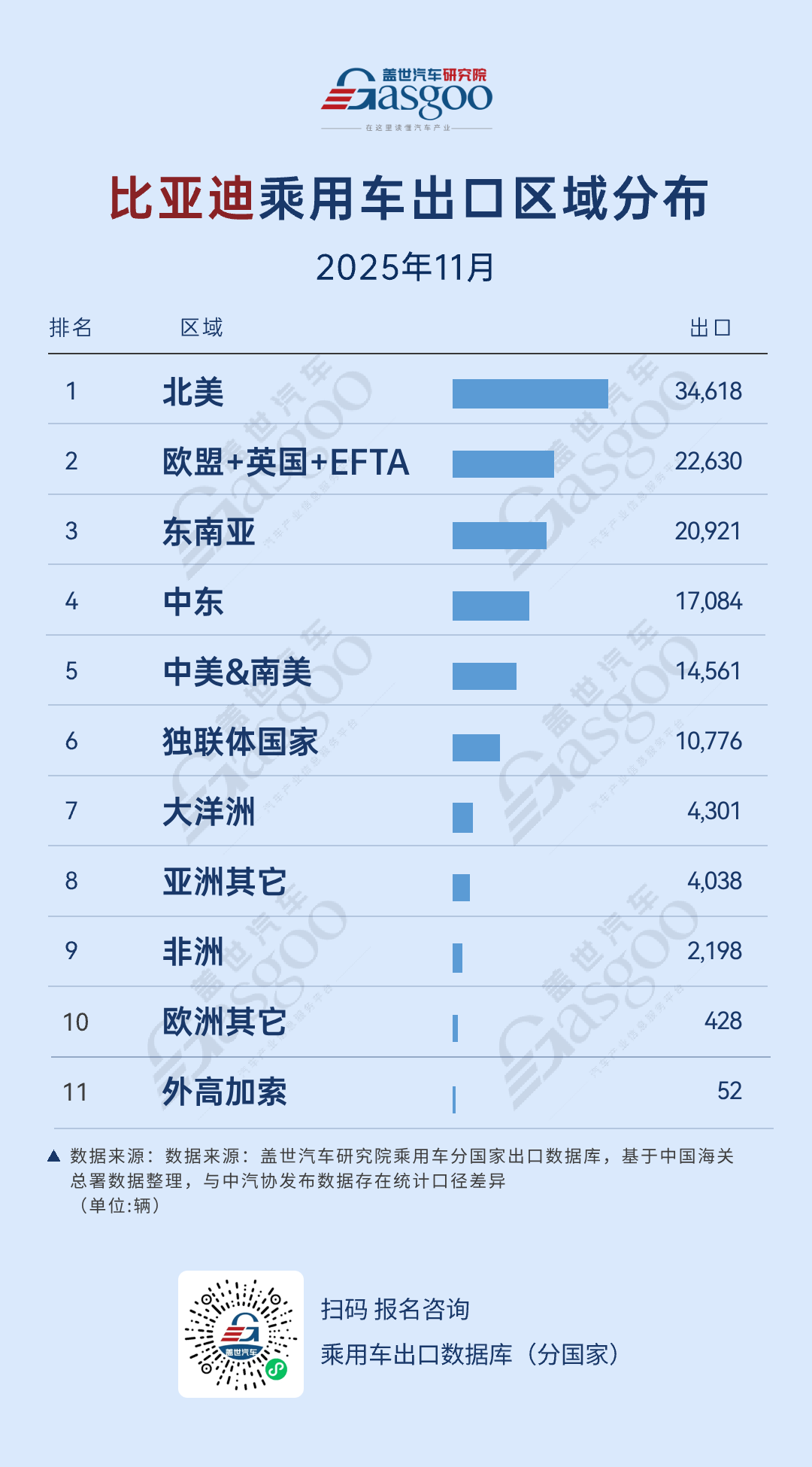
Consider BYD, which leveraged its complete NEV lineup to make simultaneous inroads into premium and emerging markets across the European Union, the Middle East, and Latin America. According to export data from Gasgoo Automotive Research Institute, its three largest export regions in November — North America, the EU plus the UK and EFTA, and Southeast Asia — each saw volumes exceed 20,000 units. Its fourth through sixth largest markets also surpassed 10,000 units each. Geely, meanwhile, solidified its dominance in the Commonwealth of Independent States (CIS) while achieving rapid breakthroughs in Southeast Asia, North America, and Africa. In November, the combined volume of Geely's second and third largest markets — North America and Africa — surpassed that of its top market, the CIS. Its fourth largest market, the Middle East, also recorded 8,680 exports, significantly optimizing its market structure.
Emerging and developed markets — represented by Mexico, the United Arab Emirates, Russia, Belgium, Australia, and Southeast Asian nations — have together formed the new pillars of China's export growth. This diversified layout has greatly bolstered the resilience of China's automotive exports against external shocks.
As Sun Xiaohong, Secretary-General of the Automotive Internationalization Professional Committee under the China Chamber of Commerce for Import and Export of Machinery and Electronic Products, noted, China's vehicle exports currently exhibit a pattern of "stabilizing volume with diverging structures." The regional focus is actively shifting from reliance on single markets to a diversified layout.
Specifically, Asia, Europe, and Latin America constitute the three major market pillars. In Asia, beyond traditional Southeast Asia, the Middle East — particularly the UAE and Saudi Arabia — has delivered standout results, serving as a stage for Chinese brands to showcase their premium and electrified offerings.
For instance, BYD officially entered the Iraqi market in late 2025, launching eight models at once — including four plug-in hybrids and four pure electrics — to meet diverse local demands.
In Europe, despite strict regulations and intense competition, Chinese automakers are steadily making headway through localized operations and precise product positioning. BYD's deepening of its European sales channels is a prime example. In April 2025, the company opened its first 4S dealership in Zagreb, Croatia. The outlet, equipped with repair facilities, aims to provide a complete after-sales experience — marking a critical step in BYD's transition from simple "trade exports" to "localized operations."
Experts at Roland Berger caution that entering Europe requires navigating its internal market differences. "Europe is not a monolith," one analyst noted. "Southern European countries like Spain and Portugal, along with Eastern European nations such as Hungary and the Czech Republic, are relatively more welcoming to Chinese brands. Western Europe presents greater challenges, while Northern Europe has smaller market capacity — each requiring a tailored strategy."
Latin America, particularly Mexico and Brazil, has become a critical node for Chinese automakers to establish regional manufacturing and distribution hubs, thanks to immense market potential and geographic advantages. For example, Geely's exports to North America — primarily Mexico — reached 7,863 units in October 2025, making it the company's third-largest export region. Chinese brands are systematically leveraging Mexico's strategic location to expand across the Americas.
Corporate Competition Shows a "Matthew Effect"
The wave of globalization is accelerating the reshaping of competition within China's auto industry. As the export drive gains momentum, the internal landscape is further polarizing, with a "winner-takes-all" effect becoming increasingly evident among top players.
In this contest, Chery and BYD have delivered standout performances. Chery continues to hold the crown as the largest exporter by volume, with cumulative exports of 1.344 million units. BYD, leveraging its leadership in the NEV sector, achieved explosive growth — full-year exports hit 1.0496 million units, a 145% surge that made it one of the fastest-growing mainstream automakers.
These export figures represent more than just a sales breakthrough; they signify global recognition for Chinese NEV and intelligent technology brands. Making inroads into mature markets with deep automotive heritage, such as Europe and Japan, holds particular significance for Chinese automakers.
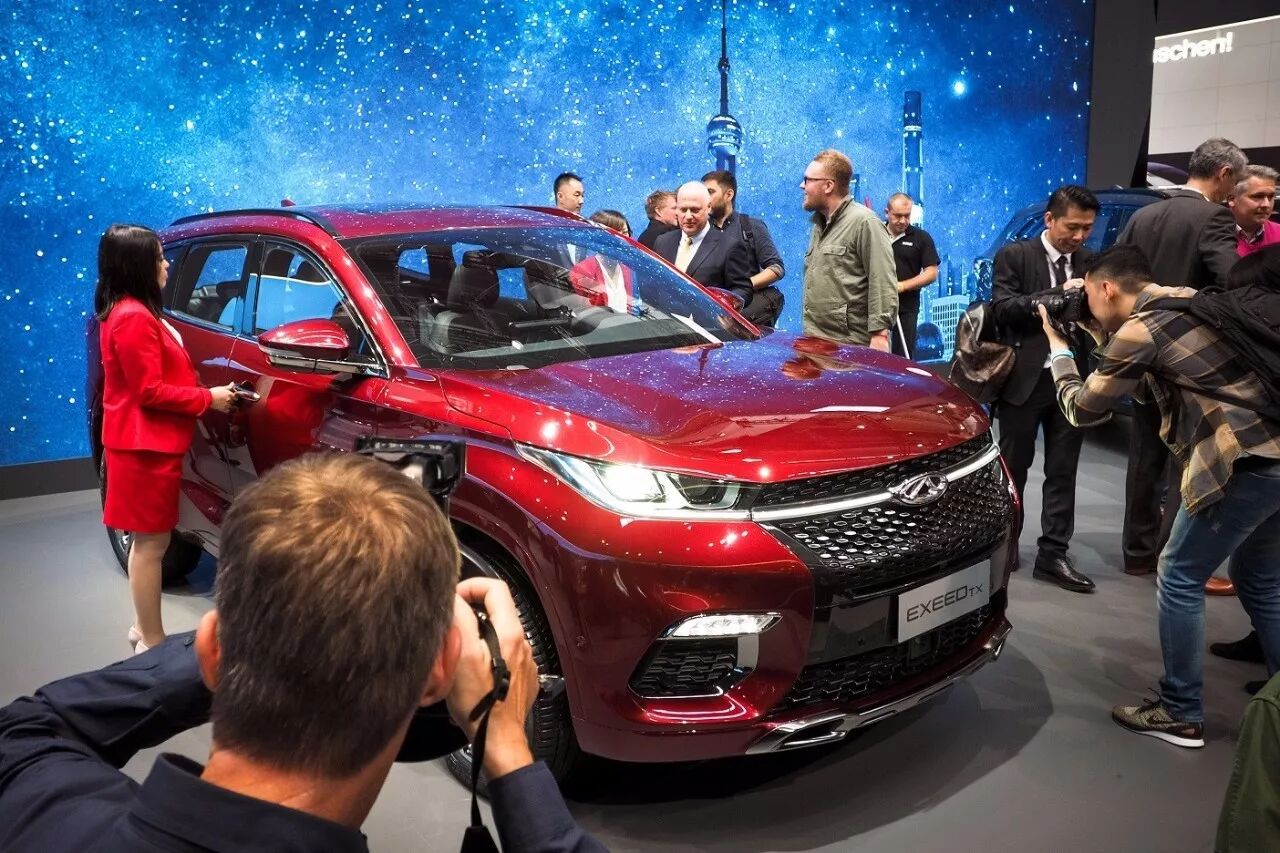
Image Source: Chery Automobile
In the European market, for instance, both Chery and BYD have transitioned from "market entry" to "brand rooting." Chery, leveraging a multi-brand matrix, sold 171,000 vehicles in the EU and the UK from January to October 2025 — a 2.4-fold year-on-year surge that far outpaced the industry average. BYD also posted rapid growth in Europe, with full-year sales of approximately 187,000 units, a massive 276% increase.
Other Chinese brands are pursuing differentiated strategies based on their respective strengths. SAIC Motor is deepening its presence in traditional strongholds like ASEAN and South America through its multi-brand portfolio. Geely, Great Wall Motor, and Changan are steadily advancing in Europe, the Middle East, and Russia.
A Roland Berger analyst, in an interview with Gasgoo, noted that different models have their own internal logic. "Partnerships like the one between Leapmotor and Stellantis offer a pragmatic, fast-track route," the analyst explained. "BYD, driven by its corporate philosophy, chose to emphasize self-operation and control. The result is that BYD currently enjoys far higher brand awareness than Leapmotor."
Notably, the share of foreign brands producing in China for export — represented by Tesla — has slipped. Data shows Tesla China's export performance trended downward in 2025: first-quarter exports fell 56.9% YoY to 38,100 units; May exports dropped 22.4% month-on-month; and September saw another 25.9% monthly decline. Ultimately, Tesla's global deliveries for 2025 ended at 1.64 million, a drop of over 8% from 2024 — marking the second consecutive year of negative growth.
This, to some extent, confirms that Chinese domestic brands are increasingly becoming the primary face of "Chinese cars" in the minds of global consumers.
A professional consulting firm noted that the rapid rise of leading Chinese NEV automakers is due to their establishment of a "new operating model." This model cuts new vehicle launch times in half, reduces investment by 40% to 50%, and delivers roughly a 30% cost advantage.
As more than one analyst has remarked: China has become one of the most fiercely competitive NEV markets in the world. It is this "China model," forged in the crucible of extreme competition, that provides critical support in efficiency and cost for leading automakers expanding abroad.
From Product Exports to System Exports
The success of China's automotive export drive is not the result of a solitary charge by finished vehicles alone. It reflects a synchronized "going global" of the entire industrial chain and ecosystem — covering R&D, manufacturing, supply chains, logistics, and service. The most intuitive and symbolic scene of this shift played out at major ports in 2025.
For years, the car shipping market was monopolized by foreign shipowners, making scarce shipping space and soaring freight rates a "chokepoint" that constrained the profitability and stability of Chinese automakers' exports. Now, however, leading players like BYD, SAIC, and Chery are building their own fleets, seeking to take control of their export capacity.
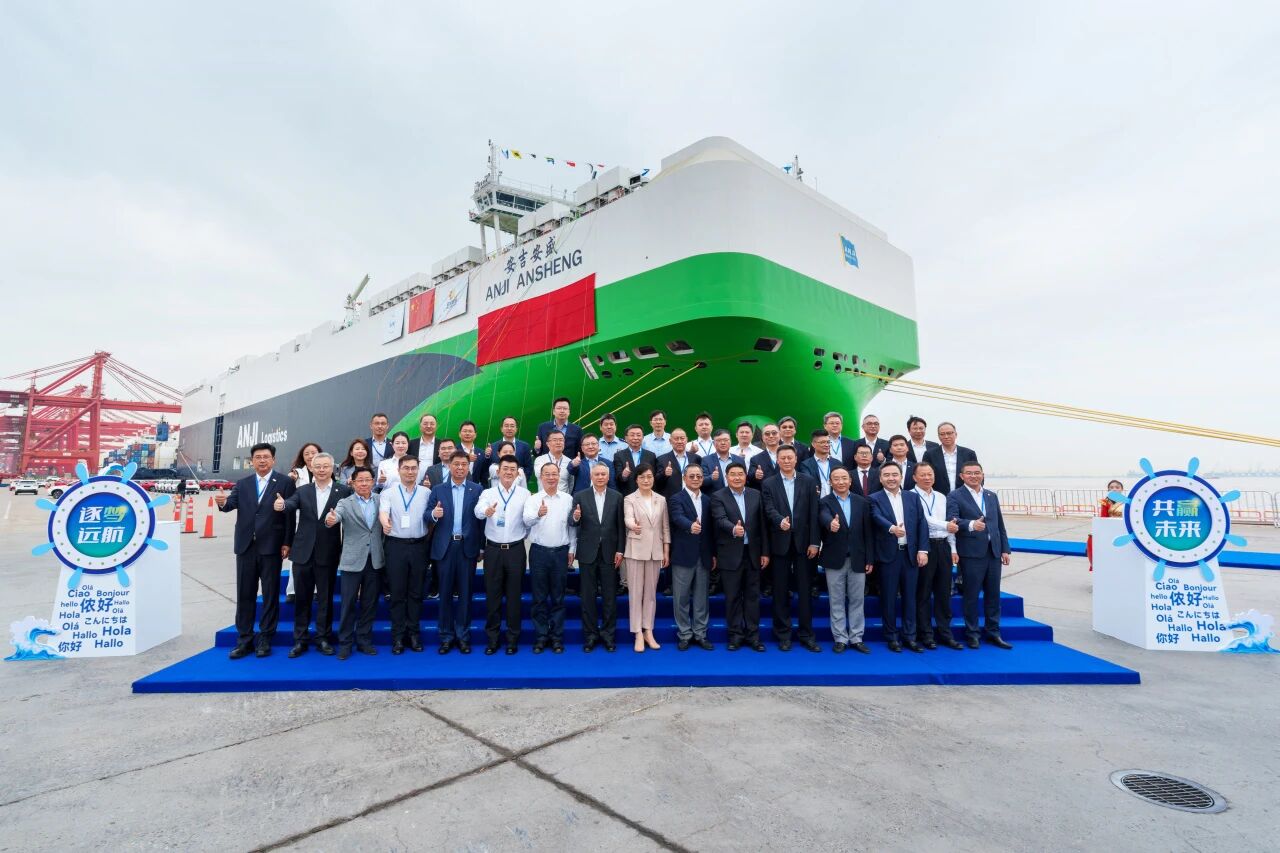
Image Source: SAIC Motor
On May 15, the "Anji Ansheng," a 9,500-car ro-ro ship built by SAIC Motor, made its maiden voyage to Europe. According to SAIC's plans, seven more ultra-large car carriers will be put into service, creating a network of ocean transport routes covering the world's major auto markets. Additionally, BYD's "Shenzhen" and "Xi'an" vessels, along with Chery's first oceangoing ship, have all been launched or delivered.
The surge of "group shipbuilding" by automakers signifies far more than just securing transport and cutting costs. It means China's auto industry is beginning to control the "main artery" of the globalized supply chain, extending industrial autonomy from the production floor to the logistics network. Liu Yan, Deputy Secretary-General of the China Association of Automobile Manufacturers, commented: "A self-controlled supply chain guarantees industrial resilience, while the upgrading of the shipping system opens up the 'last mile' of globalization. The next priority for Chinese brands is to better 'move in' and achieve the leap from 'product exports' to 'industry chain and ecosystem exports.'"
On a broader industrial level, this trend of "ecosystem exports" is equally evident. Battery maker Gotion High-Tech, for example, has established eight R&D centers and 20 production bases globally. To meet the stringent recycling requirements of regulations like the EU's New Battery Law, Gotion plans to establish 99 recycling hubs by 2025 through a mix of self-building and partnerships, systematically constructing an overseas closed-loop system covering the full battery lifecycle.
Charging infrastructure operators are also exploring partnerships with local firms to jointly build networks that meet overseas market standards. A new industrial ecosystem — centered on Chinese NEV technology yet integrated with global localized resources — is gradually taking shape.
Even as it develops rapidly, China's automotive export drive faces an increasingly complex global trade environment and the challenges of localized operations.
First and foremost are the rising trade barriers and compliance requirements. Beyond obvious tariff hikes, the more dangerous, complex, and hidden "reefs" are "technical trade barriers." These include, but are not limited to: the EU's New Battery Law and its strict demands on carbon footprints and recycling rates; unique regulations across nations regarding data security, privacy protection, and autonomous driving standards; and increasingly stringent local production and certification standards in emerging markets.
Chen Weiwei, an analyst at Gasgoo Automotive Research Institute, pointed out: "Targeted containment in the trade policies of major markets is the biggest uncertainty. Currently, the greatest risk lies in whether the EU will impose anti-subsidy tariffs on Chinese PHEVs and HEVs." He further explained: "Since the EU imposed tariffs on Chinese BEVs, automakers have bypassed those barriers by using PHEVs and HEVs as a second growth curve for the European market."
Data shows that China's exports of PHEVs and HEVs to Europe reached 457,000 units in 2025, accounting for 38% of the total. "If this sector is also targeted by tariffs, exports to Europe will see short-term stagnation, and profits will come under immense pressure," warned Chen Weiwei.
The Roland Berger source also noted that meeting overseas localization compliance requirements is the core challenge. He argued: "It is too difficult for a mature model to replace every component just to build a complete overseas supplier system. Automakers inevitably need to bring a group of core component suppliers abroad with them; otherwise, the impact on timing will be massive."
Secondly, there is the "acclimatization" challenge of local operations. Selling cars overseas is merely the first step; truly integrating into local society and building lasting brand influence is a far more arduous marathon. This requires companies to pursue deep localization across every link — R&D, production, marketing, and service.
For example, XPENG has explored four different market models in Europe. It operates a direct agency model in Denmark, while relying primarily on an agency model in other Nordic countries. In the core markets of Germany and France, it has established subsidiaries to work deeply with local dealer networks. In the rest of Europe, it uses a general distributor model for coverage. Meanwhile, XPENG has engaged in cross-border marketing in Norway by sponsoring local cycling events to better connect with the local culture.
Finally, there is the "long-term test" of after-market services. As the installed base overseas surges, a range of services — maintenance, parts supply, used vehicle circulation, and battery recycling — will become decisive factors for brand reputation and customer retention. Zhang Yongwei, Vice Chairman of the China EV 100, noted that exporting a "digitalized, intelligent, and standardized service system" is essential to accelerate integration into global markets. This requires automakers to abandon short-term sales thinking and build an overseas operational system that covers the full vehicle lifecycle.
Conclusion
Looking back at 2025, China's automotive export drive delivered a strong report card. With annual exports breaking the 8-million mark, pure electric and plug-in hybrid models accounting for over 40% of shipments, and a market footprint spanning Asia, Europe, Africa, and the Americas, the arrival of a new era has been declared. This is no longer the old story of exchanging cheap goods for foreign exchange. It is a new narrative — one that relies on advanced technology, a complete industrial chain, and novel business models to participate in and drive the transformation of the global automotive industry.
Yet, the road ahead remains fraught with challenges; it is still a marathon, not a sprint. The year 2025 serves as both a summary of one stage and the beginning of a new chapter.


