According to data from Gasgoo Automotive Institute, the trend toward market consolidation and localization in China's automotive smart components market deepened throughout 2025, characterized increasingly by rapid technological iteration and ecosystem integration. Across core segments such as cockpit domain controllers, domain control chips, HUD, AR-HUD, integrated center screens, integrated instrument clusters, and voice interaction, domestic suppliers took the lead. Leveraging mass production capabilities, agile local supply chains, and deep integration with automaker ecosystems, they strengthened their market influence. Desay SV stood out, topping installation volumes in domain controllers, integrated center screens, and integrated instrument clusters. Foryou Multimedia swept the top spots for HUD and AR-HUD, while iFlytek held its lead in voice interaction with over 40% market share. In the domain control chip market, Qualcomm remained number one, but domestic players like Huawei, SiEngine, and SemiDrive gained ground in both volume and share, accelerating the shift toward local sourcing.
As AR-HUD adoption accelerates, penetration rates for smart screens rise, and voice interaction evolves, the tech battle for smart cockpits has entered a critical phase. Traditional Tier 1 suppliers, tech giants, automakers' in-house R&D teams, and emerging supply chain players are engaging in a multi-dimensional contest across all scenarios. This dynamic is pushing the industry beyond simple localization toward a new phase defined by clear market tiers, deep ecosystem coupling, and distinct innovation. The result is a solid foundation for long-term growth and a more vibrant, diverse competitive landscape.
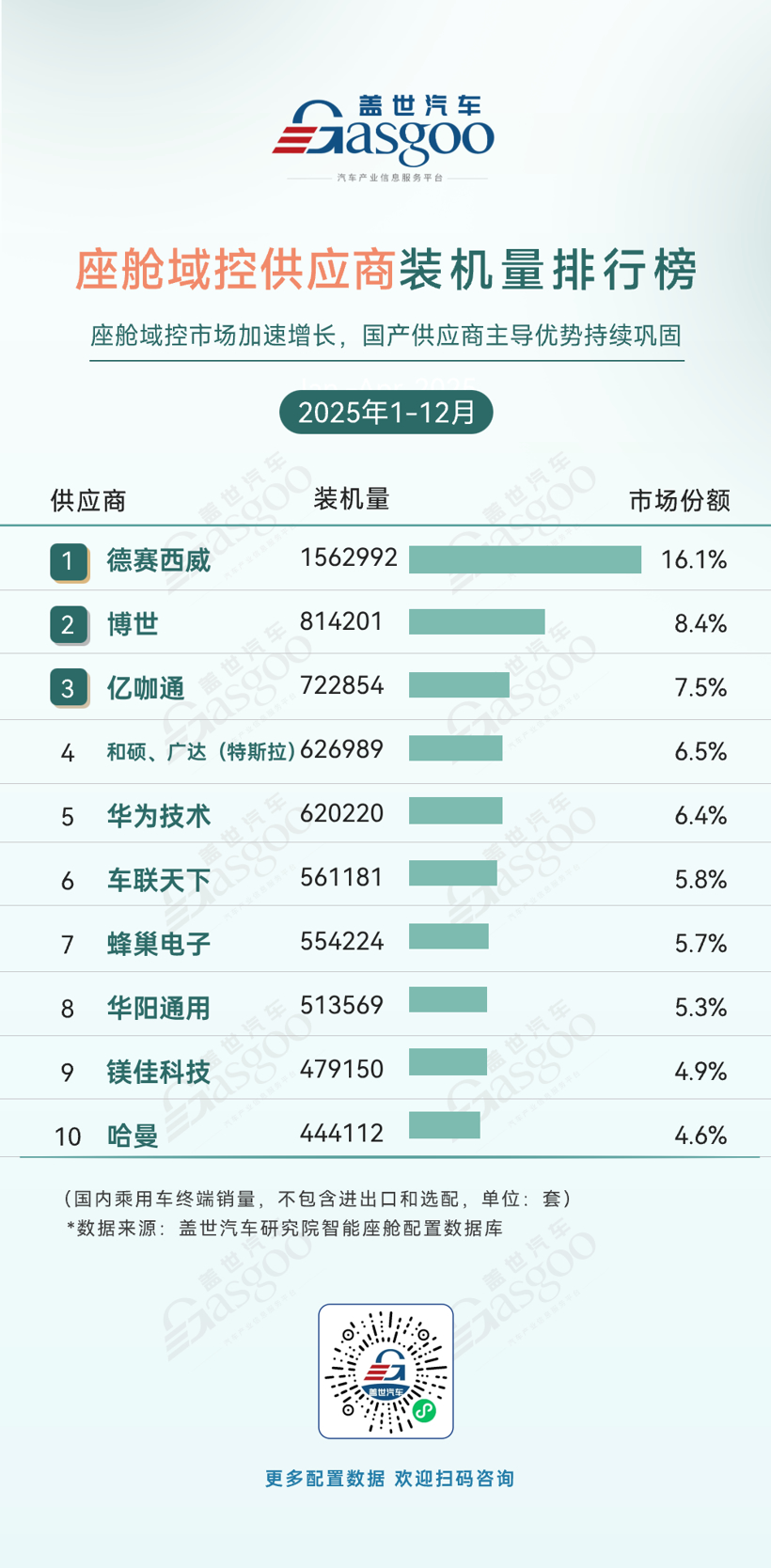
Cockpit Domain Controller Supplier Installation Rankings
Desay SV, Jan-Dec 2025 installation volume: 1.56 million units, market share: 16.1%.
Bosch, Jan-Dec 2025 installation volume: 814,201 units, market share: 8.4%.
ECARX, Jan-Dec 2025 installation volume: 722,854 units, market share: 7.5%.
PEGATRON/Quanta (Tesla), Jan-Dec 2025 installation volume: 626,989 units, market share: 6.5%.
Huawei, Jan-Dec 2025 installation volume: 620,220 units, market share: 6.4%.
Autolink, Jan-Dec 2025 installation volume: 561,181 units, market share: 5.8%.
Fengchao Electronics, Jan-Dec 2025 installation volume: 554,224 units, market share: 5.7%.
Foryou Multimedia General, Jan-Dec 2025 installation volume: 513,569 units, market share: 5.3%.
Megatronix, Jan-Dec 2025 installation volume: 479,150 units, market share: 4.9%.
Harman, Jan-Dec 2025 installation volume: 444,112 units, market share: 4.6%.
Throughout 2025, the cockpit domain controller market expanded, with domestic suppliers tightening their grip. Desay SV surged ahead with over 1.56 million units and a 16.1% share, widening its lead. Bosch followed with 8.4%, forming the market's top tier alongside the leader.
ECARX, Pegatron and Quanta (serving Tesla), and Huawei held steady with shares between 6% and 8%. The involvement of Pegatron and Quanta in Tesla's supply chain, combined with Huawei's tech entry, diversified the competitive landscape. Rounding out the top ten, Autolink, Fengchao Electronics, Foryou Multimedia General, Megatronix, and Harman clustered between 4.6% and 5.8%, separated by narrow margins in a tight contest.
Overall, as cockpit domain control penetration rises and smart demand grows, leading suppliers are leveraging scale and tech experience to stay ahead. Domestic players are amplifying their influence, while international Tier 1s, tech firms, and new supply chain entrants vie for position. Together, they are driving the industry toward smarter, more integrated solutions. The market remains highly concentrated yet teems with diverse competition, signaling sustained vitality.
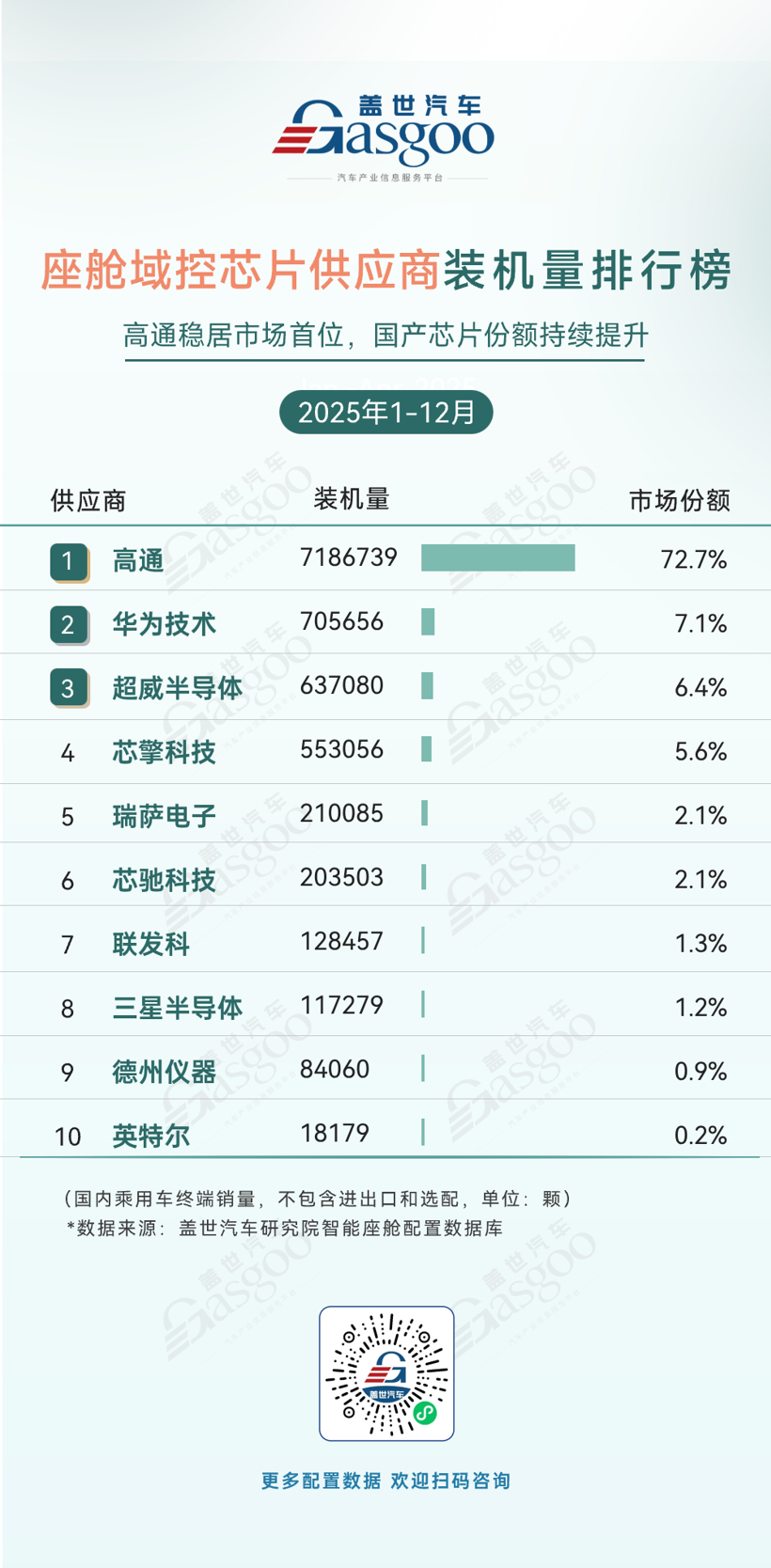
Cockpit Domain Controller Chip Supplier Installation Rankings
Qualcomm, Jan-Dec 2025 installation volume: 7.19 million units, market share: 72.7%.
Huawei, Jan-Dec 2025 installation volume: 705,656 units, market share: 7.1%.
AMD, Jan-Dec 2025 installation volume: 637,080 units, market share: 6.4%.
SiEngine, Jan-Dec 2025 installation volume: 553,056 units, market share: 5.6%.
Renesas, Jan-Dec 2025 installation volume: 210,085 units, market share: 2.1%.
SemiDrive , Jan-Dec 2025 installation volume: 203,503 units, market share: 2.1%.
MediaTek, Jan-Dec 2025 installation volume: 128,457 units, market share: 1.3%.
Samsung, Jan-Dec 2025 installation volume: 117,279 units, market share: 1.2%.
Texas Instruments, Jan-Dec 2025 installation volume: 84,060 units, market share: 0.9%.
Intel, Jan-Dec 2025 installation volume: 18,179 units, market share: 0.2%.
In 2025, the cockpit domain controller chip market remained "highly concentrated at the top, with domestic share steadily rising." Qualcomm dominated with 72.7% share and over 7.19 million units, its tech maturity and supply chain scale proving unmatched. Yet, the domestic chip camp gained momentum: Huawei held second place with 7.1%, while SiEngine and SemiDrive boosted both volume and share. This highlights the technical breakthroughs and commercial success of local chipmakers in the automotive domain.
While Qualcomm's lead looks secure for now, domestic chips are closing the gap fast through tech iteration and market penetration. As local firms sharpen their edge in performance and cost, the market will likely move away from single-player dominance. The industry is set to evolve through multi-party tech competition, becoming smarter and better tailored to local cockpit needs.
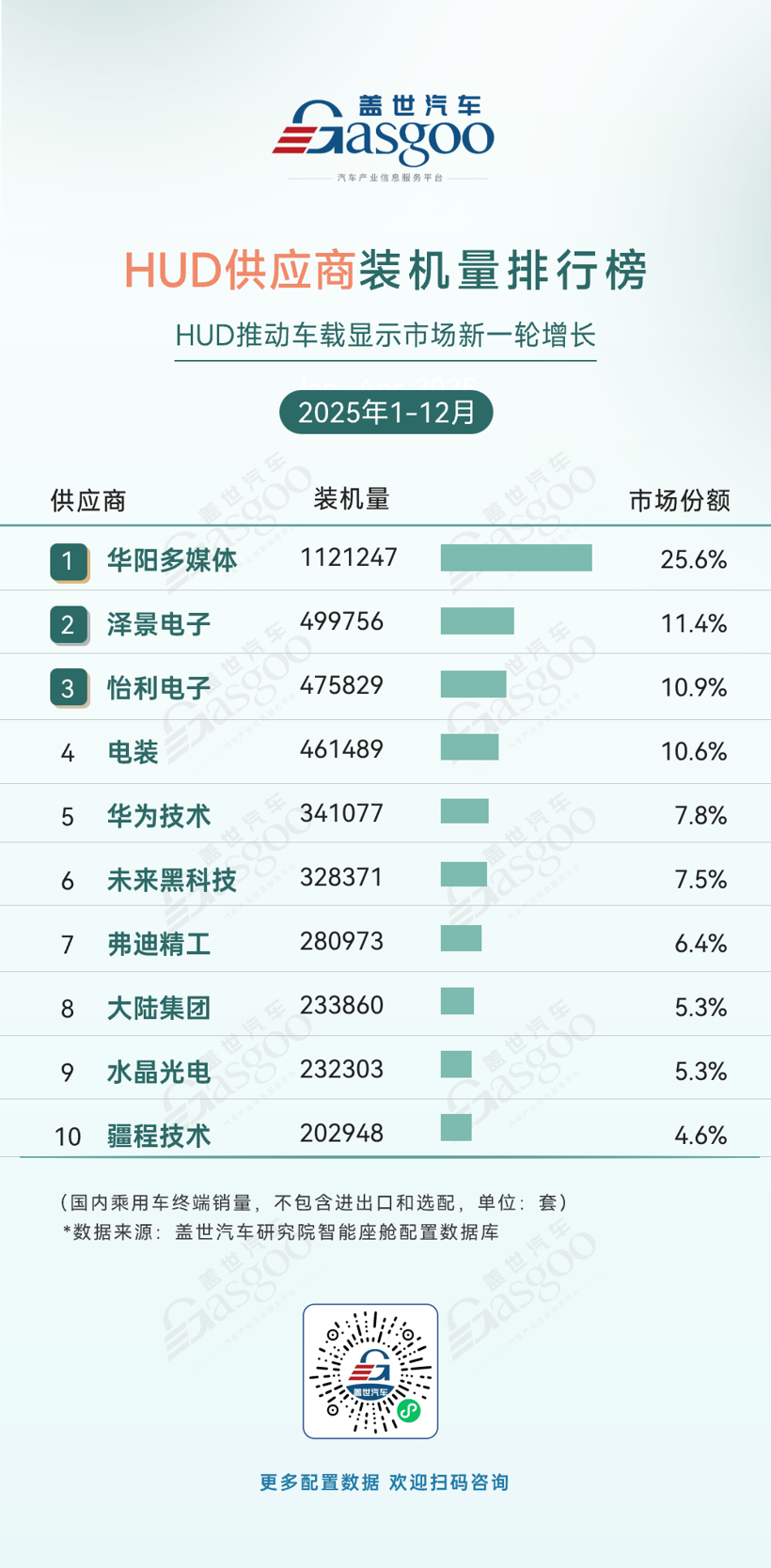
HUD Supplier Installation Rankings
Foryou Multimedia Multimedia, Jan-Dec 2025 installation volume: 1.12 million units, market share: 25.6%.
Jiangsu New Vision Automotive Electronics, Jan-Dec 2025 installation volume: 499,756 units, market share: 11.4%.
E-LEAD Electronics, Jan-Dec 2025 installation volume: 475,829 units, market share: 10.9%.
Denso, Jan-Dec 2025 installation volume: 461,489 units, market share: 10.6%.
Huawei, Jan-Dec 2025 installation volume: 341,077 units, market share: 7.8%.
FUTURUS, Jan-Dec 2025 installation volume: 328,371 units, market share: 7.5%.
FinDreams Precision, Jan-Dec 2025 installation volume: 280,973 units, market share: 6.4%.
Continental, Jan-Dec 2025 installation volume: 233,860 units, market share: 5.3%.
Crystal Optech, Jan-Dec 2025 installation volume: 232,303 units, market share: 5.3%.
Jingcheng Technology, Jan-Dec 2025 installation volume: 202,948 units, market share: 4.6%.
The widespread adoption of HUDs expanded the in-car display market in 2025, creating a landscape of "domestic leadership and diverse competition." Foryou Multimedia Multimedia led with 25.6% share and over 1.12 million units. Jiangsu New Vision Automotive Electronics, E-Lead, and Denso followed with 11.4%, 10.9%, and 10.6% respectively, intensifying the battle among the top tier. Huawei and Future Black Tech showed steady performance, while domestic players like FinDreams Precision competed directly with traditional international Tier 1s like Continental, highlighting the diversity of participants.
As smart cockpit penetration rises, HUD remains a critical interaction point, requiring suppliers to break new ground in tech—such as AR-HUD—ecosystem adaptation, and mass delivery. The industry is seeing a mix of cooperation and rivalry: local firms build service ecosystems through agile response and cost advantages; international Tier 1s maintain technical barriers with precision manufacturing; tech companies drive innovation via cross-domain ecosystem integration. Together, they are pushing HUD toward smarter, more user-centric solutions, injecting fresh momentum into the in-car display sector.
AR-HUD Supplier Installation Rankings
Foryou Multimedia Multimedia, Jan-Dec 2025 installation volume: 346,014 units, market share: 21.5%.
Huawei, Jan-Dec 2025 installation volume: 341,077 units, market share: 21.2%.
E-LEAD Electronics, Jan-Dec 2025 installation volume: 337,568 units, market share: 21.0%.
Crystal Optech, Jan-Dec 2025 installation volume: 201,995 units, market share: 12.5%.
Jiangsu New Vision Automotive Electronics, Jan-Dec 2025 installation volume: 115,989 units, market share: 7.2%.
FinDreams Precision, Jan-Dec 2025 installation volume: 73,831 units, market share: 4.6%.
FUTURUS, Jan-Dec 2025 installation volume: 72,778 units, market share: 4.5%.
Hirain Technologies, Jan-Dec 2025 installation volume: 48,828 units, market share: 3.0%.
Jingcheng Technology, Jan-Dec 2025 installation volume: 22,930 units, market share: 1.4%.
Leapmotor, Jan-Dec 2025 installation volume: 21,589 units, market share: 1.3%.
Domestic suppliers dug deep into AR-HUD in 2025, accelerating tech penetration and creating a market defined by "high concentration at the top and absolute domestic dominance." Foryou Multimedia Multimedia took first place with 21.5% share, followed closely by Huawei at 21.2% and E-Lead at 21.0%. Together, these three captured over 63% of the market, underscoring the core advantage of local firms in mass production and market expansion. Crystal Optech ranked fourth with 12.5%. Zejing and FinDreams focused on niche scenarios and ecosystem synergy, while Leapmotor's entry as an OEM added a new dimension to the competition.
The dominance of domestic players in the AR-HUD market is increasingly secure. Tech production capability and cost control have become the key barriers for suppliers seeking to break through. As the industry enters a critical phase of accelerated adoption and optimization, local suppliers—armed with localization and adaptability—remain the primary engine for market expansion and tech upgrades. They will continue to drive AR-HUD as a core differentiator in in-car displays.
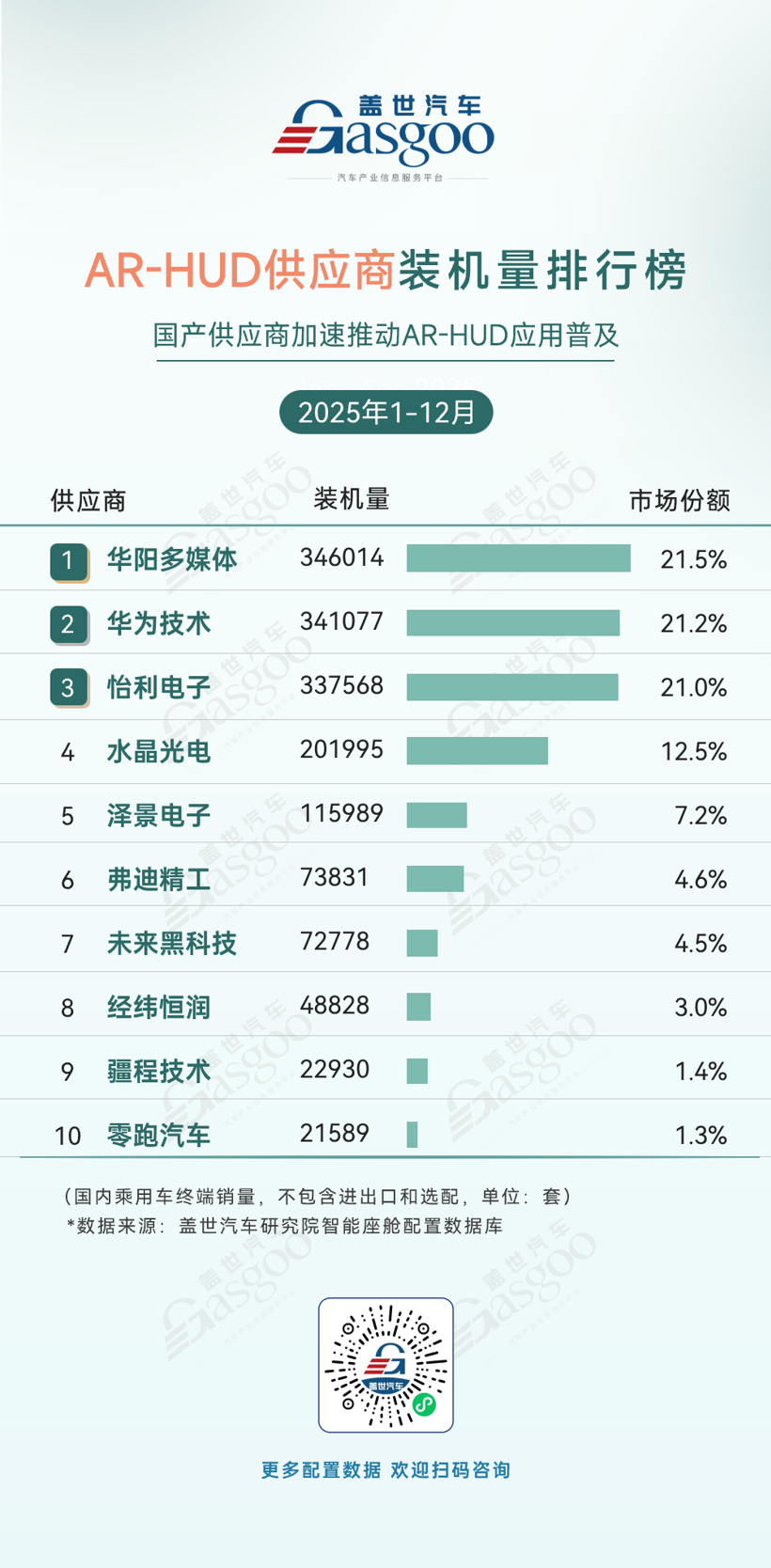
Integrated Center Screen Supplier Installation Rankings
Desay SV, Jan-Dec 2025 installation volume: 3.62 million units, market share: 16.7%.
BYD, Jan-Dec 2025 installation volume: 3.39 million units, market share: 15.6%.
Hangsheng Electronics, Jan-Dec 2025 installation volume: 1.67 million units, market share: 7.7%.
Foryou Multimedia General, Jan-Dec 2025 installation volume: 1.32 million units, market share: 6.1%.
Beidou Intelligent Connected Vehicle Technology, Jan-Dec 2025 installation volume: 915,191 units, market share: 4.2%.
Innolux, Jan-Dec 2025 installation volume: 905,418 units, market share: 4.2%.
Panasonic, Jan-Dec 2025 installation volume: 878,344 units, market share: 4.0%.
Hiway Technology, Jan-Dec 2025 installation volume: 799,571 units, market share: 3.7%.
Fulscience, Jan-Dec 2025 installation volume: 646,645 units, market share: 3.0%.
Lens Technology, Jan-Dec 2025 installation volume: 626,989 units, market share: 2.9%.
The domestic dominance in the center screen market became even more pronounced in 2025. Desay SV held the top spot with 16.7% share and over 3.62 million units. BYD followed closely, leveraging its automaker ecosystem to secure 15.6% share with nearly 3.39 million units. Together, these "local leaders" captured over 32% of the market.
Hangsheng Electronics secured third place with 1.67 million units and 7.7% share, demonstrating strong competitiveness. Foryou Multimedia General followed with 6.1%, forming the industry's second tier alongside Hangsheng Electronics. Beidou Intelligent Connected Vehicle Technology and Innolux were neck-and-neck at 4.2% each. Panasonic, Hiway Technology, Fulscience, and Lens Technology followed, with narrow gaps separating them. These players are driving differentiated competition through niche applications and cost optimization, further diversifying the landscape.
Overall, the shift toward domestic suppliers in center screens has entered a "consolidation phase." Mass production scale and cost control are the core barriers. While leading companies drive widespread adoption, niche players upgrade the experience. Local forces remain the engine of progress, pushing the "standard cockpit" center screen to evolve and compete more aggressively.
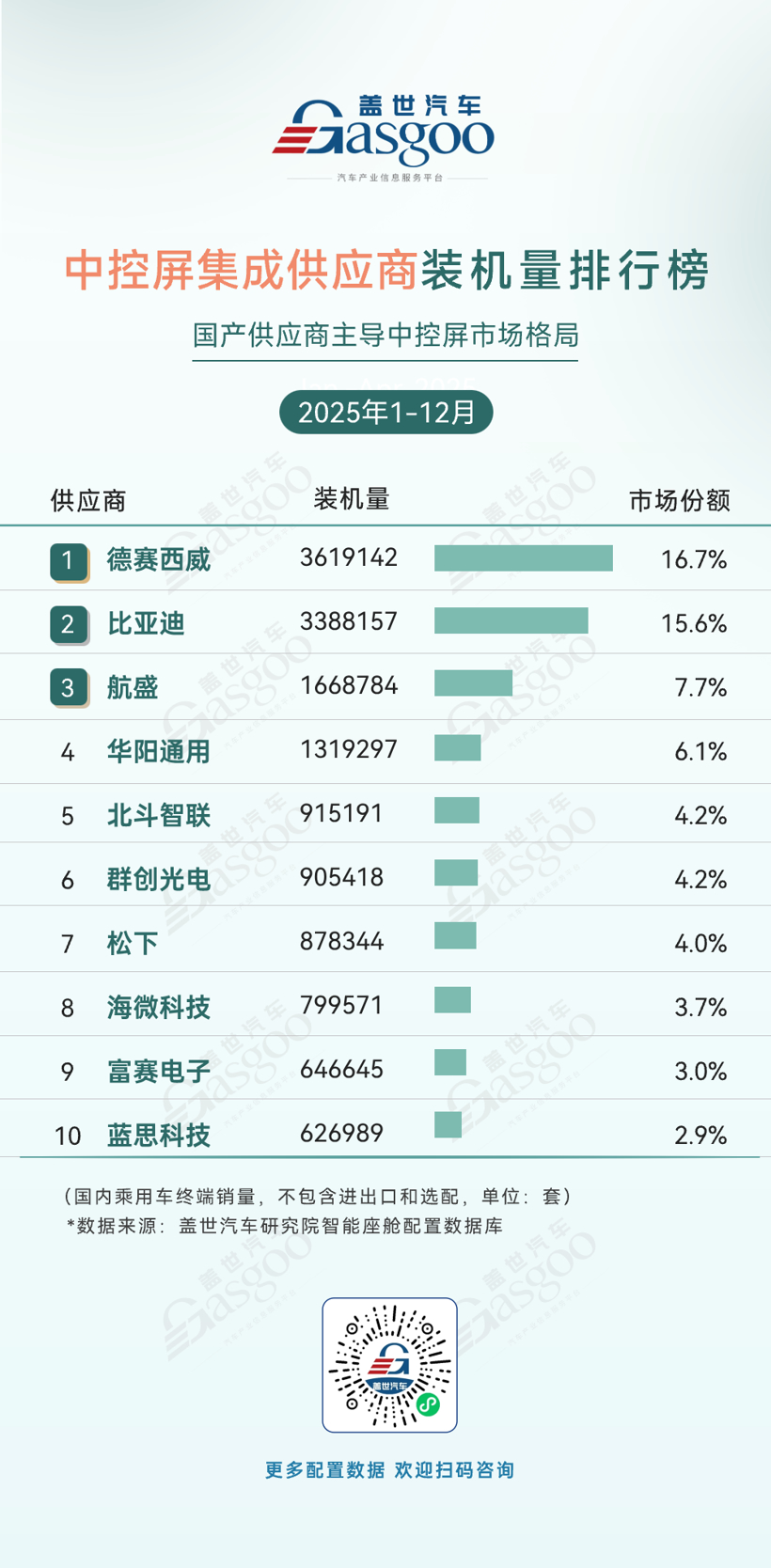
Integrated Instrument Cluster Supplier Installation Rankings
Desay SV, Jan-Dec 2025 installation volume: 2.27 million units, market share: 11.2%.
Heilongjiang Tianyouwei Electronics, Jan-Dec 2025 installation volume: 1.77 million units, market share: 8.7%.
Foryou Multimedia General, Jan-Dec 2025 installation volume: 1.69 million units, market share: 8.3%.
Denso, Jan-Dec 2025 installation volume: 1.52 million units, market share: 7.5%.
Continental, Jan-Dec 2025 installation volume: 1.50 million units, market share: 7.3%.
Visteon, Jan-Dec 2025 installation volume: 1.34 million units, market share: 6.6%.
BYD, Jan-Dec 2025 installation volume: 1.20 million units, market share: 5.9%.
Hangsheng Electronics, Jan-Dec 2025 installation volume: 1.01 million units, market share: 5.0%.
Chongqing Li-Long Technology Industry, Jan-Dec 2025 installation volume: 627,203 units, market share: 3.1%.
LG Electronics, Jan-Dec 2025 installation volume: 581,727 units, market share: 2.9%.
Competition in the liquid instrument cluster market was fierce in 2025, characterized by "coexistence of foreign and domestic players, with local firms standing out." Desay SV led with over 2.27 million units and 11.2% share. Local firms Heilongjiang Tianyouwei Electronics and Foryou Multimedia General followed closely with 8.7% and 8.3% respectively, both surpassing 1.6 million units—a testament to the strong execution capabilities of the local supply chain.
Looking at the tiers, international players like Denso, Continental, and Visteon held between 6.6% and 7.5%. They relied on their tech heritage to hold ground but faced direct pressure from local firms on production efficiency and cost adaptation. Domestic players like BYD and Hangsheng Electronics continued to penetrate the sub-6% range. Chongqing Li-Long Technology Industry and LG Electronics also cracked the top ten.
While market concentration isn't extreme, the hierarchy is clear: local firms are grabbing share through mass production and localized service, while international Tier 1s hold their ground with tech heritage. This rivalry accelerates the adoption of high-definition clusters and upgrades the user experience. The deep involvement of local players highlights the growing momentum of domestic supply chains in core cockpit components.
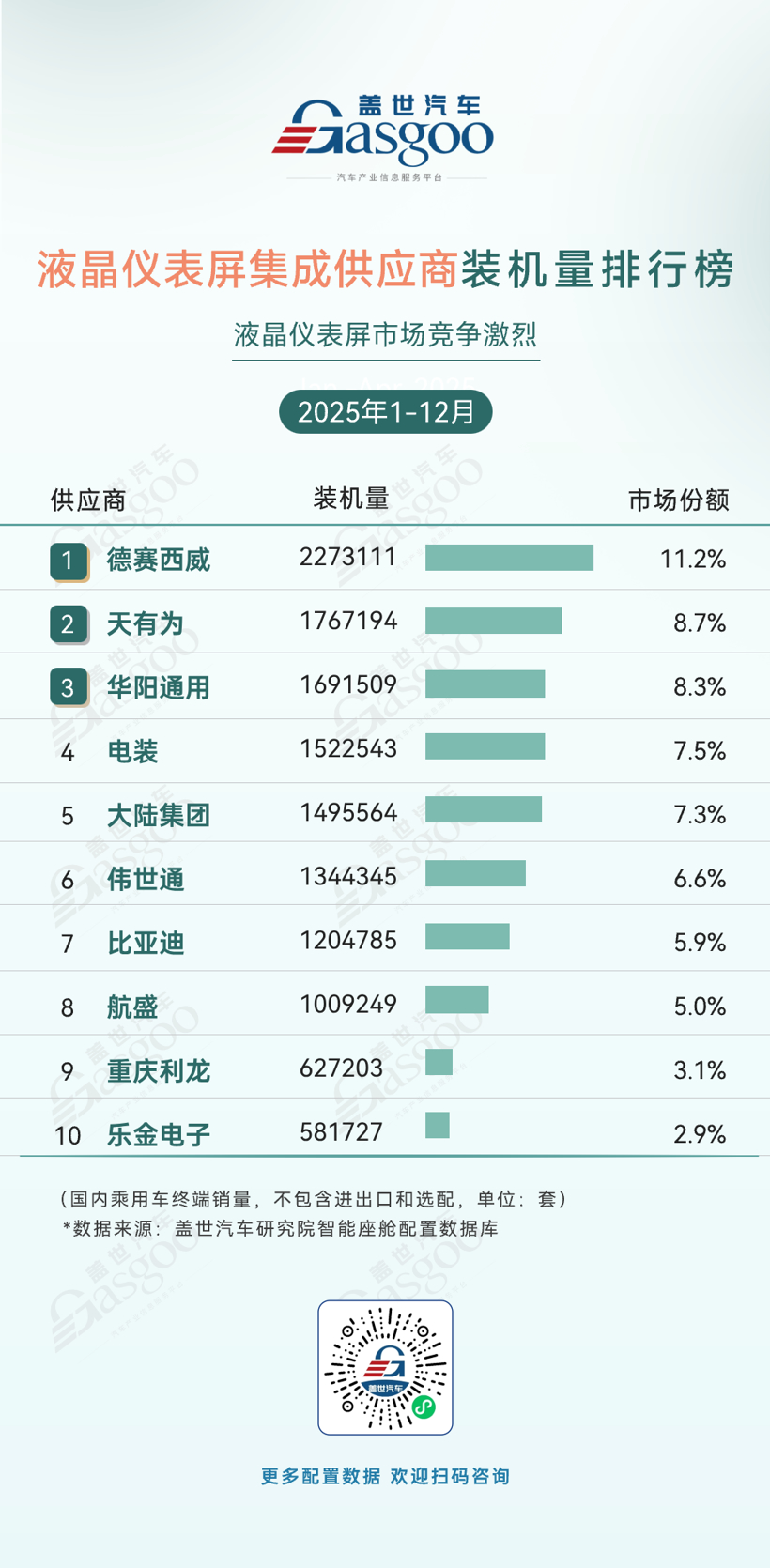
Voice Supplier Installation Rankings
iFlytek, Jan-Dec 2025 installation volume: 8.19 million units, market share: 41.9%.
Aispeech, Jan-Dec 2025 installation volume: 4.30 million units, market share: 22.0%.
Cerence, Jan-Dec 2025 installation volume: 2.50 million units, market share: 12.8%.
Baidu, Jan-Dec 2025 installation volume: 1.29 million units, market share: 6.6%.
DreamSmart Group, Jan-Dec 2025 installation volume: 1.18 million units, market share: 6.0%.
Tesla, Jan-Dec 2025 installation volume: 626,989 units, market share: 3.2%.
Xiaomi EV, Jan-Dec 2025 installation volume: 410,391 units, market share: 2.1%.
VW-Mobvoi , Jan-Dec 2025 installation volume: 327,763 units, market share: 1.7%.
XPENG, Jan-Dec 2025 installation volume: 186,221 units, market share: 1.0%.
Megatronix, Jan-Dec 2025 installation volume: 181,934 units, market share: 0.9%.
In-vehicle voice interaction continued to evolve in 2025, with the market clearly showing "domestic leadership and high concentration." iFlytek sat firmly at the top with 8.19 million units and 41.9% share, building a strong moat through tech and ecosystem adaptation. Aispeech followed with 4.30 million units and 22.0%. Together, they captured over 63% of the market, cementing local dominance. Cerence joined the top three with 12.8% share, adding key international presence to the leading pack.
Baidu and DreamSmart Group held 6.6% and 6.0% respectively. The former leverages its internet ecosystem to expand voice scenarios, while the latter uses automaker ties for precise deployment—reflecting the "tech plus ecosystem" logic of the race. Tesla, Xiaomi EV, and XPENG entered with in-house voice solutions, taking 3.2%, 2.1%, and 1.0% respectively. VW-Mobvoi and Megatronix also made the top ten with sub-2% shares, injecting diverse vitality into the market.
Ultimately, the core competitiveness in voice lies in iteration speed and scenario adaptation. The shift to domestic suppliers is not just stable but accelerating, with leaders driving better interaction experiences. The market shows both fixed dominance among top players and room for niche innovation by smaller ones. Domestic suppliers remain the primary engine advancing in-vehicle voice interaction.
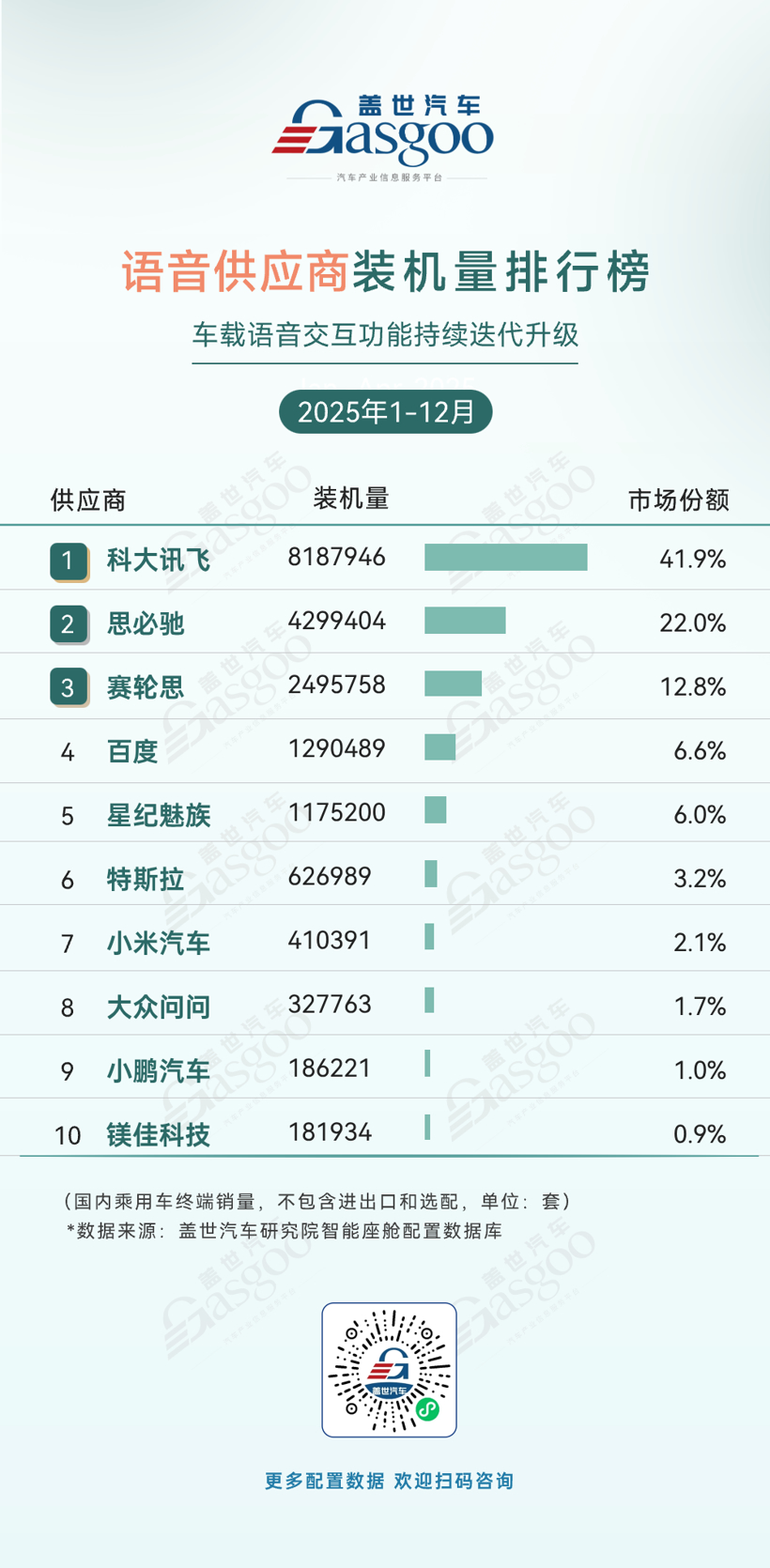
Data Source: Gasgoo Automotive Institute Smart Cockpit Configuration Database
— Recommended Content —