



Gasgoo Munich-On June 11, JD.com struck a comprehensive partnership with robot rental platform Jishizu.
The two parties will collaborate in key areas. These include equipment leasing, global supply chain logistics, maintenance, after-sales, insurance, recycling, secondary development, and data collection. They aim to build a full-link service system covering leasing, logistics, maintenance, insurance, recycling, and custom development. This will accelerate the large-scale deployment of embodied robots in commercial and household settings globally.
This marks JD.com’s second partnership in the robot leasing sector within a month. On May 21, the company announced a collaboration with Qingtianzu to accelerate the mass adoption of embodied robots.
Over the past year, a clear trend has emerged. JD.com is accelerating efforts to build an embodied intelligence ecosystem spanning the entire industry chain. The strategy revolves around data-empowered R&D, scenario-driven applications, and a comprehensive sales and after-sales network.
A Business Closed Loop Takes Shape
The commercialization of embodied intelligence currently faces three critical hurdles.
Technical iteration demands vast amounts of real-world data. However, acquisition costs are high and quality varies. Refining products requires diverse application scenarios, yet these resources are scarce and fragmented. Scaling up demands a robust after-sales system, but the industry is in its infancy, lacking established service mechanisms.
JD.com is addressing all three challenges with a single closed-loop solution.
On the data front, JD.com is building the world’s largest data collection center for embodied intelligence.
In March, the company announced plans to mobilize hundreds of thousands for data collection. This includes over 100,000 internal employees and 500,000 external industry professionals. In Suqian alone, more than 100,000 citizens will participate. They will cover over 100 specific scenarios ranging from homes and offices to factories, logistics, retail, restaurants, healthcare, and sanitation.

Image Source: Suqian Release
The goal is to accumulate 5 million hours of real-world video data within a year. This surpasses 10 million hours in two years. Simultaneously, the company will collect 1 million hours of data from the robots themselves.
In mid-April, JD.com unveiled its embodied intelligence data infrastructure. It covers the entire chain: collection, storage, labeling, training, evaluation, simulation, and testing. The aim is to create a seamless closed loop from data gathering to model validation. JD Cloud also launched the self-developed JoyEgoCam. This wearable ultra-high-definition collection terminal was released alongside an embodied intelligence data trading platform, which initially provided 2,000 hours of high-precision annotated datasets.
The Suqian center can reportedly accommodate nearly 10,000 people working simultaneously. JD.com is extending its data collection into community services and industrial production lines. It is establishing a "community crowdsourcing + industrial fixed-point" dual-track collection model.
Data is merely the "fuel." For embodied robots to achieve mass adoption, they need real-world scenarios to serve as "training grounds."
This is precisely where JD.com holds a unique defensive moat.
Statistics show that by the end of 2025, offline service scenarios will expand significantly. Stores represented by JD Home, JD Computer Digital, and JD Mobile Digital will exceed 4,500. JD MALL will have 26 locations nationwide. JD Electrical City Flagship stores will surpass 110. JD Auto Care will top 4,000. JD Outlets will have established a presence in over 50 cities.
Additionally, JD Logistics operates over 3,600 warehouses of various types in China. It also manages nearly 200 bonded, direct-mail, and overseas warehouses across 25 countries and regions.
These represent potential deployment sites for embodied robots. Consequently, JD.com has developed its own robots. It has begun deploying them across these sectors.
Guided by a "pack collaboration" philosophy, JD Logistics has incubated a "Wolf Pack" of embodied robots. These cover the entire logistics chain, including storage, handling, sorting, and last-mile delivery. Systems like the "Smart Wolf" goods-to-person setup, "Sky Wolf" pallet-to-person system, "Ground Wolf" handling robots, "Lone Wolf" autonomous vehicles, and "Flying Wolf" drones are already in use. They operate at scale in dozens of countries.
Beyond logistics, JD.com is actively pushing embodied robots into brick-and-mortar stores.
Recently, JD MALL welcomed its first batch of "intern" robot employees. Several intelligent robots have officially joined the store. They provide operational support for roles including reception, guided navigation, smart shopping assistance, shelving, and store security.
Notably, these robot interns at JD MALL have been assigned specialized roles.
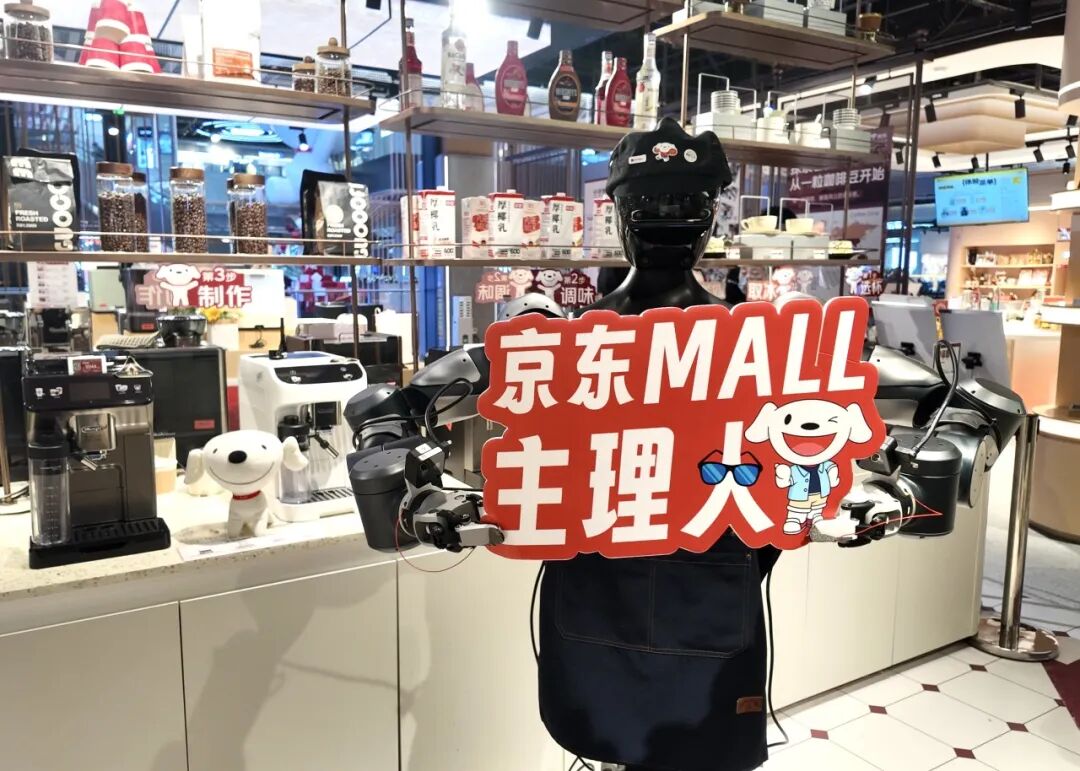
Image Source: Qianxun Intelligence
For instance, the Zhiyuan X2 handles reception. It guides customers to restrooms, service desks, and brand counters. The Unitree Go2 serves as a shopping guide. It leads customers through specific sections and adjusts routes in real time based on their needs. The Zhiyuan G2 and Realman RealBOT handle shelving tasks. They perform standardized operations like stocking, organizing, storage, and even making beds. Meanwhile, the Zhongqing shopping assistant robot provides intelligent consultation and purchasing support. It syncs real-time data on specifications, discounts, and inventory.
Under a previous plan by JD Logistics, the company aims to purchase 3 million robots. It also plans to buy 1 million autonomous vehicles and 100,000 drones over the next five years. Deploying these across the entire supply chain will cement its technological leadership in smart logistics.
The sales and after-sales service ecosystem forms another crucial pillar of JD.com’s embodied robotics strategy.
Sales are a given. As a leading e-commerce platform, JD.com boasts a vast customer base. This allows it to reach enterprise and consumer clients directly, accelerating market penetration for embodied robots.
In August 2025, JD.com launched the "Smart Robot Industry Acceleration Plan." It pledged to invest over 10 billion yuan in the sector. The goal is to help 100 smart robot brands exceed 1 billion yuan in sales within three years. It also aims to deploy robots in over 1 million end-use scenarios.
Widespread market entry will inevitably generate massive demand for maintenance and repairs. JD.com is preparing for this by establishing repair centers nationwide to service embodied robots and other cutting-edge products.

Image Source: JD Logistics
When the JD Service Technology Training and Certification Center opened in September 2025, it introduced specialized maintenance courses. These courses covered brands like Unitree, Zhiyuan, DeepRobotics, and Zhongqing. It trained hundreds of specialized robot repair engineers.
This April, JD.com unveiled its "Robot Ambulance" service. It covers basic repairs, fault diagnosis, battery swapping, testing, cosmetic maintenance, and equipment recycling. The service is currently operational in Beijing.
On-site repairs are available in 10 cities, including Beijing, Shanghai, Guangzhou, and Shenzhen. Post-sale debugging and routine maintenance are offered for various robot types. Over the next three years, the company plans to expand its on-site repair network to over 50 core cities.
JD.com has extended its on-site repair services to European countries like the UK and Germany. It plans to continue expanding into Europe, North America, the Middle East, and the Asia-Pacific. By offering localized "Robot Ambulance" services overseas, faulty robots can be repaired locally. This significantly cuts costs for businesses and consumers.
JD.com is also building a circular economy for robots. It recently launched a recycling service including door-to-door pickup, professional testing and grading, refurbishment, and compliant scrapping. The service is initially available in core cities like Beijing, Shanghai, Guangzhou, and Shenzhen. It covers categories such as humanoid robots, quadrupeds, AI companions, exoskeletons, and various commercial robots for cleaning, serving, and reception.
To support the rapid expansion of this maintenance network, JD.com has launched a talent recruitment drive. The plan is to hire over 10,000 professional robot repair technicians in the next three years. It aims to build a high-quality, specialized workforce through systematic training and hands-on experience.
This means JD.com now has an institutionalized service solution for every stage of a robot’s lifecycle. It covers sales, leasing, usage, inspection, maintenance, refurbishment, and recycling.
Why JD.com?
If the "data-scenario-ecosystem" loop explains what JD.com is doing, the deeper question remains. Why is the company committing so heavily to this bet?
The answer is straightforward. Cutting costs and boosting efficiency is the immediate priority. Securing a position in the ecosystem is the mid-term strategy. Betting on the future is the long-term play. These three layers of logic underpin JD.com’s aggressive wager on embodied intelligence.
Layer One: Cost Reduction and Efficiency. The math is simple.
JD.com’s investment in robotics begins with a simple fact. Robots actually save money.

Image Source: JD Logistics
It is an industry consensus that logistics costs remain high as a percentage of total supply chain expenses. JD.com’s response is to replace humans with machines for repetitive, heavy, and dangerous tasks.
Every robot deployed shows up directly on the balance sheet under "fulfillment costs." For a company whose lifeline is supply chain efficiency, the calculation is easy. The urgency is real.
Layer Two: Ecosystem Positioning. From Sales Channel to Rule Maker.
Saving money is just the starting point. JD.com’s greater ambition lies in redefining its own identity.
The world has long viewed JD.com as an e-commerce platform. But in the emerging arena of embodied intelligence, the company is rewriting its role. It is no longer content to be a "sales channel" for robot brands. It aims to become the "ecosystem connector" for the entire industry.
How? Through investment, for one.
In 2025, JD.com made investments in six companies. These include Zhiyuan Robot, Qianxun Intelligence, Pansi Perception, Ziji Dynamics, Zhongqing Robot, and RoboScience. The portfolio covers nearly every critical node of the embodied intelligence supply chain, from hardware bodies to components, motion control to large models.
These are not financial investments, but strategic moves. They pull promising startups into the ecosystem, paving the way for future data collection, scenario deployment, and channel distribution.
Second, by establishing cognitive standards.
JD.com’s 10-billion-yuan support plan is designed to do one thing. It aims to make "Buy robots, go to JD" the top choice for consumers. It also seeks to make "Build robots, partner with JD" the priority for manufacturers.

Image Source: JD Logistics
While the industry is still in its "wild growth" phase, whoever helps consumers establish cognitive standards first will seize the industry's leadership. JD.com aims to secure this position.
Layer Three: Betting on the Future. Making Moves for the Next Decade.
If the first two layers are extensions of its e-commerce and logistics businesses, the third represents a strategic leap. It is a true strategic leap for JD.com.
Consumer expectations for robots are shifting. People want robots that handle chores, assist with childcare, or provide companionship for the elderly. These needs are moving from imagination to concrete purchasing intent. JD.com clearly sees this shift.
That is why everything JD.com is doing now is preparation. From collecting data and empowering scenarios to building retail networks and establishing after-sales systems, it prepares for a future where robots enter millions of homes.


