



Gasgoo Munich- Zhejiang Linghao Thermal Control Co., Ltd. has officially been established, according to corporate registry data. The new entity, led by legal representative Song Yining, has a registered capital of 72 million yuan. Its business scope spans the manufacturing of automotive components and battery parts, as well as the sales of electrical accessories for new energy vehicles.
Equity filings reveal Zhejiang Linghao is wholly owned by Zhejiang Lingxiao Energy Technology, a subsidiary of Leapmotor. For an automaker defined by its "full-domain self-research" strategy, this marks another critical move into core components.
This isn't Leapmotor's first push upstream. The company has long committed to full-domain self-research, striving to master everything from the "three electrics"—motor, battery, and electronic control—to smart driving and cockpit software. The launch of Zhejiang Linghao, specifically targeting thermal control and battery components, is a natural extension of that doctrine.
As industry competition pivots toward "technological depth" and "supply chain resilience," Leapmotor's positioning speaks to its need for tighter cost controls and faster tech iteration. It also reflects a broader industry push for supply chain security and technological autonomy.
Vertical Integration: Going Deeper
Leapmotor's strategy follows a clear evolutionary path. From the outset, it focused on in-house development of core technologies like electric drive, batteries, and battery management systems. Its "eight-in-one" electric drive system highly integrates components like the drive motor and controller, optimizing both volume and weight.
In batteries, Leapmotor develops its own modules and packs and pioneered CTC (Cell-to-Chassis) technology, deeply integrating the battery with the chassis to boost space utilization and range. These investments form the technical bedrock of its product competitiveness.
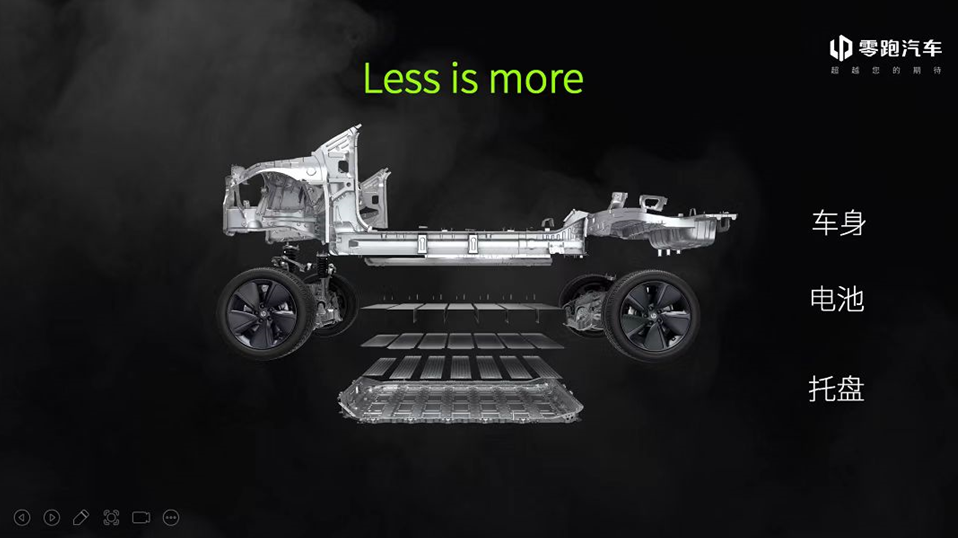
Image Source: Leapmotor
Yet, as EV technology matures, the battleground is shifting from raw "three electrics" performance to more nuanced domains. Among them, thermal management is taking center stage.
For electric vehicles, thermal management is critical—it dictates battery charging efficiency, lifespan, and safety, as well as motor performance. It is also central to resolving the consumer pain point of winter range. An efficient system enables the precise distribution and recycling of heat across the battery, motor, and cabin, significantly improving overall energy efficiency.
The creation of Zhejiang Linghao signals Leapmotor's strategic focus on this domain. The "thermal control" in its name is telling. Combined with its existing battery and electric drive capabilities, the intent is clear: convert thermal management from a purchased "black box" into a self-designed, self-made "white box," achieving integrated design from the cell to the vehicle level.
This deepening vertical integration offers multiple benefits. First is technological synergy and system efficiency. When thermal management systems are designed in sync with proprietary battery packs and electric drives, engineers can tailor thermal strategies precisely to battery charging characteristics and motor heat generation.
For instance, within a CTC architecture, the thermal system can be more tightly integrated with the battery pack structure, allowing for more efficient cooling or heating channels. Such end-to-end optimization is difficult to achieve by simply assembling parts from different suppliers. By bringing thermal management in-house, Leapmotor aims to build unique advantages in low-temperature battery performance, fast-charging heat dissipation, and overall energy consumption—directly enhancing the user experience.
Second is improved cost control and supply chain resilience. The ratio of self-made components directly dictates a company's ability to control vehicle costs. By manufacturing thermal systems and their core components internally, Leapmotor retains that margin within the group and drives continuous cost optimization.
More importantly, against a backdrop of frequent supply chain volatility, possessing autonomous production capacity for core components allows a company to mitigate risks from supplier shortages, technology blockades, or geopolitical friction. Zhejiang Linghao represents a critical line of defense for Leapmotor's supply chain security.
Third is the creation of product differentiation and a defensive moat. When every automaker sources mature thermal solutions from the same top-tier suppliers, it becomes difficult to create a performance gap between products.
Through in-house development, however, Leapmotor can engineer thermal systems with unique advantages tailored to its specific product positioning. This deep customization capability will serve as a competitive moat that is difficult for rivals to replicate.
Opportunities and Challenges of Full-Domain Self-Research
Leapmotor's continued investment in core components via Zhejiang Linghao reflects more than a single company's strategy; it is a microcosm of the EV industry's evolution into a new phase. As the sector shifts from the first half of the game—"electrification"—to the second half—"intelligence"—the debate between "vertical integration" and "open cooperation" is becoming increasingly complex.
On one hand, vertical integration is demonstrating strong vitality in the current phase. Its core advantage is "certainty." For companies with long-term ambitions, holding core technology internally means total control over product definition, iteration pace, and cost structure. Tesla has validated this model to the extreme, building high efficiency and barriers through in-house development of chips, batteries, software, and even manufacturing processes.
Image Source: Leapmotor
Leapmotor is treading a similar path. While the scale differs, the strategic logic is consistent: in the early stages of a rapidly evolving industry, in-house development ensures technological alignment with product planning. It enables deep hardware-software coupling and accelerates the conversion of cutting-edge technology into mass-produced vehicles.
The establishment of Zhejiang Linghao can be seen as Leapmotor's attempt to extend this "certainty" from electric drive and batteries to thermal management and other core subsystems, replicating its successful model of "cost reduction through technology" and "efficiency leadership."
On the other hand, vertical integration presents severe challenges. Foremost is the massive R&D investment and capital expenditure. Developing technology in-house requires building high-caliber teams, laboratories, and enduring lengthy testing cycles. From batteries to electric drives to thermal management, every self-research initiative tests cash flow and profitability. For Leapmotor, which has not yet achieved sustained profitability, balancing tech investment with financial health remains a long-term challenge.
Second is the dual risk of technology and market. In-house development means betting the company on its own technological roadmap. If the strategic judgment is flawed, or if the market shifts toward a more cost-effective supplier solution, massive R&D investments could become sunk costs. Furthermore, pouring resources into self-research can mean missing opportunities to collaborate with external partners and absorb industry best practices.
Therefore, Leapmotor's "full-domain self-research" strategy is best viewed as "selective, phased deep integration." The company does not aim to do everything itself; for instance, it still cooperates with leading suppliers in areas like smart driving chips and certain sensors. Its self-research focus remains fixed on the "three electrics" and related fields that are fundamental to vehicle performance, cost, and safety.
The core of this strategy lies in identifying the segments of the supply chain that offer the highest value, the greatest potential for differentiation, and the best match with the company's own technical capabilities—then deepening R&D there to seize the competitive initiative.
Looking ahead, Leapmotor's efforts to tighten its grip on core components through entities like Zhejiang Linghao are poised to deliver long-term strategic advantages. As the EV sector enters an "elimination round," the true competition is returning to the essentials: technological depth, cost control, and supply chain efficiency.
Leapmotor's path of vertical integration carries heavy upfront pressure, but once its technology matures and economies of scale kick in, the systemic advantages it builds will be difficult to dislodge. This approach will not only yield better vehicle gross margins but also enable faster responses to market demands, granting the company greater flexibility in pricing and product definition.


