



The start of 2026 has brought strong momentum for BAIC Group: January total sales hit 118,000 units. Proprietary brands broke through 74,000 units — an 11% year-on-year jump — while overseas sales surpassed 26,000, climbing 16%. Star performer BAIC BluePark sustained its high growth from 2025, delivering 8,073 vehicles in January for an 11.83% gain.
Looking back at 2025, full-year sales topped 200,000 units — a staggering 84.06% surge — cementing its role as a critical engine for the group's transformation.
Yet, this upward sales trajectory stands in sharp contrast to deep-seated pressure on the group's overall profitability. Although BAIC BluePark, the core listed entity, doubled its sales volume, it is still expected to report a net loss in the billions of yuan for 2025. That said, the deficit has narrowed significantly compared to the massive 6.948-billion-yuan loss incurred in 2024.
This mix of surging sales and continuous profit bleeding — a state of ice and fire — perfectly captures the dilemma facing China's large traditional automakers at the crossroads of electrification: the pain of shifting momentum coexists with the hope of renewal.
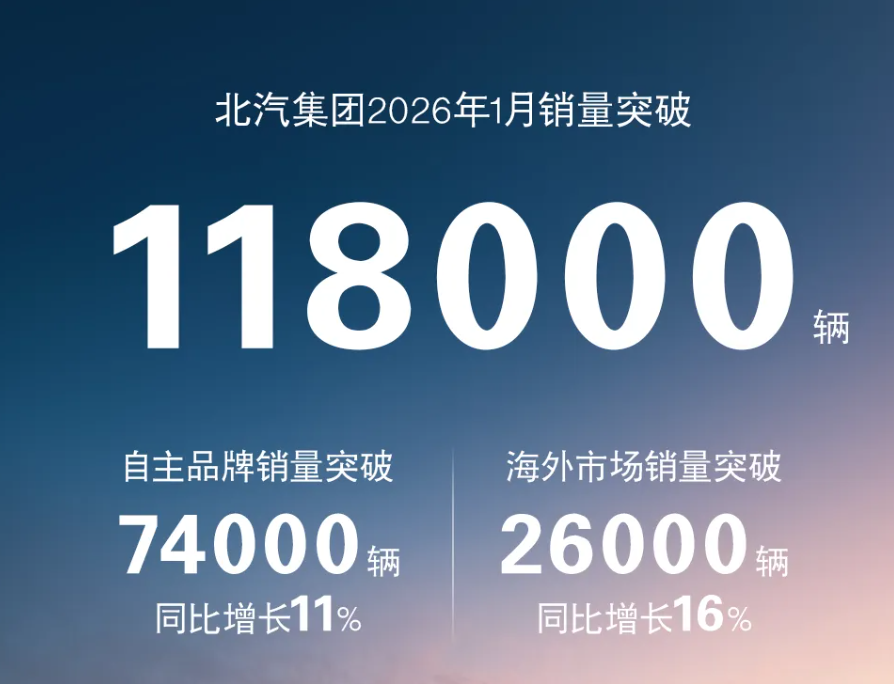
Image Source: BAIC
Proprietary Brands Are the Hope
BAIC Group's recent sales recovery is no accident; it is the result of strategic focus, product adjustments, and market opportunity aligning. The full-force drive of its proprietary brands is the primary engine.
Under BAIC BluePark, the premium-positioned Stelato brand delivered a standout performance, with January deliveries exceeding 6,000 units, establishing itself as a key growth pole and brand benchmark.
Meanwhile, the Arcfox brand's strategy of offering more cost-effective models, combined with Beijing Off-road's precise entry into the 'boxy' SUV trend with rugged models like the BJ40, jointly drove the proprietary sector's overall 11% year-on-year growth.
This marks a decline in BAIC's reliance on joint venture operations and signals tangible, phased success in its proprietary transformation.
The successful expansion of overseas markets offers BAIC a robust 'second growth curve.' The group is accelerating its global layout; while cultivating core markets, it is innovatively using models like technology licensing and localized production (SKD) to effectively bypass trade barriers.
In 2025, the group's export volume hit a record high, and January overseas sales maintained a 16% year-on-year increase. This not only boosts volume but also offers the potential to improve the overall profit structure thanks to relatively better margins.
From an industry perspective, BAIC's growth benefits from a rapid response to trends. Its product lineup is actively pivoting toward electrification and intelligence: Stelato has secured its footing in the high-end smart market, Arcfox is deploying a dual-track strategy of range-extenders and pure electrics, and the company was among the first to obtain L3-level autonomous driving permits, elevating its technical image.
At the same time, the stimulus effect of the phase-out of new energy vehicle subsidies at the end of 2025 brought a periodic market bonus to some of its high-value models.
To consolidate this growth momentum, BAIC has planned a dense and extensive new vehicle matrix for 2026, aiming to fully cover mainstream consumer hotspots.
The Arcfox brand will deepen its 'pure electric + range-extender' dual-track approach, planning to launch an Alpha S5 EREV version, a new mid-size sedan Alpha S3 (BEV/EREV), and a large 7-seater EREV MPV targeting the business travel market.
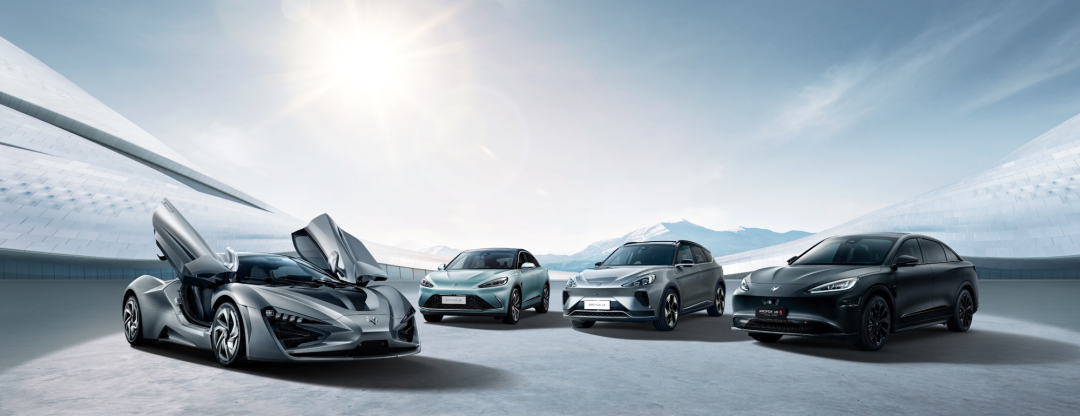
Image Source: BAIC Arcfox
Building on the hit BJ40, the Beijing Off-road brand plans to launch a personalized, co-created version based on the BJ80, with a total of six new models scheduled for release throughout the year.
Stelato, meanwhile, plans to break out of the single sedan category and expand into all-terrain SUVs and high-end MPVs, further perfecting its premium product matrix to support its ambition of doubling sales.
This series of plans indicates that BAIC is attempting to maximize market coverage through a combination of multi-brand, multi-powertrain, and multi-category strategies, turning phased growth into sustainable competitive advantage.
A State of Ice and Fire
BAIC's current 'ice and fire' situation reveals the complex time lag and structural obstacles between scale expansion and profit realization.
Rapid sales growth holds strategic value that cannot be ignored. First, it signals the initial emergence of economies of scale. As proprietary brand annual sales leap onto the 200,000 or even one-million-unit platform, massive fixed costs for R&D, manufacturing, and channels are diluted, laying the physical foundation for future profitability.
Second, it represents a fundamental optimization of the operational structure. The rising share of the proprietary sector reduces the group's reliance on a single joint venture partner for profit and enhances self-control.
Finally, the success of star models has significantly boosted confidence in BAIC's transformation among both the market and investors, creating conditions for subsequent financing and technology investment.
However, beneath the dazzling sales data, the shadow of losses remains heavy, stemming from three core reasons.
The most direct pressure comes from the rapid shrinking of the traditional 'cash cow.' Beijing Benz, the group's long-standing core profit source, saw a significant decline in both sales and profit in 2025, while Beijing Hyundai is still in the process of turning around its losses.
The cash flow contribution from the joint venture sector has shrunk sharply, while the profitability of the proprietary sector is not yet sufficient to fill the gap, putting pressure on the group's overall profit and loss statement.
A deeper reason lies in the fact that the proprietary new energy business itself is still in a period of high-intensity strategic investment. Take BAIC BluePark as an example: even as revenue soars with sales volume, massive R&D spending, marketing costs driven by fierce competition, and channel expansion costs are collectively devouring gross margins.
Currently, its sales growth is largely the result of a 'trading price for volume' strategy, and it has not yet formed a virtuous cycle of strong brand premium and per-vehicle profitability.
Furthermore, an extremely hyper-competitive market environment is squeezing profit margins for all players. The normalization of industry price wars and high supply chain costs are pressuring automakers on both the 'revenue' and 'cost' fronts. While BAIC enjoys the dividends of sales growth, it must also endure the universal challenge of industry-wide profitability difficulties.
Although the road to profitability remains long, the significant narrowing of the loss remains a key positive signal.
This is mainly due to three factors: first, economies of scale are beginning to release, lowering fixed expense rates as sales climb; second, product structure optimization, with the rising share of high-margin models like Stelato improving the overall profit model; and third, improved operational efficiency, suggesting the company may have achieved certain results in cost control and expense management.
This means BAIC's transformation is traversing the most difficult pure investment phase and beginning to transition to a stage of 'seeking efficiency through scale.'
How to effectively manage the two horses that must run simultaneously — 'sales growth' and 'profit repair' — and cross the break-even point first in the fierce elimination race will be the core test determining the ultimate success or failure of BAIC's transformation. 2026 is destined to be a critical year for tackling difficulties and validating its model.


