



Gasgoo Munich- China's passenger car market showed mixed results in March.
According to the latest data from the CPCA, retail sales reached 1.648 million units in March, a 15% year-on-year decline. While this represents a 59.4% rebound from February's Lunar New Year lull, the first quarter's cumulative total of 4.226 million units—down 17.4% year-on-year—casts a shadow over the full-year outlook. The growing pains of this "post-policy adjustment period" following the end of purchase tax exemptions have proven far more severe than anticipated.
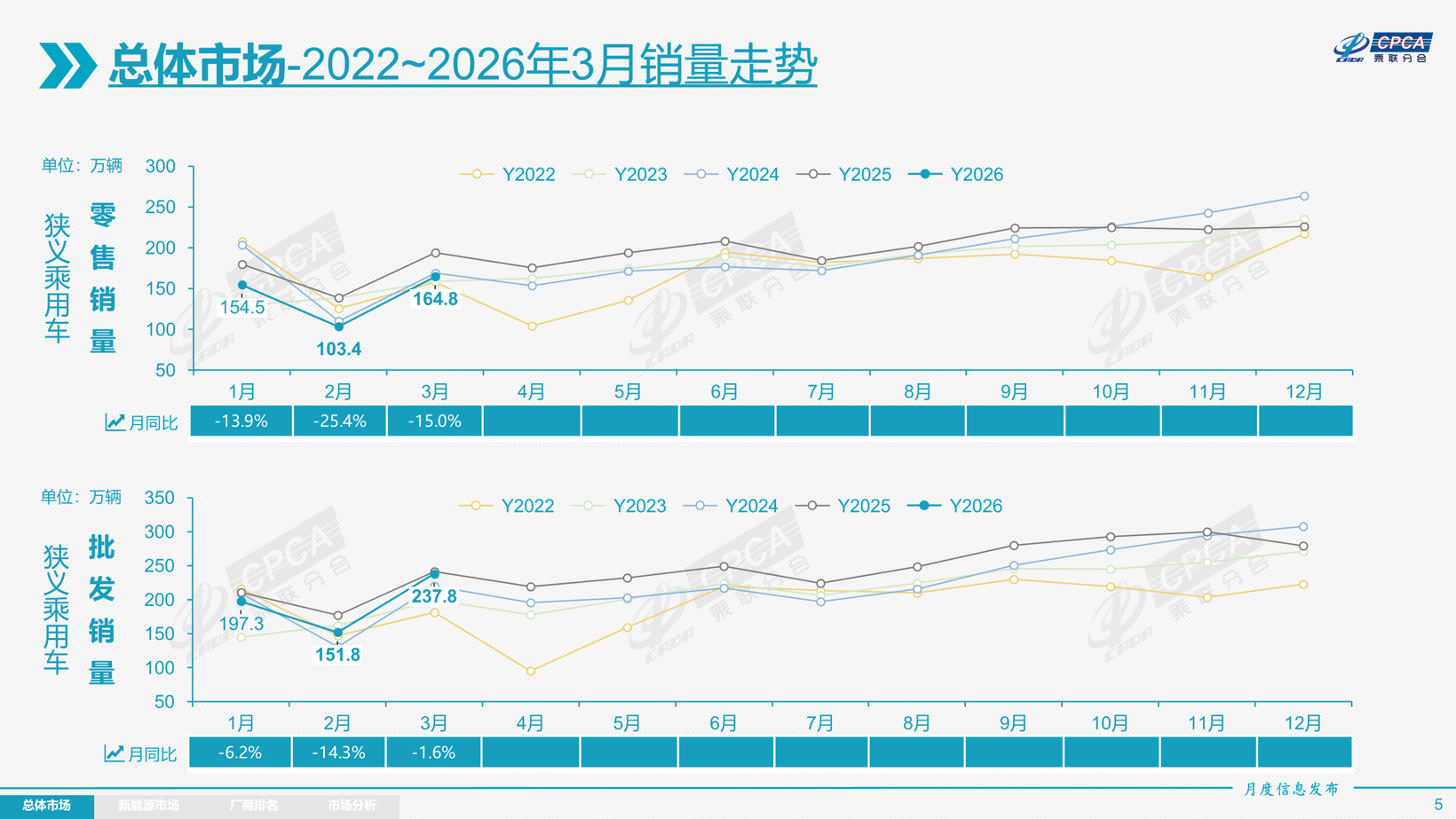
Image Source: CPCA
However, beneath the chilly aggregate data, undercurrents are shifting. The battle between domestic brands and joint ventures has taken a new turn. The new energy sector is showing a stark "cold-at-home, hot-abroad" divergence. The upcoming Beijing Auto Show in April is set to become the next catalyst for market disruption.
Domestic vs. Joint Ventures: A Subtle Shift in the Offensive-Defensive Balance
For years, domestic brands' dominance over joint ventures in market share has felt like an established rule. But in the first quarter of 2026, that seemingly ironclad law showed signs of cracking.
Domestic brands have long relied on new energy vehicles and cost-effectiveness to win. However, with the NEV purchase tax exemption officially expiring at the end of 2025, market conditions have shifted. This puts the growth model dependent on policy dividends to the test. CPCA data shows domestic brand retail sales reached 1.02 million units in March, down 16% year-on-year but up 61% month-on-month. Their domestic retail share stood at 61.8%, a dip of 0.8 percentage points. While modest, this shift is noteworthy for a sector that has been on an uninterrupted winning streak.
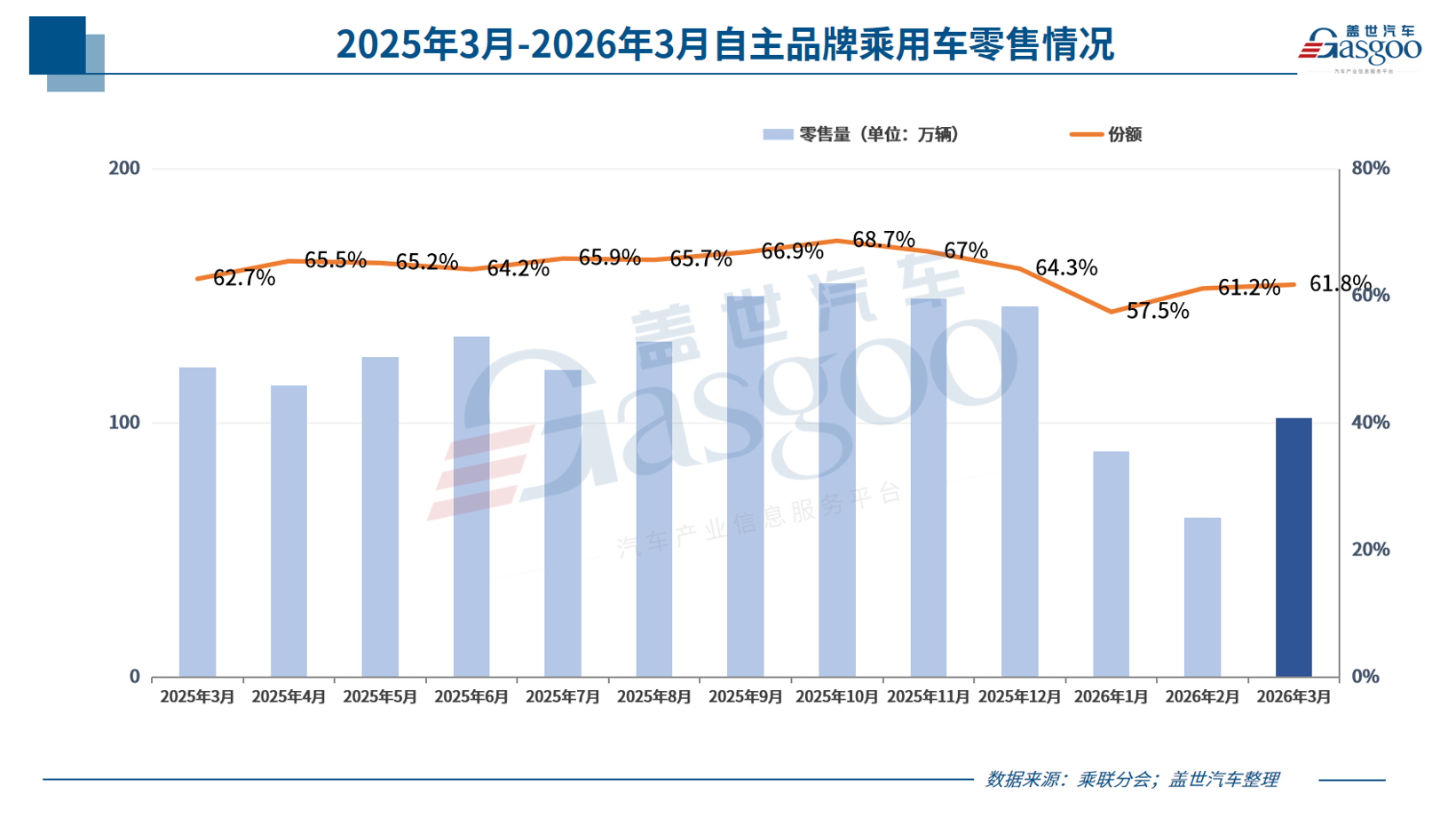
The root cause is "structural stalling." The entry-level NEV market that fueled rapid expansion took a direct hit once subsidies vanished. Amid a consumption upgrade trend, automakers pivoted new launches to the mid-to-high-end segment to protect margins. This led to a sharp drop in new economy car releases in Q1. At the same time, rising upstream raw material costs, combined with a cooling of the industry price war as excessive rivalry eases, have temporarily neutralized the domestic brands' classic strategy of swapping price for volume.
In contrast to the domestic sector's adjustment, joint ventures saw a rare "defensive bounce" in March.
Mainstream joint venture retail sales came in at 410,000 units, a 13% year-on-year decline but a 54% monthly rise, a better performance than the domestic sector's 16% drop. More telling is the shift in share: German brands held 16%, down just 0.7 percentage points; Japanese brands claimed 13.3%, actually gaining 1 percentage point; and US brands held 6.9%, also achieving year-on-year growth.
This is not because joint ventures suddenly had an epiphany. Rather, their internal combustion engine (ICE) base offers a "defensive advantage" in this specific environment. With policy incentives gone and consumer sentiment cautious, some buyers with immediate needs are returning to mature, price-stable traditional fuel vehicles, precisely the joint ventures' home turf.
The luxury market showed independent resilience. Luxury retail sales hit 210,000 units, capturing a 12.9% share, up 0.1 percentage points. As sticker prices normalized, traditional luxury brands held their ground. Their customer base is less sensitive to policy swings, highlighting the sector's risk resistance.
Industry consensus holds that this dip in domestic brand share is a short-term blip, not a reversal of their long-term upward trajectory.
Cui Dongshu, secretary-general of the CPCA, told Gasgoo that the divergence between domestic and joint ventures will widen further this year. The core gap lies in the pace of NEV transition, smart technology, and cost control. Leveraging full supply chain advantages and surging exports, domestic brands are poised to see their market share breach 70%, accelerating both in high-end and electric segments. Conversely, joint ventures—hampered by a shrinking ICE base and slow electrification—will see their share slip below 30%, with only a few top players holding steady via localized products. Overall, China's 2026 auto market will further consolidate into a domestic-led, electrification-driven landscape.
The short-term tug-of-war over share does not alter the long-term picture. Domestic brands' real strength is evident on the global battlefield. In March, domestic automakers wholesaled 1.611 million units, up 2% year-on-year, while joint ventures saw a 10% decline. On the export front, domestic brands shipped 606,000 units in March, a 76% surge, with Chery, BYD, and SAIC charging ahead overseas.
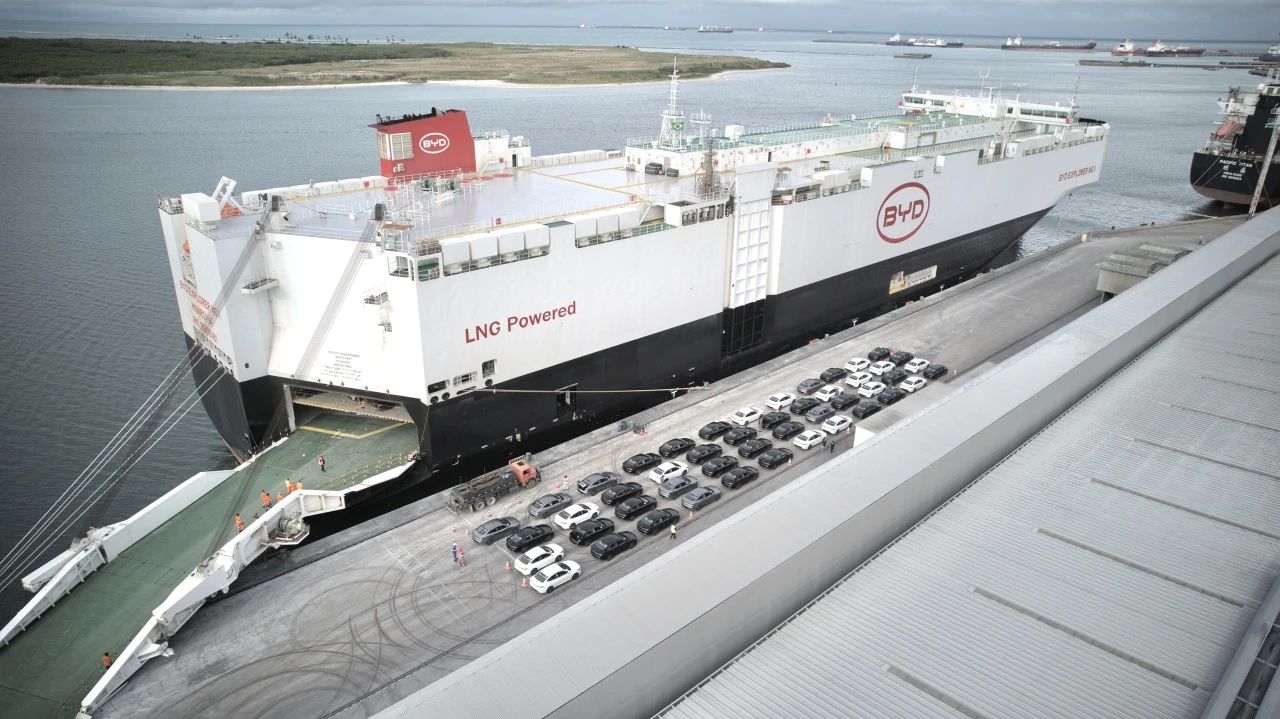
Image Source: BYD
For joint ventures, the chasm in NEV penetration—just 6.4% at the wholesale level compared to 61.7% for domestic brands—means this respite is destined to be fleeting. When the next wave of electrification hits, unless joint ventures achieve a breakthrough in product competitiveness, their current share recovery will prove to be nothing more than a rebound within a broader decline.
NEV Market: "Cold Inside, Hot Outside" Divergence Intensifies
If there was a single theme for the March market, it was "divergence." This was most apparent in the new energy sector, which played out like a real-world tale of ice and fire.
The "ice" is the sudden cooling of the broader market.
CPCA data shows NEV retail sales fell 14.4% year-on-year to 848,000 units, nearly matching the overall market decline. Domestic retail penetration remained at 51.5%, up 0.3 percentage points, so the trend of NEV dominance holds. Within that, pure electric retail sales dropped 12%, while plug-in hybrids plunged 24%. This is partly the fallout from last year's policy rush, which cannibalized Q1 demand. It is also due to a slower launch cadence; far fewer new models arrived in Q1 versus last year, leaving the market without a breakout hit.
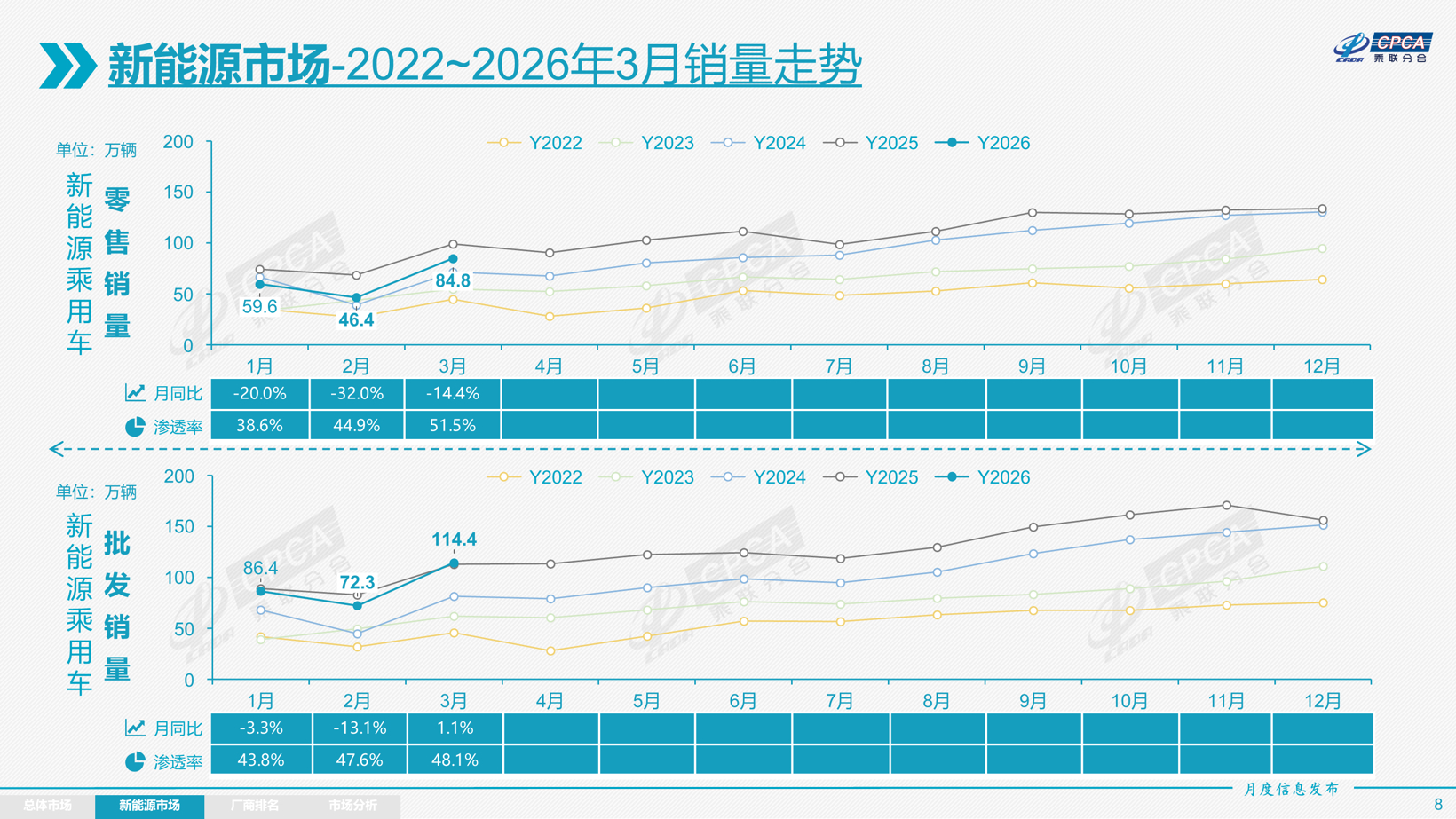
Image Source: CPCA
More worrying is the structural rot. A00-segment pure electric wholesale sales crashed 52%, with their share of the BEV market shrinking from nearly 19% a year ago to just 9%. The collapse of the entry-level commuter market suggests the foundation of NEV adoption is crumbling. While B-segment electric cars grew 12%, propping up the premium end, this structural shift toward "consumption upgrade" cannot fill the massive void in total volume.
Looking at penetration rates, the gap is stark: 73.5% for domestic brands versus just 6.2% for mainstream joint ventures, highlighting the latter's passive stance on electrification. As the industry's push against excessive rivalry curbs price wars, consumers realizing there are no deeper discounts to wait for have grown more cautious, exacerbating the market chill.
Yet, shifting the gaze overseas, the NEV sector is burning "hot."
NEV exports soared 139.9% year-on-year in March to 349,000 units, a record monthly high. NEVs accounted for 50.2% of total export volume, meaning one in every two Chinese cars shipped abroad is now a new energy vehicle.
This surge reflects the explosion of competitiveness in China's auto supply chain. BYD led the charge with 116,900 monthly exports, followed by Geely, Chery, and Tesla China, forming a formidable export fleet. Nineteen manufacturers surpassed the 10,000-unit mark in wholesale sales, accounting for 91.9% of total NEV volume, a sign of increasing concentration at the top.
Even more significant is the structural optimization: while pure electrics remain the export backbone, plug-in hybrids have risen to 44% of the mix. They are growing fast in developing markets and showing stronger adaptability than BEVs. The "new force" sector is also gaining traction, with a 21.5% retail share in March, up 4.4 percentage points, driven by Leapmotor, Li Auto, and NIO. This proves Chinese NEVs are no longer relying solely on cheap small cars to win; they are earning global recognition in higher-tech, higher-value segments.
The first quarter's "cold inside, hot outside" dynamic taught the industry a lesson. The domestic market is undergoing a painful transition from policy-driven to market-driven growth, while overseas markets offer vast incremental space to absorb capacity and build brands. For automakers, the strategic directive is clear: while refining products at home, they must elevate global expansion to an unprecedented priority.
Q2 Pressure, H2 Stabilization and Recovery
After a volatile Q1, all eyes are on April: can the market hit bottom and bounce back? The consensus points to a "slow improvement, waiting for a reversal." The second quarter will be a grinding bottoming-out period, with real light expected only in the second half.
In the near term, April is starting under pressure. CPCA analysis notes 21 working days this April, one fewer than last year, suggesting production and sales will only see a sluggish recovery. The aftershocks of the policy exit persist, consumer caution remains high, and the retail sector faces the risk of slight negative growth in Q2.
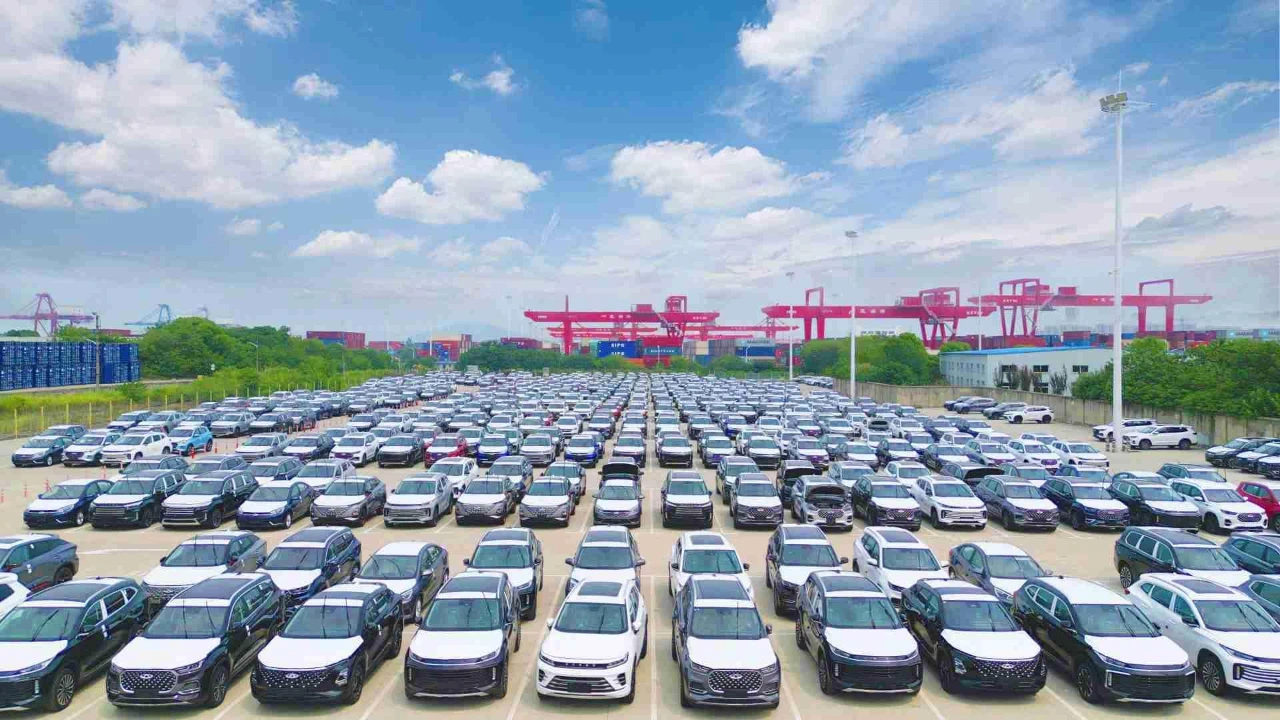
Image Source: Chery Auto
But this does not mean a continuous slide. Positive factors are quietly accumulating. The Beijing Auto Show, the year's first major event, will be the biggest catalyst for Q2. A wave of new model launches, clearer technology roadmaps, and demand for self-driving trips during the May Day holiday will all help stimulate consumption. Notably, with the domestic NEV parc at just 10%, and ownership costs rising for many, the potential for trade-ins and upgrades remains largely untapped. Cui expects Q2 to show a "gradual, slow improvement."
The true turning point is expected in the second half. Cui offers a clear forecast: manufacturer sales will fully return to positive growth in H2, and retail will stabilize in Q3 after the Q2 squeeze. With domestic brands commanding over 70% of NEV sales and exports accelerating further, overseas performance will be a crucial counterweight to domestic pressure. This "down first, up later" trajectory fits the typical recovery path after policy withdrawal. Short-term pain is inevitable, but endogenous demand will return.
To achieve sustainable domestic consumption, "long-term" policy reform is urgent. Cui suggests avoiding drastic policy swings in favor of stable measures like purchase tax deductions to drive consumption upgrades. Additionally, activating the elderly demographic—by optimizing license requirements and guiding users of low-speed EVs toward affordable electric cars—could open new incremental space.
Strong export performance will serve as a key stabilizer for the year. With Q1 growth accelerating and a forecast of over 20% for the full year, exports will effectively offset domestic headwinds. Thanks to their overseas success, domestic brands can maintain capacity utilization while boosting brand equity globally.
Overall, China's 2026 auto market will be defined by being "cold inside, hot outside" and "down first, up later." The second quarter is a stress test for resilience, requiring companies to hold share and clear inventory amid weak demand. But as policy effects fade and confidence returns in H2, the market should return to a growth trajectory. For the industry, rather than waiting for heavy stimulus, the path forward lies in global expansion, optimizing product mixes, and tapping niche user demands. The hardest moments are passing, but the road back to growth requires patience and resolve.


