



Gasgoo Munich- War clouds still hang over the Strait of Hormuz on March 5, 2026. Just six days earlier, the U.S. and Israel launched strikes on targets inside Iran, prompting Tehran to block the global oil trade's "maritime chokepoint." Satellite imagery shows vessels stranded near major ports like Fujairah in the UAE, while container carrier CMA CGM has ordered its ships in the Gulf to seek safe harbor.
For Chinese automakers that only recently claimed the top spot in global auto exports, this amounts to a sudden "pop quiz." After all, China's auto exports to the Middle East surpassed 1.25 million units in 2025 — up more than 30% year-on-year — with just Saudi Arabia and the UAE absorbing 874,000 of those vehicles.
Yet even as widespread concern grips the market, Cui Dongshu, secretary-general of the China Passenger Car Association (CPCA), offers a seemingly counter-intuitive take: short-term disruptions won't alter the broader upward trajectory of Chinese auto exports. In fact, the strategic value of the Middle East as a high-margin market is becoming even more pronounced.
Why does he remain optimistic amid the sound of artillery?
Middle East: A "Strategic Pivot" and "Stress Test" for Chinese Auto Exports
To grasp the impact of this crisis, we first need to understand where the Middle East sits in the geography of Chinese auto exports.
The data shows the Middle East is no longer just "one of the regions" — it is "core." Analysis from the CPCA indicates that over the past few years, export growth to the Middle East, Africa, and Oceania has far outpaced other regions, making them the "three engines" driving overall expansion. CPCA data reveals that in 2025, the UAE alone claimed the top spot among Chinese auto export destinations, serving as the core engine for growth in the Middle East market.
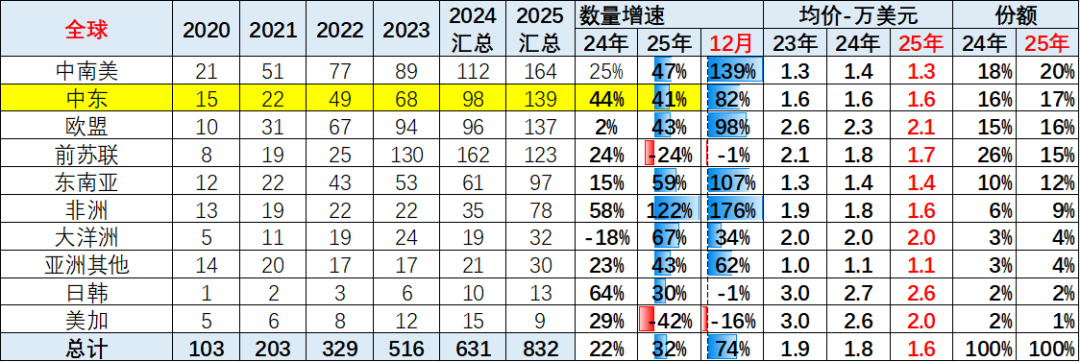
Image Source: Cui Dongshu
There is an interesting logic behind these figures: Why does the UAE need to import nearly 600,000 Chinese cars when its annual domestic new car sales are under 400,000?
The answer lies in Dubai's role as a hub. Dubai is essentially a forward warehouse. Many companies ship vehicles there first, then distribute them to final destinations across the rest of the Middle East, as well as West and North Africa.
This model leverages Dubai's geographic advantages, financial convenience, and tax incentives. Jebel Ali Port is the region's largest, a core hub for roll-on/roll-off shipping, and the key gateway for Chinese autos entering the Middle East.
Cui believes that as the U.S. and Europe erect trade barriers, the strategic value of the Middle East has transcended simply "selling cars." The region offers strong purchasing power, an urgent desire for energy transition, and a friendly policy environment.
Saudi Arabia's "Vision 2030," for example, offers unprecedented support for new energy vehicles — extending zero-tariff policies and providing purchase subsidies of up to 15%. Such an "ideal" market is rare on a global scale.
More importantly, the Middle East is becoming a testing ground for Chinese automakers to leap from "product export" to "brand deepening."
Just before the conflict erupted, Seres Group's AITO brand struck a strategic partnership with the Abu Dhabi Automobile Company in the UAE, quickly securing an initial order for 200 units. Seres stated that to better cater to high-end users in the Middle East, AITO has conducted deep localization for the UAE market, optimizing software and hardware for multi-language systems, high-temperature environments, and local driving scenarios.
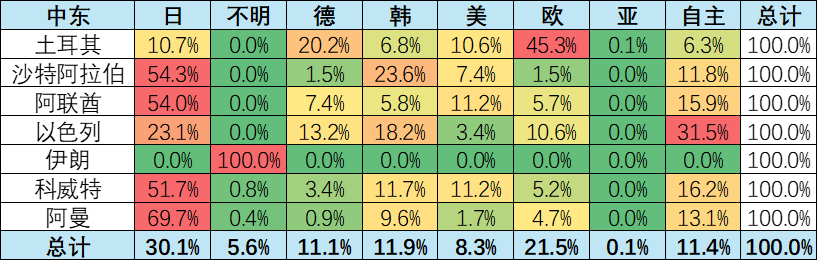
Image Source: Cui Dongshu
Almost simultaneously, Deepal unveiled three core models at the Burj Khalifa in Dubai, marking a significant showcase of Chinese smart new-energy manufacturing on the world stage.
From Geely Geometry establishing channels in the UAE to NIO assembling teams in the region, Chinese automakers are no longer content with just shipping cars over. They are launching localized operations, building after-sales networks, and even considering KD (knocked-down) assembly.
Extreme heat and sandstorms, commonplace in the Middle East, serve as the ultimate "technical certification" for Chinese NEVs. As NIO's CEO for the Middle East and North Africa, Mohammed Maktari, noted, automakers are increasingly focused on designs adapted to climate change — battery chemistry optimized for high and low temperatures ensures stable range. If a car runs smoothly here, it can handle just about anywhere else in the world.
The Impact Within the Eye of the Storm
Yet, the situation on the ground poses a very real challenge.
On the night of February 28 local time, following strikes on targets inside Iran, major global oil companies and trading giants formally announced they were suspending oil and fuel shipments through the Strait of Hormuz due to heightened security risks. Satellite imagery shows multiple vessels stranded near major ports like Fujairah in the UAE.
"For many of our member companies, this is an acute operational crisis, not an abstract geopolitical development," said Martin Kröger, Chief Executive Officer of the German Shipowners' Association.
Sea freight remains the primary and most cost-effective method for exporting Chinese cars to the Middle East. Now, tension in the Strait of Hormuz has sent shipping and insurance costs soaring while dragging out delivery cycles. Shipping routes are being forced to detour around Africa's Cape of Good Hope or the Arctic Ocean, adding roughly 10 to 14 days.
In the early hours of March 1, Jebel Ali Port in southern Dubai was attacked. Dubai's air defense systems successfully intercepted missiles or drones targeting the area, but debris from the interception fell inside the port zone, igniting a fire at one berth and disrupting operations.
The shockwaves have also spread to the European market. As risks rise along the Red Sea–Suez Canal route, freight vessels are forced to detour around the Cape of Good Hope, adding 10 to 15 days to transit times.
A report from Bernstein suggests Chinese automakers face the greatest risk of loss from this conflict. According to China Customs data, the Middle East absorbed 17% of China's total passenger car exports in 2025, a share growing at a five-year compound annual rate of 59%. Some automakers, such as JAC, SAIC, and Chery, rely heavily on the region for sales volume.
Some autonomous driving companies have already temporarily adjusted their operations in Dubai. A deeper impact comes from the supply chain: China imports 78% of its celestite (used in permanent magnet motors) and over half its methanol from Iran. A supply interruption could ripple through the core materials and chemical industries for new energy vehicles.
Where Does the Resilience Come From?
Given the gravity of the situation, Cui's calm demeanor is particularly striking.
He summed it up in seven words: "The bigger the waves, the more valuable the fish."
What does that mean? Let's break it down from three angles.
First, China does not directly export complete vehicles to Iran.
It seems simple, but it is critical. Cui points out that because China does not formally export complete cars to Iran, there is no direct impact on apparent exports to core nations. The real effect is on key markets like Saudi Arabia and the UAE — and demand there remains rigid for now.
Second, there are plenty of countermeasures, and Chinese automakers are reacting faster than many realize.
If the Strait of Hormuz is impassable, ships can divert to alternative ports like Oman. If sea freight gets too expensive, there's always the China-Europe Railway Express combined with land transport. If shipping whole cars proves difficult, companies can accelerate the launch of KD assembly plants in Saudi Arabia and Egypt.
An analysis from CICC Securities offers a framework: market evolution happens in three stages. Stage one (1–2 weeks post-event) involves disorderly freight rate fluctuations. Stage two (1–3 months of restricted transport) sees long routes replace short ones, tightening global capacity. Stage three (after restrictions lift) sees a concentrated release of demand as oil-producing nations clear inventories and consumer nations restock, further adjusting rates.
This implies that if Chinese automakers can weather the first two stages, they will be well-positioned to take the initiative in the third.
Third, there is a precedent.
Last year, conflict around Israel was intense, yet Chinese auto exports to Israel did not plummet. This suggests there is a buffer zone between geopolitical events and actual trade conditions.
Of course, Cui added a caveat: if the strait blockade lasts more than three months, or if the Red Sea route remains severed, causing widespread delivery delays and order cancellations in the UAE and Saudi Arabia, only then would expectations be lowered. For now, the focus remains on dynamic observation, with no adjustments to total volume forecasts.
In the short term, rising costs will undoubtedly erode some profits. But the supply chain advantages of Chinese automakers — scale, components, efficiency — were built over years and won't be wiped out by a single logistics fluctuation. Moreover, major automakers have been building their own ocean fleets in recent years, giving them far more leverage than before.
In the medium term, cost pressure will accelerate a divergence in export models. Low-margin models will face the greatest pressure, while high-value new energy vehicles show more resilience. This means automakers relying solely on low prices may be weeded out, while those with technical barriers and brand premiums will rise to the top.
In the long run, the structural dividends of the Middle East market remain. Led by Saudi Arabia, Middle Eastern nations are accelerating their energy transition under "Vision 2030," offering unprecedented support for NEVs. Local high-end consumer demand is robust, with premium pricing for pure electric SUVs exceeding domestic levels by over 30%. A window of combined policy and demand like this comes around maybe once in three years.
From Crisis to Opportunity
If short-term pain is unavoidable, then what does this crisis hold for Chinese automakers in the medium term?
Cui's verdict: cost pressure will force a model upgrade.
Previously, whole cars were shipped directly. Now that freight is pricey, what's the solution? Switch to exporting KD (knocked-down) parts for local assembly.
Over the long term, persistent uncertainty will force automakers to build a more multi-dimensional layout: diversified shipping routes, regional inventory buffers, and local factories advancing in tandem. Fragile reliance on single points will gradually be replaced by a resilient, risk-resistant network.
A broader perspective comes from the global trend toward electrification. Gulf Cooperation Council (GCC) members are becoming one of the fastest-growing regions for electric vehicles globally; in the UAE, 94% of pure EV owners say they would consider an EV for their next purchase.
These trends will not be reversed by a single geopolitical conflict.
So the question remains: given the complexity, why does the CPCA still maintain its forecast of over 10% export growth for the full year?
Cui's logic is actually quite clear. There is short-term pain — rising logistics costs, longer delivery cycles — but this judgment comes with a clear time limit. He emphasizes that if the strait blockade exceeds three months, causing widespread delivery delays in core markets, only then would expectations be lowered. For now, the supply chain advantages and diversified response capabilities of Chinese automakers are sufficient to weather the short-term storm.
The suspension of operations in Iran is a temporary setback. Yet some automakers were accelerating their expansion right up until the eve of the war — AITO secured 200 orders, and Deepal climbed the Burj Khalifa.
This is precisely what Cui meant by "the bigger the waves, the more valuable the fish." Players with genuine confidence won't capsize in a storm; instead, they'll find the most valuable catch amidst the waves.
In Conclusion:
It brings to mind a single term: stress test.
The situation in the Middle East is like a sudden "high-difficulty exam" for Chinese auto exports. The test is tough, but Chinese automakers are handing in a solid answer sheet.
From exporting products to exporting systems; from relying on single shipping lanes to building multi-node networks. This crisis is actually accelerating the transformation of Chinese automakers from a "major exporting nation" to a "global automotive powerhouse."
Of course, risks remain. If the strait blockade lasts more than three months, if the Red Sea route remains severed, if core markets see widespread delivery delays and order cancellations, only then might expectations be lowered. For now, the focus remains on dynamic observation, with no adjustments to total volume forecasts.


