



Gasgoo Munich- China's auto market in 2025 is a tale of two worlds: consumer demand unleashed by trade-in and new energy policies on one side, and the collective struggle of dealers on the other. According to the latest "2025 National Auto Dealer Survival Survey" by the China Automobile Dealers Association (CADA), more than half of dealers failed to meet sales targets last year. The share of dealers in the red hit 55.7%, while profitability shrank to a recent low of 23.5%. Adding to the pain, 81.9% of dealers reported selling cars below cost—a phenomenon known as price inversion—driving satisfaction with automakers down to a historic low of 60.8 points.
Image source: Gasgoo
From sustained losses in new car sales to a forced restructuring of profit models and escalating conflicts with automakers, dealers are facing an unprecedented survival test. Behind this trial lies the inevitable pain of industry transition in a saturated market, signaling a critical moment for the reconstruction of sales channels.
(Note: The CADA's national survey on dealer survival launched in early January 2026. Following two months of questionnaire collection and investor interviews, the survey covered franchised dealerships under more than 70 large and medium-sized dealer groups, as well as over 200 small groups and standalone stores. A total of 1,375 valid questionnaires were recovered.)
Sales Pressure Mounts as Profits Collapse; New Car Sales Become a "Black Hole"
The most immediate feeling in the 2025 dealer market is that selling cars is getting harder, and making money feels like a luxury. Data shows only 44.3% of dealers met their annual sales targets, a continued slide from 48.2% in 2024. With more than half failing their sales assessments, this marks yet another year of declining target completion rates.
The divergence among brands is even starker. Over 50% of dealers representing luxury or imported marques, as well as joint ventures, achieved their annual goals. In contrast, domestic brands—plagued by universally aggressive targets—saw the lowest completion rates. Only 32.9% of these dealers hit their marks, with nearly 17.4% achieving less than 70% of their quota. The pressure on sales volumes is translating directly into pressure on profitability.
Profitability paints an even bleaker picture. The proportion of profitable dealers plummeted from 39.3% in 2024 to 23.5% in 2025. While 20.8% broke even, a staggering 55.7% suffered losses—meaning roughly one out of every two dealers is in the red.
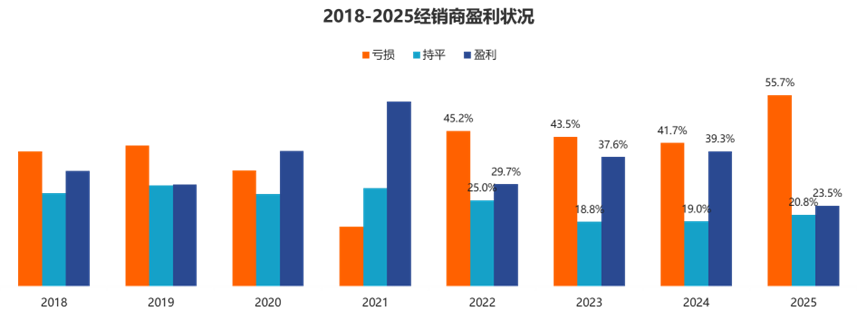
Image source: China Automobile Dealers Association (same below)
Shifts in profit structure reveal the industry's deeper predicament. The gross margin contribution from new car sales fell to -25.5%, worsening from -17.7% in 2024 and turning new vehicle sales into a veritable "black hole" for profits.
Industry insiders admit many dealers now pin their profit hopes on manufacturer rebates. "Take a model with a 500,000 yuan official price—dealers are forced by competition to sell at 400,000, eating the 100,000 yuan difference themselves," one explained. "The plan was to cover that loss with rebates by hitting sales targets, but reaching those targets has become incredibly difficult." Desperate to meet quotas, dealers stockpiled vehicles, only to find market demand couldn't keep pace with the influx. The result is an awkward dilemma of "plenty of cars, no buyers," causing inventory to pile up and financial pressure to spike.
The situation persists into 2026. Lang Xuehong, deputy secretary-general of CADA, points out that while market demand and daily sales warmed up in February 2026—signaling a positive turn—the dealer operating conditions index showed no improvement. The core reason: dealers continued to swap price for volume before and after the holidays, ramping up promotions and preventing profitability from recovering in tandem.
New car sales, once the core profit pillar for dealers, have devolved into a loss-leading traffic generator. Even industry leaders aren't immune. Zhongsheng Holdings, a top dealer group, swung from a 3.2 billion yuan profit in 2024 to a projected loss of 2 billion yuan in 2025, driven largely by a 70% widening of gross losses in its new car business.
In stark contrast to the hemorrhaging new car business, dealers' profit sources are shifting decisively toward non-vehicle sales. After-sales service has become the sole "ballast," contributing a massive 80.8% to gross margins—a sharp rise from the previous two years. This shift reflects a collective act of self-preservation: with new car sales unprofitable, maintenance, repairs, and detailing have become the core proppers-up of store operations.
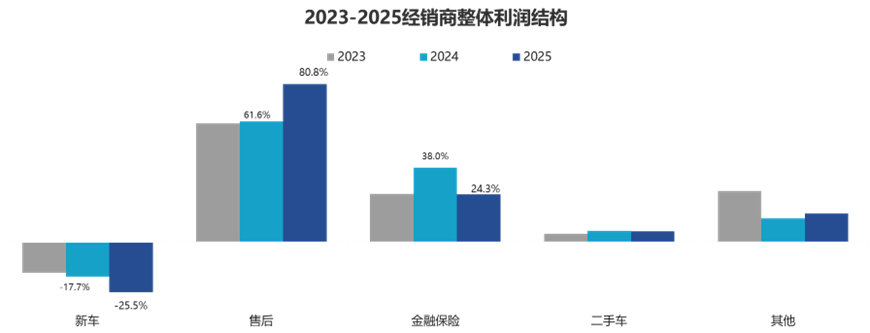
However, a slump in financial and insurance services is making this rescue effort harder. Hit by adjustments in commercial bank consumer finance products, the gross margin contribution from financing and insurance has plummeted, falling from a key profit supplement to a minor player. This simplification of the profit structure continues to erode dealers' ability to withstand risk.
The dual pressure on sales and profits is, at its core, the result of a supply-demand imbalance and intensifying industry competition.
In 2025, the passenger vehicle market entered a cycle dominated by replacement buyers rather than first-time purchasers. While demand for initial purchases slipped, production capacity continued to rise. Caught in this squeeze, automakers—chasing volume scale—forced inventory onto dealers. The national dealer inventory coefficient has lingered above the boom-bust line for an extended period. The cash crunch from high inventory forced dealers to slash prices to recoup funds, creating a vicious cycle of "high inventory—price cuts—widening losses—stuck stock." Matters were made worse in the fourth quarter when replacement subsidies in many regions ran out early, further shrinking demand and heaping pressure on an already struggling new car business.
Price Inversion Becomes the Norm; New Energy Vehicles Offer the Only Escape Hatch
If failing to meet sales targets is a "growing pain" for dealers, then price inversion is the Sword of Damocles hanging over the entire industry.
Survey data reveals that in 2025, 81.9% of auto dealers experienced price inversion to varying degrees. For 51.5% of them, the gap exceeded 15%, with some dealers seeing inversions of over 40%. In other words, the price dealers pay to acquire vehicles from automakers is far higher than the terminal market selling price—meaning a new car starts its life in the showroom already in the red.
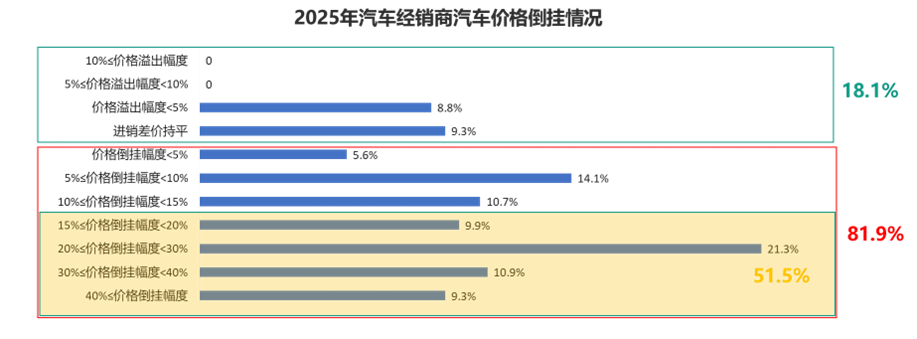
The spread of price inversion has trapped dealers in a dilemma. If they don't cut prices, cars don't sell, and the financial cost of holding inventory mounts. If they do cut prices, every sale is a direct loss. Even if they hit their targets and secure manufacturer rebates, it is difficult to offset the losses caused by inversion.
The root cause lies in the imbalance of interests between automakers and dealers. To seize market share, automakers frequently roll out price promotions while setting unreasonably high sales quotas. Desperate to complete tasks and earn rebates, dealers are forced to follow suit on price cuts, ultimately trapping the industry in a disorderly cycle of "price cuts—losses—further price cuts."
The chain reaction from price inversion is soaring operating costs and intensified financial pressure. In the survey, dealers universally reported severe strain on cash flow, high operating costs, bloated inventory, and declining customer footfall.
Fixed costs—such as rent, payroll, and financing fees—are devouring limited profits as revenue slides. Under this multi-pronged pressure, many small and medium-sized dealer groups have chosen to shut down stores. Lang Xuehong revealed that in the first half of 2025, the number of franchised dealerships nationwide shrank from 32,000 to 31,400, a net loss of about 650 stores. The total number of dealers is expected to decrease by nearly 1,500 by the end of the year.
To address this chronic ailment, policymakers are introducing remedies. Lang noted that following the early 2026 release of the "Auto Industry Price Behavior Compliance Guide," 25.6% of dealers reported some improvement in price inversion. However, 70% believe the guide's impact has yet to become obvious. The association has formed a task force to urgently study specific implementation measures, hoping to significantly alleviate the price inversion issue plaguing dealers this year.
Notably, new energy vehicle (NEV) dealerships have emerged as one of the few windows for escape. In this survey sample, dealers or agents for NEV brands accounted for 29.9%, a significant increase from 16.8% in 2024.
The profit structure of NEV dealers stands in stark contrast to their internal combustion engine (ICE) counterparts. Their new car sales contributed a positive 26.5% to gross margins, whereas traditional ICE dealers saw a contribution of -31.1%—a loss far exceeding the industry average. Although NEV dealers also face price inversion, more reasonable sales targets from manufacturers, better rebate policies, and sustained growth in the NEV market have allowed their new car businesses to maintain basic profitability.
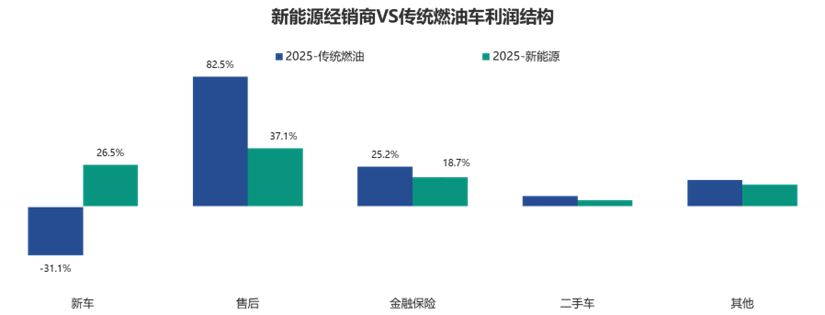
The profitability advantage of NEV dealers is also reflected in the balance of their business structure. After-sales service contributed 37.1% to gross margins, while finance and insurance contributed 18.7%. While lower than the after-sales share of traditional dealers, the coordinated development across sectors avoids an over-reliance on any single revenue stream.
Still, NEV dealers are not immune to pressure. Inventory burdens, capital occupation, and the relatively low maintenance needs of electric vehicles continue to test their long-term profitability. The ability to pivot from "selling cars" to "servicing cars"—mining the value of the customer lifecycle—will be the key to sustainable development for NEV dealers.
OEM-Dealer Conflicts Intensify as Industry Enters Critical Phase of Channel Reconstruction
Dealer satisfaction with automakers in 2025 settled at 60.8 points. This figure not only marks a historic low since 2011 but also reflects the increasingly acute conflicts between manufacturers and dealers.
Among the grievances listed by dealers, excessively high sales quotas, price inversion, bloated inventory, expensive parts, forced bundling, and an oversaturation of authorized outlets in the same city ranked highest. These issues are not new to 2025; rather, they are the concentrated eruption of long-accumulated problems. As the industry's profitability continues to deteriorate, the foundation of trust between automakers and dealers is being steadily eroded.
The traditional auto sales channel model is characterized by a "strong manufacturer, weak dealer" dynamic. As sales terminals for automakers, dealers bear multiple costs—including inventory, logistics, and sales—yet lack pricing power and a voice in decision-making.
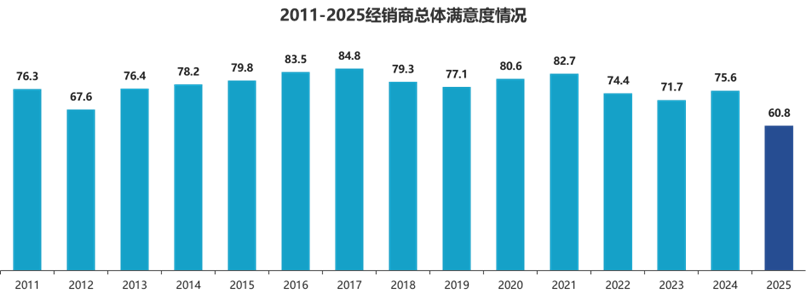
In 2025, the drawbacks of this dynamic were magnified infinitely. Chasing sales volume and market share, automakers set unreasonably high targets regardless of market realities, shifting operational pressure onto dealers through forced stock allocation and bundling. Meanwhile, the disorderly expansion of authorized outlets in the same city intensified internal competition among dealers. As price wars escalated, profitability across the entire industry slumped.
Beyond the friction in new car sales, imbalances between manufacturers and dealers in the used car and after-sales sectors are equally pronounced.
Regarding used cars, dealers cite unstable prices and insufficient manufacturer support. Yet the used car market is a critical growth engine in a saturated market; in 2025, transaction volume broke the 20 million mark for the first time, becoming a trillion-yuan sector. The absence of manufacturers makes it difficult for dealers to tap this profit potential. In after-sales, service visits and revenue per vehicle continue to slide, while manufacturers tighten policies and raise parts prices, further compressing dealers' profit margins.
Among the four major business sectors, satisfaction with new and used car operations is the lowest, and satisfaction with after-sales service is also in decline. The conflict between manufacturers and dealers has spread from simple sales assessments to the entire business chain.
Behind these conflicts lies a lag in channel transformation relative to market changes. The auto market is shifting from growth to saturation and from ICE to NEVs, yet channel models remain stuck in a hybrid, wavering phase between "direct sales" and "franchising." Many automakers are opening direct-sales NEV stores without offering differentiated policy support to their franchised dealers. This leaves authorized dealers squeezed from both sides: bearing the pressure of clearing ICE inventory while losing customer traffic to direct-sales outlets.
The heavy-asset model of the traditional 4S dealership is increasingly ill-suited to the NEV era. With construction costs in the tens of millions and high overhead for land and labor, these stores have become a heavy burden for dealers amid losses in new car sales. Furthermore, insufficient support from automakers for digital and lightweight channel transformations makes the transition an arduous trek for dealers.
Looking ahead to 2026, more than half of dealers hold a cautious and conservative view of the market. Only 23.4% believe the passenger vehicle market will achieve year-on-year growth, while 31.6% expect it to remain flat; the rest anticipate varying degrees of decline. This cautious judgment reflects dealers' concerns about the industry's future, but it also signals a return to rationality.
For automakers, the only path to repairing relations is to abandon a pure volume mindset and build a community of shared interests with dealers—by setting reasonable sales targets, optimizing business policies, and alleviating price inversion. For dealers, transformation is inevitable. Shifting focus from "sales" to "service," and tapping the potential of after-sales and used car businesses to evolve from "car sellers" into "full-lifecycle service providers," is the only way to stand firm during the industry shakeout.
The year 2025 was a difficult one for auto dealers, but it was also a year of transition. Behind the fact that half are in the red lies the concentrated eruption of problems accumulated over the long term. Yet the breakout of NEV dealers offers the industry a glimmer of hope. As the auto market enters the deep waters of saturation competition, the curtain on channel reconstruction has been raised. Only through OEM-dealer collaboration and proactive change can the automotive distribution industry navigate its way out of trouble and into a new stage of development.


