Gasgoo Munich - According to data from Gasgoo Automotive Research Institute, China’s passenger vehicle exports expanded in scale during 2025, even as destinations and product structures began to diverge more sharply. While markets like Russia, the Middle East, and Latin America remain the bedrock of total volume, new energy passenger vehicles are accelerating their penetration into Europe, Southeast Asia, and select emerging markets, driving the most dynamic growth. Overall, the sector is shifting toward a multi-region, multi-technology-track phase, with greater diversification and resilience against market volatility.
Top 10 Destinations for China’s Passenger Vehicle Exports (Jan–Dec 2025)
No. 1 Russia: China exported 555,381 passenger vehicles to Russia from January to December 2025, with 65,077 units shipped in December alone. Cumulative volume fell 46.1% year on year.
No. 2 United Arab Emirates: Exports totaled 539,712 units for the full year, with 101,604 shipped in December. Cumulative volume surged 74.3% year on year.
No. 3 Mexico: Exports reached 490,793 units between January and December, with 38,827 units in December. That marks a 44.2% annual increase.
No. 4 United Kingdom: Full-year exports hit 320,834 units, including 50,934 in December, representing a 70.3% jump from the previous year.
No. 5 Brazil: Exports stood at 299,943 units for the year, with 32,661 shipped in December, up 34.6% year on year.
No. 6 Belgium: China exported 289,548 passenger vehicles to Belgium in 2025, with 22,939 units in December, a modest 4.5% annual rise.
No. 7 Saudi Arabia: Exports totaled 250,465 units for the year, with 31,584 in December, climbing 11.2% annually.
No. 8 Australia: Full-year exports reached 246,189 units, with 16,105 shipped in December, marking a 59.3% year-on-year gain.
No. 9 Kazakhstan: Exports came to 186,965 units from January to December, with 20,253 in December, surging 74.3% year on year.
No. 10 Iran: China exported 164,110 passenger vehicles to Iran in 2025, with 9,426 units in December, down 31.6% from the previous year.
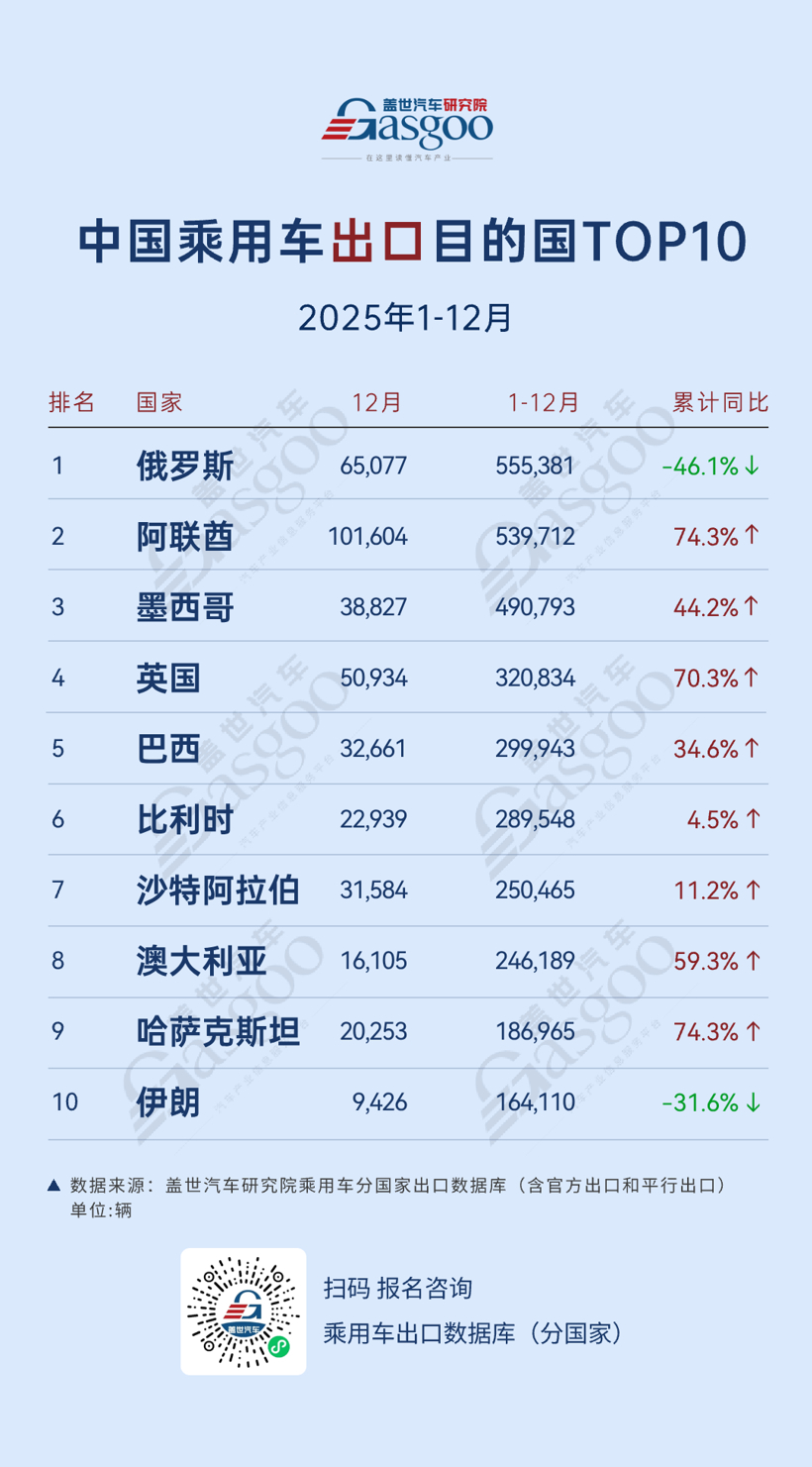
Looking at the structure of destinations, China’s passenger vehicle exports remained relatively concentrated in 2025. Russia, the UAE, and Mexico claimed the top three spots, each approaching or exceeding 500,000 units for the year and forming the core of export volume. Russia led the pack with 555,000 units. Although it remains the largest single market, cumulative volume fell 46.1% — a sign that export structures and demand patterns are adjusting toward a more stable, normalized level.
By contrast, the Middle East and select emerging markets demonstrated greater growth elasticity. The UAE saw full-year exports hit 539,712 units — a 74.3% surge — with December shipments alone surpassing 100,000 units. This reflects rising acceptance of Chinese brands in the Middle East, where activity remains high, fueled by both new energy and internal combustion models. Saudi Arabia and Kazakhstan also posted gains, underscoring stable demand for cost-effective vehicles in energy-dependent economies and neighboring emerging markets.
Performance in mature European and English-speaking markets also warrants attention. The UK saw full-year exports exceed 320,000 units, jumping 70.3%. Belgium approached 290,000 units; while growth there was more moderate, volume remained stable, cementing its role as a key hub. Australia recorded 246,000 units for the year — a nearly 60% rise — indicating that acceptance of Chinese brands in right-hand-drive markets continues to climb.
Latin American markets continue to play a role of steady expansion. Ranked third and fifth respectively, Mexico and Brazil together accounted for nearly 800,000 units, with growth holding in the 30%–45% range. Even as new energy penetration and local industry integration in these regions are still maturing, they offer a relatively stable source of incremental volume for China’s passenger vehicle exports.
Top 10 Destinations for China’s New Energy Passenger Vehicle Exports (Jan–Dec 2025)
No. 1 Belgium: China exported 277,857 new energy passenger vehicles to Belgium in 2025, with 21,942 units in December, up 5.7% year on year.
No. 2 United Kingdom: Exports totaled 224,542 units for the year, with 35,789 shipped in December, surging 91.5% annually.
No. 3 Brazil: Full-year exports reached 190,378 units, including 19,622 in December, representing a 32.2% increase.
No. 4 United Arab Emirates: Exports hit 187,603 units from January to December, with 52,725 units in December alone — a massive 148.8% year-on-year jump.
No. 5 Mexico: Exports stood at 174,493 units for the year, with 17,882 shipped in December, climbing 155.7% year on year.
No. 6 Australia: Full-year exports totaled 120,983 units, with 10,066 in December, up 66.8% from the previous year.
No. 7 Indonesia: Exports reached 118,111 units for the year, with 19,152 in December, soaring 172.1% annually.
No. 8 Thailand: China exported 111,162 new energy passenger vehicles to Thailand in 2025, with 20,475 units in December, a 56.6% year-on-year rise.
No. 9 Israel: Exports totaled 96,668 units for the full year, with 7,492 shipped in December, up 50.1% year on year.
No. 10 Spain: Full-year exports came to 86,810 units, with 9,753 in December, gaining 42.9% annually.
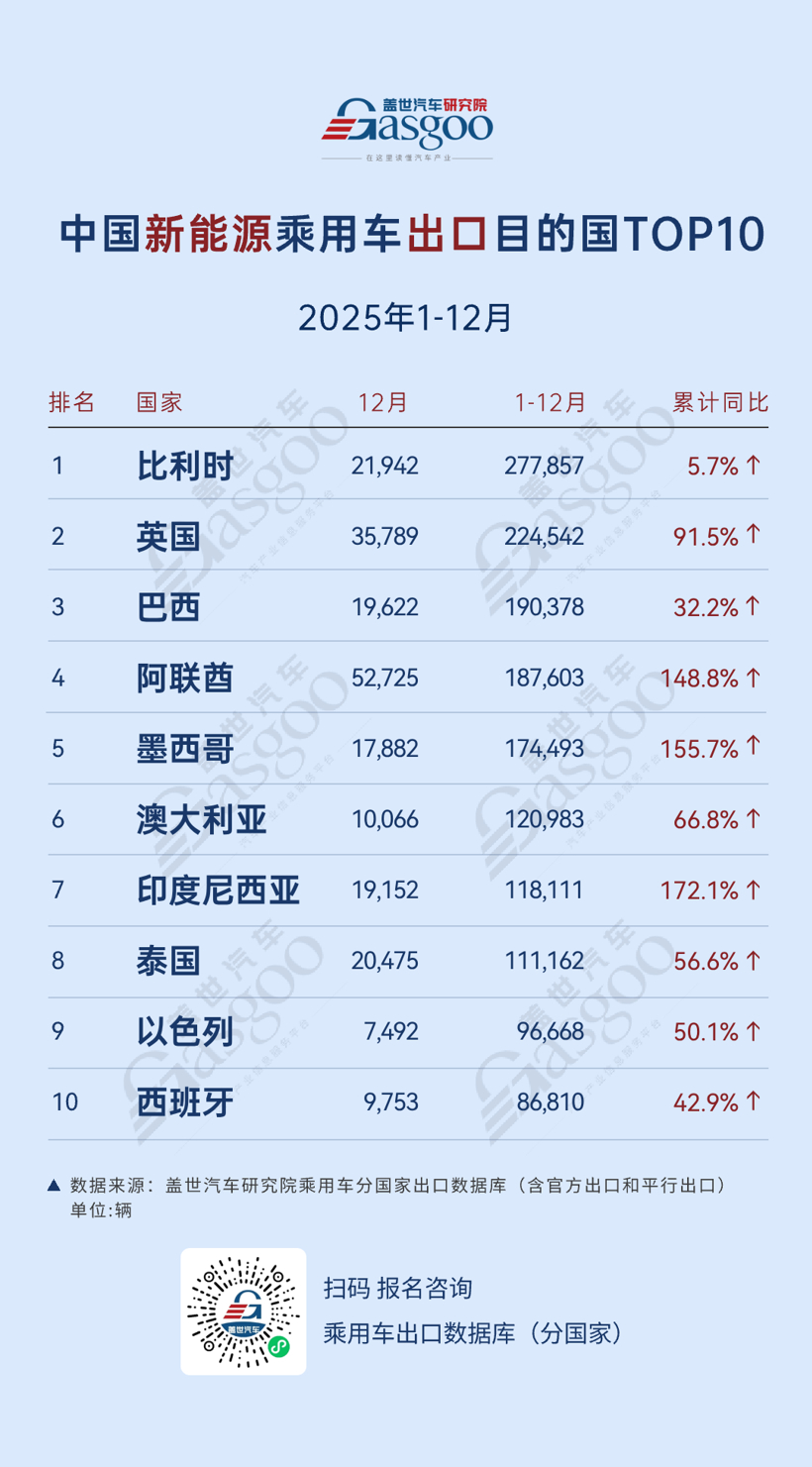
In terms of new energy passenger vehicle destinations, 2025 was characterized by "stable absorption in Europe and explosive growth in emerging markets." Belgium took the top spot with 277,857 units; its relatively modest annual growth highlights its role as a key European hub for distribution and transit. The UK followed with 224,542 units, surging 91.5%, signaling that its consumer market for new energy vehicles is rapidly opening up and that acceptance of Chinese models is deepening.
Emerging markets have become the primary engine for new energy export growth. The UAE, Mexico, and Indonesia all posted annual growth exceeding 140%, with the UAE shipping more than 52,000 units in December alone. As infrastructure improves and policies remain favorable, the Middle East is entering a phase of rapid expansion. Southeast Asia is equally active, with Indonesia and Thailand both cracking the top ten — evidence that the penetration of new energy models in the region is steadily rising.
Latin America and right-hand-drive markets are demonstrating a balance of scale and speed. Brazil approached 190,000 units for the year, achieving over 30% growth despite a high base. Australia hit 120,000 units, up nearly 67%, suggesting that product fit and channel networks for new energy vehicles in right-hand-drive markets are maturing. Within Europe, end-market destinations like the UK, Spain, and Israel continued to expand, with growth rates holding between 40% and 90%. This indicates that the sales structure for Chinese new energy passenger vehicles in Europe and its periphery is increasingly shifting toward consumer-driven demand.