On Feb. 9, industry watcher Gasgoo reported that Tesla Vice President Grace Tao recently confirmed the company has independently invested in and deployed an AI training center in China. The facility targets local assisted driving and AI application scenarios, bolstering Tesla's local AI training capabilities.
Tao did not disclose the center's specific computing power, noting only that current levels meet existing needs.
Globally, Tao revealed that Tesla's capital expenditure for 2026 is expected to exceed $20 billion (approximately 138.93 billion yuan). Investment will prioritize AI computing power, robotics factories, mass production of the autonomous Cybercab, energy storage and manufacturing, charging networks, and battery plants.
Compliance and Strategic Pivots
Establishing an AI training center in China is not an isolated event; it is an inevitable choice born of combining Tesla's global AI strategy with the specificities of the Chinese market.
First, it completes the puzzle of the data loop. As early as 2021, Tesla established a data center in Shanghai to localize data storage. Now, the training center's launch marks Tesla's completion of the full localization chain: "data storage, local training, and algorithm optimization."
Second, it is a move to comply with data regulations. In 2024, the Ministry of Natural Resources of China issued a notice strengthening the management of surveying and geographic information security for intelligent connected vehicles, explicitly mandating that geographic information data be stored within the country.
The notice clarifies requirements for data storage and cross-border transfers. Local authorities must strengthen full-process supervision to ensure geographic data collected for navigation or map updates is transmitted directly to units qualified for navigation electronic map production, prohibiting access by other entities or individuals. Geographic data must be stored domestically, and the storage devices, networks, and cloud services used must meet national security and confidentiality standards. Applications to provide geographic data overseas must undergo strict approval and map review processes, adhering to relevant data export security assessments.
The establishment of Tesla's AI training center is a concrete measure addressing these regulatory requirements.
Tao emphasized: "Tesla's assisted driving data does not need to leave the country, and we strictly follow data compliance requirements. We have now built our own AI training center in China and deployed local training capabilities to prepare for the rollout of future large-scale applications."
Finally, it lays the computing foundation for future business. The creation of the China AI training center paves the way for two critical Tesla operations: the large-scale opening of FSD and the trial operation of Robotaxis.
Tao revealed at an exchange meeting that there is no definitive timeline for FSD's entry into China. The "February" launch mentioned by Elon Musk primarily refers to the European market, with China set to "follow closely."
Reshaping China's Autonomous Driving Landscape
The activation of Tesla's China AI training center will not only alter its own competitive stance in the Chinese market but could also reshape the development trajectory of the entire country's intelligent driving industry.
The autonomous driving race is entering deep waters. Previously, Tesla's FSD operated in a hampered state in China — it possessed an advanced technical framework but lacked deep adaptation to the complex local road conditions.
With the training center now in place, Tesla has patched a critical gap in its localization strategy. The competition is evolving from a simple product comparison to a multi-dimensional battle spanning R&D, data, and computing power.
Addressing the domestic "specs war" over 800V architectures and 5C fast charging, Tao said Tesla maintains a calm attitude. She argued that overall experience trumps single metrics. Currently, adding 300 kilometers of range in 15 minutes satisfies the vast majority of scenarios. The true charging experience is defined by a combination of speed, stability, reliability, network coverage, and management capabilities — not by isolated technical specifications.
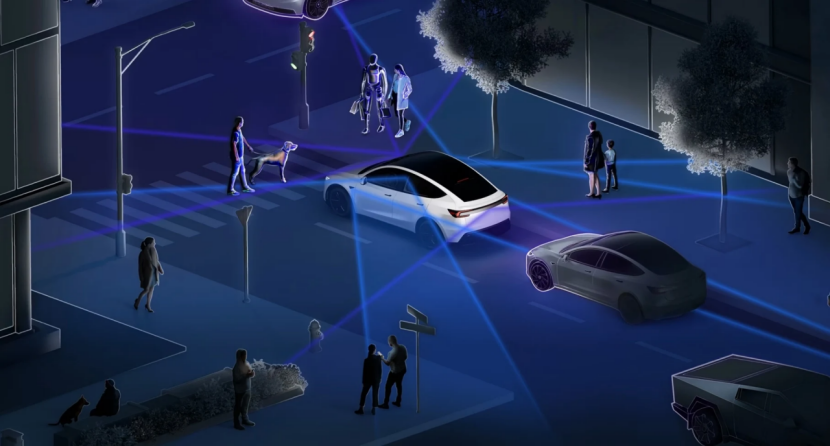
Image source: Tesla
The move is set to energize the supply chain. The establishment of Tesla's AI training center is expected to directly drive industrial development. Sub-sectors like high-precision sensors, chips, and smart cockpits will see an increase in orders. At the same time, this initiative may push the industry to transition from "hardware profitability" to a "software-hardware combined" model, cultivating consumer habits for paying for software.
The battle over technical routes is intensifying. Tesla's pure vision approach and end-to-end large model technology are set for a head-to-head clash with the multi-sensor fusion solutions widely adopted by Chinese automakers.
This competition over technical paths concerns not just product performance, but will also influence the entire industry's perception and choice of pathways toward autonomous driving.
The establishment of the China AI training center signals that Tesla is replicating a key node of its global AI strategy in the world's most important market.
On the global map of autonomous driving competition, the battle lines in the Chinese theater are being redrawn with the activation of a single AI training center.