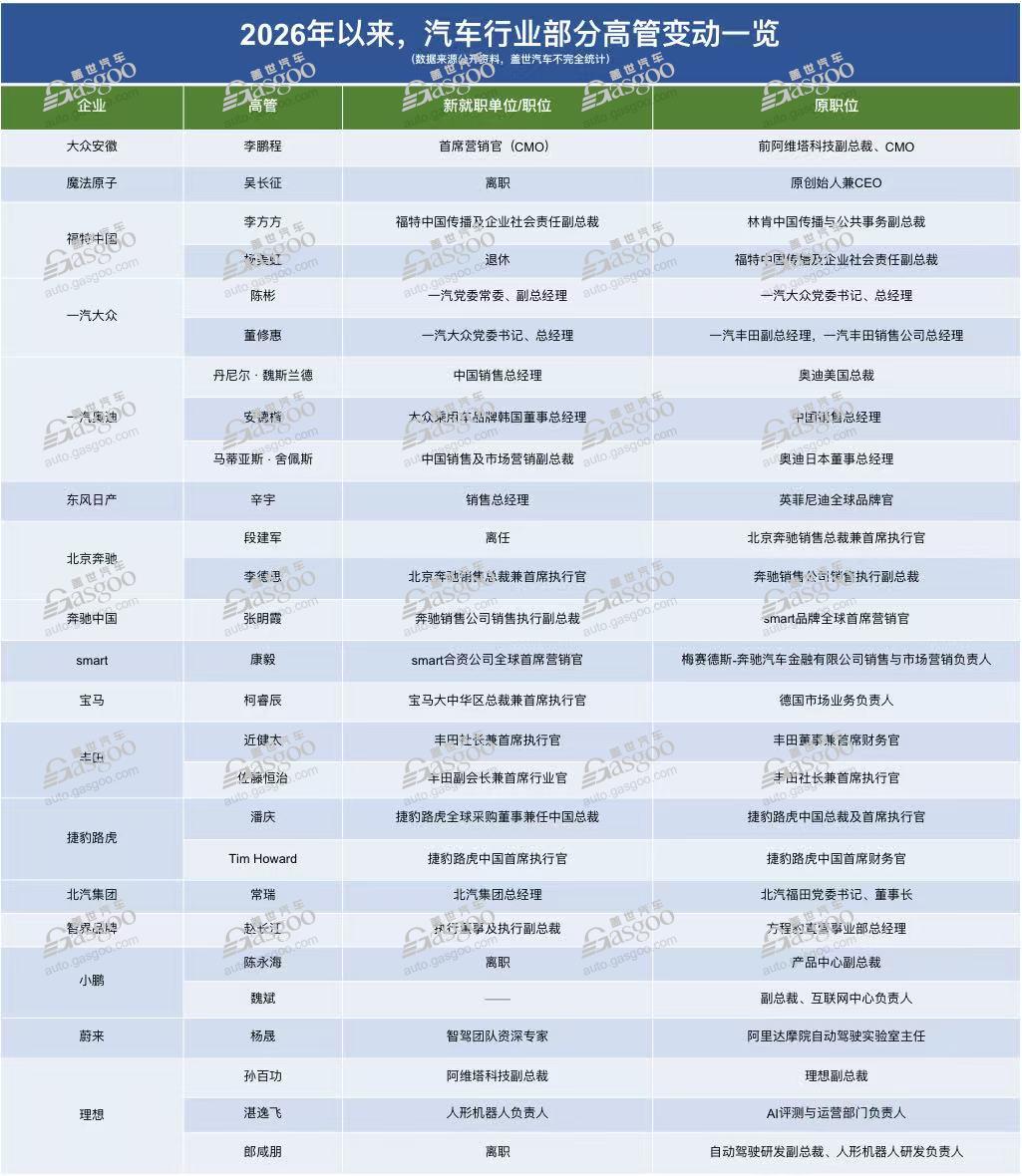
Gasgoo Munich- As the saying goes, the year's success hinges on a good start in spring. For professionals, career moves often finalize around the Lunar New Year, setting the stage for a fresh push in new roles. These individual migrations mirror the broader industry's ebbs and flows. And typically, the greater the turbulence, the more frequent the reshuffling.
Early 2026 brought a sweeping reshuffle across China's auto industry. In less than three months, more than 20 major automakers executed over 150 executive changes, with nearly 10 general-manager-level replacements. This "changing of the guard" isn't a simple rotation; it's a deeper organizational reconstruction as the industry sinks into the deep waters of saturated market competition.
The German Trio Reshuffles Leadership
In this round of upheaval, the German luxury brands—BMW, Mercedes-Benz, and Audi—moved in near unison. All three overhauled their core China management teams almost simultaneously, a density of change rarely seen over the past decade.
The immediate trigger? Slumping performance in China. In 2025, German luxury brands found themselves trapped in a dual decline of sales and revenue in the world's largest auto market.
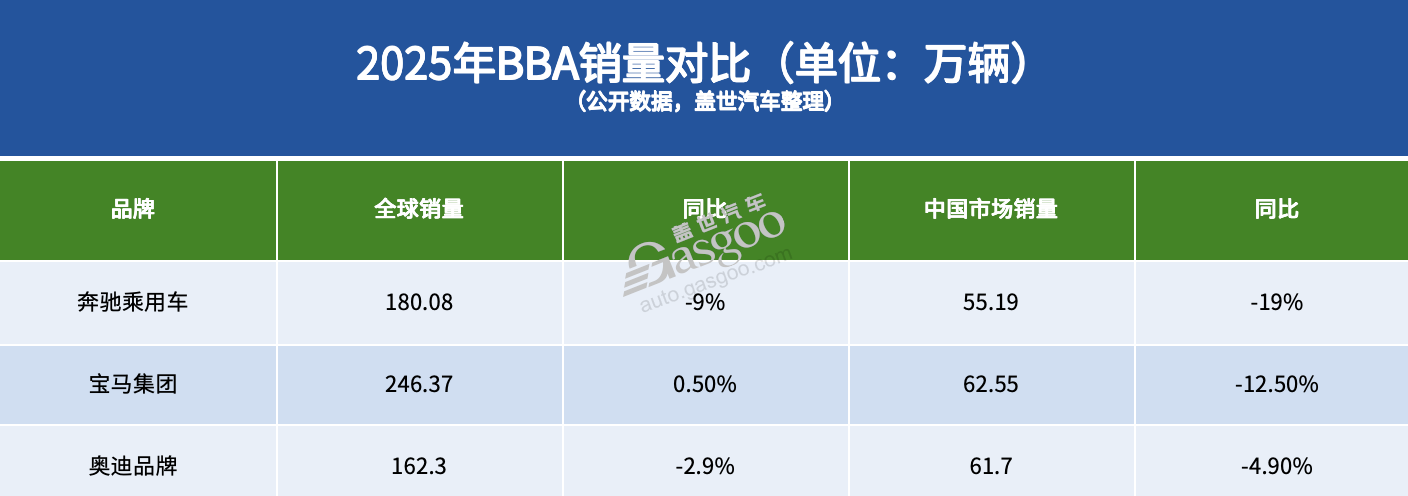
Mercedes-Benz saw passenger car sales in China plunge 19% to 550,000 units, rolling back to 2017 levels. BMW delivered 626,000 vehicles, a 12.5% contraction. Audi, while suffering the smallest dip at roughly 5%, has now failed to grow in China for three consecutive years.
The pressure on the bottom line is even starker. Mercedes-Benz's global adjusted EBIT for fiscal 2025 plummeted 40%, with net profit nearly halved to 5.33 billion euros. China was a significant drag. With both sales and profits ceding ground, the German trio is facing unprecedented survival pressure in the Chinese market.
Even more challenging is the erosion of their once-solid brand premium by a new value system in the smart electric era. As Chinese consumers redefine "luxury" through computing power, intelligent cockpits, and advanced driving, the allure of the engines, transmissions, and chassis tuning that BBA once prided itself on is fading fast.
To defend market share, the Germans have joined the price war. BMW slashed prices on 31 models at the start of the year, with its flagship electric i7 M70L cut by 300,000 yuan. Mercedes-Benz followed suit, lowering prices on core sellers like the C-Class and GLC. Most recently, Audi set the pre-sale price for the new-generation A6L at 320,000 yuan—a move industry insiders called "flipping the table."
This "volume-for-price" strategy may stabilize sales in the short term, but it continues to erode profit margins that are already under strain.
Examining the resumes of these new leaders, two keywords stand out: global synergy and hands-on experience. Starting April 1, 2026, Christian Ach will succeed Sean Green as President and CEO of BMW Group Region China. Christian Ach previously led the German market, where he amassed extensive experience in driving sales growth and advancing organizational transformation.
BMW's senior management noted that amid intensifying competition, "effectively applying regional management experience to core markets is crucial." Reports indicate Christian Ach's appointment will strengthen coordination between China and global headquarters, paving the way for the 2026 rollout of the "Neue Klasse" product lineup.
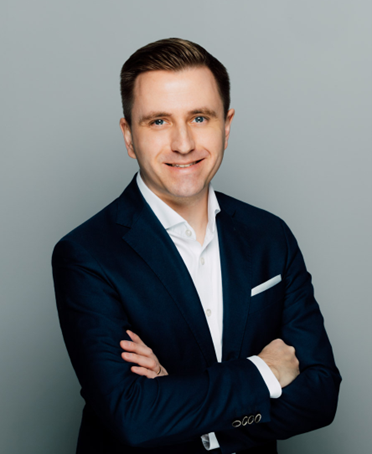
Daniel Lescow, Image source: Mercedes-Benz
At Mercedes-Benz, Duan Jianjun—the company's first Chinese CEO—stepped down and was replaced by Daniel Lescow, a veteran from German headquarters who previously oversaw smart's operations in China. Daniel Lescow brings a comprehensive background in cross-business management, having worked on both electric vehicle brand operations and the development of digital customer systems.
Industry observers view this appointment as a critical strategic move for Mercedes-Benz's intelligent transformation, signaling a subtle shift in its China strategy from local autonomy toward greater direct control by headquarters.
Audi, meanwhile, named Daniel Weissland—former president of Audi of America—as general manager of FAW-Audi Sales Company. Amid this industry upheaval, Audi is clearly betting on executives with mature international management experience to stabilize its joint venture foundation.
When asked about strategic shifts following the leadership change, Mercedes-Benz declined to comment, deferring to official announcements. BMW's actions, however, suggest that 2026 is a pivotal year for its full-scale push into intelligent electrification; the personnel shake-up aims to ensure strategic continuity and reinforce its long-term commitment to the Chinese market.
Other joint ventures are also turning to "veterans" to hedge against uncertainty. Dong Xiuhui returned to FAW-Volkswagen as general manager, tasked with leveraging his deep local market experience to regain growth momentum as joint-venture brand premiums erode. At Jaguar Land Rover, following Pan Qing's promotion to global procurement director and China president, the former China chief financial officer stepped in as the new China CEO.
Volkswagen Anhui recently welcomed a veteran returnee as well. Li Pengcheng was appointed chief marketing officer (CMO) and joined the management board. The company faces its most intensive product offensive in 2026, with four new models launching throughout the year.
Li's arrival is viewed as a masterstroke for the "Gold Standard" Volkswagen's big product year. He understands the PR logic of the Volkswagen system, experienced the build-up of XPENG's communications from zero to one, and spearheaded frontline marketing at Avita.
Yet, Zhou Lijun, dean of the Tengyi Research Institute, cautions that personnel reshuffles alone won't alter the competitive landscape. True breakthroughs still depend on product strength and an understanding of user needs; management adjustments are merely tools for organizational optimization.
Private Automakers Embrace "Diversified" Talent
Unlike the power centralization seen at BBA, China's private automakers are displaying a "borderless" approach to their early 2026 personnel layouts. Talent backgrounds are becoming increasingly diverse, with cross-industry movement extending beyond the auto sector into technology, consumer electronics, and even robotics.
It has become commonplace for executives from the smartphone sector to join automakers. Guo Rui, former president of marketing and CMO at Honor, joined Luxeed (the joint venture between Huawei's Harmony Intelligent Mobility Alliance and Chery) as CEO. In February 2026, Honor's former CEO, Zhao Ming, was named co-chairman of Qianli Technology, Geely Holding's intelligent driving unit. Meanwhile, Sun Baigong, a veteran of Huawei and Li Auto, became vice president at Avita Technology, overseeing marketing and product operations.
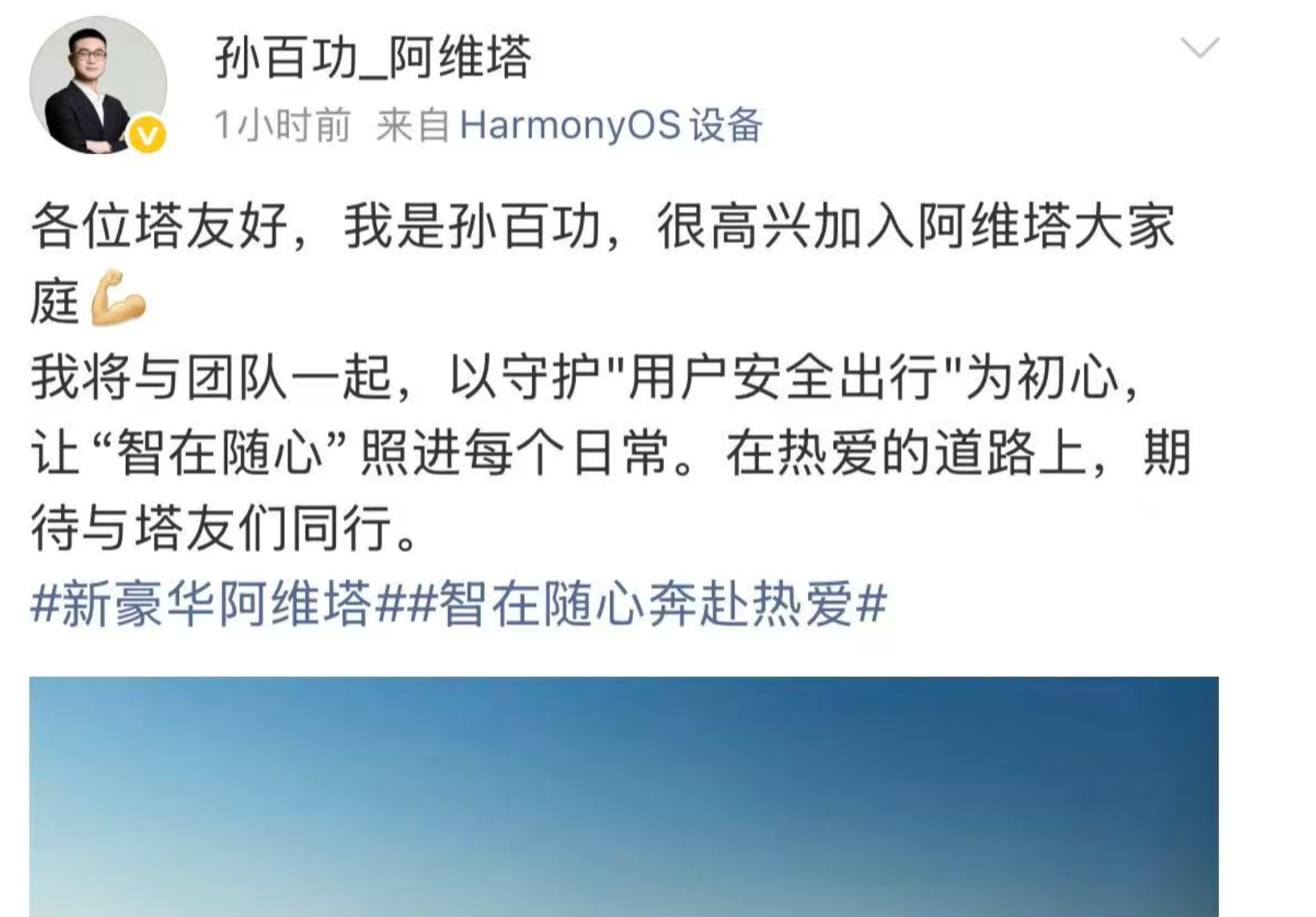
Image source: Sun Baigong's Weibo
In recent years, numerous executives from tech giants like Honor, Huawei, and Alibaba have migrated to the automotive sector. Reports indicate that over 20 former Huawei executives have defected to carmakers, including Jiang Hairong, who joined Deepal Automotive as CEO last year. The Alibaba alumni network is also making moves, with Shen Fangjun joining Zeekr Technology Group as public relations director last year.
These cross-sector recruits share a common trait: they are masters of user operations, OTA iterations, and branding in the consumer electronics space. As the logic of automotive competition shifts from mechanical prowess to software and algorithms, their arrival helps fill the capability gaps of traditional automakers.
Take Guo Rui. During his tenure at Honor, he built the brand's marketing system and drove significant overseas growth—experience that aligns perfectly with Luxeed's 2026 strategy of targeting younger demographics, accelerating global expansion, and penetrating lower-tier markets. Talent flow between traditional automakers remains robust as well; for instance, former BYD executive Zhao Changjiang has also moved to Luxeed.
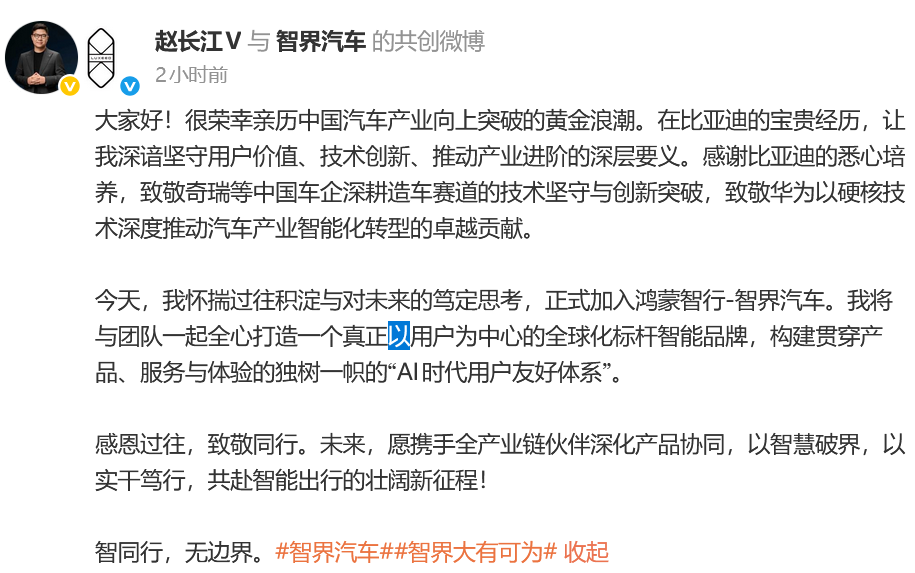
Image source: Weibo screenshot
Among leading "new force" players, personnel shifts point to deeper structural restructuring. Li Auto launched a reorganization of its R&D system early in 2026, splitting its teams into three divisions: base models, software entity, and hardware entity. Lang Xianpeng, the former head of intelligent driving, subsequently departed. This restructuring underscores Li Auto's strategic ambition to evolve into an embodied intelligence enterprise.
Reports suggest former Alibaba executive Ren Geng will partner with Lang Xianpeng to launch a startup focused on embodied intelligence.
The components sector is seeing notable shifts as well. Global semiconductor giant Renesas Electronics announced in March 2026 the appointment of Liu Fang, a veteran with 26 years of semiconductor experience, as president of its China operations. The move aligns with global CEO Hidetoshi Shibata's strategy to strengthen decision-making authority in the Chinese market.
In emerging fields like robotics and AI vision, MagicLab founder and CEO Wu Changzheng resigned, while the company aggressively hired executives from Alibaba, OPPO, and UBTech to lead hardware development and domestic and international commercialization. Horizon Robotics, meanwhile, recruited Zhu Wei, former executive president of CATL, to serve as its president.
The diversification of talent at private automakers is ultimately forced by the market environment. 2025 marked a turning point for the Chinese auto market as it shifted from being defined by software and hardware to being defined by AI. Traditional talent, skilled only in manufacturing or sales, is increasingly ill-equipped to navigate the complexities of global competition.
Yet, Zhou Lijun argues, while new faces bring a fresh atmosphere, the core challenge for companies remains unchanged: does the product truly resonate with user needs?
State-Owned Automakers Launch Personnel Reshuffles
If the personnel adjustments at private automakers reflect a borderless flow of talent, the current reshuffle at state-owned enterprises (SOEs) resembles a strategic deployment rooted in top-level design.
Since the beginning of the year, numerous central and local SOEs—including China FAW, Dongfeng Motor, GAC Group, BAIC Group, and Changan Automobile—have undergone varying degrees of management restructuring. These changes span cadre rotations at the group level, leadership turnovers at subsidiaries, and replacements in technology and marketing roles.
Three main themes emerge. First, executives familiar with independent brands and new energy operations are being moved to core group positions. Second, capable leaders from joint ventures are being deployed to support independent brand units. Third, companies are accelerating the integration of R&D, production, and sales, using cross-divisional personnel swaps to break down departmental silos and establish more flexible market response mechanisms.
Specifically, at the end of 2025, Chen Bin concluded his one-year tenure as general manager of FAW-Volkswagen and returned to the group to oversee marketing and exports. Zhang Xiaofan transferred from Dongfeng to FAW as a member of the Standing Committee of the Party Committee and vice president. Li Yang, deputy general manager of Dongfeng Peugeot-Citroën, returned to Dongfeng Motor Company as vice president.
At GAC Trumpchi, President Huang Jian and Vice President Li An both hail from the front lines of GAC Toyota, bringing deep experience in sales and channel operations. This approach of leveraging joint venture expertise to bolster independent brands reveals the urgency of state-owned automakers to break through. The days of relying on joint ventures as "cash cows" are over; talent must now be concentrated on the independent brands to lead the charge.
Changan Automobile's adjustments focus more on internal synergy. Fang Nan, former global brand lead for Changan's Gravity series, and Li Pan, former chief brand officer of Deepal, officially swapped positions. The two had worked together at Auchan for years. The intent behind this exchange is clear: to let the operational experience of Gravity and Deepal cross-pollinate, allowing each brand to learn from the other's marketing tactics.
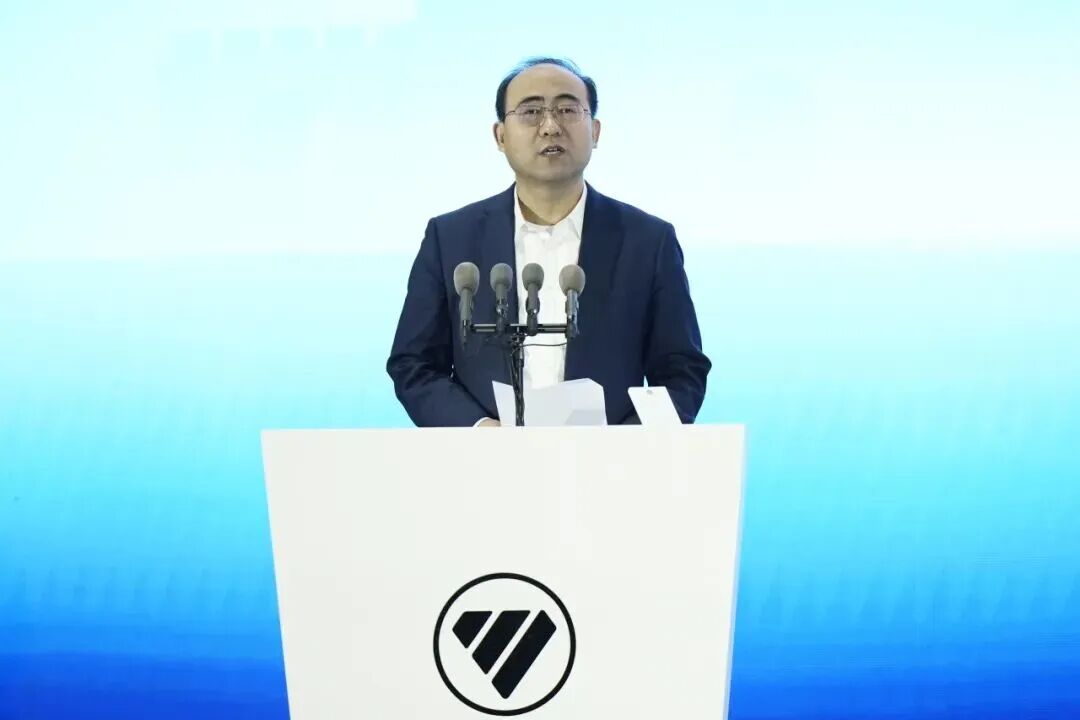
Chang Rui, then member of the Standing Committee of the Party Committee and vice president of BAIC Group, and Party Secretary and Chairman of BAIC Foton; Image source: BAIC Group
At BAIC Group, Chang Rui, who has deep roots in the commercial vehicle sector, was promoted to general manager. His appointment is expected to help maintain management stability and execution during a critical phase of brand building and the implementation of new energy strategies.
This wave of SOE reshuffling follows a clear logic. For years, state-owned automakers held significant advantages in resources, manufacturing heritage, and supply chain layout. However, as electrification and intelligent transformation enter deep waters, the institutional inertia of some traditional SOEs has, to a certain extent, slowed their response speed to the new energy market.
Faced with sustained pressure on market share, simple business supplements cannot solve fundamental problems. Only by promoting deep personnel mobility and breaking down information barriers between departments and sub-brands can innovation be activated at its organizational source.
Different Paths, Same Goal
Although the executive shifts at these three types of automakers have different focuses, they point to a single objective: to secure market share and enhance core competitiveness during this critical transition period, amidst the brutal game of a saturated market.
For BBA, the leadership changes are fundamentally about survival and defense. Dual pressure on sales and profits has compelled headquarters to re-evaluate its China strategy. The primary task for the new leaders is to boost performance and tighten central control to improve the efficiency of global resource allocation. They must establish a new defensive moat before brand premiums are diluted further. This reshuffle is results-driven, aiming to reverse the passive situation facing joint ventures in China.
The frequent reshuffling at SOEs resembles a self-revolution aimed at rebuilding the system. Beyond normal personnel transitions, SOEs shoulder a heavier mandate: transforming toward independent brands and breaking through key technological bottlenecks. By cross-rotating executives with experience in both joint ventures and independent operations, the goal is to eliminate internal communication barriers and build organizational resilience for the 2026 offensive.
The changes at private automakers and new forces are geared toward expansion and reinvention. Whether recruiting executives from the smartphone sector or restructuring intelligent driving teams, the essence is the same: breaking the cognitive boundaries of the traditional auto industry. They are using cross-industry thinking to define the next generation of products, maintaining a pioneer stance in technological competition, and establishing pricing power and discourse in the intelligent era.
As Zhou Lijun noted, changing the guard alone won't solve every problem. Its true significance lies in using the flow of talent to drive the reallocation of resources, ultimately bringing products back in line with user needs.
When facing such upheaval, manufacturers often emphasize the continuity and foresight of their strategy. Whether it is Mercedes-Benz showcasing its commitment to intelligence through a combination of moves, BMW clearing organizational hurdles for its Neue Klasse launch, or private companies achieving zero-to-one breakthroughs through diverse talent, the essence is the same: to secure their place in 2026—and perhaps find opportunities for expansion beyond mere survival in this chaotic competitive landscape.
There is an old saying: change leads to success, and success leads to longevity. In this turbulent era of industry transition, enterprises that proactively embrace change and accurately identify talent will emerge from the growing pains sooner than their rivals. The prerequisite, of course, is that the right people are chosen to steer the ship.
Appendix: Personnel Changes Table