



Gasgoo Munich- On March 20, the Shanghai Stock Exchange formally accaepted Unitree Robotics Technology Co., Ltd.'s application for an initial public offering on the STAR Market.
Unitree aims to raise 4.202 billion yuan in this IPO. The proceeds will fund four major initiatives: R&D for intelligent robot models and robot bodies, development of new intelligent robot products, and the construction of a manufacturing base. The goal is to deepen technological innovation and scale up production.
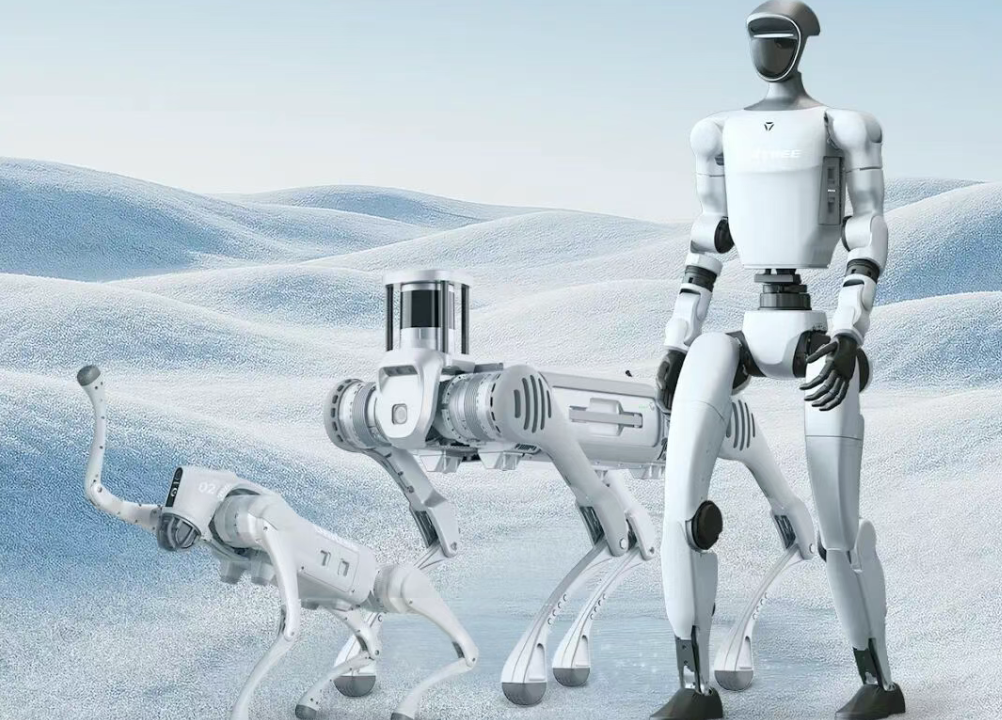
Image source: Unitree Robotics
From Quadrupeds to Bipeds: A Quiet Structural Shift
A look at Unitree's revenue structure reveals a clear evolutionary trajectory.
From 2022 through 2025, Unitree's revenue climbed from 123 million yuan to 1.708 billion yuan, passing through 159 million and 392 million along the way. Net profit followed a similar upward trajectory, shifting from a loss of 22.1 million yuan in 2022 to a profit of 288 million yuan last year.
Yet more telling than the growth itself is the structural shift behind it: in the early days, quadruped robots were Unitree's undisputed engine.
According to the prospectus, Unitree sold over 30,000 quadruped robots during the reporting period, cementing its dominant position in the global market.
In 2022, quadrupeds accounted for 76.57% of revenue, with 2,403 units sold at an average price of 38,600 yuan. By the first three quarters of 2025, however, sales had jumped to 17,946 units, yet their share of revenue had slipped to 42.25%.
In contrast, sales and market share for humanoid robots have been steadily rising.
Unitree currently offers four humanoid products: the full-size H1, the medium-sized G1, the compact R1, and the full-size general-purpose H2.
The H1 launched in August 2023, selling just 5 units that year at nearly 600,000 yuan apiece. The following year, Unitree introduced the G1, driving humanoid sales to 410 units and lowering the average price to 260,700 yuan. By 2025, driven by these four models, Unitree's shipments of humanoid robots exceeded 5,500 units—ranking first globally.
This indicates that Unitree's 335.36% revenue surge in 2025 was driven primarily by rapid product sales growth during the period.
Correspondingly, humanoids contributed less than 2% of revenue in 2023. By the first three quarters of 2025, however, that figure had reached 51.53%, overtaking quadrupeds.
So, with thousands of units sold annually, where are all these robots going?
The prospectus outlines two main channels. On the industrial front, quadrupeds are widely used for inspection and surveying by giants like State Grid, China Southern Power Grid, PetroChina, Sinopec, and Baowu Group, replacing personnel in hazardous environments such as chemical parks, substations, and underground coal mines.
In the humanoid sector, universities and research institutions remain the primary customers. On the consumer side, Unitree's products have entered education, cultural performances, and intelligent services. The "Yang BOT" performance at the 2025 CCTV Spring Festival Gala and the "Wu BOT" act in 2026 serve as key market validation.
Alongside rising sales, Unitree's gross margin has steadily improved, climbing from 44.18% in 2022 to 59.45% in the first three quarters of 2025.
This means that as sales accelerate, Unitree is generating higher profit per unit. That combination of rising volume and rising profitability is rare among hardware startups.
By comparison, UBTECH and DOBOT posted gross margins of 28.65% and 46.56% respectively in 2024, while Unitree's comprehensive gross margin stood at a notable 56.98%.
In terms of adjusted net profit margin, Unitree reached 36.88% in the first three quarters of 2025, whereas UBTECH and DOBOT were still in the red in 2024. This signals that Unitree has crossed the critical threshold from cash burn to profitability—the key differentiator between it and most of its peers.
Why Unitree?
In the robotics sector, few have managed to achieve true mass production. How did Unitree break through first? The answer lies in "full-stack in-house development."
Beyond high-performance bodies, Unitree has developed its entire technology stack in-house. This covers core model algorithms like embodied intelligence, reinforcement learning, and motion control; intelligent systems for thermal and energy management and motor drives; and key components such as high-performance motors, reducers, dexterous hands, LiDAR, and various sensors.
This in-house production of core components has given Unitree significant control over its supply chain. That not only ensures rapid product and technology iteration but also significantly cuts material procurement and manufacturing costs.
For instance, the starting price of Unitree's Go2 Air quadruped has dropped below 10,000 yuan. The G1 humanoid starts at 85,000 yuan, while the R1 Air continues the high-value strategy, reducing the market entry barrier for high-performance general-purpose humanoids to just 29,900 yuan.
The flip side of cost advantage is the feedback loop of scale.
In 2025, Unitree shipped over 5,500 humanoid robots. By comparison, overseas rivals like Figure AI and Agility Robotics shipped around 150 units each, and Tesla has not yet publicly sold its Optimus. Unitree's shipment volume is dozens of times higher than its international peers.
Scale brings not just supply chain leverage but also accumulated engineering prowess—a trajectory clearly visible in the breakthrough capabilities of Unitree's products.
Since its inception, Unitree has achieved notable innovations in high-performance general robotics, breaking numerous industry records. In 2020, the A1 quadruped hit a top speed of 3.3 meters per second, making it the fastest small-to-medium quadruped in China at the time. The following year, the Go1 pushed that to 4.7 m/s, setting a world record for quadrupeds of similar specifications.
In the humanoid sector, the H1—launched in 2023—successfully executed the world's first electric backflip in early 2024. By 2025, it achieved a running speed exceeding 5 meters per second.
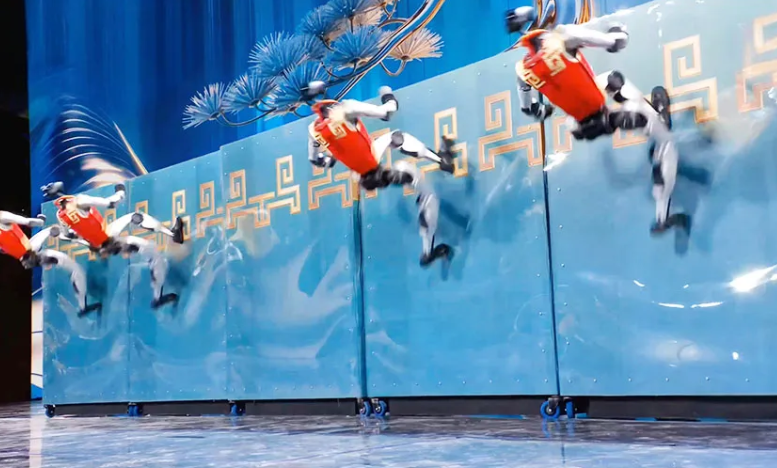
Image source: Screenshot of CCTV Spring Festival Gala broadcast
Since 2024, Unitree has continuously improved motion control and swarm scheduling. In early 2025, 16 H1 robots, driven entirely by AI, performed in the "Yang BOT" dance at the CCTV Spring Festival Gala. A year later, the "Wu BOT" martial arts performance set a new technological benchmark: 24 G1 units and one H2 demonstrated millisecond-level synchronization during high-speed parkour and drunken boxing sparring, breaking global records for continuous complex table vaulting and catapult backflips.
These standout achievements are closely linked to the data and feedback accumulated from vast numbers of Unitree robots in actual use.
Even more noteworthy is the broad developer ecosystem Unitree is building. Since 2018, the company has consistently released open-source projects on GitHub, totaling 43 to date. Covering simulation modeling, motion control, embodied large models, and associated software stacks, these efforts have fostered an active and massive developer base.
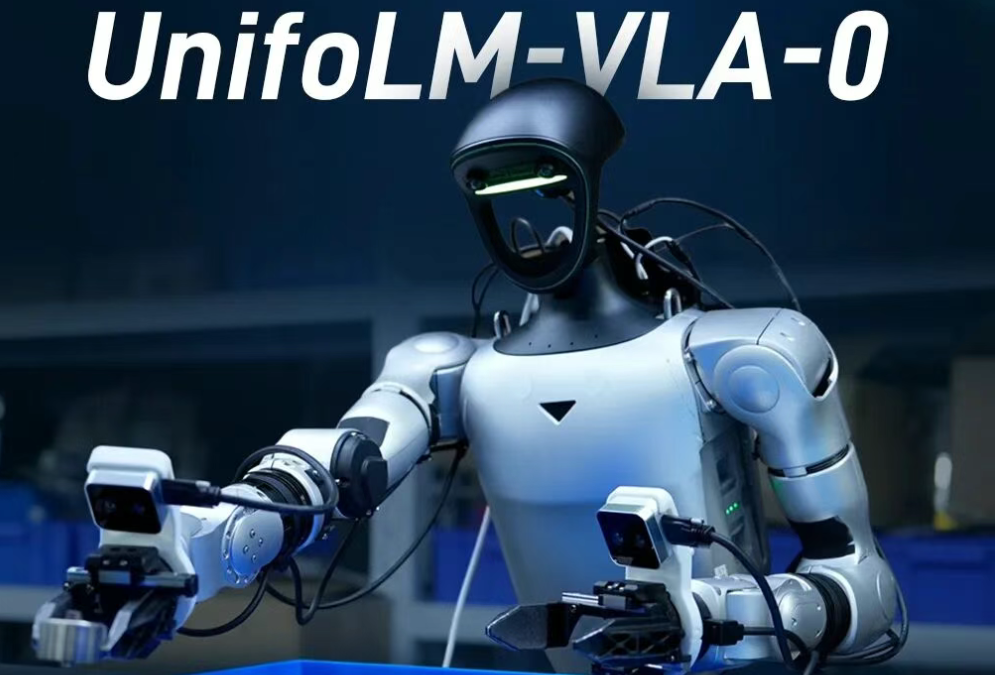
Image source: Unitree Robotics
In September 2025 and January 2026, Unitree open-sourced two general-purpose large models, UnifoLM-WMA-0 and UnifoLM-VLA-0. This open-source strategy not only attracts global developers to the ecosystem but also ensures a continuous flow of technological feedback.
Clearly, Unitree's competitive advantage is not a single technology or product, but a system built on "full-stack in-house development + mass production + open-source ecosystem." In this system, technology drives down costs; lower costs drive scale expansion; and scale expansion feeds back into technology iteration—a virtuous cycle.
Conclusion
"2026 marks the tenth anniversary of Unitree Robotics. For a decade, we have held fast to our founding mission: to advance human society through technology." This line from the prospectus serves as both a look back and a look forward.
From a lab in Hangzhou to the doorstep of the STAR Market, and from a pioneer in quadrupeds to the global leader in humanoid shipments, Unitree has spent a decade validating its technological roadmap and executing a structural pivot.
Yet technological leadership does not guarantee commercial success, and scale does not ensure a permanent competitive advantage. Mass commercialization of humanoids still faces significant uncertainties: the generalization capabilities of embodied models need breakthroughs, dexterous manipulation requires refinement, and consumer demand has not yet matured. Meanwhile, the entry of giants like Tesla could reshape the competitive landscape in the coming years.
Amid these challenges, Unitree still has a significant journey ahead if it wants to lead the global robotics industry into the era of large-scale scenario applications.


