



Gasgoo Munich- On February 26, 2026, social media platforms were flooded with drivers testing the same feature: whether their own vehicles would allow voice commands to kill the headlights while in motion.
The frenzy began yesterday, after a seemingly freak accident sent shockwaves through the auto industry. During a night drive, a passenger in a vehicle from a specific brand accidentally triggered a voice command that turned off the headlights. The sudden loss of light left the driver with no time to react, resulting in a crash.
As the incident gained traction, owners of the affected brand told Gasgoo that they had long since spotted the flaw. Some even shared their own "workarounds": if the lights go out by mistake, pull the high-beam lever and hold it there to force the lights back on.
Even more telling, some owners discovered after testing that this isn't an industry-wide plague. Their vehicles' infotainment systems simply refused to execute the "turn off lights while driving" command.
This raises a fundamental question: When it comes to smart vehicles, why do some blindly obey and kill the lights, while others hold the line?
Why Can Voice Control Kill the Headlights?
To understand the problem, we first have to look at how modern cars are designed.
Walk into any showroom today and the trend is unmistakable: physical buttons are vanishing, replaced by a single screen that controls everything. This "minimalist" aesthetic—borrowed from smartphones—looks clean and screams high-tech. But those headlight knobs that once allowed for blind operation have either been buried in touch-screen menus or handed over entirely to voice commands.
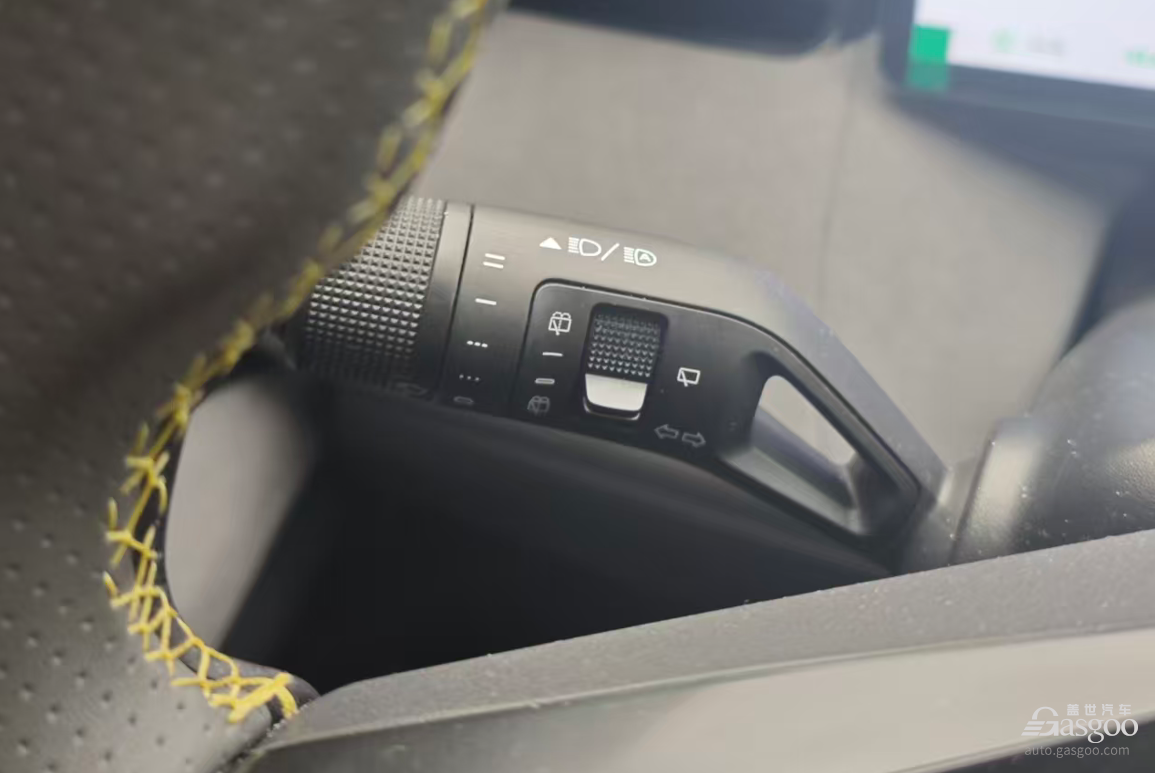
Schematic of a current vehicle lighting control stalk (not the model involved in the accident); Image Source: Gasgoo
To product managers, the logic seems sound: If you can tell your phone to "turn off the flashlight," why shouldn't you be able to tell your car to "turn off the headlights"?
But that's exactly where the problem lies. A frozen phone can be rebooted; headlights that cut out on the highway can be fatal.
The deeper cause is the shift from traditional "mechanical connections" to "software-defined vehicles." In the past, a headlight switch was a physical button; you pressed it, the circuit closed, and the lights came on—simple and direct. Now, vehicles have a central brain (domain controllers), and components like headlights, air conditioning, and windows have become "actuators" controlled by code. As an input port, the voice system can theoretically adjust anything.
If engineers didn't anticipate this risk and blacklist the "turn off headlights while driving" command during the design phase, the voice system will obediently execute the order when it receives it. After all, it is just code—it doesn't understand what "turning off the lights" means at highway speeds.
The "workaround" shared by that owner highlights a critical flaw. When the voice system scrambles the headlight logic, the user is forced to rely on the most primitive method—forcing the high beams on—to cope, ultimately depending on a "reboot" to restore the system. It's just like restarting a frozen smartphone—except a car isn't a phone, and there's no time to reboot on the highway.
The bottom line is this: headlights are vulnerable to voice commands not because the technology is rudimentary, but because they've been reduced to a generic "switch" in the code world, stripped of the status they deserve as a critical safety component.
Why Do Some Cars Refuse to Turn Off the Lights?
As more test videos surface, an interesting pattern has emerged: not all vehicles are this "obedient."
Owners of other models under the same brand have found that when they attempt to turn off the lights via voice while in Drive, the system flatly refuses. With the same voice control technology, why such a vast difference in behavior?
The answer lies in a "safety gate": some manufacturers have installed a firewall between the voice system and the headlights.
Put simply, when the system receives a command, it doesn't execute immediately. Instead, it asks a few questions: What is the current speed? Is it day or night? Is the vehicle moving? If the system determines that the combination of "nighttime + highway speed + lights off" poses a safety risk, it automatically rejects the command or requires a secondary confirmation.
Those vehicles that obediently turn off the lights likely skipped this safety gate entirely.
To some extent, this reflects a divergence in how different automakers—or even different teams within the same company—interpret "intelligence." As owners of other brands under the group involved in the accident have noted, their systems ask "is it safe?" before they try to "understand you."
Technically, implementing this safety gate isn't difficult. The challenge lies in whether automakers are willing to dedicate resources to this "invisible safety feature" while chasing flashy technologies like large voice models and end-to-end AI. After all, users rarely leave positive reviews because a car "refused a dangerous request," but they are quick to complain when a car "doesn't understand a simple command."
The significance of that safety gate goes beyond preventing a single mistaken operation—it could very well keep a lawsuit at bay.
As the fallout from the accident spreads, legal questions are mounting. Lei Wen, a lawyer at Guangdong Huaibo Law Firm, offered a professional legal analysis in an interview with Gasgoo:
"Under Article 1,203 of the Civil Code of the People's Republic of China, if a product defect causes harm to others, the injured party has the right to seek compensation from the manufacturer or the seller. In this incident, if the situation—where voice control mistakenly triggers the headlights to turn off and there is no physical emergency control—constitutes a product defect, the car owner, as the injured party, has the standing and legal basis to sue both the manufacturer and the seller."
Lei Wen further noted that whether the automaker fulfilled its obligation to inform users will directly impact the scope of liability:
"If the physical controls for the headlights are unreasonably designed or concealed, and the manufacturer or seller failed to provide adequate instructions or warnings regarding these operations—thereby neglecting their duty to inform—the automaker should bear full liability for the losses. However, if a complete user manual, operating guidelines, and safety precautions were provided with the vehicle, and the duty to inform was reasonably fulfilled, the automaker's liability may be mitigated."
This gets to the heart of the matter. The "hold the high-beam lever + reboot" workaround shared by that "veteran driver" may sound like clever folk wisdom. But if that trick is known only to experienced owners and never taught to new users, how would a court view it after an accident occurs?
So, those vehicles that refused to execute the light-off command during testing didn't just block a voice prompt—they may have also blocked a court summons for the automaker.
Final Thoughts
The "voice-controlled headlight" issue is, at its core, not unique to any single brand. It is a pitfall the entire industry has stumbled into in its pursuit of "intelligence." Some just fell deeper than others.
We are so eager to turn cars into intelligent agents, so desperate for them to obey our every command, that we've forgotten the most basic fact: a car is first and foremost a means of transportation, and safety is always the bottom line. Those vehicles that refused to turn off the lights aren't less intelligent—they understand what true intelligence really means.
After all, the light that guides you home shouldn't be extinguished unexpectedly in the dead of night.


