



Gasgoo Munich- On March 5, Gigaai announced it has recently closed a nearly 1 billion yuan Pre-B financing round.
The investor roster is extensive. Semiconductor and automotive capital players like Shanghai Pudong Science and Technology Investment Co., Ltd., Linxin Capital, Xingyuan Capital, and Wanlin International joined in. State-backed platforms including CICC Capital, Su VC, Huaqiang Capital, Changjiang Capital, Optics Valley Industrial Investment, and Xishan State Investment participated, alongside several financial institutions.
Returning shareholders CICC Capital, Huaqiang Capital, Caixin Capital, and Zhangke Yaokun doubled down with additional investments.
With this round closed, Gigaai's shareholder base now officially combines industrial capital, state-backed platforms, and financial institutions.
As capital accelerates toward top-tier embodied AI companies, why is Gigaai the target everyone is fighting for?

Image Source: Gigaai
What does it mean when industrial capital and state-backed investors pile in?
A defining feature of this round is the dense presence of semiconductor industrial capital.
Shanghai Pudong Science and Technology Investment Co., Ltd., and Linxin Capital are deeply rooted in the semiconductor supply chain. Their entry suggests they aren't just betting on the long-term promise of embodied AI; it's also tied to the role chips play in robotics.
It is well known that the "brain" of embodied AI demands massive computing power, which relies entirely on chips. For these investors, backing an embodied foundation model company is, in a sense, about securing definitive application scenarios for their chips.
Capital with automotive backgrounds, such as Wanlin International and Xingyuan Capital, also deserves attention.
For now, automotive manufacturing looks like a key market for embodied robots. From welding and assembly on production lines to inspection and logistics, these robots can significantly boost efficiency and quality stability thanks to their precision, flexibility, and endurance. This likely explains why BAIC Industrial Investment previously came on board.
It's worth noting that beyond Gigaai, BAIC Industrial Investment has also backed Galaxea, Robotera, Noetix Robotics, and GALBOT in the embodied AI space.
The heavy presence of state-backed platforms, however, likely signals a different calculation.
Behind the entry of players like Su VC, Guangzhou Industrial Investment, Optics Valley Industrial Investment, Changjiang Capital, and Zhuhai Sci-Tech Industry Group lies a trend: multiple cities are incorporating embodied AI into their local industrial layouts.
Take Suzhou. In its "15th Five-Year Plan" recommendations published in January 2026, the city explicitly stated it would accelerate the development of embodied AI, quantum technology, and brain-computer interfaces as new economic growth engines.
Earlier, documents like the "Three-Year Action Plan for the Innovative Development of Suzhou's Embodied AI Robot Industry (2025-2027)" set clear targets: by 2027, the city aims to establish a preliminary innovation system for the industry. Other goals include a core industry scale of 10 billion yuan, a related industry scale of 30 billion yuan, and a supporting robotics industry scale of 200 billion yuan.
Similarly, Wuhan’s action plans for 2025-2027 focus on five major initiatives, aiming to build the city into a national hub for specialized sensing, scenario applications, and intelligent manufacturing in humanoid robotics.
Since then, various regions have rolled out a series of supportive policies, offering aid in funding, land, and talent.
If chip capital is entering to find scenarios for technology, and the auto industry is investing to find efficiency for production lines, then the influx of state-backed platforms is about cities finding new industries.
That these three forces are converging on embodied AI at the same moment suggests the track is moving from proof-of-concept to the eve of industrial implementation.
Who is Gigaai?
To understand why investors are rushing in, we first need to ask: what kind of company is Gigaai?
The composition of Gigaai's core team largely defines its technological DNA.
Founder Huang Guan holds a Ph.D. from Tsinghua University's Department of Automation. He formerly led visual perception technology at Horizon Robotics and was a partner at PhiGent Robotics, with stints at Microsoft Research Asia and Samsung Research China. He effectively blends academic research with industrial experience.
More importantly, Huang lived through the past decade of evolution in Physical AI, bringing deep experience in technical innovation, industrial deployment, and serial entrepreneurship.
The model core team includes former VP-level architects from major internet firms and recipients of Huawei's "Genius Youth" program. The hardware R&D team hails from top domestic robotics companies, having led the development and delivery of thousands of humanoid robots.
This combination of "algorithm + hardware + mass production" is relatively rare among current embodied AI startups.

Image Source: Gigaai
In its core business, Gigaai positions itself as an "embodied foundation model and general robotics" company. Its strategic framework boils down to four pillars: embodied foundation models, world models, native body, and generalized scenarios.
These four aren't isolated: the foundation model is the "brain" for perception and decision-making; the world model is the "simulator" for efficient training and data generation; the native body is the "physical form" for execution; and generalized scenarios are the "landing grounds" for validation and iteration.
In practice, they form a closed loop: the model drives the body, the body generates data, the data feeds the world model, and the world model optimizes the model in return.
If this logic holds, Gigaai can shed its dependence on third-party data and hardware to achieve self-evolution.
The world model is the linchpin of this loop and the most distinctive part of Gigaai's technical roadmap. This strategy stems from Huang's view that current VLA-dominated embodied foundation models suffer from two critical flaws: inefficient model architectures and inefficient real-world data collection. The rapid rise of world models offers a potential path to solve both.
Around this "four-in-one" strategy, Gigaai has developed the GigaBrain series of embodied foundation models, the GigaWorld world model platform, and the general-purpose native body, Maker.
Gigaai has also made moves in autonomous driving. Its DriveDreamer and DriveDreamer4D solutions are reportedly among the pioneering efforts globally to apply world models to the physical world. They have already seen large-scale industrial deployment, with partners including Li Auto and ECARX.
Of course, technical accumulation must ultimately be validated commercially.
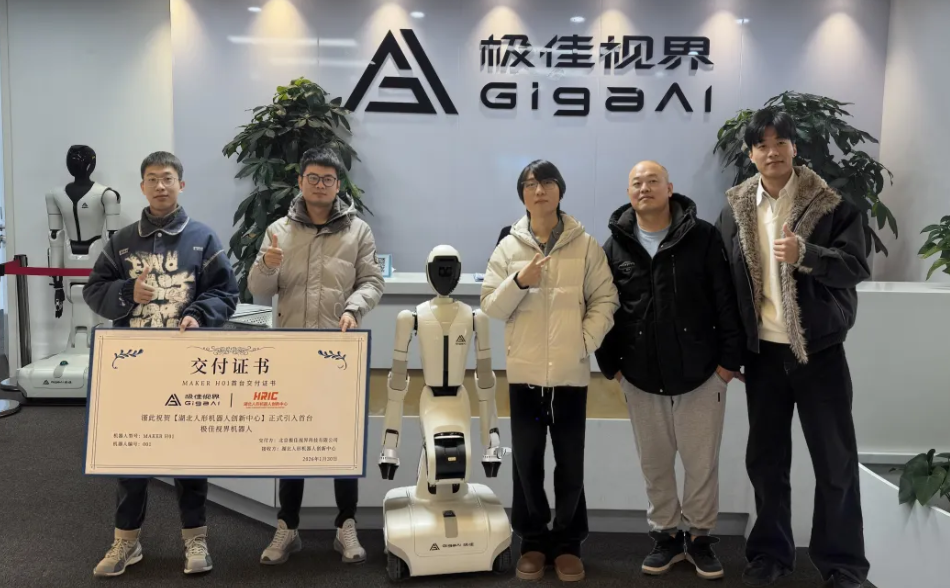
Image Source: Gigaai
Here, Gigaai offers a few metrics to watch. First is the mass delivery of its native body. In November 2025, Gigaai released the Maker H01, a fully self-developed native robot. It has now started mass production and delivery for scenarios including data collection, industrial use, and services.
Building on this, Gigaai plans to release more native body models adapted to different scenarios in 2026, aiming to deliver 1,000 units over the year.
This means Gigaai isn't just a software company providing the "brain"; it has closed the loop on the hardware side as well.
Second is progress in generalized scenarios. Public information shows Gigaai has landed benchmark clients in automotive manufacturing, 3C electronics, warehousing and logistics, high-end guiding, and home terminals. While specific order values weren't disclosed, advancing across multiple industries simultaneously suggests its products possess a degree of cross-scenario generalization capability.
Third is repeat business from industrial clients. Although specific order data is undisclosed, the continued oversubscription from returning investors like CICC Capital and Huaqiang Capital suggests the backers hold a relatively positive view of the company's commercial progress.
Conclusion
Overall, Gigaai is taking a road less traveled.
The world model technical route, the four-in-one closed-loop strategy, and the full-stack software-hardware integration—every choice implies higher input and greater uncertainty. Yet it is precisely this "difference" that has attracted collective bets from chip giants, the auto industry, and state-backed platforms.
Gigaai positions itself as the "OpenAI of the physical world." It is certainly an ambitious goal, but it also means that from technology to industry, and from the lab to the factory floor, Gigaai still has a long way to go.


