



Gasgoo Munich- On March 2, XPENG hosted a media event in Guangzhou to showcase its second-generation VLA (Vision-Language-Action), XPENG's first mass-produced physical world large model. Chairman and CEO He Xiaopeng confirmed that the updated platform will begin rolling out to users later this month.
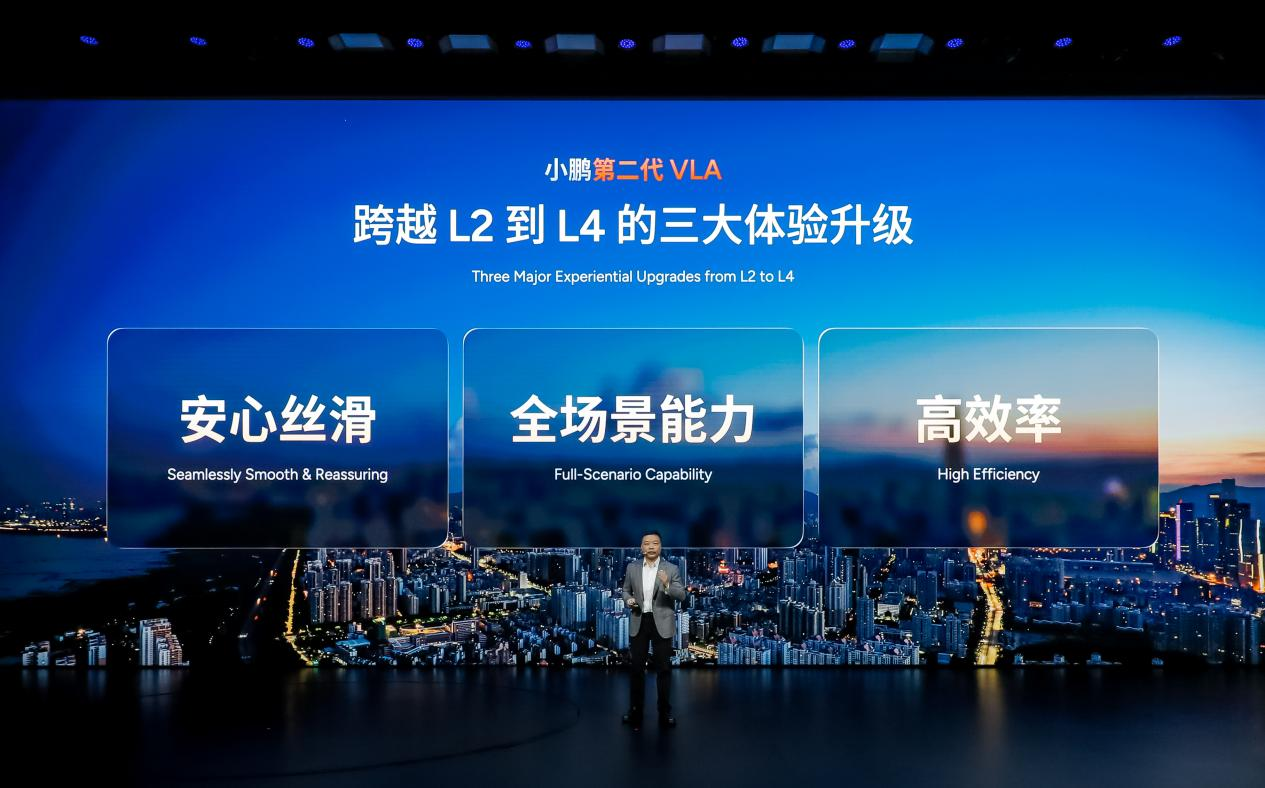
Image source: XPENG
The event also marked the market launch of the 2026 X9's BEV version, offered in five variants priced between 309,800 yuan and 369,800 yuan.
Over the past year, end-to-end architectures have become the dominant approach in China's smart driving race. However, limitations in smaller-scale models are increasingly apparent. Rather than incrementally refining conventional L2 systems, XPENG has opted for a more fundamental overhaul aimed at bridging the gap toward higher-level autonomy.
The most significant shift in the second-generation VLA lies in its architecture. Instead of using a language model as an intermediate translator, the system directly integrates visual, linguistic and motion data into a unified end-to-end “physical world” foundation model. He described the goal in simple terms: advanced driver assistance should feel like taking an elevator—press the button, and the journey from home to office happens seamlessly, without constant supervision.
To achieve that vision, XPENG says the new VLA has been refined across comfort, capability and efficiency.
In terms of driving smoothness and reassurance, the model is trained to identify irregularly shaped vehicles, navigate around accident scenes, decelerate proactively on uneven roads and yield to small animals at night. To quantify what is often a subjective ride experience, XPENG has introduced an internal evaluation tool designed to translate comfort levels into measurable scores.
On capability, the system is designed to handle a broader range of real-world scenarios, from industrial park lanes and rural dirt roads to routes without active navigation guidance. It supports autonomous pull-away from a standstill and aims to deliver assisted driving across an entire trip rather than limited segments.
Efficiency has also improved. XPENG claims a 23% increase in overall driving efficiency while maintaining safety benchmarks. In testing during Guangzhou's evening rush hour, the system's traffic throughput reportedly approached that of experienced human drivers, outperforming traditional L2 systems and even some robotaxi deployments in comparable conditions.
Beginning immediately, the company is opening the second-generation VLA to test drives by more than 200 media outlets nationwide, alongside a 5,000-kilometer cross-country smart driving campaign. From March 11, user test drives will expand to 732 retail stores across China, with a full-scale software push scheduled for late March.
He predicts that fully autonomous driving could become part of everyday mobility within one to three years. Robotaxi vehicles equipped with the second-generation VLA are already undergoing public road testing and are expected to enter trial operations later this year. Looking overseas, XPENG plans to begin global deliveries of the new VLA platform in 2027, with Volkswagen set to become the first international partner to deploy the system.


