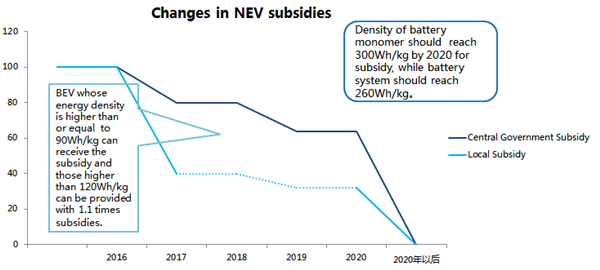
NEV
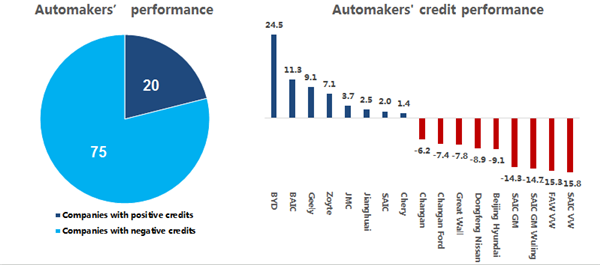
enterprises have a good performance of CAFC credits
In 2016, 33 enterprises failed to
meet the standards, which accounted for 34.3% of 96 enterprises.
Enterprises with positive credits
mainly produce NEV models while enterprises with negative ones mainly produce
SUV models. Take BYD for example. The company has a 1.748 million credits and
the average fuel consumption is 3.1L/ 100KM.

It is
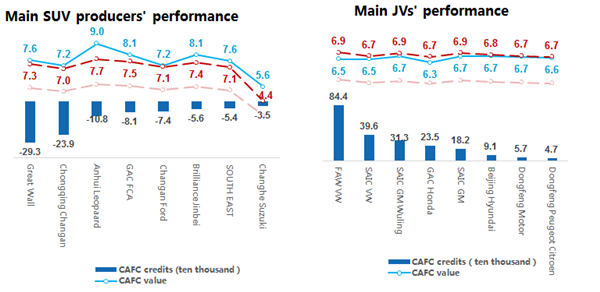
difficult for SUV to reach standard while JVs just meet the standard
Enterprises, whose main products
are SUV models, are under great pressure to realize CAFC standard. For example,
it is hard for 2016 model specifications to reach Phase Four fuel consumption
target.
Those who haven't got NEV business is also under pressure to reach the
standard. If 2016 model specifications are taken as parameters, the average
fuel consumption should be reduced by 20%.
It's
getting more and more difficult for traditional fuel vehicles to improve
fuel-efficient ability
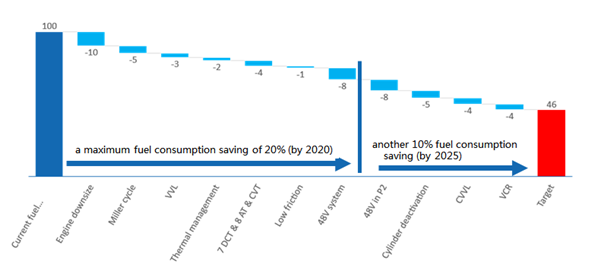
According to IHS data, relying
solely on fuel-efficient improvement to reach the target poses great pressure.
Comprehensive application of the following technologies can reduce fuel
consumption by 20% by 2020 and another 10% percent by 2025.
NEV
models are of great help to reduce CAFC value
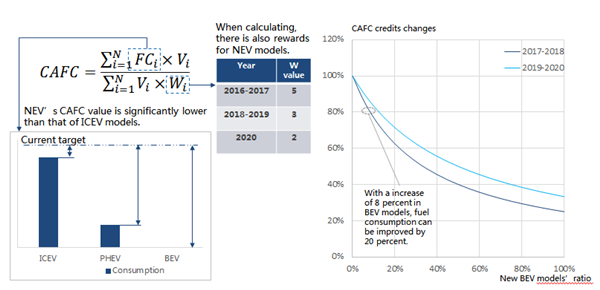
According to the current CAFC
computing way, NEV models can significantly decrease CAFC value. With a
increase of 8 percent in BEV models, fuel consumption can be improved by 20
percent.
There are a large gap between the current
value and the target of NEV credits and more models are needed
New energy passenger vehicle's
sales reached 316,000 units, whose equivalent credits may be 940,000. Of all
companies, 20 have positive credits and 75 have negative credits. Companies
with positive credits are all self-owned brands. The new energy business of JVs
haven’t been fully conducted.
According to MIIT's data, the
output of 2016 reached 23.57 million, which needs 1.886 million credits. Thus
the market still needs 946,000 credits.
The
dual credit system will promote a increase in NEV output
NEV models will decrease obviously
CAFC value and NEV credits will be improved year by year. At present, the
launch of joint ventures' NEV models are relatively conservative. PHEV will
take a dominant role in a short period, but every single vehicle has fewer
credits.
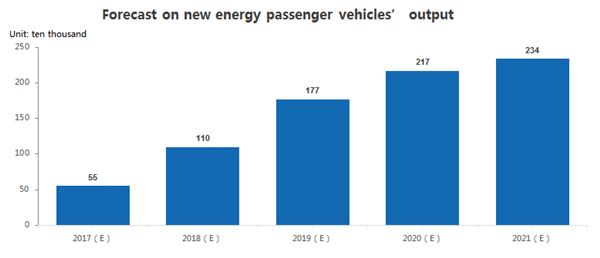
In 2018, China's new energy vehicle
sales are expected to be over 1 million units and will reach 2 million in 2020.
II.
Interpretation on New Energy Vehicle Market Trend
NEV
Market Has Severely Affected by Policies with Large Fluctuations
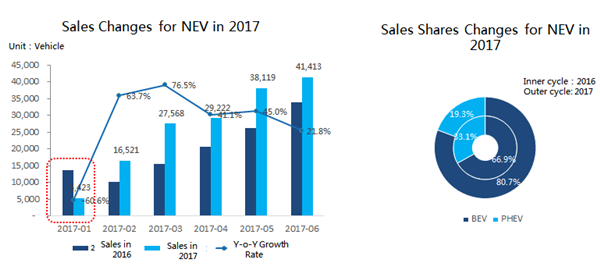
In early 2017, NEV subsidary falloff
and announcement review have resulted in halving the sales in Jan. 2017 with a
sharp drop. With the launch of NEV promoting menu and increasing of consumption
demand, the sales has gradually rebound, the sales for for 2017 H1 has reached up to 158,000 vehicles with Y-o-Y growth
rate of 31.4%. The NEV are still dominated by BEV.
NEV
Market is Dominated by BEV Models While Shares of SUV Are Gradually Growing
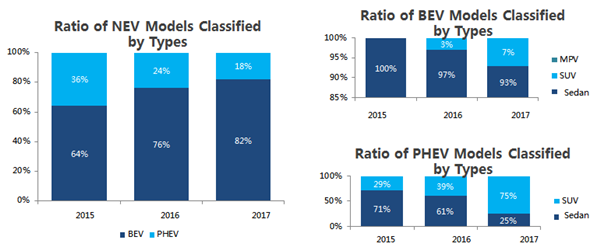
BEV has seized the major shares of
NEV market, and its market shares have been increased year by year.
As the development of NEV market
and consumers' favor in SUV, the market share of BEV is gradually expanding.
For PHEV models, SUV is prodominating the main market shares.
ZD D2
and RoeweeRX5
are the Best-selling BEV and PHEV Models Respectively
ZD is the best-selling BEV model in
2017 H1 and the sales are 18,693, followed by BAIC EC Series and BYD e5, the accumulated sales for other
models are all below 10,000.
Roewe eRX5 is the best-selling PHEV
models, and the sales are the Tope 1 for 9,205 vehicles. The TOP5 best-selling
models are all from SAIC and BYD.

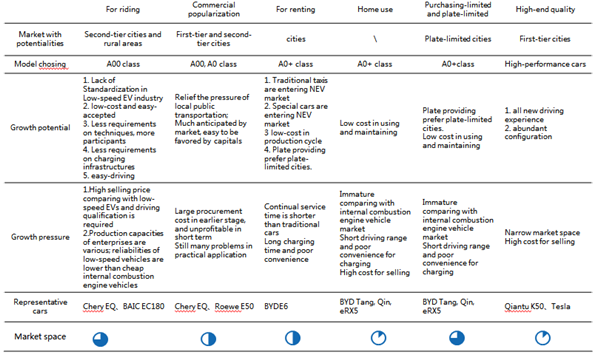
Usage
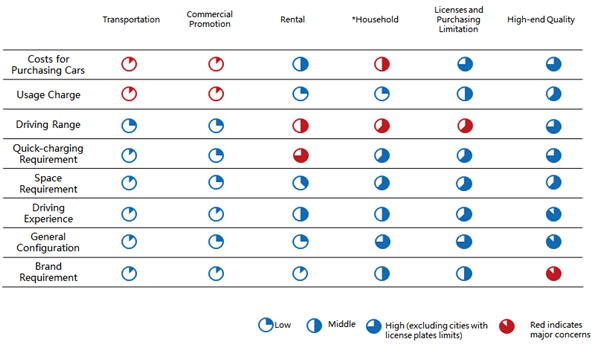
Scenarios Classification
for NEVs
New
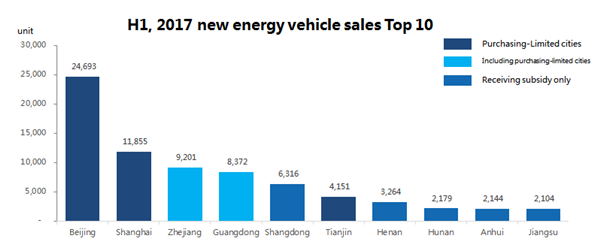
energy market concentration
of is obvious,
with Top 10 area taking up
88% market shares
Current new energy car sales mainly
focus on purchasing-limited, plate-limited cities and provinces that sales of
traditional low-speed electronic vehicle dominate large parts. Top 10 areas
take up 88% market shares.
Consumers
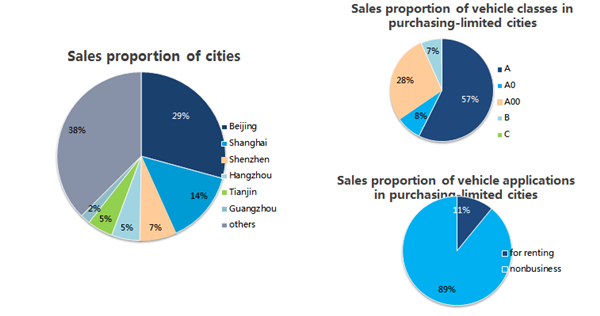
in plate-limited cities are more likely to buy A class vehicles
Six plate-limited cities dominate
62% shares in new energy market
Models are mainly in A class
vehicles which take up 57% shares, while A00 class vehicles take up 28% shares
and vehicles for renting take up 11% shares.
A00
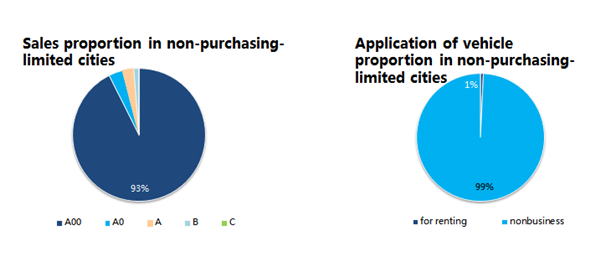
class vehicles take up large parts in non-plate-limited cities
In non-plate-limited cities that
Sales over one thousand include Ningbo, Weifang, Changsha, Hefei, Jinhua, Zhengzhou, Qindao and Wuhan.
Models are dominated by A00 class
vehicles, with shares reached 93%, while vehicles for renting only take up 1%
shares.
New
market and new business model become the major impetus in growing market
PotentialAnalysis
on NEV Scene