Gasgoo Munich- What comes to mind when people think of motorsport is often the roar of combustion engines, the blur of high-speed corners, and the unmistakable scent of fuel.
For decades, racing has been synonymous with excess consumption and high emissions. But at the 2026 Shenzhen International Performance Car & Customized Vehicle Exhibition on March 20, Geely Holding set out to challenge that narrative, unveiling a methanol-powered race car alongside plans for a competition fueled entirely by green energy. The move signals a bold attempt to reconcile performance culture with the demands of decarbonization.
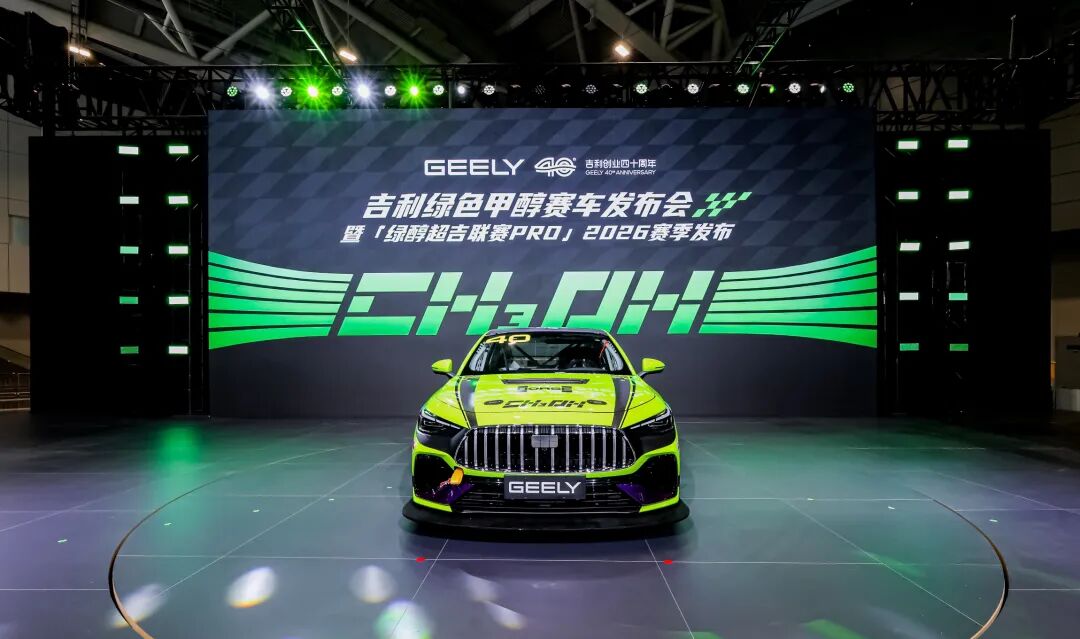
Image source: Geely Holding
What might once have sounded like a fringe idea is now being tested in a real-world motorsport setting.
Why methanol? A solution born from real-world constraints
The rationale behind methanol lies in the limitations of existing racing technologies. Battery-electric race cars deliver instant torque, but the weight of large battery packs compromises handling, while charging times disrupt the fast-paced rhythm of competition. Conventional internal combustion engines, meanwhile, continue to rely on fossil fuels, putting them at odds with tightening carbon reduction goals.
Methanol—particularly when synthesized from captured carbon dioxide and green hydrogen—offers a potential middle ground. As a liquid fuel, it preserves the operational advantages of traditional engines, including rapid refueling and extended range, while significantly lowering lifecycle emissions. In effect, it provides a low-carbon substitute for gasoline without requiring a complete reinvention of the racing format. The concept has been framed as "liquid sunlight," a way of storing renewable energy in a form that is both transportable and immediately usable.
On-track proof: the technology behind 250 horsepower
Geely's answer to the performance question comes in the form of the Xingyao 6 single-spec race car powered by green methanol, built around an engine optimized for M100 methanol fuel. The powertrain delivers over 250 horsepower and 400 Nm of peak torque, with a thermal efficiency exceeding 48% and a compression ratio of 15:1—figures that highlight the company's long-term investment in alternative fuel technologies.
On track, the setup aims to combine the immediacy of combustion engines with improved environmental credentials. Drivers retain the familiar auditory and mechanical feedback that define motorsport, without the added mass associated with battery systems. Just as crucially, the liquid nature of methanol allows for rapid refueling within minutes, eliminating one of the key operational constraints faced by electric race series.
Beyond the spectacle, the project serves as a high-intensity proving ground for methanol as an energy carrier. By testing the fuel under the extreme demands of racing, Geely is effectively exploring whether such solutions could scale beyond the track and into broader mobility applications.
A sober assessment shows that despite the spectacle on track, methanol faces formidable hurdles before it can scale to everyday mobility. That reality helps explain why Geely is stress-testing the technology in motorsport's harshest environments: only under extreme conditions do limitations surface fully—and only then can they be systematically addressed.
Cost remains the first barrier. Green methanol—particularly when produced using renewable hydrogen and carbon capture—still carries a premium over conventional gasoline. Although Geely has spent over two decades refining its methanol engine technology and bringing costs to a manageable level, broader adoption will depend on further efficiency gains across the entire value chain.
Infrastructure presents another bottleneck. By 2025, Geely had deployed more than 50,000 methanol-powered vehicles, a notable milestone but still marginal relative to China's vast vehicle parc. Refueling infrastructure remains sparse, far behind the scale of gasoline stations and EV charging networks. The dilemma is a familiar one: without enough vehicles, investment in stations lags; without stations, consumer uptake stalls.
Equally critical is public perception and policy support. For many consumers, methanol lacks the futuristic appeal associated with battery electric vehicles and is often perceived as an industrial chemical rather than a clean fuel. Bridging this perception gap will require sustained education efforts and clearer policy backing. For now, regulatory incentives remain more heavily skewed toward electrification, leaving methanol's long-term strategic standing uncertain.
Against this backdrop, Geely's decision to bring methanol into motorsport appears strategic. By showcasing the technology in a high-performance, emotionally engaging setting, the company is seeking to reshape public perception and position methanol as a viable alternative within the broader low-carbon mobility landscape.
Green Methanol Super League PRO: a racing series to fast-track talent, technology
To provide a proving ground for its methanol ambitions, Geely has introduced the "Green Methanol Super League PRO," a racing series designed to go beyond commercial entertainment and serve as a platform for both technological validation and talent development.
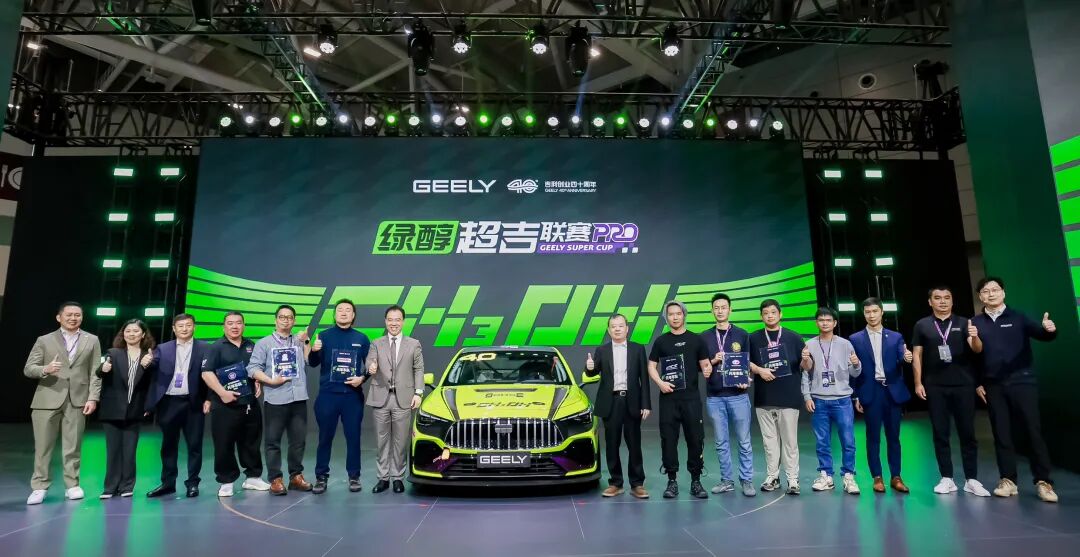
Image source: Geely Holding
Positioned as China's only one-make touring car series equipped with sequential gearboxes, the championship offers a competitive format comparable to professional TCR racing. The 2026 season, spanning five events and ten rounds, is expected to bring drivers from across the country into close competition, showcasing the real-world capabilities of methanol-powered race cars.
Looking beyond the series itself, it forms a crucial component of Geely's broader motorsport ecosystem. Internationally, Lynk & Co Cyan Racing has already built a strong reputation with multiple championship titles, demonstrating the competitiveness of Chinese automotive engineering. Domestically in China, Geely has established a full pipeline—from grassroots motorsport to professional driver development. With the introduction of methanol racing, sustainability is now being integrated at the highest level of this ecosystem.
A two-decade bet on methanol—and the next generation
The strategy extends beyond professional racing. By sponsoring the Formula Student China competition from 2025 to 2028 and introducing methanol engines into university programs from 2026, Geely is embedding the technology at the grassroots level. The goal is not only to validate engineering concepts, but also to inspire the next generation of automotive talent. As students begin building and racing methanol-powered cars, familiarity with alternative fuels becomes part of their technical foundation.
Geely's commitment to methanol is the result of sustained, long-term investment rather than short-term experimentation. Over two decades, the company has tackled durability challenges, scaled deployment to more than 50,000 vehicles, and accumulated over 23 billion kilometers of real-world operation (as of September 2025). In parallel, it has built an ecosystem spanning fuel production, distribution and end use. Marking its 40th anniversary, Geely's decision to spotlight methanol through a green racing platform signals a broader message: the future of mobility in China may not be defined by electrification alone, but by a diversified energy mix.
When the first methanol-fueled race car crosses the finish line, it marks more than a sporting milestone—it challenges the boundaries of how clean energy is perceived. If Geely's vision holds, the idea of driving a car powered by "liquid sunshine" may one day feel as natural as filling up a tank today—combining driving enjoyment with a reduced environmental footprint. That, ultimately, is the broader ambition behind this green push.
![[Gasgoo Newsflash] HIMA cumulative deliveries exceed 1.3 million](https://gascloud.gasgoo.com/production/2026/03/1e37f49e-3f62-416b-a73c-52efffd09e9f-1774449624.png)