



As electric vehicle usage expands beyond city commuting to long-distance travel, the speed and quality of charging infrastructure have become critical to the industry's development. Data from the China Charging Alliance for January 2026 shows the total number of charging connectors reached 20.698 million by the end of the month — a 49.6% year-on-year surge. This milestone not only signals the network’s entry into the "20 million era" but also highlights a structural shift: a boom in private chargers, upgrades to public stations, and the expansion of battery swapping facilities.
Private Chargers Drive Growth as Public Infrastructure Shifts Toward Efficiency
January’s incremental data outlines a clear structural shift in the charging network. The nation added 606,000 charging points, up 53.3% from a year earlier. Private chargers accounted for 522,000 of that total — a 143.5% explosion that contributed over 86% of the growth. Meanwhile, public charger additions fell 53.6% to just 84,000. This divergence suggests that core charging needs are migrating from public spaces to private residences.
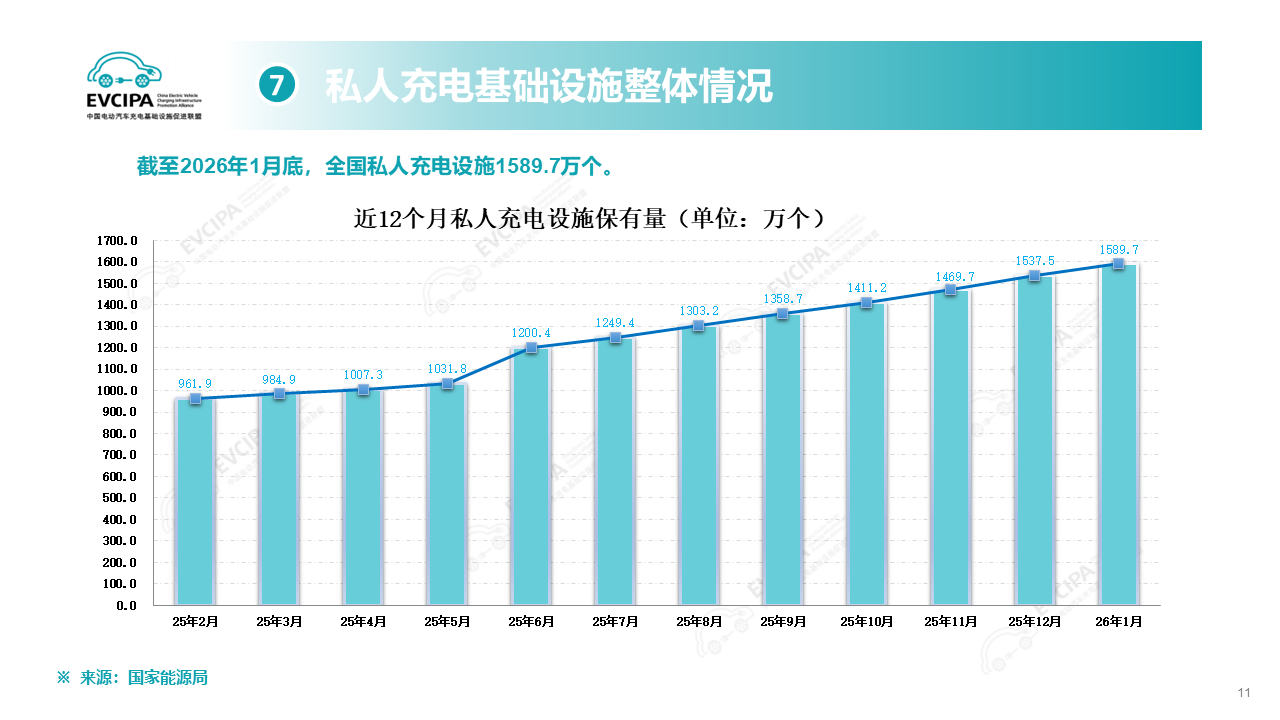
Image source: China Charging Alliance (same below)
By the end of January, the stock of private chargers hit 15.897 million, a 56.1% annual increase that represents 76.8% of all infrastructure. Installed capacity for these units reached 138 million kilovolt-amperes, indicating a largely mature scale. This trend is driven by relaxed policies on installation and closer cooperation between property developers and automakers, making "buy a car, get a charger" the standard experience. The routine of plugging in at night and leaving with a full battery in the morning has effectively solved daily charging needs for most commuters.
Shared private chargers are also bolstering the network. By the end of January, 88,943 such units were recorded, with Star Charge accounting for 86.6% of the total. Beijing, Guangdong, and Jiangsu lead in deployment, demonstrating how socializing private assets is increasing network density.
Unlike the private sector, public infrastructure is pivoting from sheer expansion to quality upgrades. The public stock stood at 4.801 million units at the end of January, up 31.2% year-on-year, with a total rated power of 226 million kilowatts. The average power per unit climbed to roughly 47.01 kilowatts, marking a clear shift toward high-power charging. In the segment exceeding 250 kilowatts, Huawei Digital Energy and TGOOD dominate, with 70,608 and 69,823 units respectively. The large-scale rollout of these ultra-fast chargers at highway service areas and major shopping hubs is making "coffee-and-go" charging a reality.
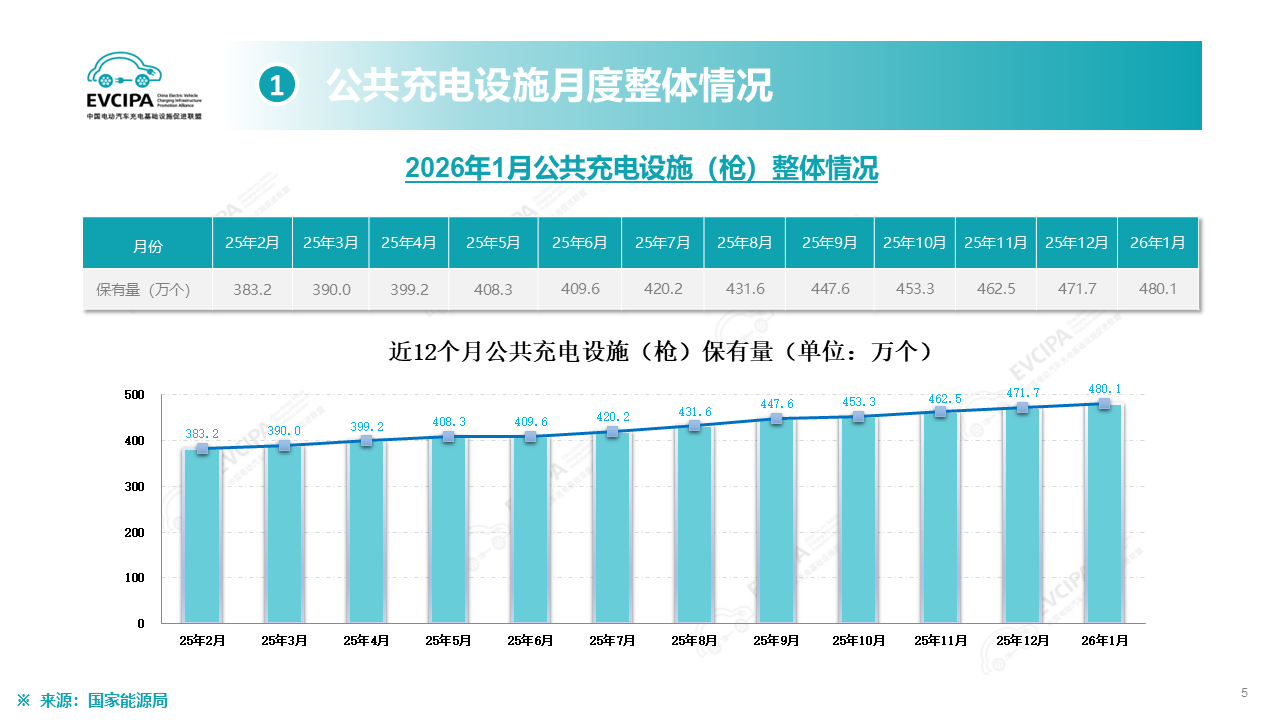
Regional distribution remains highly concentrated. The top 10 provinces, including Guangdong, Zhejiang, and Jiangsu, hold 65.6% of the nation’s public chargers. Guangdong alone leads the pack with 813,000 public chargers and 44,570 stations, setting the benchmark for public charging networks.
Rising Volume and Efficiency Signal Vitality as Charging Ecosystem Aligns with Industry Growth
The ultimate value of charging infrastructure lies in its utilization efficiency and alignment with industry needs.
January’s data illustrates this maturity through "rising volume and efficiency." Total power consumption reached approximately 9.99 billion kilowatt-hours — a 66.4% year-on-year jump and a 10.2% increase from December. Over the past 12 months, public chargers alone have delivered 89.77 billion kilowatt-hours. This sustained climb in electricity use confirms that both EV market penetration and usage frequency are on the rise.
Guangdong topped the consumption charts with 1.43 billion kilowatt-hours, followed by Hebei, Jiangsu, and Zhejiang. The geographic distribution of electricity use aligns closely with EV ownership and public charger placement. Notably, the bulk of this power flows to buses and passenger vehicles, while sanitation trucks and taxis account for a smaller share — underscoring that private cars are now the primary consumers in the EV market.
The surge in power consumption is also tightly linked to efficiency gains. As average public charger power rises and ultra-fast units become widespread, the efficiency of individual charging sessions has improved significantly, underpinning the overall growth in electricity throughput.
The rapid development of battery swapping adds a crucial piece to the puzzle, serving as an effective complement to both public and private charging.
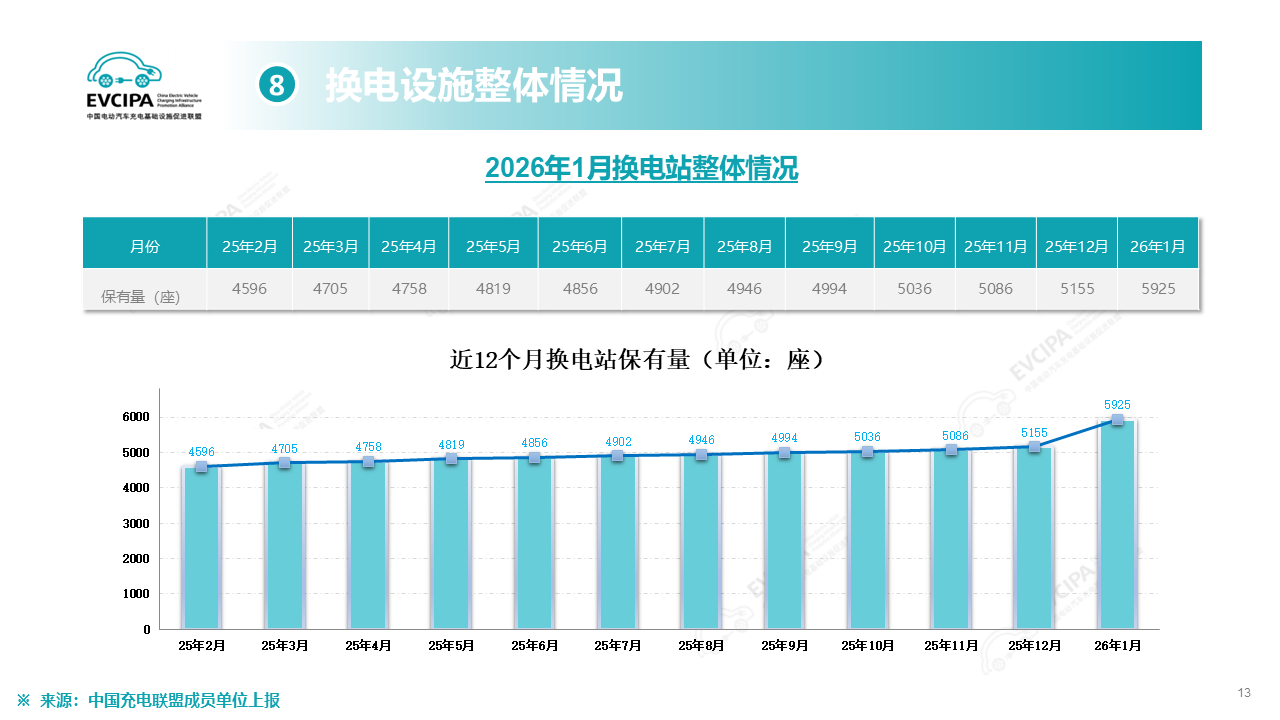
By the end of January, the total number of battery swap stations reached 5,925, a sharp increase from 5,155 in December 2025. Guangdong, Zhejiang, and Jiangsu lead with 740, 686, and 604 stations respectively. This scale meets the rapid refueling needs of commercial EVs and ride-hailing fleets, complementing charging infrastructure to diversify the energy replenishment ecosystem.
Crucially, infrastructure construction is now precisely matched to market demand. In January, domestic NEV sales reached 643,000 units against 606,000 new chargers, yielding a construction-to-sales ratio of 1:1.1. This means for every 1.1 new vehicles sold, one new charging point was added — a pace that perfectly matches the industry’s expansion. Even as NEV sales face year-on-year headwinds, the continued buildout of charging capacity is laying the groundwork for the market’s eventual recovery.
From the 20 million milestone to the balance between chargers and cars, and the integration of charging and swapping, China’s EV replenishment network is entering a new phase of quality and quantity growth. Driven by the "Three-Year Doubling Action Plan" for EV charging service capacity, the network will extend further into counties and rural areas, becoming increasingly high-powered, intelligent, and interconnected.
As coverage, efficiency, and ecosystem diversity continue to improve, EV adoption is shifting from policy-driven mandates to genuine consumer choice — cementing its role as a core engine for the automotive industry’s transformation.


