



The global automotive industry is undergoing a profound transformation driven by electrification and intelligentization. This shift is not only redefining the driving experience but also reshaping the value chain across the entire industry. As intelligent electric vehicles scale rapidly and advanced driving-assistance systems (ADAS) move closer to higher levels of automation, OEMs are placing unprecedented demands on core vehicle systems—seeking faster response, higher precision, tighter software–hardware integration, and system-level redundancy designed for future autonomous driving.
Within this transformation, the vehicle chassis—long regarded as a purely mechanical foundation—is evolving from its traditional role as the "muscle" of the vehicle into a signal- and data-driven "nervous" system. Against this backdrop, chassis-by-wire technologies have emerged as key enablers of ADAS, with their maturity increasingly setting the upper boundary of vehicle intelligence.
Periods of structural transformation in the automotive industry often give rise to new category leaders. In recent years, a new generation of Chinese technology companies—distinguished by rapid development cycles and strong system-integration capabilities—has begun to play an increasingly central role in shaping next-generation vehicle architectures.
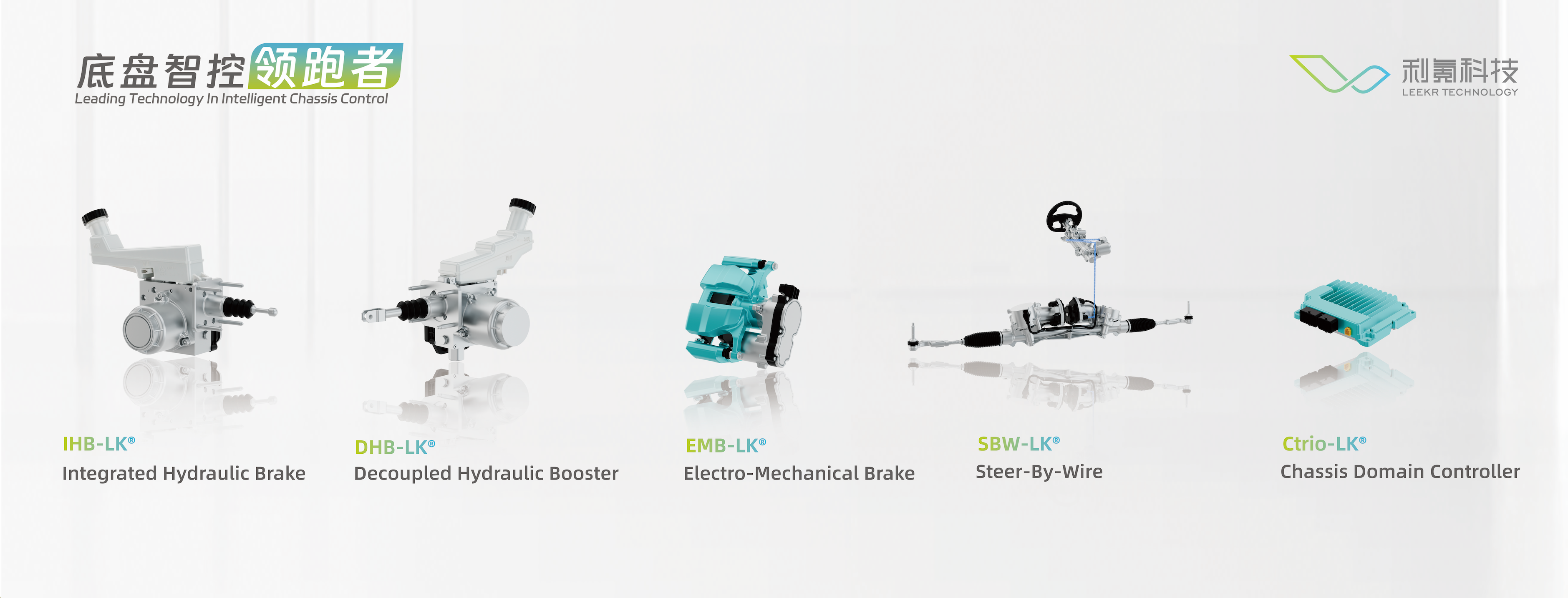
Image source: LEEKR Technology
LEEKR Technology stands out as a representative example of this shift. Built around a fully self-developed chassis-by-wire portfolio, the company has established a solid position among the leading players in its segment and is progressively extending both its technological scope and commercial footprint toward global markets.
Entering the Market: Why LEEKR Bet Early on Brake-by-Wire
When LEEKR Technology was founded, China's new-energy vehicle market was shifting from policy-led growth to demand-led expansion. The outlook was strong, but technology roadmaps were still fluid. At the same time, intelligent driving concepts were gaining momentum, yet large-scale commercialization remained uncertain.
At this pivotal moment, LEEKR identified a structural turning point: as automotive electronic and electrical architecture are evolving from distributed systems toward integrated systems, authority over vehicle dynamics is gradually shifting from human drivers to central domain controllers. This transition placed new demands on the vehicle's execution layer—the chassis—requiring faster response, higher precision, and tighter coordination than ever before.
Based on this assessment, LEEKR launched its two flagship brake-by-wire systems in 2022, just one year after its establishment: fully decoupled hydraulic booster DHB-LK® (Two-box), and integrated hydraulic braking system IHB-LK® (One-box). At the time, LEEKR became the only Chinese Sci-Tech innovation company to achieve dual-product R&D and large-scale mass production—marking a defining milestone in its early development.
The technical rationale was clear—but execution was demanding. The fully decoupled hydraulic architecture reduces braking response time to within 150 milliseconds, meeting the stringent requirements for execution certainty of ADAS. Meanwhile, tightly integrated energy regeneration control delivered real-world driving range improvements of roughly 16-20%, directly addressing one of the core pain points of electric vehicles.
Market momentum soon validated this technological path. Brake-by-wire systems shifted from an optional technology to a mass-production requirement.
According to Gasgoo Research Institute, brake-by-wire installations in China's passenger vehicle market reached 11.2 million units in the first ten months of 2025, with penetration rate climbing to nearly 60%. Among them, highly integrated One-box solutions dominated the market with a share exceeding 67%, signaling the formation of a market already valued in the tens of billions of yuan.
As the first Chinese Sci-Tech innovation company to achieve large-scale mass production of One-box systems, LEEKR leveraged its early-mover advantage and solid engineering capabilities to successfully surmount the high threshold of large-scale mass production and stable delivery. To date, its IHB-LK® system has been equipped on multiple vehicle models by more than ten mainstream automakers, including Chery and Seres, while joint R&D collaborations with leading OEMs such as BYD are also underway—firmly placing the company among the top tier of China's brake-by-wire market.
But brake-by-wire, for LEEKR, was only the beginning.
Scaling Up: Moving Toward Full-Domain X-by-Wire as Advanced Driving Enters the Deep End
As intelligent driving moves into a more demanding phase—defined by the wider rollout of urban NOA and the approaching commercialization of L3 automation—the industry's focus is shifting. The key question is no longer whether vehicles can execute commands, but whether multiple high-performance actuators can function as a coordinated, safety-critical system.
In this context, isolated technological leadership is no longer sufficient. Industry demand is evolving from "brake-by-wire" solutions toward "full-domain, system-level X-by-wire architectures".
LEEKR's roadmap closely mirrors this transition. After securing large-scale deployment and market leadership with its One-box braking products, the company chose not to remain confined to a single-product line. Instead, it redirected R&D toward next-generation actuators and system architectures, marking a strategic evolution from "intelligent braking" to a broader "intelligent chassis".
The core of LEEKR's Phase 2.0 strategy is to move toward full-domain X-by-wire architecture. Key initiatives include the development of electro-mechanical braking (EMB-LK®) and steer-by-wire (SBW-LK®) systems.
Unlike conventional hydraulic-based solutions, EMB relies on electric motors to drive the brake actuators directly, enabling millisecond-level signal transmission and digital control, with response times below 85 milliseconds. By eliminating hydraulic constraints related to performance limits, packaging complexity, and redundancy design, EMB lays the foundation for fully electric redundant braking systems compliant with the highest functional safety requirements (ASI-D). According to the company, this technology is already under collaboration with leading OEMs including BYD, with mass production planned in 2026.
Steer-by-wire systems follow a similar logic. By eliminating the mechanical connection between the steering wheel and the wheels, SBW not only unlocks new possibilities in interior design but—more importantly—provides automated driving systems with direct, flexible, and redundant steering control, which is essential for advanced functions such as active obstacle avoidance and high-precision trajectory tracking.
Together, these developments reflect LEEKR's ambition to establish braking and steering—the two most critical control dimensions—on a fully X-by-wire foundation.
The deeper challenge of intelligent driving lies in system orchestration. High-performance actuators can only deliver limited value when operating in isolation. This realization underpins LEEKR's forward-looking 3.0 phase: a shift toward chassis domain control and system-level coordination.
At this stage, LEEKR's chassis domain controller—internally referred to as Ctrio—goes beyond simply executing commands from the autonomous driving domain. Instead, it performs cross-domain coordination and global optimization across braking, steering, suspension, and other subsystems based on real-time vehicle dynamics, representing a fundamental shift from functional integration to system-level intelligence.
Notably, LEEKR's platform capability was not the result of a predefined blueprint. Instead, it evolved organically through continuous mass-production validation and iterative system refinement. As its brake-by-wire and steer-by-wire systems matured, the underlying hardware–software architecture gradually developed into a reusable and scalable technology foundation.
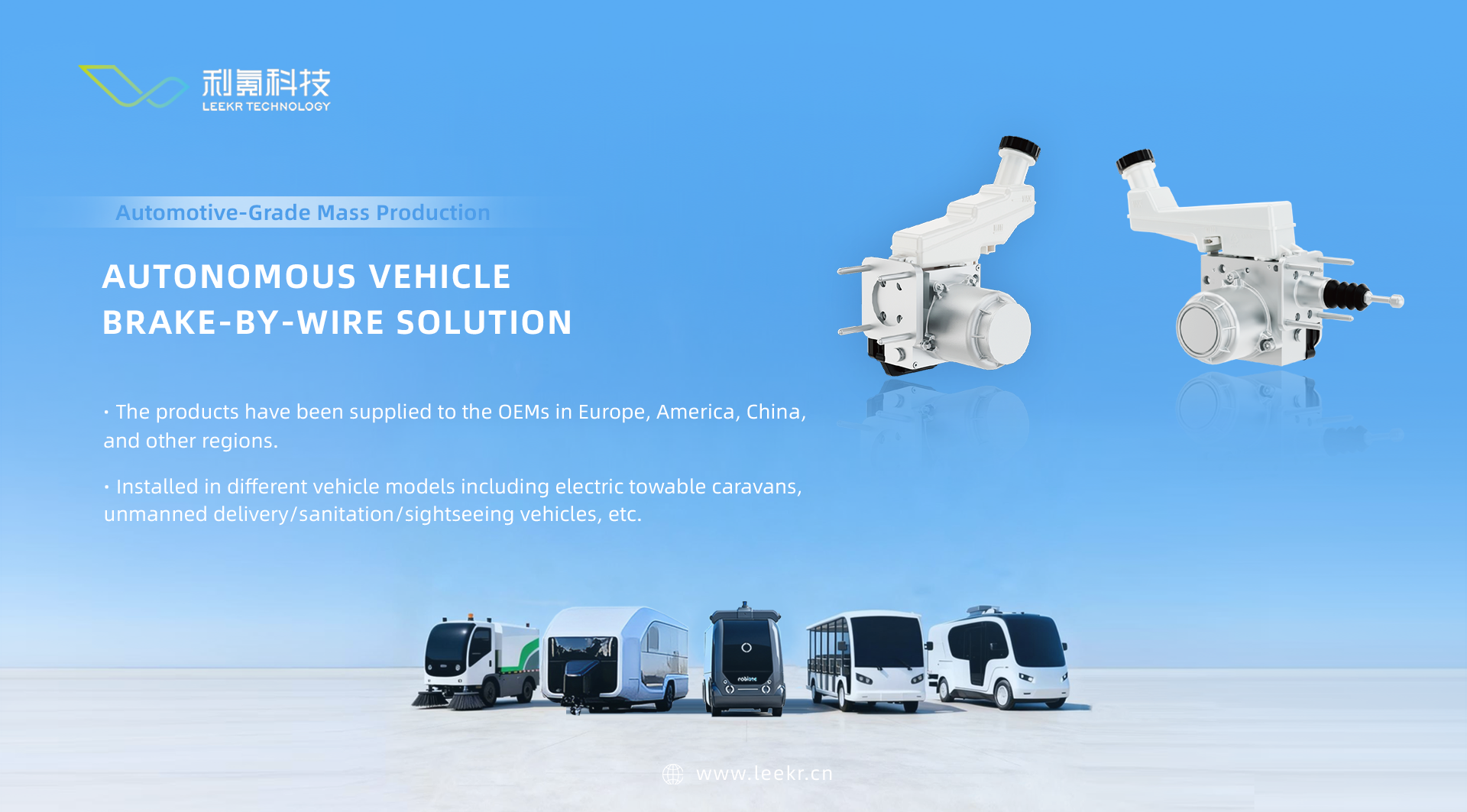
Image source: LEEKR Technology
This approach has already translated into real-world applications. In L4 autonomous scenarios such as unmanned delivery vehicles and sanitation vehicles, LEEKR's brake-by-wire solutions have already been deployed, leveraging inherent system-level safety designs and built-in redundancy to support real-world driverless operations.
From brake-by-wire to full-domain X-by-wire, and onward to coordinated chassis domain control, while continuously expanding scalable platform capabilities, LEEKR has charted a multi-layered technological trajectory closely aligned with the broader evolution of the automotive industry.
Going Global: Leveraging China's Momentum on the World Stage
As China's new-energy vehicle production and sales surpass 13 million units annually, the global narrative is beginning to shift. What began as complete vehicle exports has now evolved into comprehensive globalization—encompassing core technologies, system solutions, and industrial ecosystems.
Within this wave, LEEKR has steadily moved toward the forefront. Its brake-by-wire solutions have already been integrated into autonomous driving applications in Europe and Australia, signaling that its technology has gained access to leading global innovation ecosystems and marking its evolution from a "Chinese supplier" to "global technology partner".
On the commercial front, LEEKR has adopted a more embedded approach to globalization. Its strategic partnership with Vietnam's Geleximco Group illustrates a deeper model of international expansion—moving beyond market entry toward embedded collaboration through technology co-development and industrial integration.
Capital and institutional recognition have further reinforced this trajectory. over the past three years since establishment, LEEKR Technology has raised nearly USD 280 million in cumulative funding and providing solid backing for continued investment in intelligent chassis technologies and mass-production capabilities. In 2025, the company was recognized by China's Ministry of Industry and Information Technology as a national-level high-tech enterprise—an acknowledgment of both its technological strength and industrial contribution.
As Chinese automakers expand globally, they are bringing entire supply chains—spanning batteries, intelligent driving systems, cockpits, and chassis systems—onto the global stage. For LEEKR, this represents a historic window of opportunity. The company's integrated advantages in technical performance, cost efficiency, and rapid response—honed in the highly competitive Chinese market—align closely with the global automotive industry's demand for innovation, cost reduction, and agile development amid its electrification transformation.
Conclusion
LEEKR Technology's trajectory reflects the broader rise of China's intelligent electric vehicle supply chain across several critical niche segments.
As the automotive industry enters a new era defined by electrification, intelligentization, and software-defined architectures, companies like LEEKR Technology—shaped by China's uniquely demanding market—are steadily moving toward the center of the global stage, and contributing to the reshaping of the intelligent mobility landscape worldwide.


