



Gasgoo Munich- On February 11, a new company with a registered capital of 5 million yuan was established in Beijing. In an automotive AI sector where burning through 100 million yuan is routine, that sum barely covers a month of R&D salaries at top-tier firms. Yet this entity—named BAIC Yuanjing Intelligent Technology—is wholly controlled by BAIC BluePark, with Liu Guanqiao, head of marketing at BAIC New Energy, serving as its legal representative.
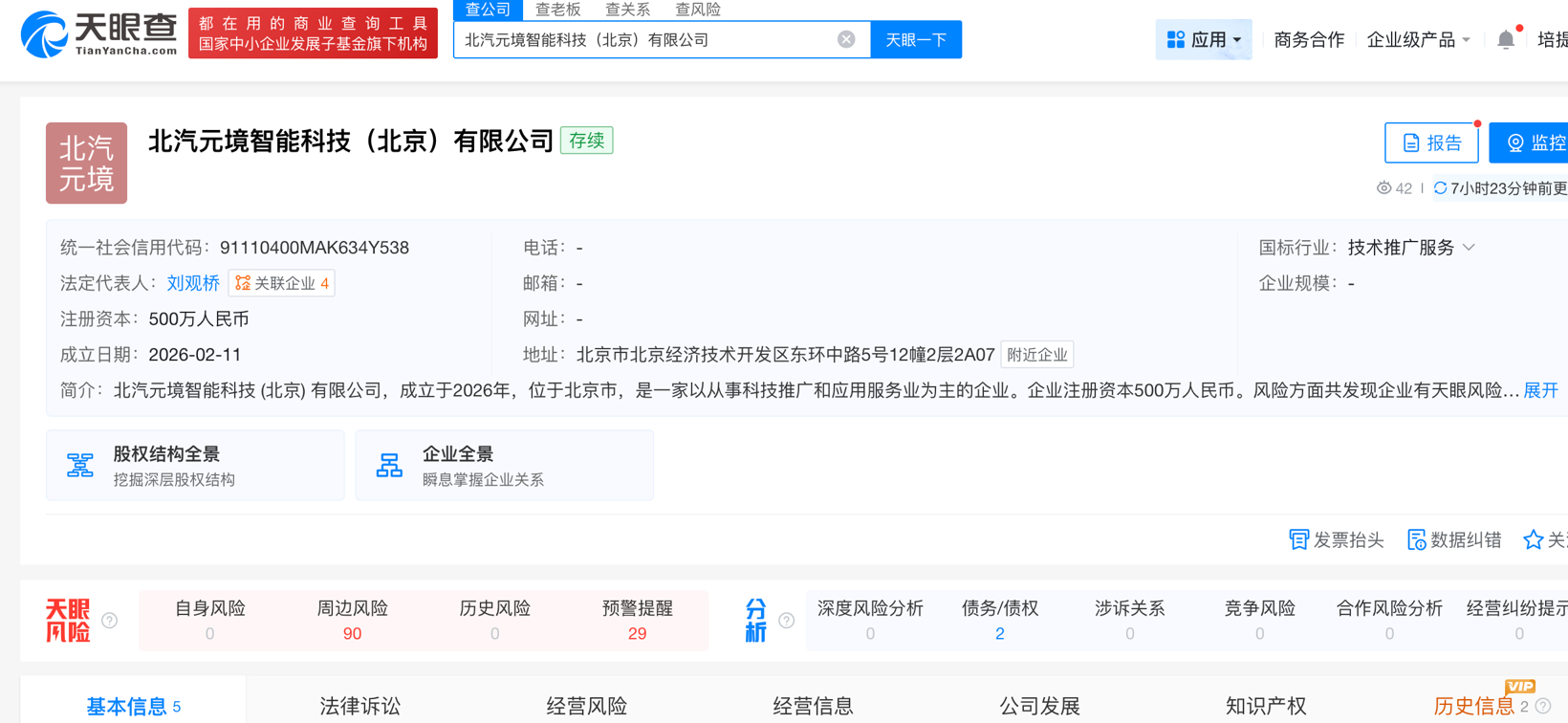
Image Source: Tianyancha App
A breakdown of equity ownership on Tianyancha reveals a clear picture: BAIC Yuanjing's sole shareholder is Beijing New Energy Automotive Co., Ltd., the core vehicle manufacturing entity behind BAIC BluePark. That means this new venture was never designed as a financial play or external investment from day one.
"Artificial intelligence basic software development" occupies a prominent spot in its business scope. The auto industry has already entered the deep waters of AI-driven innovation: L2 driver assistance is becoming standard, smart cockpits span mainstream price bands, and technological parity is reshaping the market landscape. In this critical moment, BAIC New Energy's decision to launch a wholly-owned tech unit sends an unmistakable signal: BAIC is serious about AI.
BAIC BluePark Accelerates
BAIC BluePark's financial performance over the past two years has been underwhelming.
Its report for the first three quarters of 2025 shows a net loss of 3.426 billion yuan. As of the market close on February 12, 2026, shares sat at 8.08 yuan—down 3.81% over the past year—with a total market capitalization of 51.4 billion yuan. Compared with BYD, Tesla, Li Auto, and NIO, BAIC BluePark's product line certainly offers value. Yet when customers walk into dealerships, they inevitably ask if the smart cockpit is fluid and if the driver assistance actually works—and on these fronts, the brand lacks a memorable edge.
Historically, BAIC BluePark relied on third-party partnerships for intelligence: sourcing ADAS solutions from suppliers, outsourcing cockpit systems, and sharing vehicle definition rights with partners. That model worked during the early adoption of new energy vehicles, when the battle was fought on range and specifications, and intelligence was merely a bonus feature.
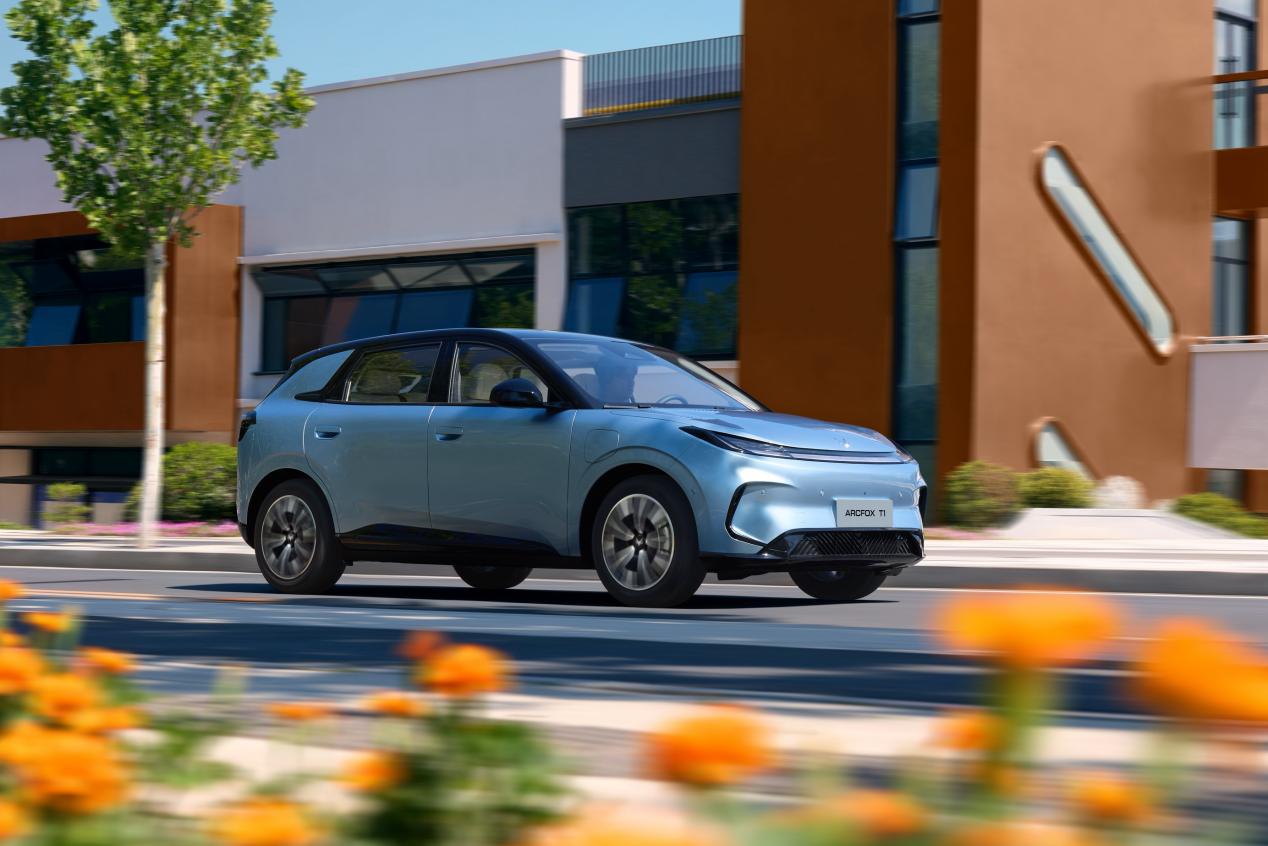
Image Source: Arcfox
But the logic of competition shifted after 2025. Fu Bingfeng, executive vice president of the China Association of Automobile Manufacturers, stated explicitly at the 2025 China Automotive Software Conference that the industry is accelerating its transition from "hardware-defined" to "software-defined" vehicles.
Consumers are no longer satisfied with a car that simply drives; they ask if the car understands them. That understanding comes from in-house development or deep integration—not from simply stacking hardware specs.
Enter BAIC Yuanjing. Wholly owned, staffed by core management from BAIC New Energy's marketing arm, and focused squarely on AI basic software, the setup sends a blunt message: BAIC BluePark no longer wants to be a "patchwork player" in intelligence; it intends to grip core technologies in its own hands.
Can 5 Million Yuan Leverage AI?
What does 5 million yuan in registered capital actually mean in the realm of automotive AI R&D? At leading firms, total compensation packages for algorithm engineers routinely hit the million-yuan mark, while building an autonomous driving data collection fleet easily exceeds 10 million yuan. Strictly speaking, BAIC Yuanjing's capital covers only a few months of salaries and a handful of servers.
But that's not the only way to do the math.
Breaking down its business scope, BAIC Yuanjing's direction appears remarkably pragmatic. It isn't touching the capital-intensive, long-cycle "daunting challenges" like high-level autonomous driving or large-model cockpits. Instead, its three core pillars—AI basic software development, IoT application services, and automotive parts R&D—interlock to address technical gaps that can be implemented in the short term and reused in the medium term.
Take AI software first. The most realistic entry point isn't building ADAS chips or end-to-end algorithms from scratch, but focusing on three specific scenarios: optimizing voice interaction to resolve user complaints about unresponsiveness; tuning driver assistance for Chinese road conditions on top of existing L2 capabilities; and using AI diagnostics to predict component lifespan via real-time data. This cuts maintenance costs while bolstering the after-sales system. These aren't disruptive innovations, but tangible experience upgrades users feel every day.
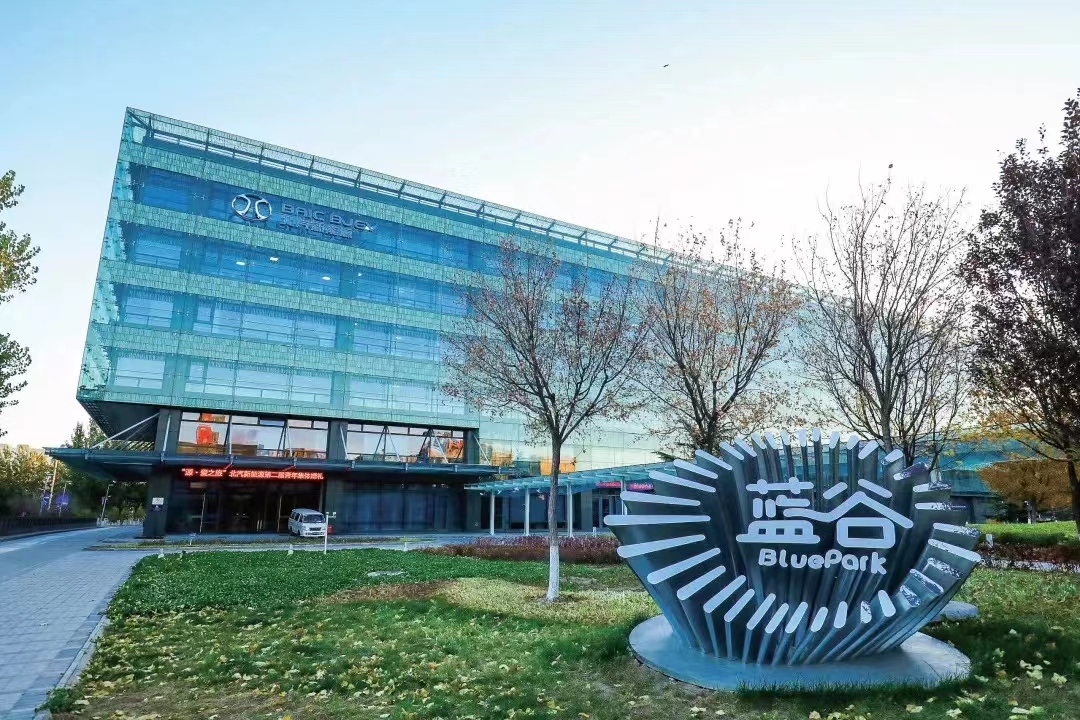
Image Source: BAIC BluePark
The value of IoT application services lies in ending the isolation of BAIC's models. Remote phone control, car-to-home connectivity, and real-time status updates are standard among leading startups, and BAIC needs to catch up. Meanwhile, its automotive parts R&D targets hardware like smart sensors and in-vehicle controllers, ensuring software-hardware synergy and gradually reducing dependence on external suppliers.
The cleverness of this combination is that it allows BAIC BluePark to narrow the experience gap with industry leaders without pouring astronomical sums into R&D. The wholly-owned structure also ensures the shortest possible decision-making chain, avoiding the internal friction over strategic differences that plagues joint ventures.
Yet the shortcomings are equally obvious. Beyond limited capital, the bigger concern is talent. The Ministry of Human Resources and Social Security predicts that by the end of 2025, the intelligent manufacturing sector will need 9 million professionals, leaving a gap of 4.5 million. Talent with dual expertise in AI and automotive engineering is the object of a fierce tug-of-war across the industry.
Given BAIC BluePark's weak track record in intelligence—and its lack of competitive edge in salary and technical platform resources—poaching the right people from the gravitational pull of Tesla, BYD, or even Huawei is a challenge more fundamental than choosing a technology roadmap.
Summary: A Comeback Fight That Must Be Won
BAIC Yuanjing is not an industry first. FAW established Qiyi Technology to focus on the convergence of low-altitude economy and AI, while Geely formed Qianli Technology to commercialize autonomous driving. By comparison, BAIC's layout is more grounded: it isn't chasing the flying car hype or betting on concepts like the metaverse. It is simply catching up on basics and solidly developing parts.
This strategy of "looking inward" is, at the very least, headed in the right direction.
But the right direction does not guarantee a successful outcome. BAIC BluePark's biggest uncertainty is not whether it chose the wrong technology roadmap, but whether it can reconcile the conflict between profitability pressure and the need for long-term investment. Can a company with consecutive losses withstand the pressure of short-term financial reports to keep funding this AI venture?
Yet this is a battle BAIC BluePark must fight. The window of opportunity in the intelligence race is narrowing, and the technological moats of industry leaders are rising higher. BAIC BluePark must deliver convincing in-house innovations and competitive products to win this comeback fight.


