



As the group marks its 40th anniversary, annual sales exceeded 4 million for the first time, and it climbed to seventh globally, this release is clearly more than a routine annual outlook. It represents a systematic strategic repositioning for Geely.
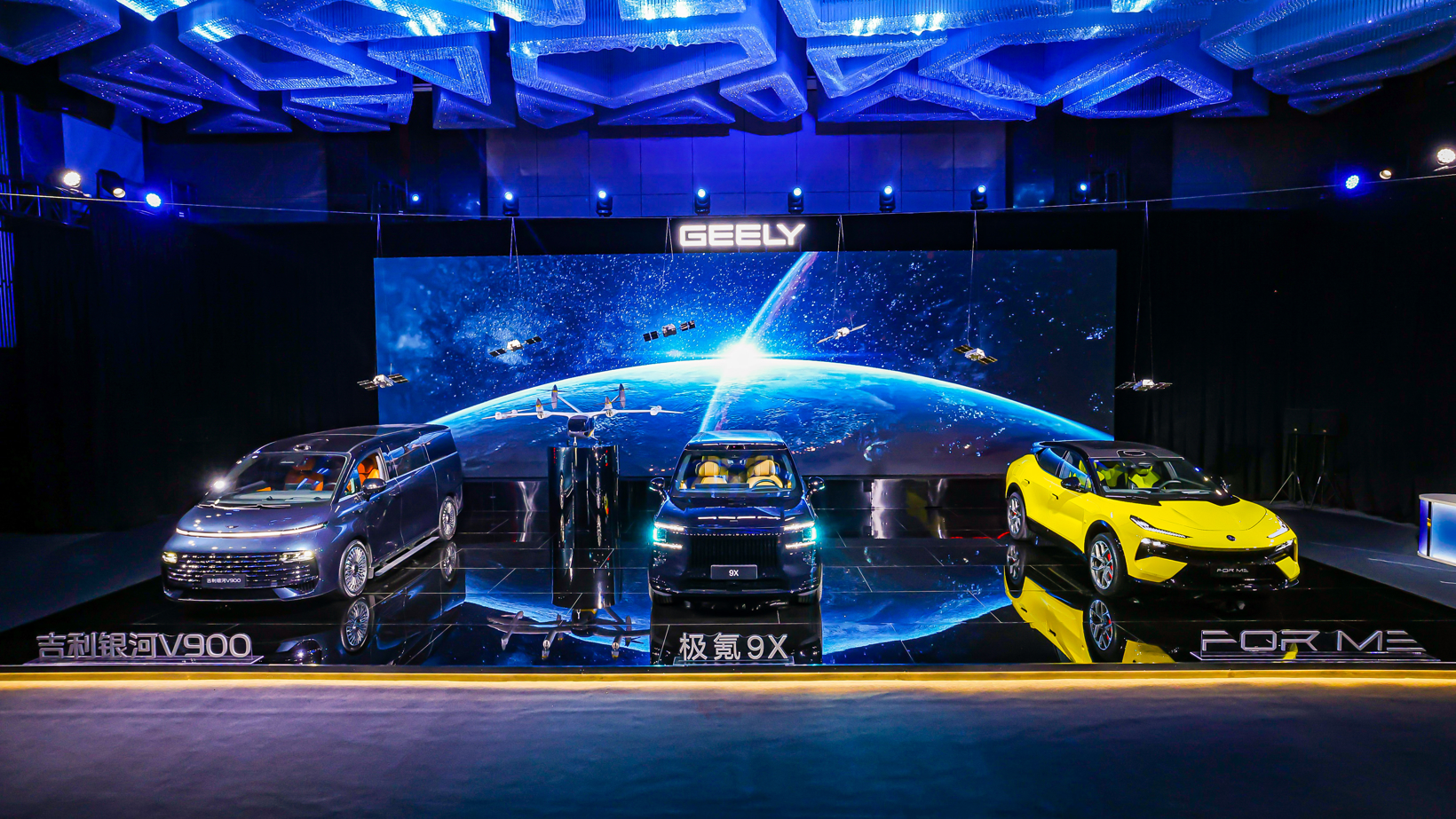
Image Source: Geely Auto
The global auto industry has entered a critical phase of electrification and intelligent competition, while Chinese automakers are shifting from simply exporting products to exporting entire systems. For Geely, this repositioning is a deep integration; for the industry, it serves as a crucial preview of how Chinese automakers can build leadership in the next round of global competition—and solve the dilemma of being "big but not strong" amidst fierce internal rivalry.
Strategic Upgrading Is Inevitable
Over the past decade, Geely has built a massive, diverse brand cluster through precise international mergers and in-house incubation. This includes Geely, Lynk & Co, ZEEKR, Volvo, Polestar, Lotus, smart, and Farizon Auto.
This diversified strategy proved effective at the time, helping Geely quickly acquire technical capabilities and premium brand DNA. It also gained global channel access and mature management experience, while incubating electric and intelligent pioneers such as ZEEKR, creating unique potential for scale and synergy.
Annual sales of 4.116 million units, a 56% penetration rate in new energy vehicles, and a global ranking of seventh represent the culmination of this phase.
But as the competitive landscape shifts profoundly, the core dynamics of the automotive market battle have shifted fundamentally. A clear signal is that "intensifying competition" has become a focal point of industry discussion.
The battle has expanded from a simple contest of products and technology to a comprehensive clash involving brand influence, ecosystem experience, global operational efficiency, and supply chain resilience. Inevitably, issues like management complexity, scattered resources, internal friction, and the need for strategic focus have surfaced. Geely Holding Group's CEO An Conghui openly acknowledged the challenges behind the numbers. "The global governance system needs further improvement, global brand influence needs strengthening, and the pace of global development needs urgent acceleration," An said, directly pinpointing the core governance and operational issues Geely must solve as it transforms from a Chinese giant to a global one.
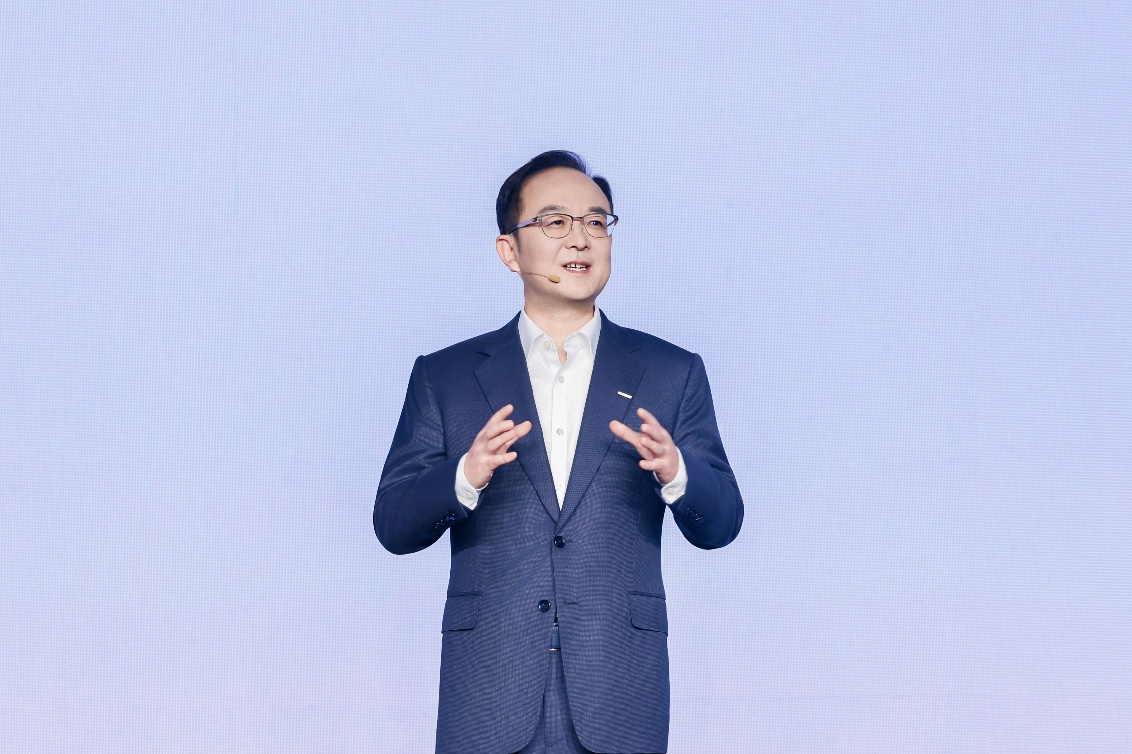
Image Source: Geely Auto
At the turn of the year, the external environment is undergoing drastic changes. Tesla and BYD have established strong vertical integration and cost advantages in electrification. Transnational giants like Volkswagen and Toyota are pushing electrification with the determination to make decisive cuts, relying on their balanced global layouts and century-old brand heritage to maintain their position.
There is no doubt the market has entered an intense elimination phase, where price wars and technology wars intertwine, squeezing profit margins to the limit. Against this backdrop, the primary significance of the "One Geely" strategy is to help Geely move quickly from the physical integration of assets to the deep integration of capabilities and the unification of a strategic nerve center. An Conghui stated that "One Geely" means strengthening Geely Holding's top-level planning and global governance, building strategic synergy mechanisms and a resource integration platform, and ensuring all business units operate legally, compliantly, orderly, and efficiently—realizing a global strategic pattern of "unified strategy."
This means Geely must build upon its holding-company management by constructing a strategic command and coordination platform to focus its strength on key areas. Specifically, this will manifest in co-creating technology, expanding markets together, and sharing supply chains. As An Conghui noted, the goal is to open up vast space for continuous growth, build a strong platform for synergistic development, and generate new momentum for the future.
Chairman Li Shufu also emphasized in his New Year message that at critical moments, one must dare to make choices and have the courage to break the deadlock. Geely's current strategic focus and deep integration are precisely that key step to "break through," aiming to transform its vast asset and business matrix into systemic competitiveness based on scale and synergy.
Geely's "readjustment" actually reflects the fundamental shift in the nature of industry competition. As visible elements like pure electric platforms and smart cockpit hardware become increasingly homogenized, and intelligent competition enters a marathon phase centered on data loops, algorithm iteration, and user experience, the sustainability of relying solely on a single sub-brand or a successful product for a breakthrough is becoming limited. The future competition will be between ecosystems.
Volkswagen Group is pushing its "NEW AUTO" strategy to strengthen technical synergy across platforms like SSP; Toyota is accelerating its comprehensive transformation under the "Woven City" vision. These traditional giants, though slow to transform, still possess deep capabilities in global coordination, economies of scale in purchasing, multi-market balancing, and cash flow—their future competitiveness cannot be underestimated. On the other hand, Tesla’s integrated die-casting, vertically integrated FSD, and energy ecosystem; BYD’s Blade batteries, DM-i technology, and full industrial chain layout; and a host of "emerging EV" brands, whose attention, market performance, and profitability are continuously strengthening, are all building their own new moats.
By choosing the "One Geely" reform approach, Geely essentially hopes to forge a new path of integrated innovation for a legacy automaker in this complex new environment. It aims to use its internal brand matrix—from mass market to luxury hypercars—to meet diverse, tiered global market demands, forming the advantage of a "collective strength." At the same time, through top-level synergy, it seeks to avoid the resource internal conflict and brand ambiguity often caused by multi-brand strategies, achieving scale effects and synergy efficiency comparable to traditional giants in core R&D, global market expansion, and compliance. Meanwhile, it maintains the agility and precision of a tech company in intelligence, electrification, and user experience innovation.
This is an active, systematic solution to "organizational inertia" and the "innovator's dilemma." Its success or failure concerns not only Geely itself but will also provide valuable experience for global comprehensive auto groups at a transformation crossroads on how to balance scale with flexibility, and unity with diversity.
2030 Key Targets Face Real Test
Based on the synergistic foundation and new governance framework of "One Geely," Geely has set clear and ambitious quantitative goals for 2030: global sales exceeding 6.5 million units, revenue exceeding 1 trillion yuan, new energy sales accounting for about 75%, overseas sales exceeding one-third, and a significant reduction in R&D cycles and costs based on new architectures.
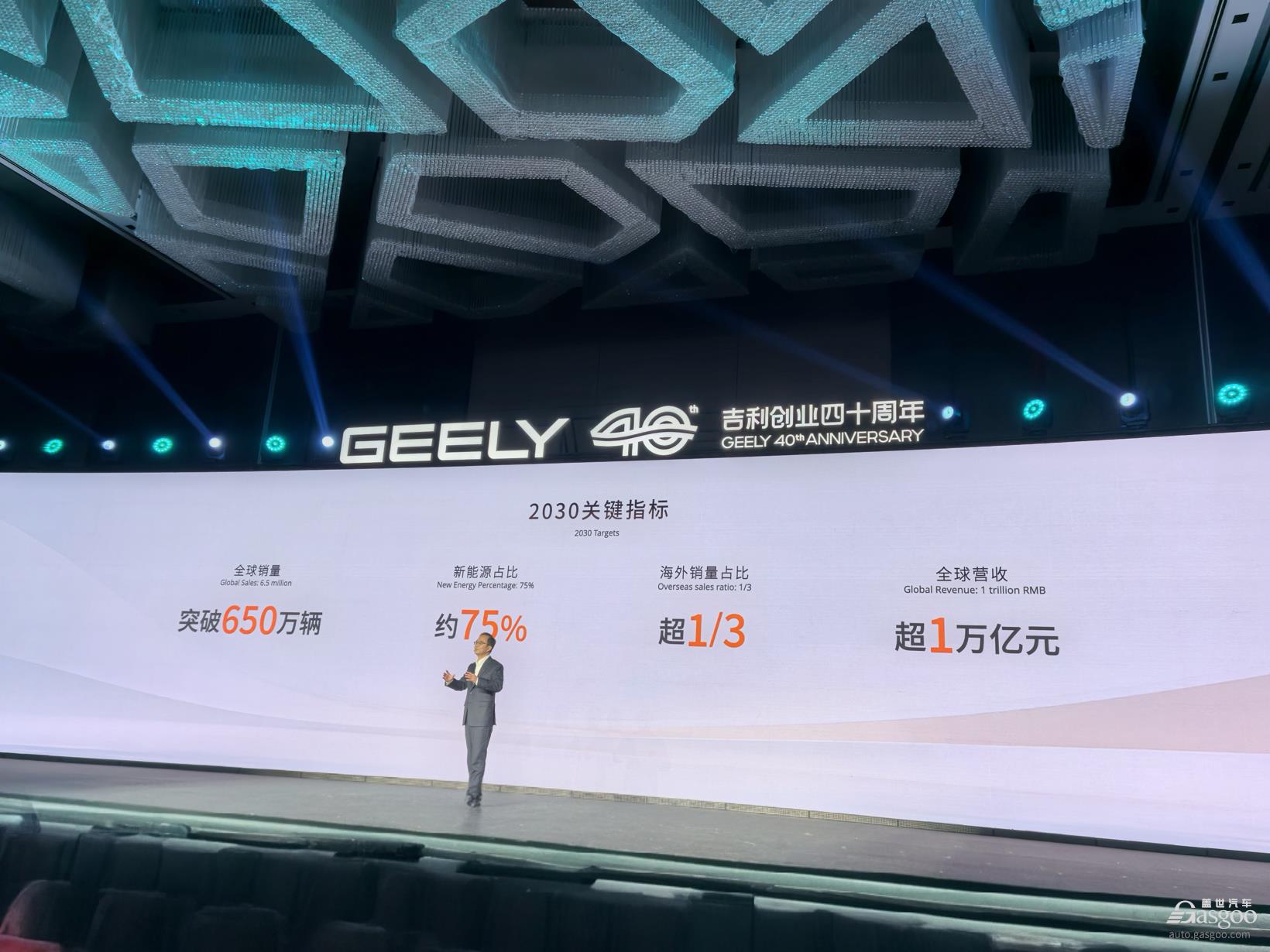
Image Source: Gasgoo
These numbers outline an ambitious vision of leaping from a mainstream player to a global leader. Yet, the path to achieving each goal cannot be accomplished overnight; it will severely test Geely Group's strategic resolve, precision in resource allocation, and cross-cultural execution capabilities.
In terms of feasibility and basis, Geely's 2030 goals are built on considerable growth momentum and a solid business base. In 2025, Geely Holding sales exceeded 4 million for the first time, a year-on-year increase of 26%, ranking seventh globally with the highest growth rate among the world's top ten automotive groups. Based on this, achieving the 6.5 million target in 2030 requires maintaining a compound annual growth rate of around 10%. Given that total global auto market growth has plateaued and growth naturally slows as the company's base expands, Geely Auto's challenge in maintaining a 10% CAGR over the next five years is definite, but not a fantasy. Its core driving force is explicitly and reasonably pinned on "dual drivers": new energy and overseas markets.
The 75% new energy target aligns with policy directions and consumer trends in major global markets, demonstrating Geely's determination to push itself as a transformation pioneer, and matching its comprehensive layout across hybrid, pure electric, and methanol-hydrogen technologies. The goal of overseas sales exceeding one-third is the most strategically significant and challenging link. This requires Geely's overseas business to undergo a fundamental shift from a supplementary role to a core pillar, upgrading from a model based mainly on exporting via trade and breakthroughs in select markets to a global enterprise with genuine localized operations across the full value chain of R&D, production, sales, and service.
Future strategic leeway will mainly be reflected in the following areas.
The delicate balance between brand synergy and differentiated implementation. An Conghui proposed building a global brand matrix with clear positioning, distinct personalities, and complementary potential, clarifying the approach of strengthening the Geely main brand as the core while efficiently synergizing global brands like Volvo, Polestar, and Lotus. The greatest difficulty here lies in how, under the "One Geely" coordination, to achieve the sharing of underlying platform technologies, electrification systems, and intelligent systems to meet goals like "developing a world-class new energy architecture covering A- to E-segment vehicles" and "reducing R&D cycles and comprehensive costs by over 30%," while strictly maintaining the unique brand souls and user experiences of Volvo's "safety and sustainability," Polestar's "high-performance pure electric," Lotus's "superior handling," and smart's "new luxury and agility," avoiding the trap of product homogenization caused by shared technology.
This requires capabilities beyond traditional automotive engineering—extremely precise brand management, user insight, and product definition. If done successfully, it will be a fusion of art and technology.
The continuous widening and commercialization realization of the technological moat is also a top priority. Geely's new strategy systematically proposes the "Seven Verticals" full-domain technology system, along with specific flagship technologies like the Qianli Haozhan intelligent driving platform, AI OS smart cockpit, Shield Gold Brick battery, and NordThor AI Hybrid Electric Engine. These are the foundation supporting its product premiumization and global competitiveness.
An Conghui also emphasized the need to build a solid technological moat and lead the industrial transformation.
Of course, in every field, being a leader means fighting a tough battle.
In intelligent driving, after entering 2026, achieving full L2 coverage is merely the entry ticket. The industrialization of L3 and the commercial deployment of L4/Robotaxi involve massive long-term investment and business model innovation.
In power batteries, moving from current Shield batteries to the industrialization of semi-solid-state and solid-state batteries involves heavy hurdles in materials, processes, and costs.
In AI, deeply integrating AGI and Agent technology into smart cockpits and vehicle control to create a "super intelligent life form" requires profound data accumulation, algorithm R&D, and hardware-software integration capabilities.
These fields involve massive investment and long cycles, and are crowded with strong competitors, ranging from cross-border tech companies to traditional automakers in rapid pursuit. Whether Geely can maintain a lead in these core areas and efficiently convert technological advantages into user-perceivable value and market sales performance will be key to determining the success of its future market goals and overall brand ascent.
Achieving the goal of one-third overseas sales also means Geely needs to complete a qualitative change in its global operational capabilities, achieving strategic breakthroughs simultaneously in fiercely competitive established markets like Europe and the US, and in emerging markets with huge potential but complex situations.
Geely's strategy demonstrates pragmatism and wisdom. By fully unleashing the local advantages and localized operational capabilities of its international passenger vehicle brands—leveraging the deep accumulation of Volvo, Polestar, and Lotus in Europe and the US, Proton's local advantages in Southeast Asia, and deep partnerships with international partners like Renault—it is essentially building a multi-layered, multi-pivot global network rather than relying solely on the Geely brand to expand its presence.
But how to efficiently integrate these overseas companies and partners across different cultures, legal systems, and business habits to form true strategic synergy rather than operating independently? How to shift from simple product export to the export and integration of technical standards, business models, service ecosystems, and even corporate culture? And how to cope with increasingly complex global geopolitical situations, trade protection barriers, and differentiated regulations? These are all systemic risks that cannot be ignored. Building global capabilities is a systems engineering project far more complex than tackling products and technology, and a comprehensive test of Geely's organizational resilience and strategic stamina.
Geely's Ecosystem Restructuring
The "One Geely" strategy explicitly elevates ecosystem competitiveness to a core status alongside products and technology, emphasizing key layouts in user services, future mobility, and the methanol-hydrogen electric industry ecosystem. This marks Geely's systematic push to transform its identity from an automobile product manufacturer to a smart, green mobility technology service provider, aiming to secure more sustainable and innovative revenue streams beyond vehicle sales.
As vehicle hardware standardization increases and profit margins face universal pressure, services surrounding the user's full lifecycle, software subscriptions, data applications, and ecosystem connectivity have become recognized industry second-growth curves and brand moats. An Conghui also proposed to "make service a core competitive advantage of the enterprise," announcing the start of a new era in user service on the occasion of the 40th anniversary and launching the "Geely Boundless" ecosystem to realize the sharing of user value across multiple brands.
The layout of the future mobility ecosystem (space-ground integration) also showcases Geely's corporate "strategic ambition" for the future.
By integrating Geely Auto (ground intelligent vehicles), Cao Cao Mobility (shared mobility services), Aerofugia (eVTOL air mobility), and Geespace (low-orbit satellite communication and remote sensing), Geely is envisioning a three-dimensional smart mobility network connecting "ground, low-altitude, and low-orbit."
This is not only a challenge of technology integration (vehicle-road-cloud-network-map integration) but also a breakthrough for existing urban traffic management systems, airspace management regulations, infrastructure standards, and commercial insurance models. It represents Geely's ultimate thinking on the form of future urban transportation: after high-level autonomous driving technology matures, mobility will be provided as a seamless, on-demand, efficient, and intensive public service. If this ecosystem can be successfully built and commercialized, Geely will no longer be just a car company, but will upgrade to an important builder and operator of future urban smart transportation infrastructure, controlling the key entry point for mobility data. Its corporate value will be fundamentally reconstructed.
The persistence and deepening of the methanol-hydrogen electric ecosystem is Geely's strategic differentiation strategy based on China's energy structure.
While the pure electric route has become the absolute mainstream, Geely has also engaged in decades of independent development in the green methanol field. It is reported that Geely has now formed a full industrial chain from methanol production, transportation, and refueling to vehicle manufacturing, holding over 400 core patents. More than 50,000 methanol-hydrogen vehicles have been put into operation, with a cumulative mileage exceeding 23 billion kilometers.
With relevant national support policies being introduced one after another, and driven by the dual goals of energy security and "dual carbon," the methanol route is seeing a clear commercialization window in commercial vehicles, ships, and construction machinery in fixed routes and energy-rich regions. By elevating methanol to the level of a group strategic ecosystem, Geely aims not only to occupy the high ground in multi-energy technology routes and cultivate a new growth market, but also to contribute a "Chinese solution" based on China's resource endowments to the global auto industry's discussion on carbon neutrality paths, thereby enhancing its influence in industrial policy and standard setting.
Conclusion:
On the occasion of its 40th anniversary, Geely Holding released the "One Geely, Comprehensive Leadership" strategy. This is a proactive strategic upgrading and self-transformation based on insight into disruptive industry changes and a clear understanding of its own strengths and weaknesses. It is an internal answer to the governance challenge of how to manage a vast global auto empire, and an external declaration of its roadmap for participating in high-level global competition in the second half of the electrification and intelligence era.
"In the era of electrification and intelligence, competition in the auto industry has upgraded to a long-term comprehensive contest of technology, cost, brand, globalization, and supply chain resilience," An pointed out. The core of this "long-term comprehensive contest" is precisely the comparison of systemic capabilities. The significance of Geely's strategic adjustment goes beyond pursuing numerical leaps on the sales ranking list; it lies in exploring a feasible path in the current complex market environment to integrate global resources, balance economies of scale with innovative vitality, and ultimately win a long-term leadership position in the industrial transformation.
The road ahead will inevitably be full of challenges. But as stated by Li Shufu, one needs the clarity of "no doubts" at forty to see the essence, and the resilience of "unwavering" effort to cross cycles.


