



Gasgoo Munich- On February 13, Great Wall Motor issued a statement declaring its firm support for and commitment to the "Guidelines on Compliance with Price Behaviors in the Automotive Industry" (hereinafter the "Guidelines"), actively contributing to the healthy development of China's automotive industry.
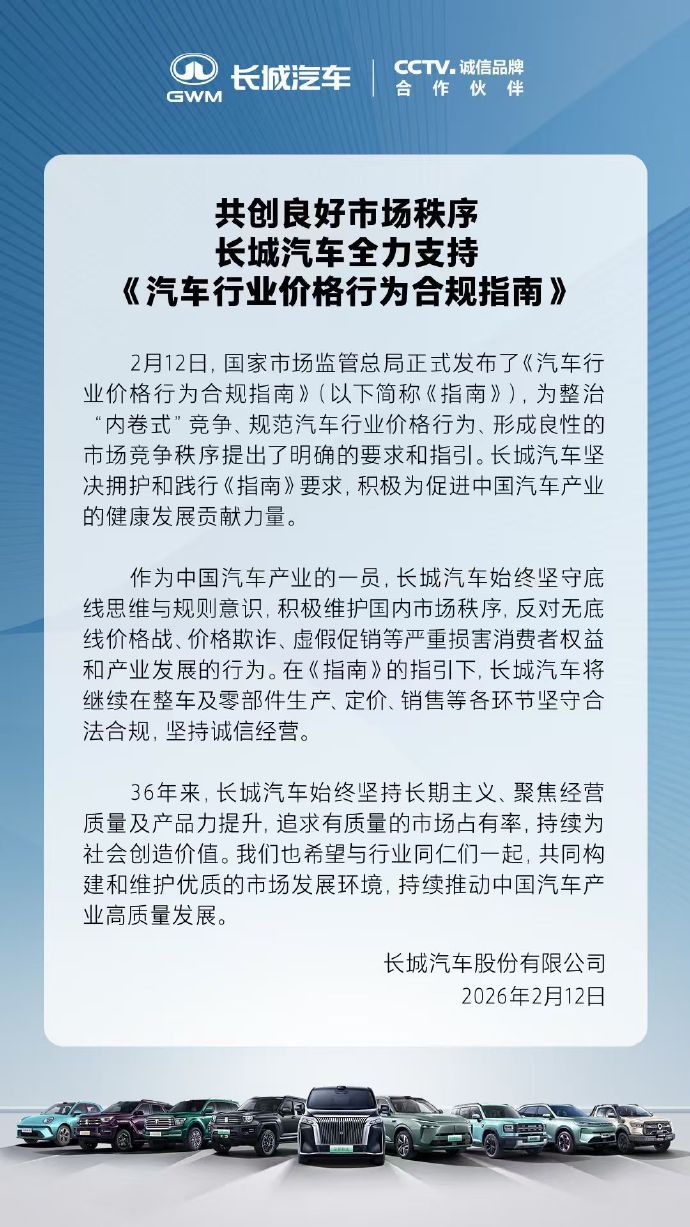
Image source: Xiaomi EV
Great Wall Motor stated that as a member of China's automotive industry, the company has always adhered to bottom-line thinking and a strong sense of rules, actively maintaining domestic market order. It opposes behaviors such as reckless price wars, price fraud, and false promotions that severely harm consumer rights and industrial development. Under the guidance of the "Guidelines," Great Wall Motor will continue to uphold legal compliance in all aspects, including vehicle and parts production, pricing, and sales, insisting on honest business practices.
Finally, Great Wall Motor noted that for 36 years, it has championed long-termism, focusing on operational quality and product strength, pursuing high-quality market share, and continuously creating value for society. We also hope to work with industry peers to jointly build and maintain a high-quality market environment, continuously promoting the high-quality development of China's automotive industry.
In addition to Great Wall Motor, Xiaomi EV also released a statement supporting the "Guidelines." Xiaomi EV stated that it will use the "Guidelines" as a benchmark to continuously optimize its price management and compliance system, strictly implementing transparent pricing requirements and resolutely putting an end to price fraud and unfair competition. Meanwhile, Xiaomi EV will leverage supply chain synergy to drive partners to jointly implement the "Guidelines," working with industry peers to maintain fair competition order and contributing to the high-quality development of China's automotive industry with practical actions.
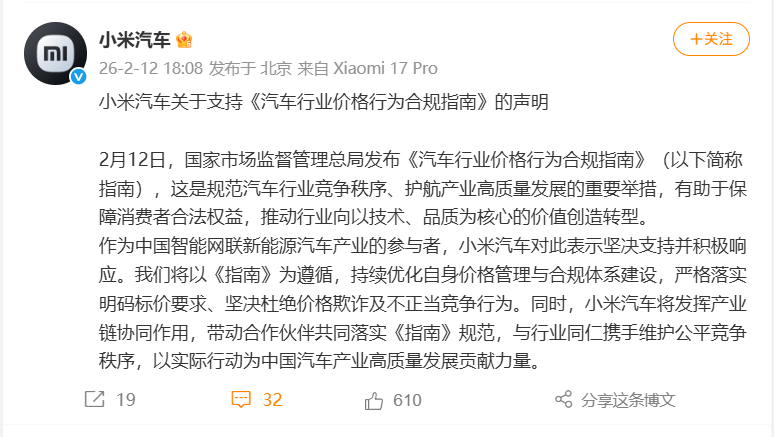
Image source: Screenshot of Weibo
Previously, on February 12, the State Administration for Market Regulation released the "Guidelines" to implement the decisions of the Party Central Committee and the State Council on rectifying "cut-throat" competition, further standardizing price behaviors in the automotive industry and promoting healthy and orderly market development.
The "Guidelines" point out that the automotive industry is a vital pillar of the national economy, with a long industrial chain and broad coverage, closely tied to consumers' lives. Currently, the industry faces illegal acts such as failure to clearly mark prices and price fraud, which damage the interests of consumers and operators, undermine fair market order, and hinder high-quality industry development. Based on the current reality of the automotive sector, the "Guidelines" further clarify behavioral boundaries, unify regulatory rules, guide auto manufacturers and sellers to operate legally and compliantly, and promote a market order characterized by quality-driven pricing and healthy competition.
The "Guidelines" consist of five chapters and 28 articles, primarily covering the following five aspects. First, clarifying general principles and requirements. This defines the purpose, basis, and scope of the "Guidelines," stipulates the basic principles for price behaviors, and encourages industry associations to strengthen self-discipline and promote industry price compliance. Second, refining price behavior norms for auto manufacturers. This clarifies price compliance requirements from vehicle and parts production to pricing strategies and sales behaviors. It involves implementing full-process price management, strengthening fair pricing constraints, standardizing promotions and pricing, and combating unfair price practices according to the law.
Third, clarifying price behavior requirements for auto sales enterprises. This focuses on the new car sales segment, targeting prominent issues such as failure to mark prices as required and false promotions. It establishes a risk alert mechanism, encouraging platforms to provide dual warnings regarding business and consumption risks for abnormally low pricing. Fourth, guiding enterprises to strengthen internal compliance construction. This encourages auto production and sales enterprises to establish internal price compliance management mechanisms, covering six areas: price decision-making, sales contract management, internal supervision, price emergency response, risk prevention and control, and price compliance training, to achieve full-process control over price behaviors. Fifth, supplementary provisions. This emphasizes the role of industry associations, guiding them to formulate detailed implementation measures based on the "Guidelines."


