On March 10, PsiBot announced it had closed angel and Pre-A funding rounds totaling 2 billion yuan.
Even in the capital-intensive embodied AI sector, that figure stands out. Yet the lineup of backers is even more compelling than the size of the round. The angel round united state-backed giants including China Development Bank Capital, Guozhong Capital, and the CCTV Media Convergence Industry Investment Fund, followed closely by industry leaders and prominent funds. The Pre-A round, meanwhile, brought in state capital from Shanghai, Wuxi, and other regions.
Why has a company barely a year old managed to attract a collective showing from state-backed and industrial capital? The logic behind this bet is perhaps worth dissecting even more than the 2 billion yuan itself.
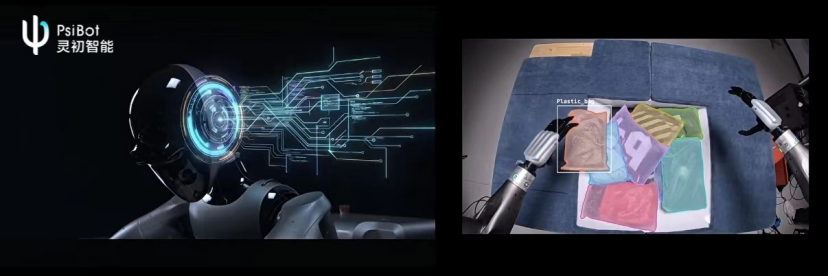
Who Is PsiBot?
Founded in 2024, PsiBot boasts a core founding team packed with top-tier industry talent.
Founder and CEO Wang Qibin has deep roots in robotics and consumer electronics. A veteran with over two decades of hardware and commercialization experience, he previously served as president of JD.com Robotics and vice president of products at Yunji Technology, while also holding roles at ForwardX Robotics, BlackBerry, and Sonos.
Co-founder Chen Yuanpei, dubbed a "post-00s tech prodigy," is a protégé of renowned AI expert Professor Li Feifei. A selectee of Huawei’s "Genius Youth" program, Chen has secured multiple breakthroughs in reinforcement learning and robotic dexterous manipulation.
The third co-founder, Chai Xiaojie, brings over 15 years of experience in robotics and autonomous driving. Having held core technical roles at tech giants Tencent, Alibaba, and JD.com, Chai is well-versed in algorithms, simulation, engineering, and full-stack technology.
Beyond the founders, PsiBot has appointed Yang Yaodong, an assistant professor at Peking University’s Institute for Artificial Intelligence, as its chief scientist.
Clearly, this is a "dream team" that combines deep technical accumulation with extensive practical experience across robotics, AI, and commercialization.
Strategically, PsiBot has chosen a path distinct from most peers: rather than building full-stack hardware bodies, it focuses on a "small full-stack" approach.
This "small full-stack" approach concentrates R&D on software and toolchains centered around end-to-end Vision-Language-Action (VLA) models. The focus is on combining dual arms, five-finger dexterous hands, and wheeled chassis to solve the challenge of dexterous manipulation in embodied AI.
In terms of scenario selection, PsiBot has anchored its sights on semi-structured logistics and retail environments.
The company’s logic follows that home environments involve too many edge cases, making short-term commercialization difficult, while traditional factory data remains relatively siloed. Logistics, by contrast, offers high-frequency demand for generalization and contains numerous non-standard tasks relying on human dexterity—making it an ideal entry point for embodied AI to prove its worth.
According to disclosed information, PsiBot has already completed small-scale scenario validation in actual client warehouses, achieving improvements in sorting efficiency.
This means its technological roadmap has been initially validated in real-world environments, marking the transition from laboratory to production line.
Why the Intense Capital Interest?
One keyword defines it: "data."
A consensus is forming in the embodied AI sector: high-quality real-world data is the critical bottleneck to reaching general intelligence. In PsiBot’s view, the competition in this sector is, at its core, a battle for high-quality data.
Regarding data acquisition, the industry currently relies on several mainstream methods. One involves generating massive amounts of simulated data via simulation. While cost-effective and scalable, simulated data cannot fully replace real-world physical interactions—specifically physical feedback like force, friction, and shifts in center of gravity, which simulation cannot replicate.
Another method is manual data collection and annotation. This ensures authenticity and accuracy but demands significant human, material, and time resources. Moreover, it struggles to cover complex, shifting real-world scenarios, limiting data diversity and generalizability.
A third approach leverages the vast reservoir of online video resources to extract visual information for model training. While acquisition costs are low and the range of scenes and actions is broad, critical elements such as texture, weight, and the sense of force during operation remain missing. This often leads to a situation where the model "sees and understands but cannot execute correctly."
To address these pain points, PsiBot has chosen to focus on "human data collection." In its view, the structure of human execution dictates that large-scale data must inevitably stem from daily human operations.
To fully capture this data, PsiBot developed Psi-SynEngine, an embodied-native human data acquisition solution. This system includes a portable exoskeleton tactile glove collection suite, a large-scale "in-the-wild" data pipeline, and a cross-embodiment data transfer model based on world models and reinforcement learning.
The company's self-developed exoskeleton tactile glove, designed specifically for data collection, achieves positioning accuracy of up to the sub-millimeter level. It captures the full degrees of freedom of the hand and arm along with comprehensive tactile information, all without interfering with the operator's normal workflow.
To support this acquisition scheme, PsiBot has built pipelines and platforms capable of large-scale data processing. Paired with self-developed large models, this enables high-precision data annotation and post-processing, forming a complete closed loop for data production.
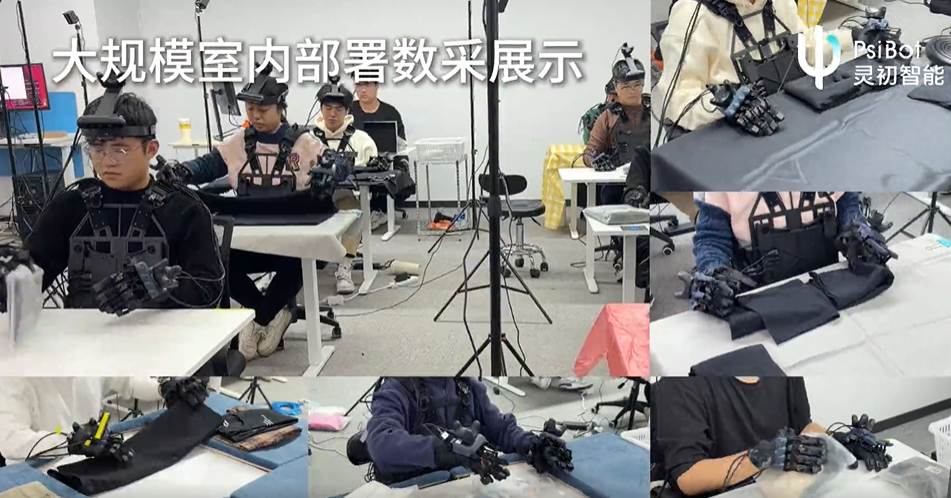
Image Credit: PsiBot
According to PsiBot, Psi-SynEngine can directly capture operational data from frontline workers in real-world settings—covering logistics, factories, supermarkets, hotels, and homes—without the need for secondary migration. This implies that compared to traditional data collection methods, this solution is not only more portable and efficient but also boasts a significant cost advantage.
CEO Wang Qibin notes that the comprehensive cost of data collection via gloves can be reduced to roughly one-tenth of using real-machine teleoperation. Looking ahead, PsiBot plans to launch a portable, crowdsourced version of the system, which is expected to drive costs down even further.
Currently, PsiBot plans to establish the country's largest dexterous hand dataset this year. The two core destinations for this 2 billion yuan financing round are precisely the large-scale application of logistics scenarios and the construction of a massive data acquisition solution system.
It is worth noting that even with sufficient data, bridging the structural and functional gap between human hands and robotic manipulators—applying human data to actual robot operations—remains a major challenge. This is where PsiBot’s Psi-SynEngine builds its moat.
Reportedly, leveraging Psi-SynEngine, PsiBot has already rapidly built the Psi-SynNet-v0 dataset internally in 2025, spanning tens of thousands of hours. The plan is to break the million-hour mark this year, aiming to establish it as the world's largest dexterous manipulation dataset.
Concurrently, this year PsiBot plans to further drive the deployment of embodied AI in complex logistics environments, streamlining delivery processes to truly bring humanoid robots into factories.
Conclusion
In the embodied AI race, it appears that whoever can acquire more, higher-quality human data at a lower cost will be better positioned to spin the iterative flywheel from "data" to "model" to "scenario."
Judging by disclosed information, PsiBot’s logic is undergoing preliminary validation in logistics scenarios.
But the 2 billion yuan financing is just the starting point. The real test lies in whether this flywheel can keep turning—extending from efficiency gains in sorting to far more complex industrial scenarios.
About "Seeds Discovery":
Gasgoo’s "Seeds Discovery" column aims to build a service platform connecting startups, industrial chain ecosystem partners, investment firms, and local governments, deeply empowering the upstream and downstream supply chain. Since its inception, the column has been dedicated to uncovering promising companies, technologies, and business models that offer inspiration and leadership during the wave of intelligent transformation, driving the growth of innovative forces in the auto industry. According to Gasgoo statistics, nearly every startup featured in "Seeds Discovery" has successfully integrated with industrial chain ecosystem resources.