



On March 2, He Xiaopeng, chairman of XPENG, revealed his proposal for the "Two Sessions" during a media briefing: accelerating policies to bridge the gap from L2 to L4 autonomous driving. In his view, L3 remains a "transitional state," and the industry must lay the groundwork for the imminent L4 era.
The proposal arrives as China's intelligent driving industry stands at a delicate tipping point. On one side: the mass proliferation of L2 driver-assist systems and the ensuing regulatory crackdown. On the other: the legal "thaw" and commercial probing for L3 and L4 high-level autonomy. 2026 could be the pivotal year the sector shifts from unbridled growth to compliant advancement.
Pangs of Prosperity: L2 Enters an Era of Strict Regulation
Over the past few years, China's auto market has been defined by a specs war centered on "smart driving." According to the "2025 City NOA Automotive Assisted Driving Research Report" by the China Association of Automobile Manufacturers, sales of passenger cars equipped with city NOA reached 3.129 million units between January and November 2025, accounting for 15.1% of insured passenger vehicles. Some institutions forecast that by 2026, new cars featuring city NOA will hit around 4 million units. Yet, beneath this prosperity, concerns are quietly surfacing.
Currently, L2 driver-assist systems suffer from two critical pain points: ambiguous liability boundaries for accidents and a lack of data retention mechanisms.
While L2 systems legally require the driver to remain in full control, some automakers tend to blur this line with marketing rhetoric. When accidents occur, lengthy user manuals become the corporate "firewall" against liability. This practice is eroding consumer trust in the technology.
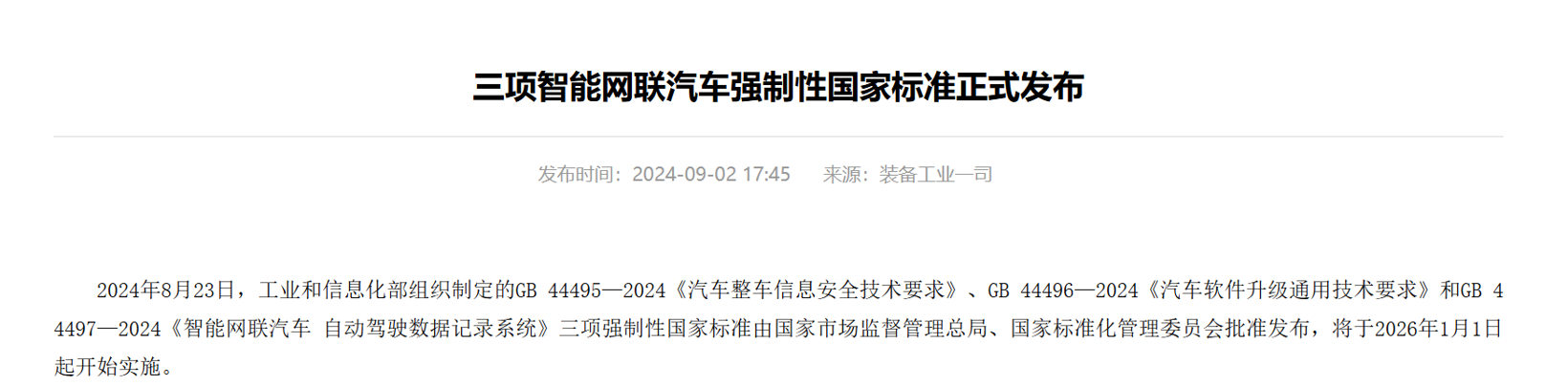
Image Source: Screenshot from MIIT
In February 2025, the Ministry of Industry and Information Technology (MIIT) and the State Administration for Market Regulation jointly issued a notice requiring companies to improve event and accident data recording and storage management. Starting January 1, 2026, several mandatory national standards, including "Technical Requirements for Vehicle Information Security" and "General Technical Requirements for Automotive Software Upgrade," officially took effect.
This signals the end of the "launch first, verify later" model. Compliance is fast becoming the entry ticket for the smart driving race.
Institutional Paving: L3/L4 Move from Testing to Ground
If the regulatory focus for L2 is about "plugging holes" and "standardizing," the policy tilt for L3 and L4 leans more toward "paving the way" and "guiding."
Industry insiders view 2026 as the inaugural year for L3 mass production, largely because policy frameworks have completed critical groundwork. The mandatory national standards taking effect on January 1, 2026, provide a clear technical framework for high-level smart driving to hit the road compliantly. Notably, the "Intelligent Connected Vehicles — Autonomous Driving Data Recording System" standard explicitly defines data recording requirements, offering key support for determining liability in L3 accidents. Meanwhile, with the revision of the Road Traffic Safety Law and the solicitation of opinions on new standards like "Intelligent Connected Vehicles — Autonomous Driving System Safety Requirements," the regulatory framework for L3 liability transfer is taking shape.
At the local level, regulatory construction is also accelerating. The "Tianjin Regulation on Promoting the Development of Intelligent Connected Vehicles," effective January 1, 2026, opens testing roads across the entire city, with open mileage reaching 5,389 kilometers. Shunde has become the first administrative district in Foshan to achieve full-region openness for intelligent connected vehicles, and Baidu's "Apollo Go" has been approved for 90 vehicle indicators.
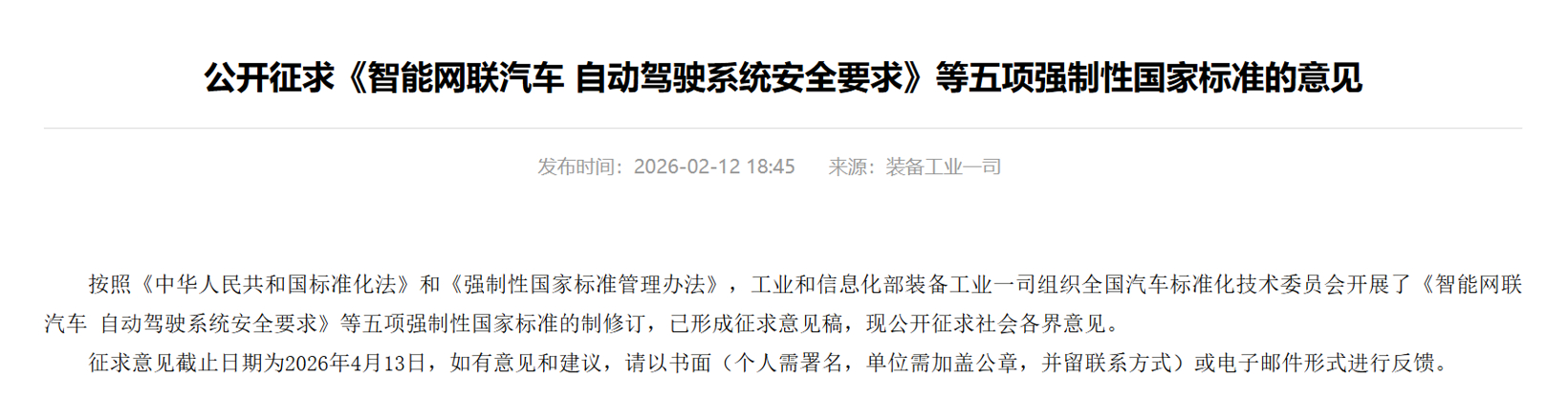
Image Source: Screenshot from MIIT
More significantly, on February 12 of this year, the MIIT sought public comments on the mandatory national standard "Intelligent Connected Vehicles — Autonomous Driving System Safety Requirements." Targeting L3 and L4 systems, this standard imposes detailed requirements on safety documentation, user monitoring strategies, and Minimal Risk Condition (MRM) logic. It signals that high-level autonomous driving is shifting from recommended standards to mandatory compliance.
Image Source: XPENG
Technological evolution is accelerating in tandem. XPENG officially released its second-generation VLA model; reports indicate that mass-production vehicles equipped with this system have passed third-party field tests, secured road testing permits in Guangzhou, and are currently conducting L4 tests on public roads. Joyson Electronics announced that its first L3 intelligent driving domain controller product is slated for mass production in mid-2027, while its L4 controller—destined for low-speed unmanned logistics vehicles—could become the first L4 product mass-produced on a domestic chip platform.
From legislative refinement to technological implementation, from road rights to commercial validation, the institutional cornerstone for L4 autonomous driving is being laid, piece by piece. As industry insiders put it, compliance will become the baseline for survival over the next two to three years. Companies that can achieve technological implementation within compliant frameworks and close the business loop in specific scenarios will seize the first-mover advantage in the coming boom.
2026 may well be that historic juncture: the regulatory patching for L2 and the institutional paving for L3/L4 will jointly propel China's intelligent driving industry from unbridled expansion to standardized development. He Xiaopeng's proposal to "leap from L2 to L4" is, at this turning point, a forward-looking reflection on the regulatory and management systems needed ahead.


