



In the era of software-defined vehicles, the speed of iteration in autonomous driving will decide who holds sway in the industry.
Hyundai Motor Group said in a recent statement that it has appointed Minwoo Park — a former senior executive who worked on autonomous driving R&D and commercialization at NVIDIA and Tesla — as the new head of its Advanced Vehicle Platform (AVP) division. The move is aimed at sharpening Hyundai's edge in software-defined vehicles and autonomy-based vehicle software, while accelerating product development.
Park will also serve as CEO of 42dot, a Hyundai subsidiary focused on autonomous driving technologies and other mobility platforms.
For Hyundai, which is betting on autonomy, this is far more than a routine personnel change. It’s a strategic play to shore up its software shortfalls and speed commercialization — and a sign of the white-hot global talent war in autonomous driving.
Executive value aligned with Hyundai’s strategy, precisely addressing two core gaps
Hyundai chose Park for his dual strengths bridging tech-firm R&D and real-world commercialization — a profile that fits the company’s strategic needs right now.
Park’s time at Tesla, in particular, is crucial for helping Hyundai shed a hardware-first mindset and build a software-led R&D system. For all its manufacturing might, Hyundai still trails leaders like Tesla in the pace of algorithm iteration for autonomous driving.
His experience at NVIDIA, meanwhile, is a key link between automakers and the wider tech ecosystem. Hyundai is deepening its cooperation with NVIDIA; at the 2025 APEC summit, it announced plans to build an AI factory in Korea equipped with 50,000 NVIDIA Blackwell GPUs to support autonomy and other advanced technologies.
By wearing both hats, Park is also tasked with integrating Hyundai's internal autonomous driving resources.
Hyundai has been active in autonomy in recent years, taking majority control of the Motional joint venture to advance Level 4 robotaxi development, while using 42dot to build underlying technologies for software-defined vehicles. Even so, the cadence between R&D and commercialization has often been out of sync.
As Hyundai's core base for software R&D, 42dot still needs to speed up how quickly its technologies reach production vehicles.
Executive Chair Euisun Chung was blunt at Kia's 80th anniversary event: "Motional has indeed made solid progress, but overall we're still behind — Chinese companies and Tesla are moving very fast. That said, rather than simply racing to catch up, ensuring safety is more important. Safety always comes first."
As competition turns white-hot, Hyundai faces both openings and hidden challenges
Hyundai's personnel move comes against an increasingly fierce global race in autonomous driving.
Waymo has commercialized robotaxi services in multiple cities; Tesla's FSD, fueled by massive data, keeps iterating and leads in assisted driving; Chinese automakers are catching up via in-house R&D and ecosystem partnerships, with Baidu Apollo's robotaxi already covering many cities.
For Hyundai, autonomy is not just a technology contest — it's a fight for market clout.
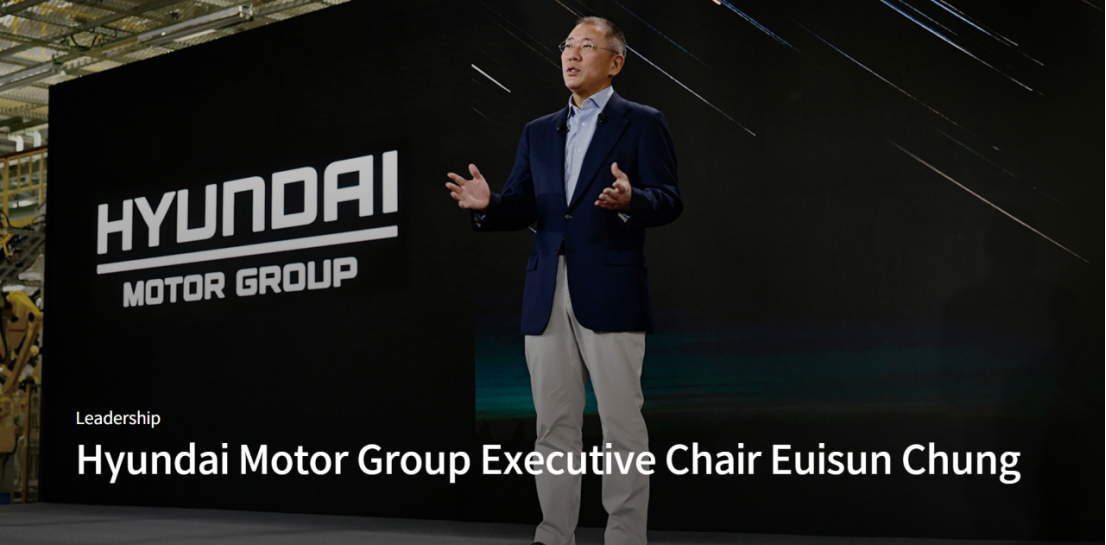
Image source: Hyundai Motor Group
Under Euisun Chung's leadership, Hyundai Motor Group is ramping up investment in autonomy. In November 2025, the group announced plans to invest 50.5 trillion won between 2026 and 2030 in AI-driven autonomous driving and other new growth areas in Korea (about USD 35 billion).
Hyundai Motor Group is advancing autonomous driving R&D with 42dot and Motional at the core, built on its in-house "Atria AI" end-to-end deep learning platform. In parallel, it is partnering with NVIDIA to leverage its physical AI infrastructure, bolstering high-end compute capacity and simulation capabilities for autonomy.
By bringing in Park — with pedigrees from both Tesla and NVIDIA — Hyundai aims to absorb top-tier know-how quickly, narrow the technology gap with leaders, and tap his industry ties to deepen ecosystem collaboration, positioning itself more favorably in the software-defined vehicle era.
The appointment signals Hyundai’s autonomous driving strategy entering deeper waters. Park's technical and managerial chops should give Hyundai's SDV transition a shot in the arm, though it will take time to prove out both breakthroughs and commercialization. As global automakers pivot toward tech-company playbooks, this bout of talent poaching — and the breakout bid behind it — will be one to watch.


