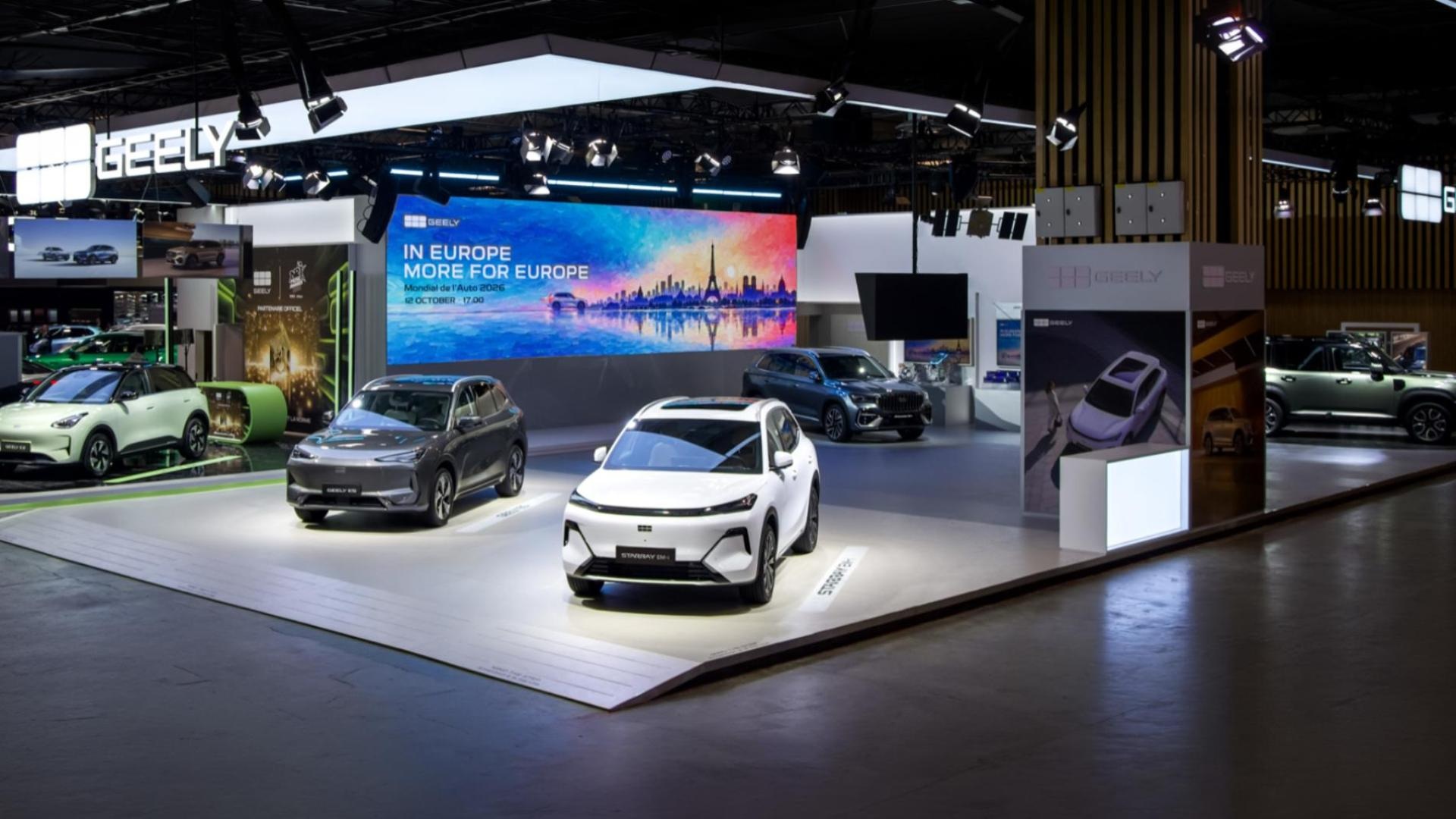
Legions of Chinese are earning more disposable income, and China’s auto industry is set to cash in on their dreams of driving.
Gridlock traffic, no parking, an endless barrage of horns. Such phrases may evoke images of New York or Los Angeles, but lately it seems they more accurately reflect China’s cities. The automobile, driven within living memory only by government officials, has suddenly become a key part of life and the economy in China. With the market opening up, wages rising, and auto prices falling, the dream of car ownership is coming true for the new army of urban middle class Chinese.
China is in the midst of what is probably the largest and fastest boom in automobile production and sales in the vehicle’s history, and foreign companies are vying for a piece of this growing pie. Domestic firms are also looking to parlay their knowledge into profitable bottom lines and even expansion into foreign markets.
Many observers expected china’s WTO accession in 2001 to negatively affect its domestic automobile industry. But reality played out somewhat differently. The automobile market experienced 30% annual growth in 2001 and 2002, and a phenomenal 80% growth in 2003, when a total of 2.04 million cars were sold in China. In a country with a population as large as China’s, these figures still amount to a total of about 40 million private cars on the roads in China today, compared to the more than 200 million in the United States. Many industry insiders think the best is yet to come.
Further driving the automotive frenzy has been the introduction of financing by automobile retailers. This option is creating a vast new potential market for those middle class Chinese who can’t afford to pay the entire sticker price of a car upfront.
Although optimists had hoped to see this profitable trend soar into the future, the figures for 2005 showed the Chinese car market coming back down to earth, at least for the short term. Growth in sales has been sluggish compared to previous years, and the industry as a whole saw profitability down 59% in the first quarter of 2005.
A variety of factors is being blamed for the sudden change. Chief among these is a rise in raw materials prices, especially steel, as well as a significant increase in competition. Long time heavy weights in the market like Volkswagen and GM have been losing market share to newer, mainly Asian brands like Hyundai and Toyota which arrived in the market a bit later.
This is plainly illustrated by the sales figures for First Auto Works, a joint venture with Volkswagen, in the first part of 2005. FAW suffered losses of UA$68.9 million in the leading few months of the year with almost half of its production inventory remaining unsold. Conversely, Beijing-based Hyundai saw sales of 56,100 vehicles in the first quarter of 2005, making it the industry leader for that time period, largely due to a massive upgrading of Beijing’s taxi fleet.
The importance of the automobile industry to China’s economy is reminiscent of the post-world war Ⅱ automobile-driven economic boom experienced by the US, in that the country is seeing a massive and sudden trend in car ownership, and the flow-on positive economic effects of an expanding auto industry. A telling example is that, despite the fact that Volkswagen’s China sales have been slipping; they are still upping production in anticipation of resurgence. There third factory on the mainland, to be located in Chengdu, Sichuan province, will begin operations in May 2007.
In the early 1980s, the Chinese government began soliciting foreign carmakers to form joint ventures with domestic firm to manufacture automobiles. This was when Volkswagen (VW) made its way into China. With its successful pairings with Shanghai Automotive Industry Corporation (SAIC) in Shanghai and First Auto Works (FAW) in Changchun, the German auto maker has been the market leader for 20 years with VW’s Santana passenger sedan the top selling car in the country for the past several years.
Another heavy weight in the industry is GM, who also teamed up with SAIC to enter the Chinese auto market. Although traditionally seen as a runner up to the wildly successful Volkswagen, GM sales actually surpassed VW’s by over 40,000cars in the first half of 2005 with a total of 308,722 units, making it number one in auto sales in China.
More significantly, these pairings between market-tested foreign car-makers and technologically lagging and ill-managed state-owned monoliths have proved to be crucial to the development of China’s domestic car manufacturers. Such cooperation allowed companies like SAIC and FAW to streamline management, acquire advanced technologies and increase global exposure. In 2004, SAIC renewed its joint venture contract with Volkswagen for an additional 20years.
China currently has about 100 domestic carmakers, most of which are expected to collapse or be swallowed up during the next few years of intensifying competition in the China auto market. Given the market’s increasingly cutthroat nature and China’s comparatively low respect for intellectual property rights(IPR), many foreign companies are finding themselves in tough IPR battles. These clashes often involve smaller carmakers which “borrow” every-thing from design to even logos from foreign companies. These standoffs, which sometimes go to court, have even emerged between JV partners, illustrating that such cooperation is not always the “win-win situation” envisioned by eager foreign firms.
A key reason for many IPR issues is the overlap between a small number of Chinese firms with the world’s largest car producers. The top three domestic car manufacturers, SAIC, FAW and Dongfeng Motor, have snagged most deals with foreign auto companies. SAIC has JVs with VW, and GM, FAW has ventures with VW, Mazda and Toyota and Dongfeng has teamed up with Nissan and Renault.
The JV relationships can be difficult in other ways. It is rumored SAIC chose to partner with GM when VW refused to turn over certain technologies to the Chinese firm. Of course, the relatively lax (some say protectionist) attitude displayed by Chinese courts toward such matters has not helped to change the IPR climate in China.
Car imports are generally limited to high-end luxury vehicles, primarily due to price-inflating tariffs. But current tariffs are not as steep as in years past, due to new WTO regulations. In 2005, they ranged from 38-43%, depending on the origin of the car, and in 2006 the tariff is expected to drop to a flat rate of 25%. Previously the rate was as high as 130%. As a result, car imports are growing steadily, reaching over 100,000 units in the first half of 2005, with a value of over US$ 3billion.
China’s auto exports have grown rapidly in percentage terms recently, primarily because they were starting from a low base. But still, indications point toward China becoming a top automobile exporter in the coming years, particularly as the potential for oversupply becomes ever more likely in the domestic market. Volkswagen for example, has announced that it plans to export its China-made vehicle to 84 countries by 2009.Othercar manufacturers will certainly follow suit.
A potential bubble looms on the horizon. Analysts estimate nationwide automobile production capacity to be around 5.5 million vehicles per year with a likely expansion to more than ten million vehicles in the coming years, far exceeding market demand. If such a scenario plays out, the result will be China-based automobile manufacturers pursuing an aggressive export strategy.
Aside form the obvious economic impact of the automotive industry, the popularization of the automobile is also being felt in Chinese society. Much to the chagrin of Chinese urban planners who had envisioned massive public transportation networks as the principal means of transport for China’s bustling urban metropolises, it seems Chinese people have instead fallen in love with car culture. The number of cars in Shanghai reached the 2020 estimate by the beginning of 2005, and new highways are being saturated with traffic as quickly as they are built. In Beijing, simply getting across town during rush hour has the potential to be a several-hour ordeal. For better or worse, car ownership is fast becoming synonymous with success in China and the automobile is here to stay.