



Gasgoo Munich- In the arena of smart vehicles, the chip has long been the most deeply buried, yet decisive, peak of the "smile curve."
For a long time, the chip sector was the exclusive domain of multinational giants. Yet the latest data from Gasgoo Automotive Institute clearly marks a turning point for domestic players. From January to December 2025, in the top five rankings for cockpit domain control chip installations, Qualcomm retained the lead—but two Chinese firms have made inroads in a list long dominated by foreign suppliers. Huawei overtook AMD to take second place with a 7.1% share, while SiEngine claimed fourth with 5.6%. They are the only two Chinese companies to enter the top five.
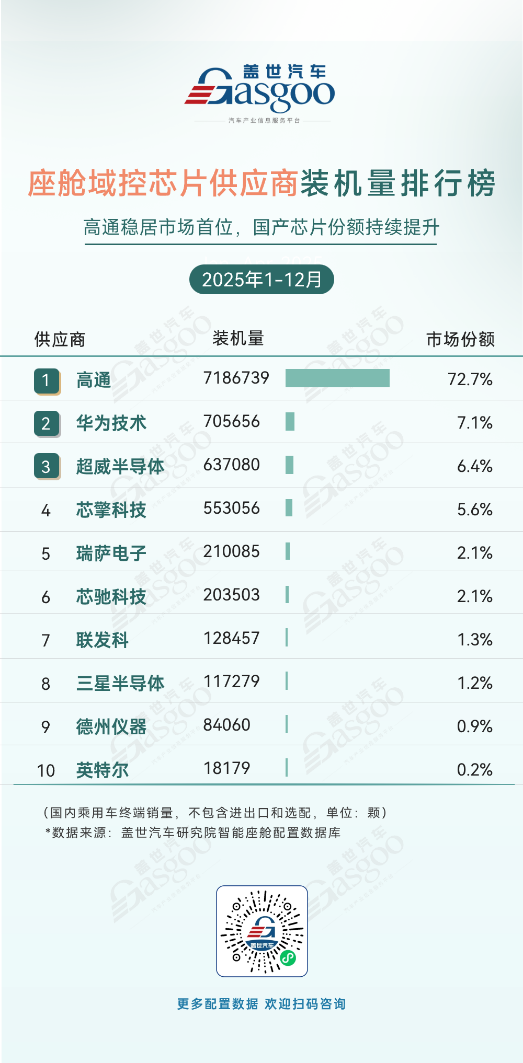
It is worth noting that compared to the giant Huawei, SiEngine is a young company founded only in 2018. Another signal that demands closer attention: according to Gasgoo Automotive Institute, SiEngine ranks first among domestic vendors for cockpit domain control chip installations in vehicles priced below 400,000 yuan.
The sub-400,000 yuan price bracket is the "core segment" of China’s auto market—the largest by volume and the most highly competitive. Spanning the mainstream consumer segment from economy to mid-to-high-end vehicles, it is the critical battleground where automakers increase sales volume and build brand equity.
Securing the top domestic spot in this segment demonstrates that SiEngine’s products have been tested by the broadest possible market. It signifies that the company’s product strength, cost control, and supply chain capabilities have withstood the rigorous scrutiny of the mass market. This success is no accident found in niche or low-end segments; it is a testament to core competitiveness.
What warrants closer examination is the path behind SiEngine’s rapid ascent. It points to a new route for domestic chips to break through the barriers of foreign dominance. The true future of domestic automotive-grade chips lies not merely in substitution, but in profound integration capabilities: understanding market demand, mastering technological roadmaps, and redefining the industrial ecosystem.
Starting with the Cockpit Crown
Tracing the trajectory of this company, founded less than eight years ago, the logic behind its product evolution, technological breakthroughs, and strategic elevation is clearly visible.
SiEngine’s technological breakthrough began with a milestone product.
In 2021, SiEngine launched the "Dragon Eagle One," China’s first 7-nanometer automotive-grade smart cockpit chip. To date, cumulative shipments of the Dragon Eagle One have surpassed the one-million mark. In 2024, it ranked first among domestic suppliers in terms of smart cockpit domain controller SoC installations, successfully powering dozens of mass-produced models across the Lynk & Co, Galaxy, FAW Hongqi, and Changan Qiyuan series.
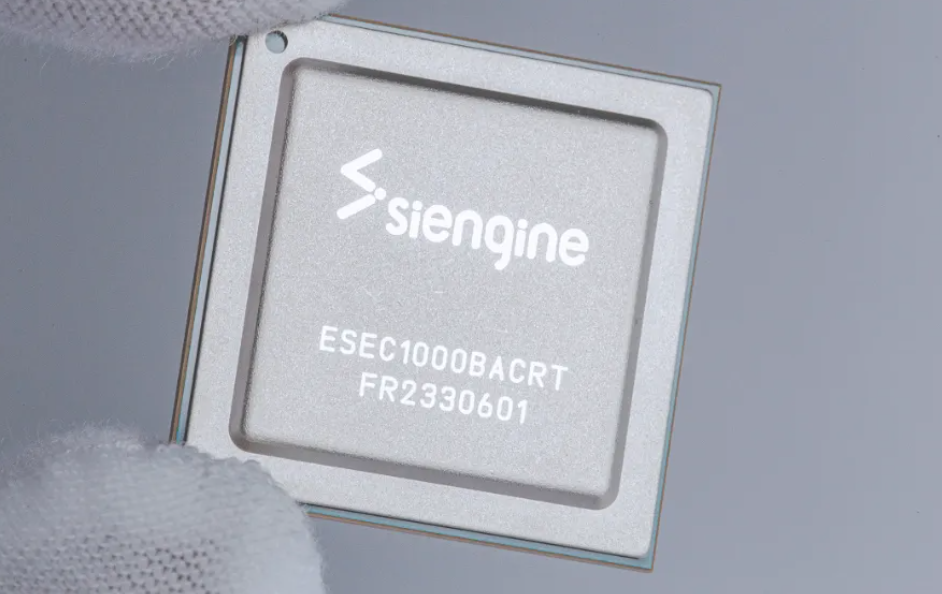
Image Source: SiEngine Official Website
Moreover, amidst the competition for computing power advantage, SiEngine advocates a more rational value proposition: customers are not paying for market price or paper TOPS (trillions of operations per second), but for a balance between system-level efficiency and total cost of ownership.
This demands forward-looking system thinking in chip design: How to optimize memory bandwidth to reduce data bottlenecks? How to use high integration to minimize peripheral components, saving PCB space and power consumption? How to ensure chip reliability and longevity to lower vehicle lifecycle costs? Once functional safety thresholds are met, these "invisible" system-level optimizations are often the deciding factor in whether a chip makes it into mainstream, high-volume models.
SiEngine’s pioneering "Dragon Eagle One" single-chip solution for cockpit, driving, and parking integration offers an effective solution.
By integrating smart cockpit, driver assistance, and automated parking functions onto a single chip, the solution not only reduces component count but also delivers high-bandwidth, low-latency memory support and rich video signal input capabilities. It significantly lowers system integration complexity, ultimately helping automakers achieve cost savings of over 30%. This solution has already been deployed in the Galaxy E5, which is achieving strong sales in mainstream markets across Asia and Europe.
This philosophy accurately addresses the pain points of mainstream automakers. They do not need "high-specification devices" with endlessly stacked specs, but rather "reliable partners" that offer stable performance and system integration at a competitive cost, while guaranteeing continuous mass production delivery.
SiEngine’s leadership in the sub-400,000 yuan market is clear proof that its system-level innovation strategy has passed the broadest market test.
Elevating the Competition: From "Single-Product Competition" to "Platform Layout"
As smart vehicles move from "Intelligence 1.0" to "Intelligence 2.0," the competitive landscape for automotive-grade chips has fundamentally shifted. It is no longer a contest of single-product performance, but a comprehensive comparison of full-stack platform capabilities.
SiEngine completed its strategic upgrade from "single-point breakthrough" to "full-stack empowerment" earlier than most, now capable of delivering full-stack solutions ranging from cockpits to intelligent driving.
In 2025, SiEngine officially launched the "Star One," a high-end driver assistance chip. Public records indicate mass production began by the end of 2025. Built on a 7-nanometer multi-core heterogeneous architecture, the chip boasts an NPU of up to 512 TOPS on a single die, with a multi-chip collaborative solution capable of delivering up to 2,048 TOPS of computing power.
At the same time, the Star One features an independent high-performance safety island, supporting the EVITA Full safety standard and an integrated hardware security module capable of executing national cryptographic algorithms and international encryption protocols. To accelerate AI model development and deployment, the chip provides a high-performance AI toolchain with deep optimization for CNN and Transformer architectures, offering automakers platform-level support for achieving L2+ to L4 autonomous driving.
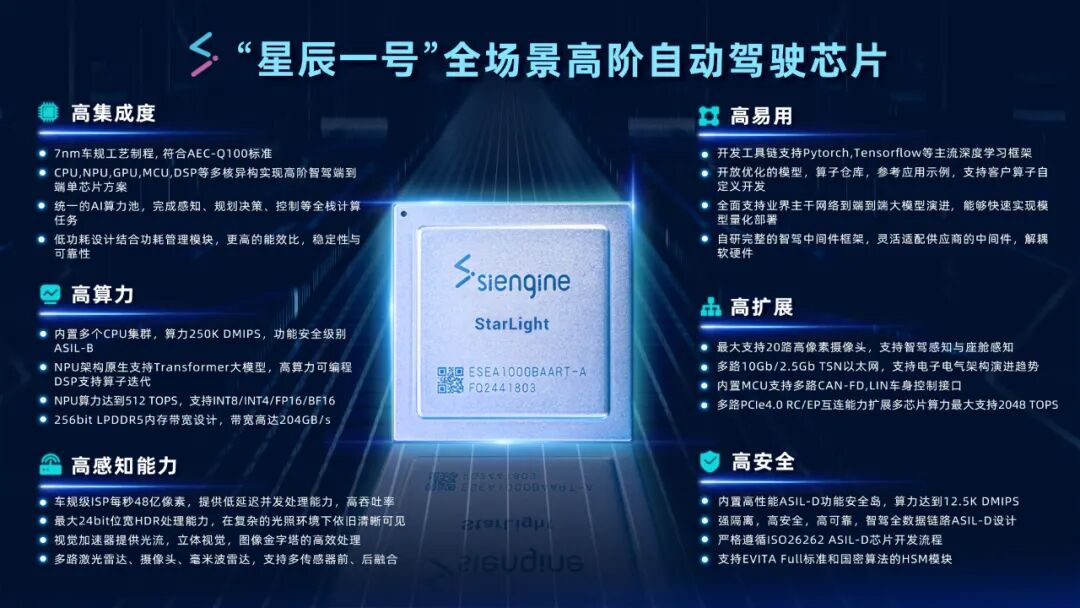
Image Source: SiEngine Official Website
It is evident that as automotive electronic architectures evolve from distributed to domain-centralized models, automakers are increasingly inclined to reduce the number of chip suppliers and lower system integration complexity. Consequently, chip companies with full-stack platform capabilities are poised to become the market leaders in the industry.
SiEngine opened doors in the smart cockpit sector with the "Dragon Eagle One," building a reputation for mass production and supply chain trust. With the "Star One" entering mass production, the company has completed a dual high-end product matrix layout for "cockpit and driving integration," possessing the core capability to provide the market with full-stack, platform-based solutions.
"Openness" as Strategy
Addressing the industry-wide pain point of the difficulty in integrating high-end automotive chips, SiEngine has forged a unique path to breakthrough. By leveraging an open ecosystem to gather strength across the industry and abandoning the closed model of "isolated operation," the company delivers cost-effective solutions based on systemic thinking rather than raw computing power. This marks an upgrade in role from "chip supplier" to "ecosystem enabler."
Unlike some vendors that adopt "software-hardware integrated" solutions, SiEngine has built a full-scenario ecosystem platform. By opening core capabilities to partners up and down the supply chain, it lowers adaptation barriers for the entire industry and accelerates product time-to-market through ecosystem synergy.
Dr. Wang Kai, founder and CEO of SiEngine, once stated: "Amid the trend of intelligence, those who can cooperate openly will be the first to usher in the industry's inflection point."
Last year, SiEngine launched the "SiEngine Ark," a full-scenario ecosystem platform. It offers open empowerment across chip fundamentals, operating systems, system software, middleware, algorithm operator libraries, and AI toolchains. The platform provides one-stop algorithm development and end-to-end large model deployment, while possessing capabilities for data flow optimization, vehicle-level planning and control adaptation, and a closed-loop data system combining edge and cloud.
This open strategy has already translated into numerous collaborative achievements. In September 2025, SiEngine signed a strategic partnership agreement with Puhua Basic Software Co., Ltd. Focusing on smart cockpits and intelligent driving, the two parties are building a multi-dimensional R&D system covering chips, systems, and applications. They have established a collaborative innovation mechanism for functional safety certification, middleware development, and cross-domain fusion solutions. Through Puhua’s customized vehicle control operating system and development environment, they aim to achieve deep decoupling of hardware computing power from software functionality.
This serves as a microcosm of a larger trend: SiEngine’s open model not only reduces adaptation costs for automakers but also attracts more software and algorithm companies to optimize on its hardware. This creates a virtuous cycle of "chip-software-automaker." Ultimately, the ecosystem "network" expands, and the chip’s position as the "foundation" becomes increasingly solid.
In this model, SiEngine’s competitiveness lies not merely in transistor density, but in its value as an industry connector.
Beyond Boundaries: Extending and Empowering with Automotive-Grade Technology
Going global—the path for Chinese chips faces significant challenges. SiEngine’s global expansion is not a simple export of products, but rather a synergistic "chip + vehicle" strategy leveraging the globalization advantages of China’s automotive industry.
By the end of 2024, SiEngine had successfully become the designated supplier for Volkswagen’s global models, with the first batch of vehicles to be launched in Europe and the Americas. This made it the first domestic smart cockpit chip supplier to secure a major, long-term international order. Additionally, popular models like the Geely EX5, powered by the "Dragon Eagle One," are now sold in 35 countries and regions.
It is reported that SiEngine is also collaborating with OEMs in Europe and the Asia-Pacific region beyond Volkswagen.
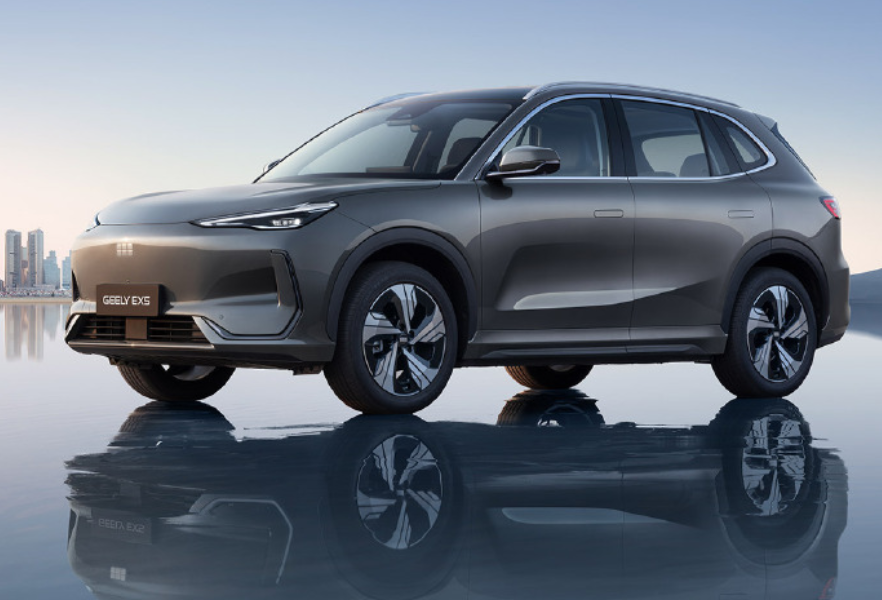
Image Source: Geely Auto Group Weibo
But SiEngine’s ambitions extend beyond automobiles.
Leveraging the core technologies of high reliability, real-time performance, and security accumulated in the automotive chip sector, SiEngine is actively laying out a second growth curve. It is extending its technology into embodied intelligence, the low-altitude economy, and edge computing.
As early as 2024, SiEngine launched the industrial-grade "Dragon Eagle One" 7-nanometer AIoT application processor, the SE1000-I, targeting domestic high-end industrial edge computing and robotics applications. That same year, in collaboration with Arm China and Radxa, the company introduced the SiRider S1—a single-board computer based on the industrial-grade Dragon Eagle One, designed specifically for the industrial sector.
In the robotics field, SiEngine showcased the Agassi robot, powered by the industrial-grade "Dragon Eagle One," at the 2025 Shanghai International Auto Show. The company is currently collaborating with other robotics hardware and algorithm firms, with new product releases planned for 2026.
Navigating the complexities of high-end automotive chips, SiEngine entered the market at precisely the right moment—when domestic chips had gained the most momentum. SiEngine’s path may well map out the next competitive paradigm for domestic chips: moving from substitution and catch-up to parallel competition; from hardware supply to ecosystem construction; and from meeting demand to jointly defining the future architecture. In this process, the disruptor has become the definer of the new landscape.
The chip competition for smart vehicles is far from over, but the market dynamics are being rewritten.


