



Gasgoo Munich- After a decade of burning cash, Robotaxis are finally starting to generate their own revenue.
Pony.ai and WeRide recently released their 2025 earnings reports, and the numbers are striking. Pony.ai generated $16.6 million in Robotaxi revenue last year — a 128.6% surge — while WeRide’s Robotaxi business brought in 148 million yuan, jumping 209.6%.
Even more significant, both companies have cleared the same critical hurdle: turning a profit on each vehicle. Pony.ai has achieved positive unit economics across Guangzhou and Shenzhen, while WeRide reached break-even on unit economics in Abu Dhabi.
This signals that the Level 4 Robotaxi sector — doubted for a decade — is finally ready to stand on its own two feet.
Robotaxis Are Starting to Make Money
Pony.ai and WeRide have both released their 2025 financial reports recently, and they point to a single conclusion: Robotaxis are becoming profitable.
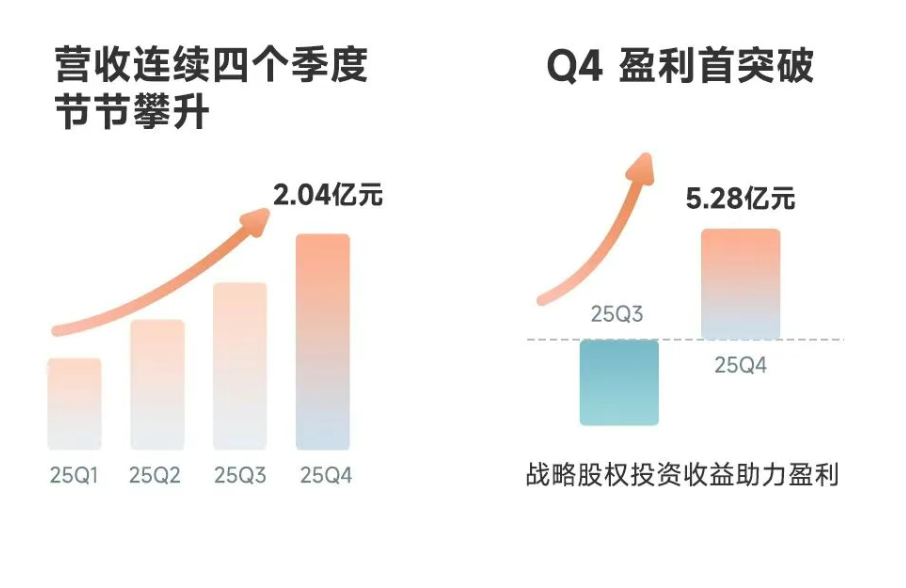
Image source: Pony.ai
First, consider Pony.ai.
In 2025, Pony.ai recorded total revenue of $90 million (about 620 million yuan), a 20% increase. Gross profit hit $14.16 million, yielding a margin of 15.7% — slightly up from 15.2% the previous year. Net losses narrowed sharply by 72.1% to $76.78 million.
In 2024, Pony.ai’s revenue was still dominated by autonomous trucking services, which accounted for 53.8%. By 2025, however, that share had slipped to 45.1%. Conversely, the contribution from autonomous mobility services surged from 9.7% to 18.5%.
This suggests Pony.ai is shifting its revenue mix from a truck-heavy focus toward a more balanced model combining mobility, trucking, and technology licensing.
Specifically, Pony.ai’s Robotaxi mobility services generated $16.6 million in cumulative revenue for 2025, up 128.6%. The fourth quarter alone contributed $6.7 million — a 160% year-over-year jump.
Wang Haojun, co-founder and CFO of Pony.ai, attributes this rapid growth primarily to passenger fares. In the fourth quarter of 2025, fare revenue soared more than 500%, with annual growth approaching 400% — a sign that genuine paid demand for mobility is accelerating.
This momentum is also underpinned by the rapid expansion of Pony.ai’s Robotaxi fleet and improved operational efficiency.
As of March 25, 2026, Pony.ai’s Robotaxi fleet had surpassed 1,400 vehicles — more than a fivefold increase from the 270 vehicles at the end of 2024. Its operations now cover China’s four first-tier cities, as well as eight countries across East Asia, the Middle East, and Europe, including Singapore, the UAE, and Qatar.
Shenzhen has become a key proving ground. In the first two months of 2026, paid Robotaxi orders in Shenzhen alone surpassed Pony.ai’s total for all of 2025. On March 22, its seventh-generation Robotaxis in the city hit a record high of 394 yuan in daily net revenue per vehicle, completing 25 orders per car that day.
To put 394 yuan in perspective: that’s on par with, or even exceeds, the daily earnings of local ride-hailing drivers. It means that under the right conditions, "AI drivers" have the economic foundation to compete directly with their human counterparts.
Even more notable, Pony.ai turned positive on per-vehicle profitability across Guangzhou in November 2025 and in Shenzhen in February 2026.
"Achieving positive unit economics is a major victory for the entire industry," said Peng Jun, CEO of Pony.ai. "It proves our technology can be effectively validated in the real world, and that Robotaxis aren't just technically feasible — they can be profitable at scale."
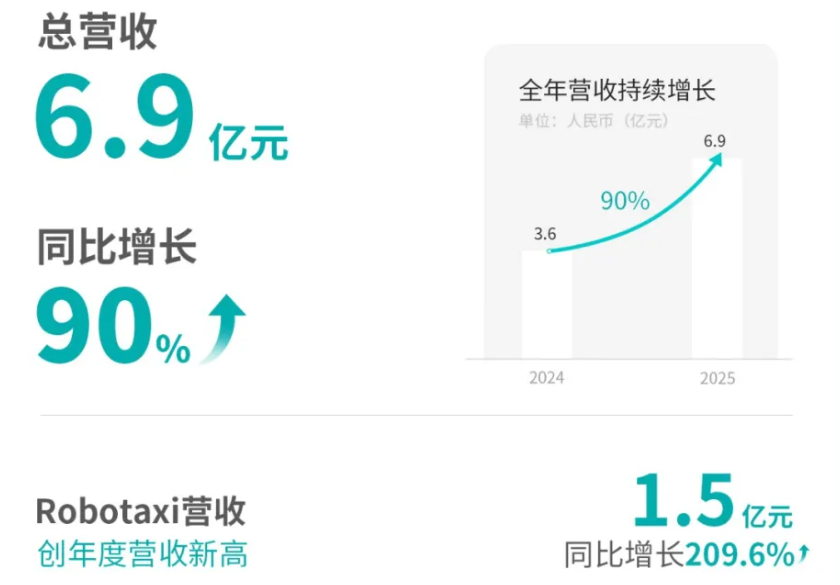
Image source: WeRide
Now, consider WeRide.
In 2025, WeRide posted total revenue of 685 million yuan ($97.9 million), an 89.6% increase that slightly outpaced Pony.ai. Gross profit came in at 207 million yuan, yielding a margin of 30.2% — largely flat compared to 2024’s 30.7% but significantly higher than Pony.ai’s 15.7%. Net losses narrowed by 34.2% to 1.655 billion yuan.
Breaking it down by segment, WeRide generated about 360 million yuan in product revenue in 2025, driven largely by sales of autonomous minibuses and street sweepers. That represents a 310.3% surge and accounts for 52.6% of total revenue. Service revenue reached 325 million yuan, up 18.8%.
This means WeRide currently derives more than half of its revenue from selling autonomous vehicles.
Specifically for Robotaxis, WeRide generated 148 million yuan in revenue in 2025 (including both product and service income), a 209.6% jump.
Behind these figures lies a global fleet of 2,113 autonomous vehicles, including a Robotaxi fleet of 1,125. Operating in more than 40 cities across 12 countries, WeRide is one of the autonomous driving companies with the broadest global footprint.
In Abu Dhabi, the company has achieved unit economics break-even for its Robotaxi fleet by removing safety drivers from inside the vehicles.
Pony.ai has successfully validated its unit economics (UE) model in the core districts of China’s first-tier cities, proving that "Robotaxis can make money in China." WeRide, meanwhile, has reached break-even in overseas markets with favorable policies, proving that "Robotaxis can work abroad."
Though their paths differ, the destination is the same: Robotaxis are moving from "technologically feasible" to "commercially viable."
Two Paths, One Destination
On the surface, the revenue figures for both Pony.ai and WeRide look impressive. But dig a little deeper, and their money-making models are starkly different.
Pony.ai is "tackling the hard challenges first, then replicating with an asset-light model."
The "hard challenges" refer to the core areas of China’s first-tier cities — places like Guangzhou Higher Education Mega Center, Shenzhen’s Qianhai, the area around Beijing’s Yizhuang, and Shanghai’s Jiading and Pudong districts.
Pony.ai’s logic is straightforward: these areas have complex road conditions and heavy traffic, placing extreme demands on autonomous driving technology. But they also boast high user density and strong demand. Once the business model works here, it creates a powerful demonstration effect and economies of scale that allow for rapid replication elsewhere.
When Pony.ai entered Zagreb, the capital of Croatia, it leveraged experience gained in China to launch operations directly in the high-value city center.
"We’ve achieved large-scale operations in the dense core areas of major Chinese cities, around the clock and in all conditions," said Lou Tiancheng, Pony.ai’s founder and CTO. "This means when we enter a new city like Zagreb, we aren’t starting from zero because our system’s capabilities already cover every scenario we might encounter in a new market."
But replicable technology and experience aren't enough. Large-scale Robotaxi deployment requires a robust fleet and strong operational support.
To that end, Pony.ai has chosen a co-built fleet model, partnering with ecosystem players to deploy and operate vehicles, accelerating the scaling process.
Simply put: partners foot the bill for the vehicles — and sometimes handle ground operations, maintenance, and charging — while Pony.ai provides the technology and operational expertise. The profits are then shared.
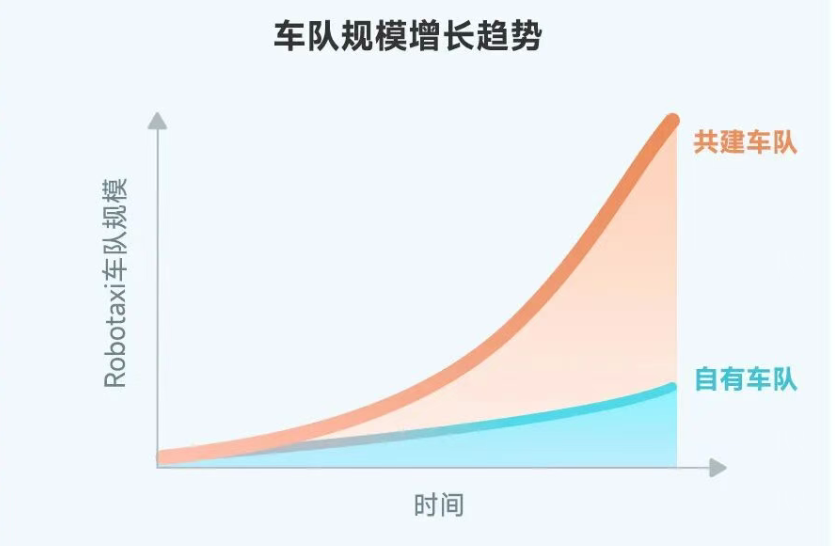
Image source: Pony.ai
According to Peng, Toyota was the first to join this model. Pony.ai has locked in an order for 1,000 bZ4X Robotaxis equipped with its seventh-generation autonomous system, to be deployed throughout the year. The company is also partnering with BAIC and GAC Group, leveraging their mature supply chains and after-sales networks to lower vehicle costs, with plans to co-build fleets overseas as well.
To reach a wider user base, Pony.ai has partnered with Tencent to integrate with the WeChat mobility service platform, allowing hundreds of millions of WeChat users to easily hail its Robotaxis.
Overseas, Pony.ai is teaming up with local players like Uber, Singapore’s ComfortDelGro, Qatar’s Mowasalat, Luxembourg’s Emile Weber, and South Korea’s GemVaxLink to deploy Robotaxis in their respective markets.
In Wang Haojun’s view, this creates a win-win scenario. Partners gain a growing revenue stream, while Pony.ai can rapidly scale its fleet without tying up significant capital. This improves capital efficiency during expansion and opens new revenue channels through profit-sharing or licensing fees for its "virtual AI driver" technology.
Pony.ai plans for nearly half of its new vehicles in 2026 to be deployed through this model, expecting more companies to join the fold this year.
It is worth noting, however, that while the co-built fleet model allows Pony.ai to expand with light assets, it also means the pace of that expansion depends on the willingness of its partners.
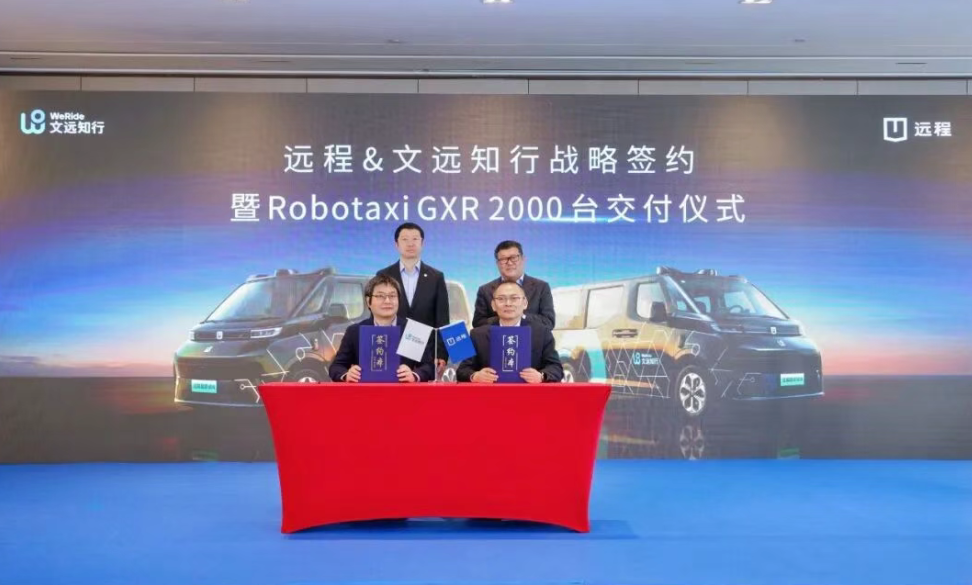
Image source: WeRide
WeRide, by contrast, leans toward a heavier asset expansion model. Beyond selling Robotaxis to downstream operators, it retains ownership of its own autonomous technology and vehicles.
According to its financial report, WeRide’s revenue comes from two main streams. First is product sales — including Robotaxis, autonomous minibuses, and street sweepers — which generated 360 million yuan last year. Second is service revenue, covering smart data services as well as operations and technical support for autonomous driving, which totaled 325 million yuan.
This means WeRide is not just a Robotaxi operator; it is also a seller of autonomous vehicles.
Moreover, unlike Pony.ai’s "domestic first, then international" approach, WeRide moved earlier on internationalization and has a more balanced global footprint.
Financial data shows WeRide already operates more than 250 Robotaxis outside of China and the U.S., with over 200 deployed in the Middle East alone.
Still, like Pony.ai, WeRide partners with local players to drive commercialization overseas. Its Robotaxi services in Abu Dhabi, Dubai, and Riyadh are all launched in partnership with Uber, while in Singapore, it has teamed up with Grab.
This "technology export plus localized operations" model lowers barriers to entry and leverages partners’ advantages in local policy, resources, and market channels. It allows Chinese Robotaxi services to integrate into local ecosystems faster, laying a solid foundation for sustained overseas revenue growth.
Next Step: Taking the Fight Global
Building on their high growth in 2025, both Pony.ai and WeRide have issued optimistic forecasts for their Robotaxi businesses in 2026. Unsurprisingly, both have identified "going global" as a strategic priority for the next phase.
"In 2026, the company will fully enter a high-growth trajectory," said Peng Jun. "Relying on our fully driverless capabilities, policy support, mass production systems, scaled operational experience, and ecosystem maturity, we will push the Robotaxi business forward at full speed."
Specifically, Pony.ai will execute a "China + Overseas" dual-engine expansion strategy this year. The plan is to deploy Robotaxis in more than 20 cities globally in 2026, with overseas markets accounting for nearly half that total.
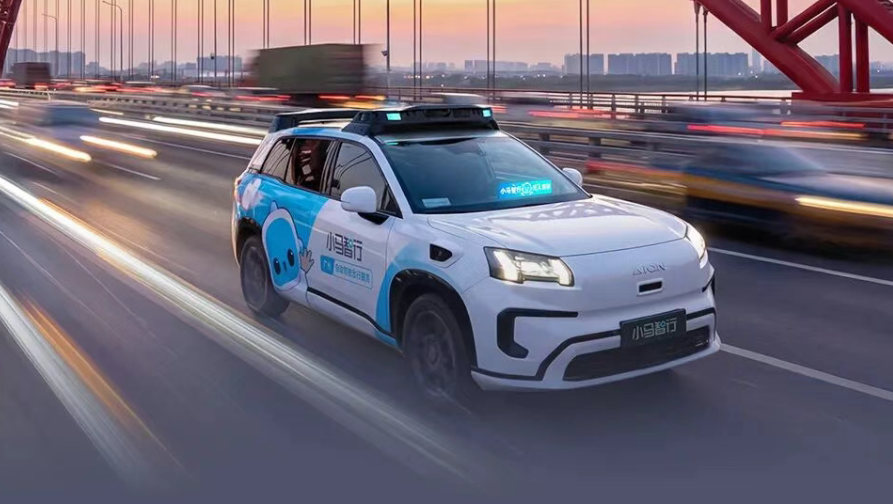
Image source: Pony.ai
Domestically, Pony.ai is expanding into the Greater Bay Area and "new first-tier" cities. In March, it successfully launched in Hangzhou and Changsha.
Overseas, Pony.ai recently partnered with Uber and Verne to enter Croatia, launching Europe’s first commercial Robotaxi service. In this collaboration, Pony.ai provides the autonomous solution, while Verne acts as the fleet owner and operator. Uber integrates the service into its global ride-hailing network, complementing Verne’s own user platform.
The Middle East is a key focus area. Peng revealed on an earnings call: "Next, we plan to launch paid services in Doha, Qatar, in partnership with Mowasalat. In Dubai, we are ready to fully launch fully driverless operations once approval is granted later this month." He also addressed concerns about geopolitical risks in the region: "So far, current geopolitical tensions have had almost no direct impact on our business."
To support this expansion, Pony.ai is ramping up production capacity.
In February, the mass-produced bZ4X Robotaxi — a collaboration between Pony.ai, Toyota China, and GAC Toyota — officially entered mass production. The three parties plan to deploy a total of 1,000 bZ4X Robotaxis this year, operating in China’s first-tier cities.
Additionally, Robotaxis developed with BAIC and GAC are rolling off the assembly line. Backed by these ecosystem partnerships, Pony.ai plans to grow its fleet to over 3,000 vehicles by the end of the year, aiming to more than triple its 2025 revenue from autonomous mobility services.
"Overall, the core pillars supporting our expansion into over 20 cities are clear," said Lou Tiancheng. "A multi-OEM partnership network gives us diverse vehicle platforms adapted to local needs. Our standardized operational system — from remote assistance to fleet management — is highly replicable. And our technology supports a wide Operational Design Domain (ODD), allowing us to cover complex urban environments."
WeRide, for its part, plans to grow its global Robotaxi fleet to 2,600 vehicles by the end of 2026 — slightly less than Pony.ai’s target.
The Middle East is also a key battleground for WeRide. It has already deployed over 200 Robotaxis there, a figure set to jump to between 500 and 1,000 in 2026. In the coming years, WeRide and Uber plan to expand the Middle Eastern fleet to several thousand vehicles.

Image source: WeRide
In February, WeRide outlined a partnership with Uber, committing to deploy at least 1,200 Robotaxis in the Middle East by 2027, covering the three key cities of Abu Dhabi, Dubai, and Riyadh.
Ultimately, WeRide aims to deploy tens of thousands of Robotaxis globally by 2030.
The ambitious expansion plans of Pony.ai and WeRide are just a microcosm of the broader sector. Recognizing the vast potential of Robotaxis, automakers, ride-hailing firms, tech giants, and even startups are all piling into the market.
Peng Jun welcomes the competition. "The influx of new players shows that everyone sees the long-term potential of this track. We certainly welcome it — let’s grow the market together."
But he offers a reminder: L4, especially Robotaxis, is an incredibly complex systems engineering challenge. It relies on five pillars — technology, policy, mass production, operations, and ecosystem cooperation — all of which are interconnected. You can’t simply throw resources at it to accelerate development.
Lou Tiancheng offered a more direct technical assessment: "I don’t believe automakers have an inherent advantage in L4 Robotaxis just because they are strong at manufacturing or good at L2. L2 and L4 are completely different; they are not two stages on the same path."
In his view, improving Miles Per Intervention (MPI) in L2 can actually increase risk. Semi-autonomous driving creates a dangerous illusion that the system is "basically fine," until it suddenly fails at a critical moment when the human driver can’t take over in time. "This is why L2 doesn’t naturally lead to L4, especially when discussing the large-scale operation of fully driverless fleets," Lou said.
Lou believes the hardest part of L4 isn’t the first 99%, but the final 1% — those rare but safety-critical edge cases. "To handle these scenarios safely, relying solely on trajectory data from single metrics is far from enough. What truly matters is understanding the various possible behaviors of other vehicles and pedestrians as they interact with an AI driver."
More specifically, Lou points out that this requires support from two closed loops: a world model built specifically for L4, allowing for large-scale trial and error in a virtual environment; and a real-world Robotaxi fleet that continuously identifies gaps between the model and reality, using operational data to feed back into model iteration.
In other words, the experience automakers accumulate through ADAS might help them stand firm in the L2 market. But the core technological breakthrough for L4 Robotaxis requires more than just more road test data. It demands a profound understanding of the essence of "human-machine interaction" and relies on fully driverless operational data to continuously narrow the gap between the world model and the real world. And that, Lou suggests, is precisely where Pony.ai’s strongest moat lies.
Conclusion
In 2025, Robotaxis completed the leap from "technical validation" to "commercial validation."
Going forward, the focus of competition in this sector will shift to a more practical question: who can replicate their successful model in more cities faster, all while keeping costs under control.
This will be a contest of business model resilience. When technical parameters are no longer the only yardstick, a profit logic that withstands scrutiny is the real trump card.


