



On February 24, marking the first workday of the Chinese New Year of the Horse, XPENG Chairman He Xiaopeng sent an internal memo to global staff titled "Steady Progress, Breaking the Game."
He outlined a core strategy for 2026: "Physical AI and Globalization must be fully penetrated." The memo offers a clear look at an automaker built on smart technology trying to shed the "car company" label and pivot to becoming an embodied AI firm focused on mass production.
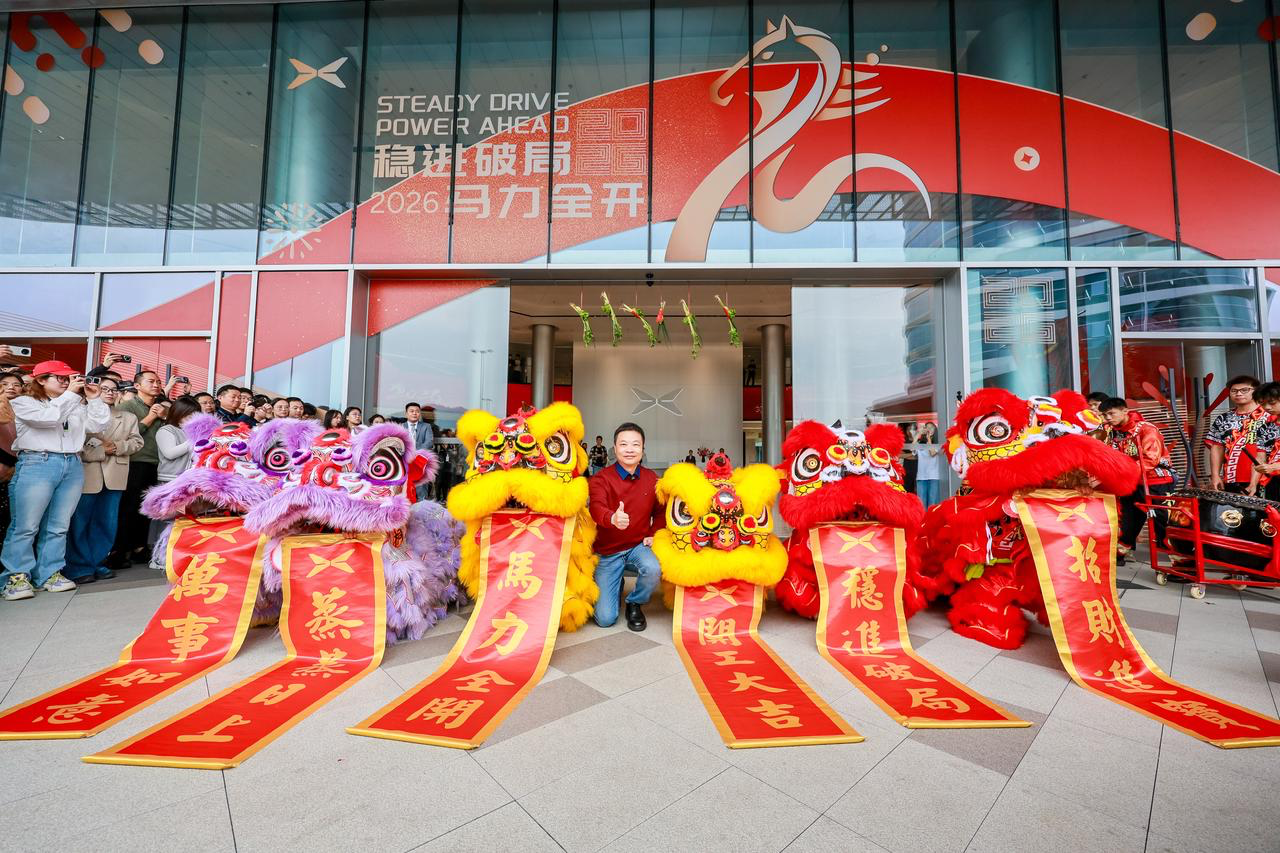
Image Source: XPENG
Volkswagen Becomes Launch Customer for VLA; Cabin-Driving Fusion Enters Deep Water
The most technically significant section of the memo concerns progress in autonomous driving.
He revealed that during the Chinese New Year holiday, he was rigorously testing XPENG's second-generation VLA (Vision-Language-Action model). He assessed its progress as moving from "showing off" to "emergence." He views the model as "XPENG's first delivery for the L4 autonomous driving era," with an official rollout slated for this quarter.
Notably, He announced that Volkswagen will be the launch customer for XPENG's second-generation VLA model. Convincing a top global automaker to pay for Chinese AI technology is significant not just for the partnership itself, but because it validates XPENG's global competitiveness in core technology—proving its capabilities are exportable and reusable.
To support this technical path, XPENG completed a critical organizational restructuring in early February, merging its autonomous driving center with its smart cockpit center to form a "General Intelligence Center." This means driving decisions and human-machine interaction will no longer be managed by separate teams, but will instead share a single AI foundation model.
This restructuring reflects a bet on the form of the "car robot." In the future, users will simply need to say, "Take that small path ahead and avoid the traffic lights," and the vehicle will execute the command directly. Coincidentally, Elon Musk expressed a similar technical view just days ago, noting that FSD will soon support direct language control. The fusion of cabin and driving functions is becoming a technical consensus among industry leaders.
Robots, Flying Cars, and Robotaxis: Mass Production in the Same Year
If VLA represents XPENG's "brain," then physical entities are its "hands and feet."
He has set an extremely ambitious goal for 2026: to become the world's first technology company to achieve full mass production of three cutting-edge AI businesses—robots, flying cars, and robotaxis—within the same year.
The specific timeline is as follows:
Robotaxis: Pilot operations for ride-hailing models will launch this year to validate the initial loop of technology, customers, and business. The sector is expected to enter an early stage of rapid growth between 2027 and 2028.
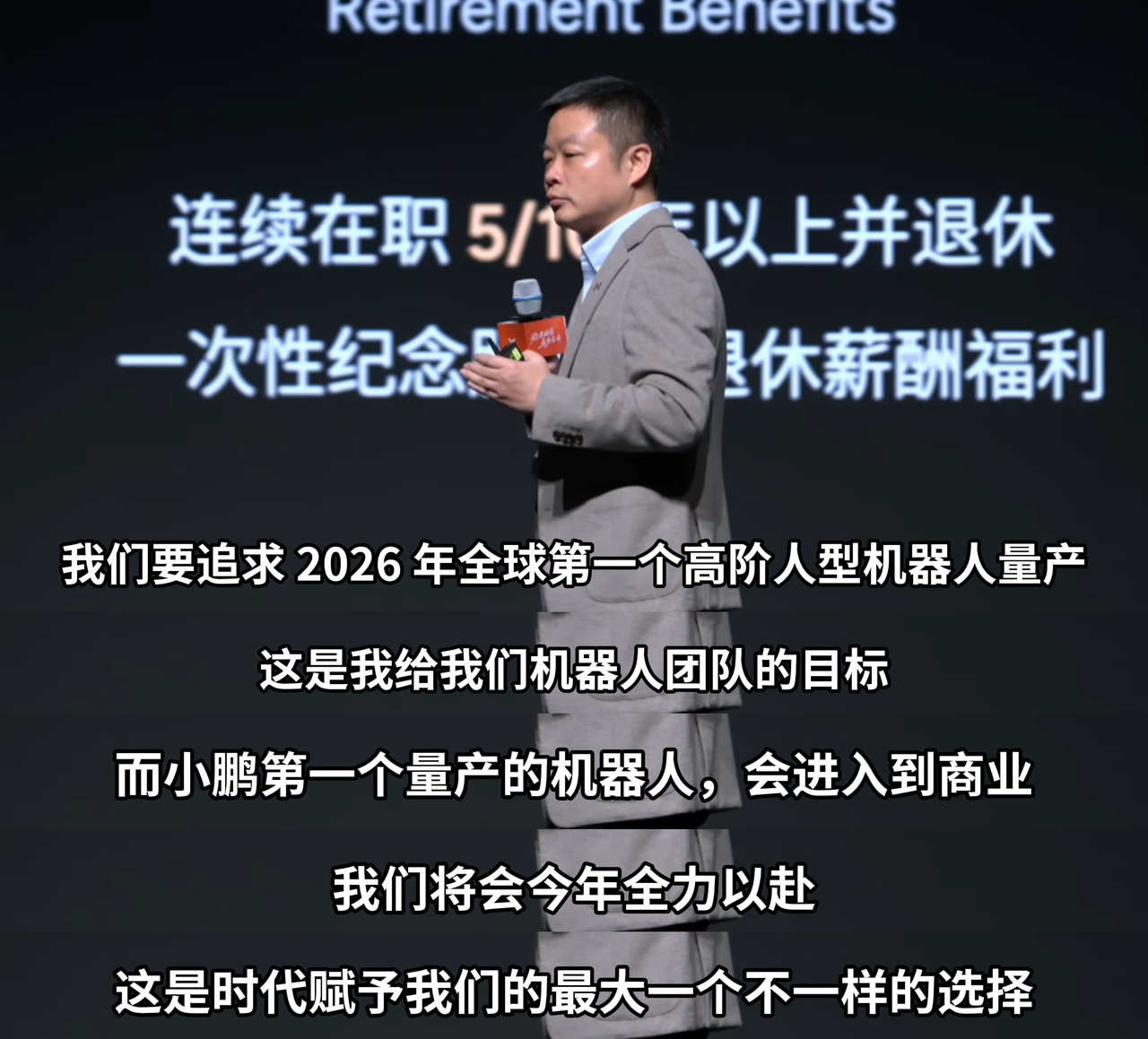
Image Source: XPENG
IRON Robots: Mass production of the next-generation IRON robot will begin at the end of the year, with the goal of becoming the world's first mass-produced, high-end humanoid robot. Built to automotive-grade standards, the robot will first be deployed in scenarios such as guiding and shopping assistance, with an SDK opened to global developers.
Flying Cars: The split-type "Land Aircraft Carrier" has rolled off the trial production line, with scalable mass production and delivery targeted for this year.
He defines 2026 as a watershed moment for XPENG, marking the shift from "can do" to "can mass produce." Over the past decade, XPENG has achieved many "firsts," but converting that potential into momentum—turning laboratory prototypes into scalable commercial products—is the true moat of an embodied AI company.
A Product Offensive and Talent War: The Logic Behind Expansion
Underpinning these cutting-edge initiatives is an unprecedented product offensive and talent reserve.
On the product front, 2026 is set to be a "banner year" for XPENG. In the first quarter, the company will launch three super range-extender products, fully rolling out its "one car, dual energy" strategy. Within the year, at least four new models will enter overseas markets. The XPENG P7+ has completed trial production in Austria and is poised for delivery across 25 European countries. Brokerage reports suggest XPENG is targeting sales of 550,000 to 600,000 units in 2026.
Regarding globalization, He summarizes the strategy in eight characters: "Sharp knife" to break in, "Red carpet" to keep them. The "sharp knife" refers to focusing on five benchmark markets—Israel, Germany, Norway, Thailand, and France—with sales outlets doubling to 680 this year. The "red carpet" involves improving certainty in delivery times, service response, and energy replenishment. The long-term target is aggressive: sell 1 million vehicles overseas by 2030, generating over 70% of profits.
To support this massive business footprint, XPENG has launched a new wave of talent expansion. In 2026, the global workforce will grow by another 8,000, including 5,000 campus hires. He emphasized that future XPENG leaders will increasingly come from internal growth and promotion, and he encouraged more employees to take positions on the overseas front lines.
At the same time, He is stressing the evolution of internal efficiency. AI should be not just a product, but a "power suit" for every employee—from coding and training generation to digital workflows and tool automation—using AI to unlock human potential and drive efficiency for profit.
Summary: Standing at the start of 2026, XPENG is attempting a perilous leap: it must defend its core automotive business while expanding its reach, all while delivering on mass-production promises in frontier fields like robotics and flying cars.
As He wrote in the memo: "From technology to product, from product to business, from China to the world—in 2026, we are not just launching new products, we are redeeming the admission ticket to the next era."
Volkswagen paying for VLA signals that Chinese AI technology is beginning to export globally; the mass production of robots and flying cars marks the shift of embodied intelligence from concept to reality. For XPENG, 2026 is destined to be a comprehensive test of production capabilities, organizational efficiency, and global execution.


