



In 2025, SAIC-GM-Wuling's full-year sales reached 1.635 million vehicles, up 6.2% year on year. New-energy models topped the 1 million mark for the first time — 1,000,066 units — a 31.9% increase, pushing NEV penetration past 61% and serving as the brand's main growth engine.
By model mix, the performance reflects the combined lift from Wuling's Silver Badge passenger cars, Red Badge commercial vehicles and the Baojun brand. The Hongguang MINIEV family sold 435,598 units for the year, while the Bingo family logged 213,367. Together they accounted for nearly 40% of total sales, forming the core matrix of the brand’s NEV lineup.
As competition intensifies and industry NEV penetration nears 60%, why has SAIC-GM-Wuling managed to post such strong results?
Knowing what people need
One key reason behind Wuling NEV's market showing is its credo: "Build what people need." With an all-scenario product layout that serves different user groups, it carves out distinct positions in niche segments.
In passenger cars, Wuling has a dual-track lineup — the Hongguang MINIEV and Bingo families — aimed at the A00 commuting segment and the A0 quality-mobility segment, respectively.
The Hongguang MINIEV franchise — prized for being good-looking, easy to drive and park, and frugal — has led its subsegment in sales for 65 straight months, with cumulative sales above 1.85 million. To address rising demands for practicality, Wuling introduced a four-door version that expands rear-seat space and load capacity; storage can extend to 745 liters, and the model offers 301 km of range plus fast charging, fitting urban commutes and family runabouts.
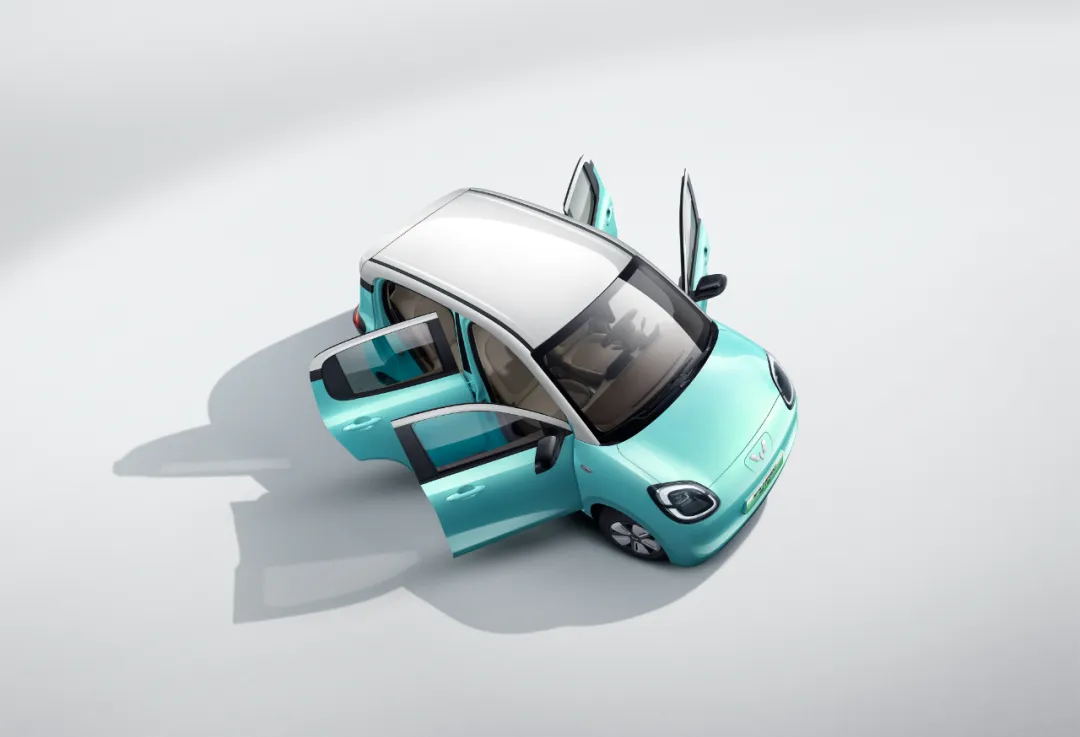
Image source: SAIC-GM-Wuling
The Bingo family targets the A0 segment; in 2025 it sold 213,367 units. The Bingo S took home a "2025 China Top 10 Car Bodies" award — the first A0-class model to make the list since the accolade's inception.
Built on the Tianyu Architecture's M Platform, the mode's body-in-white uses 74.45% high-strength steel, with hot-formed steel accounting for 23.7%. A five-ring high-strength structure and three energy-absorbing designs enhance crash safety.
Dimensions are 4,265×1,785×1,600 mm, with 84% space utilization. Fold down the rear seats and the trunk expands to 1,450 liters. Paired with 430 km of range and smart features, it balances space, safety and endurance — with young buyers squarely in its sights.
The commercial-vehicle NEV pivot is paying off: in 2025, Wuling’s Red Badge NEV commercial models sold 148,166 units, a 113% jump, topping their subsegment.
The Yangguang, Hongguang New Energy and Zhiguang EV families lead the light van, rear-drive MPV and microvan markets, respectively. Their designs focus on the needs of small and micro business owners, striking a balance between payload and running costs to build a passenger–commercial product matrix that covers varied use cases.
Iterating to address user pain points has been key to Wuling NEV's competitiveness. The Starlight 730, a large seven-seat MPV built on the Tianyu Architecture's D Platform, sold more than 10,000 units in its first 12 days on the market — filling a gap in the segment.
Its 1.5-liter plug-in hybrid system delivers up to 1,100 km of combined range, with fuel consumption at 5.3 L/100 km when running on depleted battery — easing range anxiety for long family trips.
At the same time, Wuling keeps end-user prices in check and leverages NEV policy support to differentiate on value for money — translating technical strengths into market accessibility.
Lead with value, backed by solid tech
A targeted product layout set the market base for Wuling NEV, while a complete tech stack and executable go-to-market tactics underpinned the core models’ performance — creating a virtuous loop in which technology empowers products and the market unlocks value.
Core technology safeguards product performance. Wuling's "Tian·Ling·Shen" technology system enables vehicles across architecture, powertrain and safety.
As a modular platform, the Tianyu Architecture comprises M and D platforms — fitting small cars such as the Bingo S and MPVs like the Starlight 730. Lego-style body structures and a modular chassis boost compatibility and iteration speed, supporting rapid model updates.
The Lingxi Power 3.0 suite earned a "China Heart Top 10 Engines & Hybrid Systems" certification, with an edge in energy efficiency. Paired with Lingmou intelligent driving and the Lingyu cockpit, it raises the bar on smart features.
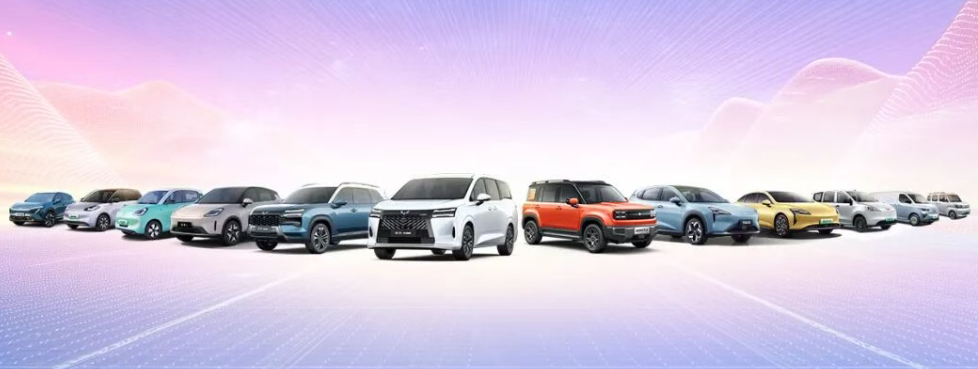
Image source: SAIC-GM-Wuling
Lingmou Intelligent Driving offers layered driver-assist features: the standard package supports highway NOA and smart parking, while the advanced version adds eight active-safety functions including full-speed, all-direction AEB. The Lingyu cockpit is powered by a self-developed central AI large model; voice response latency is 0.38 seconds, it understands eight major dialects, and recognition exceeds 95% — sharpening the human–machine interface.
Smart manufacturing and end-to-end supply chains underpin capacity and quality. Wuling's "Smart Island Manufacturing System" was selected as a national pilot-level smart factory: welding shops are 100% automated, final assembly uses an island layout, and AI applications account for more than 75% — keeping assembly tolerances tight while enabling both mass production and customization.
Building its own industrial cluster and partnering with firms such as Saikrip and Desay Battery, Wuling has localized more than 63% of components, securing in-house development and steady supply of core parts — an edge in cost control and technical autonomy.
Execution on market strategy widened product reach.
Wuling is leaning into lower-tier markets, with county and township sales making up 37% of the total. A "county network revitalization" drive sharpened channel management — channeling resources to benchmark counties and stationing support teams at weaker ones — helping 258 priority county outlets post month-on-month gains for three straight months. Thirty-six benchmark counties now average more than 100 units a month, building a stable network.
Leveraging the "NEVs to the Countryside" policy, Wuling runs grassroots promotions — vehicle displays, test drives — to lift product awareness. It also pushes crossover marketing: the Bingo family appeared at the Shanghai International Trend Plush Expo, winning "Annual Cross-Over Influence Auto Brand," while influencer tie-ups and livestreaming delivered tens of millions of impressions to reach younger buyers.
User operations tightened the bond with customers. Wuling hosts user banquets and runs campaigns such as "trade in your MINI at original price for a Bingo" to build private-domain communities, releases the "Hongguang Index," and launches the "Strivers Special Program" — strengthening ties with grassroots users and firming up its market position.
From product design to user services, this end-to-end approach has helped Wuling stand out amid lookalike competition — steadily lifting both sales and reputation. That pressure won't fade soon.


